
Latex Tubing and Hybrid Vehicles
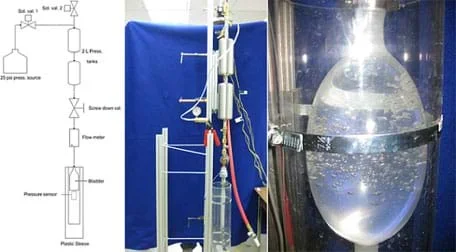 Engineers create experiments to test the design and strength of hydraulic accumulators made of latex, with the idea of using latex hydraulic accumulators to capture braking energy in hydraulic hybrid vehicles.Copyright Center for Compact and Efficient Fluid Power (CCEFP). Used with permission.
This "legacy cycle" unit is structured with a contextually based grand challenge followed by a sequence of instruction in which students first offer initial predictions (generate ideas) and then gather information from multiple sources (multiple perspectives). This is followed by research and revise as students integrate and extend their knowledge through a variety of learning activities. The cycle concludes with formative (test your mettle) and summative (go public) assessments that lead students towards answering the challenge question. See below for the progression of the legacy cycle through the unit. Research and ideas behind this way of learning may be found in How People Learn: Brain, Mind, Experience and School, (Bransford, Brown & Cocking, National Academy Press, 2000); see the entire text at http://www.nap.edu/catalog.php?record_id=9853.
The "legacy cycle" is similar to the "engineering design process" in that they both involve identifying existing societal needs or challenges, combining science and math to develop solutions, and using research conclusions to design optimal solutions. Though the engineering design process and the legacy cycle both result in viable solutions, they vary in how solution are devised and presented. See an overview of the engineering design process at https://www.teachengineering.org/populartopics/designprocess.
In the first lesson of this unit, students are introduced to the engineering challenge: To create small-scale models from which their testing results could be generalized to large-scale latex tubing for a hydraulic accumulator suitable for a passenger car. They learn about how hydraulic accumulators and hydraulic systems function, specifically how they conserve energy by capturing braking energy usually lost as heat. Through a nine-minute video, they watch and listen to an engineer talking about his lab-based model to test the feasibility of using an elastomer as an energy accumulator. Then they brainstorm and generate ideas for how to solve the challenge.
Through practice in the second lesson, students learn to quickly and efficiently interpret graphs and gain familiarity with common graph terminology such as independent variable, dependent variable, linear data, linear relationship, rate of change, as well as the equation for calculating slope. The focus is on students becoming able to clearly describe linear relationships by using the language of slope and the rate of change between variables.
During the associated activity, student groups use latex tubes and bicycle pumps to conduct experiments to gather research data about the relationship between latex strength and air pressure. Students use this data to create graphs and linear models from which they extrapolate latex strength to answer the engineering design challenge question—to predict the latex dimensions that would be required for a full-size hydraulic accumulator installed in a modern passenger sedan. To conclude the unit, students describe the entire engineering analysis process that they experienced in order to answer the challenge, and explain their conclusions and how they could be applied to the design of hydraulic hybrid vehicles.
Modeling is commonly used in mathematics and engineering and frequently used to make generalizations based on collected data. Currently, engineers of varied specializations are applying their expertise to create vehicles that require less fuel, making them more sustainable. Hydraulic hybrid vehicles use a hydraulic system with a hydraulic accumulator to store energy from the braking process and reuse it to accelerate the vehicle. In this unit, students learn about this engineering design and an engineering lab at a university that is researching the strength of latex used in such a hydraulic accumulator. The work includes designing and conducting experiments to collect data and model relationships between variables, such as the wall thickness of latex tubes and their corresponding strengths (pressure at the point of explosion), from which they can extrapolate the appropriate latex tube measurements required in order to store maximum energy in a modern hybrid passenger vehicle's braking system.
- CCSS.Math.Content.HSF-LE.B.5 Interpret the parameters in a linear or exponential function in terms of a context.
Grades 9-12
Do you agree with this alignment?
Day 1: Latex and Hybrids: What's the Connection? lesson
Day 2: Variables and Graphs: What's Our Story? lesson
Days 3-4: Linear Models and Exploding Latex! activity
- Latex Tubing and Hybrid Vehicles
Contributors
Erik Bowen; Carleigh Samson
Supporting Program
VU Bioengineering RET Program, School of Engineering, Vanderbilt University
Acknowledgements
The contents of this digital library curriculum were developed under National Science Foundation RET grant nos. 0338092 and 0742871. However, these contents do not necessarily represent the policies of the NSF, and you should not assume endorsement by the federal government.
Copyright
2013 by Regents of the University of Colorado; original © 2006 Vanderbilt University