
Keeping Our Roads Smooth
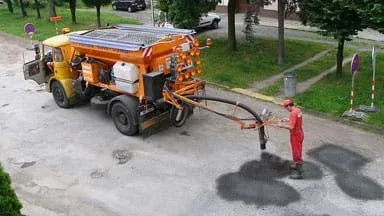 Pothole patching with a spray-injection device.Copyright 2005 Michal Maňas, Wikimedia Commons https://commons.wikimedia.org/wiki/File:Pothole_patching.jpg
Students learn how roadways are designed and constructed, and discuss the advantages and limitations of the current roadway construction process. They look at current practices of roadway monitoring, discuss the limitations, and consider ways to further road monitoring research. To conclude, student groups compete to design smooth, cost-efficient and sound model road bases using gravel, sand, water and rubber (representing asphalt). This lesson prepares students for the associated activity in which they act as civil engineers hired by USDOT to research through their own model experimentation how to best use piezoelectric materials to detect road damage by showing how piezoelectric transducers can indicate road damage.
Civil engineers are vital to the development, construction and maintenance of the human-made structures in our world. They make sure the structures are safe, well designed and built—and decide how to repair them when necessary. Roads are one type of structure. When designing roads, civil engineers consider factors such as ground conditions, weather, and traffic volumes. Being able to continually monitor the physical condition of roads helps engineers improve road construction and maintenance. Engineers are continually devising road maintenance techniques to find ways to replace current sensors that monitor road damage. Most current road sensors are battery-powered, which has the limitation of exhausted batteries, and solar power won’t work for devices embedded in asphalt. Researchers are developing and testing the use of piezoelectric material—which converts mechanical energy to electrical energy when pressed—to harvest road vibration energy to power the sensors to collect data that is useful to detect and predict damage trends.
After this lesson, students should be able to:
- Analyze the road construction process.
- Discuss the limitations on current road monitoring techniques and provide solutions.
- Students will develop an understanding of engineering design.
Grades K-12
Do you agree with this alignment? - Students will develop an understanding of and be able to select and use energy and power technologies.
Grades K-12
Do you agree with this alignment?
- HS-ETS1-2 Design a solution to a complex real-world problem by breaking it down into smaller, more manageable problems that can be solved through engineering.
Grades 9-12
Do you agree with this alignment? - HS-ETS1-3 Evaluate a solution to a complex real-world problem based on prioritized criteria and trade-offs that account for a range of constraints, including cost, safety, reliability, and aesthetics, as well as possible social, cultural, and environmental impacts.
Grades 9-12
Do you agree with this alignment? - HS-PS3-3 Design, build, and refine a device that works within given constraints to convert one form of energy into another form of energy.
Grades 9-12
Do you agree with this alignment?
- HS-ETS1-2 Design a solution to a complex real-world problem by breaking it down into smaller, more manageable problems that can be solved through engineering.
Grades 9-12
This resource focuses on the following Three Dimensional Learning aspects of NGSS:
Science & Engineering Practices- Design a solution to a complex real-world problem, based on scientific knowledge, student-generated sources of evidence, prioritized criteria, and tradeoff considerations.Do you agree with this alignment?
Disciplinary Core Ideas- Criteria may need to be broken down into simpler ones that can be approached systematically, and decisions about the priority of certain criteria over others (trade-offs) may be needed.Do you agree with this alignment?
Do you agree with this alignment? - Design a solution to a complex real-world problem, based on scientific knowledge, student-generated sources of evidence, prioritized criteria, and tradeoff considerations.
- HS-ETS1-3 Evaluate a solution to a complex real-world problem based on prioritized criteria and trade-offs that account for a range of constraints, including cost, safety, reliability, and aesthetics, as well as possible social, cultural, and environmental impacts.
Grades 9-12
This resource focuses on the following Three Dimensional Learning aspects of NGSS:
Science & Engineering Practices- Evaluate a solution to a complex real-world problem, based on scientific knowledge, student-generated sources of evidence, prioritized criteria, and tradeoff considerations.Do you agree with this alignment?
Disciplinary Core Ideas- When evaluating solutions it is important to take into account a range of constraints including cost, safety, reliability and aesthetics and to consider social, cultural and environmental impacts.Do you agree with this alignment?
Crosscutting Concepts- New technologies can have deep impacts on society and the environment, including some that were not anticipated. Analysis of costs and benefits is a critical aspect of decisions about technology.Do you agree with this alignment?
Do you agree with this alignment? - Evaluate a solution to a complex real-world problem, based on scientific knowledge, student-generated sources of evidence, prioritized criteria, and tradeoff considerations.
- HS-PS3-3 Design, build, and refine a device that works within given constraints to convert one form of energy into another form of energy.
Grades 9-12
This resource focuses on the following Three Dimensional Learning aspects of NGSS:
Science & Engineering Practices- Design, evaluate, and/or refine a solution to a complex real-world problem, based on scientific knowledge, student-generated sources of evidence, prioritized criteria, and tradeoff considerations.Do you agree with this alignment?
Disciplinary Core Ideas- Criteria and constraints also include satisfying any requirements set by society, such as taking issues of risk mitigation into account, and they should be quantified to the extent possible and stated in such a way that one can tell if a given design meets them.Do you agree with this alignment?
- At the macroscopic scale, energy manifests itself in multiple ways, such as in motion, sound, light, and thermal energy.Do you agree with this alignment?
- Although energy cannot be destroyed, it can be converted to less useful forms—for example, to thermal energy in the surrounding environment.Do you agree with this alignment?
Crosscutting Concepts- Energy cannot be created or destroyed—it only moves between one place and another place, between objects and/or fields, or between systems.Do you agree with this alignment?
- Modern civilization depends on major technological systems. Engineers continuously modify these technological systems by applying scientific knowledge and engineering design practices to increase benefits while decreasing costs and risks.Do you agree with this alignment?
Do you agree with this alignment? - Design, evaluate, and/or refine a solution to a complex real-world problem, based on scientific knowledge, student-generated sources of evidence, prioritized criteria, and tradeoff considerations.
Familiarity with the causes that affect road conditions, both natural and human-made. Familiarity with energy transformations and how piezoelectric material converts energy; see more information as part of the Piezoelectricity lesson.
What is structural health monitoring?
Structural health monitoring is used to monitor the conditions of roads, bridges, and other structures. The most common way to monitor the health of a structure is by non-destructive evaluation, which means that the integrity of the structure is not compromised. Damage is defined as any changes that are introduced into a system that adversely affect its current or future performance. Damage might include cracks, potholes, loosening bolts on a bridge or structure, etc. Damage detection using non-destructive evaluation relies on the premise that as the structure becomes damaged, the material will have an altered stiffness, mass and energy dissipation (or energy loss) due to the effect of external forces acting on the structure. The properties of a structure can change, including its fundamental frequency—which is the natural vibrational frequency of the object—in other words, how the structure vibrates. In order to detect changes, small sensors (see Figure 1) are placed in the roadway asphalt or along the sides of bridges to gather road condition data such as changes in the fundamental frequency of the structure or the strain experienced.
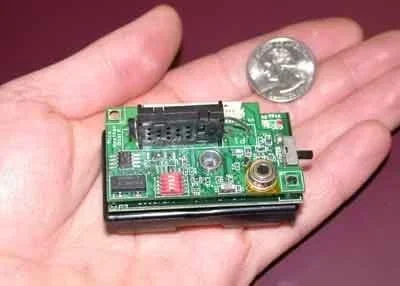 Figure 1. An example current road damage sensor. These are placed in the ground to monitor road damage.Copyright 2014 Nizar Lajnef. Used with permission.
These road damage sensors require power to operate. Using batteries is not effective because when the batteries die, they cannot be replaced because the sensors are buried in the asphalt, so no more data can be collected. Thus, a better electrical energy supply is needed to supply continuous power for data collection as long as the road or structure exists. A recent research development is focused on a new way to power these sensors—by harvesting energy from the road vibrations as vehicles drive over them. The use of piezoelectric transducers converts the mechanical energy from a structure to electrical energy to power the sensors. This approach has great potential to provide for continuous monitoring of road conditions.
What is piezoelectricity?
Piezoelectricity is the generation of electrical energy from vibrations around a piezoelectric crystal. Piezoelectricity stems from the Greek words “piezo,” which means press or squeeze and “electricity.” Therefore, piezoelectricity means electricity from pressure. The piezoelectric effect is when certain materials generate electric fields when pressed or squeezed, resulting in electrical energy. This effect was discovered by brothers Jacques and Pierre Curie. The aforementioned effect is called the direct piezoelectric effect. The reverse effect is when an electrical charge is introduced on a piezoelectric material, causing it to deform. See Figure 2 for an animation of the piezoelectric effect.
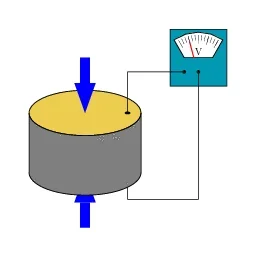 Figure 2. An animation of the piezoelectric effect.Copyright 2007 Tizeff, Wikimedia Commons https://commons.wikimedia.org/wiki/File:SchemaPiezo.gif
Only certain materials are considered piezoelectric. It depends on the symmetry of the positive and negative charges in the object. If there is symmetry, then the material is not piezoelectric; the charges cancel out and no electrical field is generated. However, if the charges are not symmetric, then the material is piezoelectric. As it is compressed or squeezed, an electric dipole forms that creates an electrical field, thus converting mechanical energy to electrical energy. Common piezoelectric materials include quartz, sugar, topaz, bone, wood silk viruses, DNA and lead zirconate titanate (pzt); the latter is currently used to power embedded road sensors. You might be interested to know that the piezoelectric effect is used in many common things we use on a daily basis such as doorbells, light-up shoes, microphones, ignition buttons on gas stoves and barbeques, and cigarette lighters.
(Be ready to show the class a 50-second online video titled, “Quality Russian Roads,” at https://www.youtube.com/watch?v=SJCObmm66Y0 to show an extreme case of a bumpy asphalt road. Mute the audio so the narration is not distracting. Also make sure students have paper and pencil handy. Begin by introducing students to the typical road design and construction process before leading a class discussion. All discussions unfold differently, depending on the participants, and the one described below is a possible example of how it might look for this lesson. Plan on 30-minutes for the discussion, although it might take more or less time, depending on student responses. When facilitating the discussion, make sure to discuss the following items: pavement construction steps [planning, designing, earthwork, paving, opening the road], what’s missing in the process [monitoring], ways we can monitor [sensors, physical examination, etc.], how we can power in-road sensors [batteries, solar panels, piezoelectric material, etc.], and have students generate questions on how we can analyze road conditions [refer to the post-introduction assessment].)
Have you ever wondered about our state’s roads and what makes them “bad”? Can you think of some stretches of roadway that are in poor condition? What makes roads crack and develop potholes? Let’s take a minute to look at an example “bad” road. (Show the YouTube video of an amazingly crumpled and unsmooth single-lane asphalt road in Russia.) Wow! Refer to the associated activity Preventing Potholes to design and conduct their own model “road” experiments to research how to best use piezoelectric materials to detect road damage.
What can we do to help make our roads smoother? (Listen to student ideas. Expect them to suggest patching cracks sooner, using better materials to build the roads, etc.) Designing roads is not as simple as smoothing the ground and placing asphalt on top; an involved process is required every time roads are created or repaired.
(Call on a random student.) What do you think should be done first in order to create a new road? (Expect students to mention road construction planning, such as state departments of transportation monitoring traffic conditions, crash statistics and other data, and looking at who is funding the project, its priority level and other questions.) Can you elaborate on planning (or whatever students suggest be done)? (The goal is to elicit ideas from students. Record their ideas on the classroom board for all to see.) Great! The department of transportation (DOT) must first plan its project using data to support the actions.
(Call on a student.) What do you think happens next? (Listen to student ideas.) The next step is to conduct more specific research, including analyzing the location, terrain and soil properties, traffic volume, ratio of cars to trucks, and other items. Then engineers consider the gathered information in their road designs, ensuring that roads will be stable and weather appropriate for their sites, for example specifying how to prepare a road base and whether to use concrete or asphalt.
(Call on a student.) What do you think happens next? (Listen to student ideas.) Next is what is called “earthwork,” which is the beginning of road construction. Embankments are built. The ground’s surface is leveled for the road. Drains and sewers are installed. Everything is prepared for the paving phase.
What happens next? I can think of two more steps. (Call on a student.) What do you think is done next? (Listen to student ideas.) The final paving is done, either concrete or asphalt, depending on what was decided during the design and planning phase.
Finally, the road opens! What happens after the road opens? (Listen to student ideas.) That’s right, we all use the road until some point in time when it is becomes so destroyed with potholes and cracks that the DOT must begin the process all over again!
With all the effort that goes into building roads, it would be great if roads lasted—and remained in good condition—for longer periods of time. How could we do that? It would be great if we could somehow monitor the roads after they are built, so that we could take steps to stop and repair any damage and improve any structural issues sooner, thereby keeping the roads in useable shape much longer.
Let’s think about this some more. Get into small groups (three or four students each) and discuss ways that we could monitor road conditions. Write down all your ideas, including any limitations associated with those ideas. You have five minutes. Be prepared to share the results of your group discussion. (Circulate from group to group as students discuss, noting what they are talking about for sharing.)
Which group would like to share its ideas for ways to monitor road health? (Listen to group ideas and record them on the board for further discussion. Guide the discussion so that students ask themselves what materials are needed to monitor pavement conditions.) Before we continue, write your response to this question: How can we use the materials you brainstormed to monitor the structural health of roads, or more specifically, the progression of road damage like cracks and potholes? (Give students a few minutes to write their responses. Circulate the room to glance at the responses in order to call on particular students to explain their reasoning.)
(Call on a specific student.) Tell us what you wrote down. (Let students explain their answers. Highlight a few interesting ideas and a few that need work. Have the class pitch in to help each other. Record their thoughts on the board and come up with a class consensus on what they are looking for.
Based on our class discussion, what can we do to help monitor the health of different structures such as our roadways? (Possible answers: Look at changes over time, traffic conditions, sensors, etc. Bring into the discussion information that was recorded on the board during the discussion.)
Sensors provide us with the most accurate and quickest way to monitor road conditions. What are some limitations to using sensors? (Answer: Battery life limitations prevent continuous use.) What are some ways to harvest energy to self-power the sensors? What are some limitations? (Answers: Solar power requires the sun, which won’t work for sensors under the asphalt. Piezoelectric materials might work; will they be able to generate enough energy to power the sensors?)
Let’s discuss piezoelectric materials. Who remembers what piezoelectricity is? (Listen to student responses. Make sure they know that it is electricity generated when a material is under strain or pressure.) That’s right, piezoelectric materials generate energy or voltage when under strain. The more strain a piezoelectric object is under, the more energy or voltage is created. This might be useful in our next activity.
(Next, conduct the post-assessment, and then move on to conduct the associated activity. If desired, show students a piezoelectric transducer [one of the piezo elements listed in the activity’s Materials List] and recap the upcoming activity challenge.)
- damage
- Changes to a material and/or the geometric properties of a structural system that adversely affect its performance.
- energy harvesting
- Obtaining energy from external sources (solar, wind, thermal, kinetic, etc.) to create, store and use electrical energy.
- piezoelectric effect
- A process by which a material converts a mechanical force into an electrical response. In other words, deforming a material to generate an electrical potential (or voltage).
- pothole
- A hole in the pavement in a smooth road surface. Typically this structural failure in asphalt pavement is caused by the presence of water in the underlying soil structure and traffic passing over the area until it weakens and breaks out the asphalt surface and underlying soil.
- road design
- Analysis of the land, traffic volume, ratio of cars to trucks, future development to the design of a road or bridge. Also called highway engineering.
- road earthwork
- The establishment of a stable foundation for road creation by moving and shaping the soil and rock to build embankments, compacting the soil to maximum density, installing sewers, drains and curbs, etc.
- road paving
- The placement of asphalt or concrete on top of the preparatory earthwork.
- road planning
- Collecting and analyzing data about existing road and bridge conditions, and traffic volumes and crash statistics to determine what and how to build a new road or bridge.
- structural health monitoring
- Implementing a damage detection and characterization strategy for engineered structures. In other words, detecting any damage to structures and getting reliable information about the integrity of structures.
- voltage
- The potential difference in charge between two points on an electrical field. In other words, the amount of potential energy between two points on a circuit.
Embedded Introduction Assessment
Discussion Questions: During the introductory discussion, incorporate the following questions and solicit, integrated and summarize student answers.
- When designing a road, what are factors that need to be taken into account? Why? (Example answer: We need to consider the potential road site, traffic volumes, weather, etc.)
- Once a road is constructed, what are the next steps? What else is important to the road construction process at this point? (Example answer: Once a road is in use, we need to provide road maintenance and damage progression analysis.)
- What could we do to monitor the health (condition) of a structure? (Example answer: We could make visual observations to monitor the health of a structure. Do we see any damage?)
- Using sensors would be the least destructive way to monitor the pavement health, so how could we power them? What are the limitations of these options? (Example answer: Batteries can be used, but when they die we would have to tear up the road to change the batteries! Solar power could be used to power the devices, but since they are embedded under the asphalt, they would not receive any sunlight!)
- How can we use sensors and various power sources to inform us or predict for us any road damage? (Example answer: The sensors collect data on changes in energy in order to diagnose when a road has sustained some damaged.)
Post-Introduction Assessment
How Might Piezoelectric Transducers Predict/Show Damage? Have students work in small groups (of three or four students each) to discuss how piezoelectric transducers can detect/predict road damage. Direct the teams to come up with a list of three or four questions (one per student) that can be answered through research and experimentation. Expect this to take groups about seven minutes to complete. As a class, decide on one or two questions to be answered; expect this portion to take ~10-15 minutes, depending on the classroom discussion. As an example, those two questions might be:
- How can damage be detected by using a piezoelectric transducer? (Answer: A piezoelectric transducer produces changes in voltage when damage is introduced. The more damage, the more the area vibrates and generates more voltage, which we can measure as data.)
- Does a piezoelectric transducer detect local or global damage? In other words does it detect damage anywhere on a road or just at a specific location? (Answer: A transducer only detects local damage, or only damage near the transducer, which makes its data location-specific.)
Lesson Summary Assessment
Build a Road: If intending to complete the associated activity after this lesson, use some of the associated activity materials to have student groups compete to design the smoothest, least expensive and most structurally sound model road using gravel, sand, water and rubber. The teacher determines the specific material costs, but it is recommended that the asphalt and water be free and the sand and gravel are charged per unit. Use piezoelectric elements to determine voltage changes to conclude which groups did the best job creating structurally sound “roads” with the least amount of vibration; the lower the voltage, the lower the vibration, which signals a structurally sound road. The best roads contain a mixture of sand and gravel, not layered, on the bottom with a little water to clear any air spaces. The rubber, acting as the asphalt, is placed on top of the mixture (the road base). Dropping a heavy bolt while the piezoelectric element is attached to a voltage probe creates a disturbance that generates vibrations.
To further explore this topic, consider conducting the Piezoelectricity lesson and its associated activity, Building a Piezoelectric Generator during which students add into a circuit a piezoelectric element that converts movements into electrical energy that is stored until enough is generated to light up an LED.
Chatti, Karim. “An Intelligent Structural Damage Detection Approach Using Self-Powered Wireless Sensor Data.” March 2014. Presentation, Research Experience for Teachers, Michigan State University, East Lansing, MI.
Lajnef, Nizar, Karim Chatti, Shantanu Chakrabartty, Mohamed Rhimi, and Pikul Sarkar. “Smart Pavement Monitoring System.” May 2013. Technical report from the Research, Development and Technology Turner-Fairbank Highway Research Center, McLean, VA; Federal Highway Administration, U.S. Department of Transportation. Publication number FHWA-HRT-12-072. https://www.fhwa.dot.gov/publications/research/infrastructure/pavements/12072/12072.pdf
Lynch, Jerome P. and Kenneth J. Loh. “A Summary Review of Wireless Sensors and Sensor Networks for Structural Health Monitoring.” March 2006. The Shock and Vibration Digest, Vol. 38, No. 2, pp. 91-128. https://pdfs.semanticscholar.org/f530/5cd90970a8917392f1a0e65c2ecf69325374.pdf
Park, G., Farrar, C.R., Todd, M.D., Hodgkiss, W., Rosing, T. 2007. “Energy Harvesting for Structural Health Monitoring Sensor Networks,” Los Alamos National Laboratory Report, NM; LA-14314-MS.
Sohn, Hoon, Charles R. Farrar, Francois M. Hemez and Brett R. Nadler. “A Review of Structural Health Monitoring Literature: 1996 - 2001.” January 2004. Los Alamos National Laboratories, NM; LA-13976-MS. https://www.researchgate.net/publication/281785598_A_Review_of_Structural_Health_Monitoring_Literature_1996-2001
Structural Health Monitoring. Last updated June 24, 2016. Wikipedia, the free encyclopedia. Accessed June 25, 2016. https://en.wikipedia.org/wiki/Structural_health_monitoring
- Keeping Our Roads Smooth
Contributors
Adam Alster; Victoria Davis-King; Amir Alvai; Nizar Lajnef; Drew Kim; Andrea Varricchione
Supporting Program
Smart Sensors and Sensing Systems RET, College of Engineering, Michigan State University
Acknowledgements
This curriculum was developed through the Smart Sensors and Sensing Systems research experience for teachers under National Science Foundation RET grant no. CNS 1609339. However, these contents do not necessarily represent the policies of the NSF, and you should not assume endorsement by the federal government.
Copyright
2016 by Regents of the University of Colorado; original © 2016 Michigan State University