
Learning Light's Properties
 City street lights at night.Copyright Microsoft Corporation, One Microsoft Way, Redmond, WA 98052-6399 USA. All rights reserved.
Students learn the basic properties of light — the concepts of light absorption, transmission, reflection and refraction, as well as the behavior of light during interference. Lecture information briefly addresses the electromagnetic spectrum and then provides more in-depth information on visible light. With this knowledge, students better understand lasers and are better prepared to design a security system for the mummified troll.
Absorbency is an important concept that biomedical engineers must address when designing and using lasers. In surgery, for example, when a patient is having an operation involving laser ablation, the doctor must be aware of the absorbance of the tissue at hand in order to choose a wavelength on the laser with minimum absorption depth. The concept of the laser's light being absorbed, reflected or refracted off the human body is crucial for students to understand as it leads them to designing a laser alarm system that has a distinct means of triggering. This topic is addressed in questions 4, 5 and 6 of the post-lesson assessment.
After this lesson, students should be able to:
- Understand basic properties of light.
- Explain various behaviors of light.
This lesson also meets the following Tennessee Foundations of Technology educational technology content standards: 2.0, 3.0, 4.0, 5.0, 6.0, 7.0 and 8.0; see https://www.teta.org/
This lesson also meets the following National Science Education Standards (NSES) teaching standards: A, B, C, D, E, F; see https://www.nap.edu/topic/
- CCSS.Math.Content.HSN-Q.A Reason quantitatively and use units to solve problems.
Grades 9-12
Do you agree with this alignment?
- Students will develop an understanding of the relationships among technologies and the connections between technology and other fields of study.
Grades K-12
Do you agree with this alignment? - STEL-3G Explain how knowledge gained from other content areas affects the development of technological products and systems.
Grades 6-8
Do you agree with this alignment?
- HS-PS4-5 Communicate technical information about how some technological devices use the principles of wave behavior and wave interactions with matter to transmit and capture information and energy.
Grades 9-12
This resource focuses on the following Three Dimensional Learning aspects of NGSS:
Science & Engineering Practices- Communicate technical information or ideas (e.g. about phenomena and/or the process of development and the design and performance of a proposed process or system) in multiple formats (including orally, graphically, textually, and mathematically).Do you agree with this alignment?
Disciplinary Core Ideas- Solar cells are human-made devices that likewise capture the sun's energy and produce electrical energy.Do you agree with this alignment?
- Information can be digitized (e.g., a picture stored as the values of an array of pixels); in this form, it can be stored reliably in computer memory and sent over long distances as a series of wave pulses.Do you agree with this alignment?
- Photoelectric materials emit electrons when they absorb light of a high-enough frequency.Do you agree with this alignment?
- Multiple technologies based on the understanding of waves and their interactions with matter are part of everyday experiences in the modern world (e.g., medical imaging, communications, scanners) and in scientific research. They are essential tools for producing, transmitting, and capturing signals and for storing and interpreting the information contained in them.Do you agree with this alignment?
Crosscutting Concepts- Systems can be designed to cause a desired effect.Do you agree with this alignment?
- Modern civilization depends on major technological systems.Do you agree with this alignment?
- Science and engineering complement each other in the cycle known as research and development (R&D).Do you agree with this alignment?
Do you agree with this alignment? - Communicate technical information or ideas (e.g. about phenomena and/or the process of development and the design and performance of a proposed process or system) in multiple formats (including orally, graphically, textually, and mathematically).
- CCSS.Math.Content.HSN-Q.A Reason quantitatively and use units to solve problems.
Grades 9-12
Do you agree with this alignment?
- 3237.3.11 Examine properties of light waves.
Grades 9-12
Do you agree with this alignment? - 3237.3.12 Investigate reflection, refraction, diffraction, and interference of light waves.
Grades 9-12
Do you agree with this alignment? - CLE 3237.3.7 Investigate the interaction of light waves.
Grades 9-12
Do you agree with this alignment?
Legacy Cycle Information
This lesson falls into the research and revise phase of the legacy cycle, during which students begin to learn the basic concepts required for understanding lasers. Following this lesson, students should be able to adjust their initial thoughts and begin seeking new, more appropriate information in attempting to solve the challenge question.
Properties of Light (Lecture Material)
What is light? --- Light is the movement of energy through space. It is easy to consider light waves just like the waves in the oceans (see Figure 1). Ocean waves are not actually heaps of water being thrown up and down. Waves represent energy traveling through the water creating pattern of crests and troughs. Similarly, the energy of light waves may travel through a medium such as the air or water. Light waves may even travel in the absence of a medium, for example in a vacuum. This energy is composed of electric and magnetic fields that travel perpendicular to one another. For this reason, light energy is termed electromagnetic radiation. Figure 1. A powerful ocean wave.Copyright Microsoft Corporation, One Microsoft Way, Redmond, WA 98052-6399 USA. All rights reserved.
How do we measure electromagnetic radiation? -— Electromagnetic radiation is classified by its size. A scale known as the electromagnetic spectrum (see Figure 2) was designed to classify waves by their size. For this scale, size is quantified by wavelength, measured in nanometers. Visible light waves, which represent the colors of the rainbow, have wavelengths in the range of 400-700nm. (Direct students to look at the electromagnetic spectrum image on their handout.)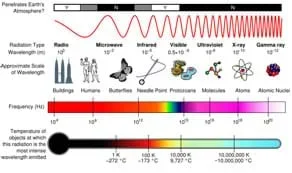 Figure 2. Diagram of the electromagnetic spectrum.Copyright Inductive Load, Wikimedia Commons., http://commons.wikimedia.org/wiki/Image:EM_Spectrum_Properties_edit.svg
Does light act as a wave or particle? — Two schools of thought exist on the behavior of light. One depends upon the "wave theory," while the other depends upon the "particle theory." Some say, light, composed of electrons, can exhibit properties of both waves and particles, a property that is described as "wave-particle duality." Evidence of electrons behaving with wave light nature was established well before the idea of particulate behavior was developed. In Young's famous double-slit experiment (see Figure 3), electrons were detected at a metal grate with two slits. A screen behind the grate revealed a pattern of bright and dark fringes demonstrating constructive and destructive interference, a characteristic of waves. We will learn about these characteristics soon.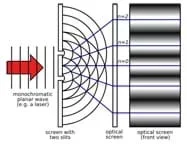 Figure 3. Young's two-slit experiment demonstrating constructive and destructive interference.Copyright Inductive Load, Wikimedia Commons., http://commons.wikimedia.org/wiki/Image:Two-Slit_Experiment_Light.svg
The results of the photoelectric effect hit mainstream at the turn of the century. These results directly contradicted the well-accepted wave theory of classic physics. The photoelectric effect showed that when light was shined on metal, electrons were emitted immediately (see Figure 4). Increasing the intensity of the light increased the number of photons, but not their kinetic energy. This led to the idea of quantum physics, which describes light as pockets of energy at discrete energy levels. Figure 4. The photoelectric effect.Copyright Wolfmankurd, Wikimedia Commons., http://commons.wikimedia.org/wiki/Image:Photoelectric_effect.svg
What happens when light hits an object? — When light hits an object, it is absorbed, reflected, transmitted or refracted. The deciding factors between these results are the energy of the entering light wave, the frequency of vibrations in the receiving material, and how tightly the receiving material holds onto its electrons.
- When light is absorbed by a material, the frequency of the light wave is very close to the vibration frequency of the electrons in the receiving material. Also, the receiving material has a tendency to hold onto its electrons very tightly. When the light hits the receiving material, its electrons absorb the energy of the entering light and begin to speed up and collide with other atoms. As result, they attempt to release as much energy as possibly by giving off heat. When we are hit by the powerful energy of the sun, our bodies absorb the energy but try to cool us down by giving off heat.
- When light is reflected, none of the entering light matches the natural frequency of the receiving material, which is considered opaque. The electrons in the receiving material are held very loosely. In this case, when electrons in the receiving material are energized by the incoming light, they vibrate for only a short period of time and then light waves are sent back out of the object at the same frequency as the incoming wave (see Figure 5). According to the law of reflectance, the light is reflected back at an angle equal to that of the entering wave.
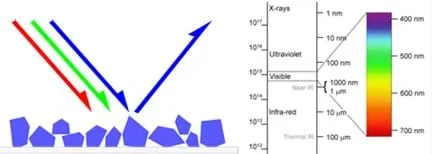 Figure 5. (left) Blue light reflected (notice the angle of reflection). (right) Diagram of the visible light spectrum.Copyright Phidauex, Wikimedia Commons (rocks); Penubag, Wikimedia Commons (spectrum)., http://commons.wikimedia.org/wiki/Image:Simple_reflectance.svg http://commons.wikimedia.org/wiki/Image:Electromagnetic-Spectrum.png
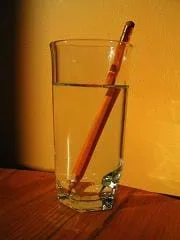 Figure 6. A demonstration of refraction.Copyright Denise Carlson, ITL Program, College of Engineering, University of Colorado at Boulder.
- Transmitted light waves are similar to reflected light waves, except they occur in transparent material instead of opaque material. In the case of transmitted waves, the frequency of the entering light does not match the natural vibrating frequency of the receiving material. The electrons in the material's atoms do not capture the energy of the incoming light and the wave passes through the material unchanged. Light waves are reemitted on the opposite side at the same angle at which they entered.
- Refracted light waves are similar to transmitted waves as light exits the material on the opposite side as it enters. The difference is that light refracts when the entering wave is of the same frequency as the natural vibrating frequency of the material. The electrons of the receiving material capture the energy of the entering light and begin vibrating. The vibrations are passed on to neighboring atoms until the energy escapes by means of a wave exiting at the same frequency. The deep penetration of the light wave takes time and the portion of the wave inside the material slows down. This has the effect of bending the light and the angle of bending or "angle of refraction" depends upon the material's properties. Placing a pencil in a glass of water demonstrates the bending property because the index of refraction of water is different from air (see Figure 6).
What happens when waves interact with one another? — When waves pass through one another, their behavior is described as interference. To decide what happens at a given point in time during interference, waves are superpositioned upon one another and analyzed. This means their amplitudes can be summed. Consider the Figure 7 image, representing superposition.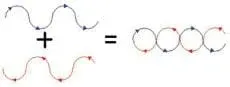 Figure 7. Two waves superpositioned.Copyright Meghan Murphy. Used with permission.
In Figure 7, the two waves are considered out of phase; the crest of one wave passes through the trough of the other. When the amplitudes of these two waves are summed, the result is destructive interference. Because these two waves have equal and opposite amplitudes, they cancel one another out.
Alternatively, if the crest of one wave passes through the crest of another wave, the two waves are considered in phase and the sum of their amplitudes results in constructive interference. In Figure 8, the resulting wave's amplitude would be double each contributing wave's amplitude.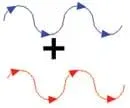 Figure 8. Diagram of constructive interference.Copyright Meghan Murphy. Used with permission.
(Make copies of the attached Light Properties Worksheet (PDF), one per student.)
Returning to our engineering challenge, today we are going to develop an understanding of the fundamental concepts of light, which moves us one step closer to designing and producing our invisible security system. Let's explore what we already know. When light strikes a mirror, what happens? (It is reflected.) Or, how about a glass window? (It is transmitted.) In today's lesson, we will learn why light responds to certain objects as it does. Also, when we are talking about light, does anyone know what type of energy are we discussing? (Visible light, a type of electromagnetic radiation.) Today, we will explore where the light we are discussing falls along the electromagnetic spectrum.
How about when two light waves collide with one another; does anyone know what may result? Imagine yourself sitting on the beach watching waves crash on the shore. What happens when one wave behind another catches up and the two waves crash on the beach together? How would you expect the crash of the double wave to differ from the first wave's crash? Wave interactions such as this one can be classified either as constructive interference or destructive interference. We will discuss both of these and learn to distinguish between the two.
I will pass out a worksheet with a series of pictures that follows the concepts in the order in which we address them. In addition to taking notes on the lecture material, please fill in the terms where blanks appear on your worksheet. (Throughout the lecture, direct students to take notes on and complete the worksheet.)
By the end of the lecture, material on light's properties, you will have enough understanding to explore and apply lasers toward your security system design. Following the lesson, refer to the associated activity Exploring Light: Absorb, Reflect, Transmit or Refract? to illustrate light's properties of absorption, reflection, transmission and refraction.
Embedded Assessment
Worksheet: Have students complete the attached Light Properties Worksheet (PDF) during the lecture, and refer to it for visuals that supplement lecture material. Review students' answers to gauge their mastery of the subject.
Understanding Units: Have students convert numbers from the electromagnetic spectrum from nm to m in order to get a better idea of how small a nm is and how that is scaled in the electromagnetic spectrum.
Post-Lesson Assessment
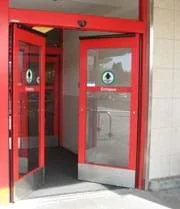 How do the automatic doors work at a store entrance?Copyright Denise W. Carlson. Used with permission.
Journaling: Ask students to compose answers in their journals to the following questions:
- Why is light's behavior described as dualistic?
- How does light behave in a vacuum?
- If a glass door is closed, why can you see light outside?
- How might automatic doors depend on light?
- Upon which theory would this relationship rely?
- How do automatic doors and security systems relate?
Writing and Sharing: Ask students to write a paragrah using technical information about how some technological devices use the principles of wave behavior and wave interactions with matter to transmit and capture information and energy. Have students share their thoughts to their classmates.
Contributors
Terry Carter; Meghan Murphy
Supporting Program
VU Bioengineering RET Program, School of Engineering, Vanderbilt University
Acknowledgements
The contents of this digital library curriculum were developed under National Science Foundation RET grant nos. 0338092 and 0742871. However, these contents do not necessarily represent the policies of the NSF, and you should not assume endorsement by the federal government.
Copyright
2013 by Regents of the University of Colorado; original © 2008 Vanderbilt University