
Laser Types and Uses
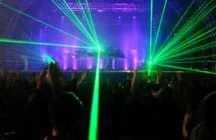 Laser lights!Copyright lukaszfus, StockXchange (royalty-free image) http://www.sxc.hu/photo/937720
Through two classroom demos, students are introduced to the basic properties of lasers through various mediums. In the Making an Electric Pickle demonstration, students see how cellular tissue is able to conduct electricity, and how this is related to various soaking solutions. In the Red/Green Lasers through Different Mediums demonstration, students see the properties of lasers, especially diffraction, in various mediums. Students will gain an understanding of how light can be absorbed and transmitted by different mediums. Follow-up lecture material introduces students to the mechanisms by which lasers function and relates these functions to the properties of light. In the associated activity, student teams research specific laser types and present their findings to the class.
Biomedical engineers use lasers in diagnostics including optical imaging, which allows for early identification of pathologies. Light's reflected properties must be understood for the use of optical coherence tomography (OCT), in order to create cross-sectional images of the tissue microstructure in an optical biopsy. A focused laser beam shines into the tissue and the echo time delay of the reflected light from the tissues is measured. The image information is obtained, forming a picture that shows the cellular structures in the tissue. Similar to the OCT process, a delay or absence of the laser at the receiving sensor is how the alarm system is triggered for the mummified troll security system. In the post-lesson assessment, students apply the concept of diffraction studied in the second demo and the properties of lasers learned in lecture to understand the mechanism of triggering the alarm.
After this lesson, students should be able to:
- Understand basic properties of lasers.
- Understand how light is transmitted through various mediums
- Develop their own model to test how light will be transmitted through various mediums
- Study and research laser types and their uses.
This lesson also meets the following Tennessee Foundations of Technology educational technology content standards: 2.0, 3.0, 4.0, 5.0, 6.0 and 8.0; see https://www.teta.org/
This lesson also meets the following National Science Education Standards (NSES) teaching standards: A, B, C, D, E, F; see https://www.nap.edu/topic/
- Students will develop an understanding of the relationships among technologies and the connections between technology and other fields of study.
Grades K-12
Do you agree with this alignment? - STEL-3G Explain how knowledge gained from other content areas affects the development of technological products and systems.
Grades 6-8
Do you agree with this alignment?
- HS-PS4-5 Communicate technical information about how some technological devices use the principles of wave behavior and wave interactions with matter to transmit and capture information and energy.
Grades 9-12
This resource focuses on the following Three Dimensional Learning aspects of NGSS:
Science & Engineering Practices- Communicate technical information or ideas (e.g. about phenomena and/or the process of development and the design and performance of a proposed process or system) in multiple formats (including orally, graphically, textually, and mathematically).Do you agree with this alignment?
Disciplinary Core Ideas- Solar cells are human-made devices that likewise capture the sun's energy and produce electrical energy.Do you agree with this alignment?
- Information can be digitized (e.g., a picture stored as the values of an array of pixels); in this form, it can be stored reliably in computer memory and sent over long distances as a series of wave pulses.Do you agree with this alignment?
- Photoelectric materials emit electrons when they absorb light of a high-enough frequency.Do you agree with this alignment?
- Multiple technologies based on the understanding of waves and their interactions with matter are part of everyday experiences in the modern world (e.g., medical imaging, communications, scanners) and in scientific research. They are essential tools for producing, transmitting, and capturing signals and for storing and interpreting the information contained in them.Do you agree with this alignment?
Crosscutting Concepts- Systems can be designed to cause a desired effect.Do you agree with this alignment?
- Modern civilization depends on major technological systems.Do you agree with this alignment?
- Science and engineering complement each other in the cycle known as research and development (R&D).Do you agree with this alignment?
Do you agree with this alignment? - Communicate technical information or ideas (e.g. about phenomena and/or the process of development and the design and performance of a proposed process or system) in multiple formats (including orally, graphically, textually, and mathematically).
- 3237.3.11 Examine properties of light waves.
Grades 9-12
Do you agree with this alignment? - CLE 3237.3.7 Investigate the interaction of light waves.
Grades 9-12
Do you agree with this alignment?
Before exploring lasers, make sure students have a good, basic understanding of light principles as provided in lesson 2, Learning Light's Properties.
Legacy Cycle Information
In this lesson, students continue in the research and revise phase of the legacy cycle. They apply their knowledge of light refraction and transmission to understanding lasers and their behavior through various mediums. This new knowledge guides students in designing their laser-based security systems.
The two teacher-led classroom demonstrations illustrate the behavior of light through various mediums, one being cellular tissue (that of a once-living cucumber) and the second being a water solution with suspended colloids. After the demonstrations, conduct the associated activity, in which the teacher assigns student teams specific types of lasers to research. Then teams present their findings to the class while the class takes notes on the various laser types. Doing this step helps students solve the grand challenge and design their security system to protect the mummified troll.
Demonstration 1: Making an Electric Pickle
This demonstration shows students how electric fields may be established in various mediums, one being the cellular tissue of a pickled cucumber. Pickles that have been soaked in various solutions illuminate in various colors. This demonstration works best in a room that can be darkened.
Demo 1 Materials List
- extension cord (that will be cut for the demo)
- heavy-duty scissors
- 2 large (16-penny) nails
- 1(or more) large kosher dill pickle(s), soaked in salt/vinegar solutions for 1-2 weeks
- containers (to hold pickles and solutions)
- water, salts (see Table 1) and vinegar
In advance of the demo, soak a cucumber in one of many possible salt solutions, which each generate different colors in the demo (see Table 1). Mix with vinegar and soak for 1-2 weeks. It's fun to prepare more than one pickle using different salt solutions.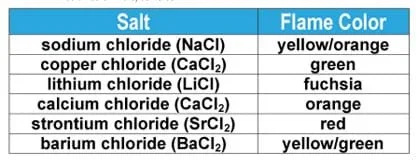 Table 1. Different salts and the resulting flame colors they produce in Demo 1.Copyright 2008 Terry Carter. Used with permission.
Demo 1 Instructions
- Cut the receptacle end off of an extension cord at the location you would plug it into an appliance (not the end that you plug into the wall).
- Separate the wires and peel back some of the plastic — about a half inch (1.3 cm).
- Wrap the ends of the two wires around two separate large (16 penny) nails.
- Stick the ends of the nails into opposite ends of a pickle, MAKING SURE THAT THE ENDS OF THE TWO NAILS DO NOT TOUCH.
- Place the pickle on a non-conducting surface, such as a lab bench.
- Turn off all lights.
- Plug in the extension cord for NO LONGER THAN 15 SECONDS. Then UNPLUG it.
- The pickle should light up at one end during the 15 seconds.
- Repeat steps 4-8 with pickles soaked in various mediums (see Table 1).
Safety Note: After the experiment, the nails are hot, so be careful when removing them.
Demonstration 2: Red/Green Lasers through Different Mediums
Next, begin the demonstration of Red/Green Lasers through Different Mediums to introduce students to lasers and their properties expressed through various mediums. This demo works best in a room that can be darkened.
Demo 2 Materials List
- 1 red laser
- 1 green laser
- 2 medium or large beakers
- powdered coffee creamer
- red and green food coloring (additional colors are optional)
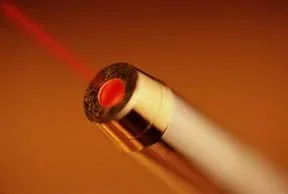 Copyright 2004 Microsoft Corporation, One Microsoft Way, Redmond, WA 98052-6399 USA. All rights reserved.
Demo 2 Instructions
- Fill one beaker with water and shine each laser through. (Point out to the students that they cannot see the laser beams in the water.)
- Gradually sprinkle coffee creamer on top of the water in one beaker and allow for the creamer to diffuse in the water. (Students should see the beams begin to appear in the water). Tip: Do not saturate the water!
- Add red food coloring to the beaker and let students hypothesize which color laser beam will travel through the solution better, before shining each through the creamy red solution.
- Repeat steps 1-3 in a second beaker, using green food coloring instead of red.
- As time permits, repeat steps 1-3 with different colors such as orange, blue, yellow, etc., and note the effect of each color on the laser beams.
When you think of a laser, what characteristics come to your mind? How do lasers compare to flashlights? What do you know about the color or the radius of the laser's beam? What uses readily come to mind when you think of lasers in today's society? Did you know the first use of a laser came in the 1970s in grocery store scanners? How about medical applications today — do you know of any?
Today, we will explore the answer to all of these questions. In addition, (in the associated activity) you will work in the computer lab in small groups to explore specific types of lasers and create presentations to share our findings with the class. With the conclusion of the presentations, you should know exactly what type of laser would be best for use in your security system design. Even further, you will know exactly why we are using a laser based security system to invisibly detect the presence of a thief.
(Next, conduct the two class demonstrations as described in the Lesson Background and Concepts for Teacher section. Then, proceed with the following brief lecture material.)
How Lasers Work (Lecture Material)
Lasers play many roles in our everyday lives, from optical storage (CDs and DVDs) to metal cutting to tattoo and hair removal. Not everyone knows that laser is actually an acronym. (Take guesses from students.) Laser stands for light amplification by stimulated emission of radiation. Referring back to the particle theory of light, which has led us to today's quantum physics, we know that atoms struck by light waves (electromagnetic radiation) begin to vibrate causing their electrons to jump to higher energy levels until the atoms reach an excited state. When the atoms begin to relax, their energy is released in the form of photons, which are simply pockets of light energy. A laser is a device that controls this release of photons (pockets of light energy).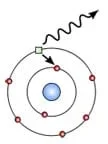 Photon emission. Photons are pockets of light energy.Copyright Dake, Wikimedia Commons. http://commons.wikimedia.org/wiki/Image:Sem_X_photon.svg
Characteristics of Laser Light
Laser light is described as coherent, monochromatic and collimated.
- The property of coherency is distinct to lasers; it means that laser light waves are in phase and the photons move in step with one another. This property explains why laser beams are very narrow and show little divergence.
- Secondly, laser light is monochromatic, which means that the light waves are consistently of one wavelength. This results from the fact that the released photons originate at one set of atomic energy levels only.
- Lastly, laser light is described as being collimated, meaning laser waves run parallel to one another and perpendicular to mirrors at either end of the laser cavity. This helps to prevent divergence and sustain amplification, as compared to a flashlight for example.
Laser Uses
Lasers found their first use in the 1970s in local grocery stores, in the product scanner. The next major accomplishment for laser technology was the CD player. Today, uses span from hospitals to battlefields, to electronics, to factories. Here are some examples:
- In medicine: surgical treatment, vision treatment, kidney stone treatment, dentistry, hair removal, skin treatment, tattoo removal, etc.
- In the military: missile guidance, radar replacement, target guidance, etc.
- In electronics: CDs, DVDs, laser printers, holograms, barcode scanners, etc.
- Factories: cutting, welding, heating materials, etc.
In short, engineers and scientists have determined a way to stimulate high-energy release and guide its output toward accomplishing productive and useful tasks.
(Next, have students conduct the associated activity, Researching Types and Uses of Lasers, in which they research assigned laser types and present their findings to the class. Each member of the class is responsible for taking notes on the presentations using the activity handout.)
- coherent
- Of or pertaining to waves that maintain a fixed phase relationship.
- collimate
- To bring into line, or to make parallel.
- laser
- A device that emits coherent light through a specific mechanism.
- light sensor
- A device that detects the presence of a light source.
- monochromatic
- Light of one color, or radiation of a single wavelength or narrow range of wavelengths.
- photon
- The quantum of electromagnetic energy, regarded as a discrete particle having zero mass, no electric charge, and an indefinitely long lifetime.
Pre-Lesson Assessment
Discussion Question: Ask a few discussion questions to get students to think about the upcoming lesson. After soliciting answers, explain that these questions will be answered during the lesson.
- What do you know about lasers?
- Are lasers the same as flashlights?
- What do you know about the color or the radius of the laser's beam?
- How do we use lasers?
- What are different mediums?
- Will milk or water transmit light better and where is the light being absorbed?
- How is light affected through different mediums?
Post-Lesson Assessment
Journaling: Ask students to compose answers in their journals to the following questions:
- What will be the role of lasers in your security system design?
- What properties of the laser's wave are important to your laser selection?
- What is the medium your laser will travel through?
- How might your design change if the medium changed?
- What properties of light are important to detecting a thief?
- How will you know if the troll's safety has been breached?
Dictionary.com. Lexico Publishing Group, LLC. Accessed August 7, 2008. (Source of vocabulary definitions, with some adaptation)
Contributors
Terry Carter; Meghan Murphy
Supporting Program
VU Bioengineering RET Program, School of Engineering, Vanderbilt University
Acknowledgements
The contents of this digital library curriculum were developed under National Science Foundation RET grant nos. 0338092 and 0742871. However, these contents do not necessarily represent the policies of the NSF, and you should not assume endorsement by the federal government.
Copyright
2013 by Regents of the University of Colorado; original © 2008 Vanderbilt University