
Security System Design
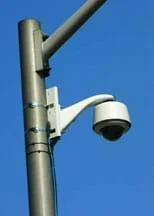 Security cameras line streets, keeping us safe.Copyright 2004 Microsoft Corporation, One Microsoft Way, Redmond, WA 98052-6399 USA. All rights reserved.
Students apply everything they have learned about light properties and laser technologies to designing, constructing, defining design limitations and presenting laser-based security systems that protect the school's mummified troll. In the associated activity, students "test their mettle" by constructing their security system using a PVC pipe frame, lasers and mirrors. In the lesson, students "go public" by creating informational presentations that explain their systems, and serve as embedded assessment, testing each student's understanding of light properties. It is important to convey to the students that part of the design challenge is to use as few lasers to patrol the largest area. By doing so this limits the overall cost of the design.
Engineers use their understanding of the properties of light to create systems in which a beam of light can control other devices. For example, they create photo-electric beam systems that transmit infrared light (which cannot be seen by the naked eye) across areas where the light beams may be obstructed. If/when a laser beam is obstructed, a sensor triggers an alarm. Through their presentations, students demonstrate an understanding of this technology, realizing that an infrared system is the best candidate for a security system, as specified by the challenge question.
After this lesson, students should be able to:
- Explain how a laser security system works.
- Create an informational presentation of their system design including a cost estimate.
This lesson also meets the following Tennessee Foundations of Technology educational technology content standards: 2.0, 3.0, 6.0 and 7.0; see https://www.teta.org/
This lesson also meets the following National Science Education Standards (NSES) teaching standards: A, B, C, D, E, F; see https://www.nap.edu/topic/
- Students will develop an understanding of the attributes of design.
Grades K-12
Do you agree with this alignment? - Students will develop an understanding of engineering design.
Grades K-12
Do you agree with this alignment? - STEL-1J Develop innovative products and systems that solve problems and extend capabilities based on individual or collective needs and wants.
Grades 6-8
Do you agree with this alignment? - STEL-7Q Apply the technology and engineering design process.
Grades 6-8
Do you agree with this alignment?
- MS-ETS1-1 Define the criteria and constraints of a design problem with sufficient precision to ensure a successful solution, taking into account relevant scientific principles and potential impacts on people and the natural environment that may limit possible solutions.
Grades 6-8
This resource focuses on the following Three Dimensional Learning aspects of NGSS:
Science & Engineering Practices- Define a design problem that can be solved through the development of an object, tool, process or system and includes multiple criteria and constraints, including scientific knowledge that may limit possible solutions.Do you agree with this alignment?
Disciplinary Core Ideas- The more precisely a design task's criteria and constraints can be defined, the more likely it is that the designed solution will be successful. Specification of constraints includes consideration of scientific principles and other relevant knowledge that is likely to limit possible solutions.Do you agree with this alignment?
Crosscutting Concepts- The uses of technologies and any limitations on their use are driven by individual or societal needs, desires, and values; by the findings of scientific research; and by differences in such factors as climate, natural resources, and economic conditions.Do you agree with this alignment?
- All human activity draws on natural resources and has both short and long-term consequences, positive as well as negative, for the health of people and the natural environment.Do you agree with this alignment?
Do you agree with this alignment? - Define a design problem that can be solved through the development of an object, tool, process or system and includes multiple criteria and constraints, including scientific knowledge that may limit possible solutions.
A complete knowledge and understanding of light and laser properties as well as the uses of various lasers as acquired in this unit's lessons 2 and 3, Learning Light's Properties, and Laser Types and Uses, and their associated activities.
Legacy Cycle Information
This lesson and its associated activity include the final steps of the legacy cycle, the Test Your Mettle step and the Go Public step. In the associated activity, students construct their laser security system and answer the post-lesson assessment questions. This activity tests each student's comprehension of light and laser properties and their abilities to apply their knowledge to solve the challenge. During the lesson, they prepare their Go Public presentation. Students are graded on their understanding of laser and light properties as reflected by their informational presentation.
Informative Presentation
Prior to the beginning of presentation preparation, distribute the attached Security System Design Presentation Grading Rubric (PDF) to the class. Depending on classroom resources, these informational presentations might be infomercials or commercials in video, skit, poster, slide or pamphlet format. Each design group prepares one presentation, though students are graded individually on their comprehension of the material. Each student is responsible for contributing to the oral presentation and each student must answer at least one follow-up question after the presentation has concluded. It is the responsibility of each student to demonstrate their comprehension of light and laser properties with respect to a security system.
Sample Solution
The best candidate for the security system, as specified by the challenge question, is an infrared system.
Get ready to go public with everything you have learned! Today, we will design and build our laser security systems for the troll's new home. In addition to building the invisible security system, you will be responsible for creating an infomercial that explains how your design is reliable and cost effective. You must demonstrate your understanding of the material we have covered including light properties and laser technology.
You may use my grading rubric as a guide for what to include in your presentation. Though we will be building our security systems and creating the infomercials in small groups, each of you is responsible for demonstrating what you have learned. In addition, following your presentation, your classmates and I will ask a few follow-up questions and you each must answer at least one. Now let's get started going public!
(Next, conduct the associated activity Construct It! in which teams design and build their security systems. Then, have teams each prepare an informational presentation describing their security systems. Grade each team and student as they give their presentations in front of the class.)
Post Lesson Assessment
Engineering Presentations: Each group prepares an informational presentation that is graded using the attached Security System Design Presentation Grading Rubric (PDF). Each student is individually responsible for demonstrating his/her comprehension of light and laser properties. Distribute the grading rubric to students prior to presentation preparation.
If available, Windows Movie Maker is a suitable software application for making video presentations.
Contributors
Terry Carter; Meghan Murphy
Supporting Program
VU Bioengineering RET Program, School of Engineering, Vanderbilt University
Acknowledgements
The contents of this digital library curriculum were developed under National Science Foundation RET grant nos. 0338092 and 0742871. However, these contents do not necessarily represent the policies of the NSF, and you should not assume endorsement by the federal government.
Copyright
2013 by Regents of the University of Colorado; original © 2008 Vanderbilt University