
Efficiency of an Electromechanical System
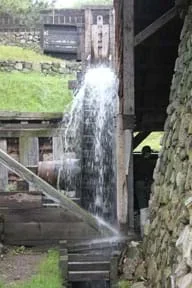 Engineers have taken the ancient water wheel and applied its process to modern water turbines that generate power with great efficiency.Copyright National Park System http://www.nps.gov/sair/planyourvisit/things2do.htm
Students use LEGO® motors and generators to raise washers a measured height. They compare the work done by the motor-generator systems with the energy inputs to calculate efficiency.
With most energy conversions, some energy is lost in the process, so engineers improve the energy efficiency of systems to reduce energy consumption. Engineers have learned that more complicated processes that have many components are typically less efficient than simple systems. Making systems that include energy conversions more efficient can help to reduce our consumption of fossil fuels and reduce greenhouse gas emissions.
After this activity, students should be able to:
- Explain where energy is "lost" in conversions and why.
- Compute the efficiency of an energy conversion given input and output.
- Identify system by-products and explain how they can be used effectively to increase overall system efficiency.
- Design a simple energy conversion system and test its efficiency.
- Use collected data to calculate the efficiency of a system.
- CCSS.Math.Content.6.NS.B.3 Fluently add, subtract, multiply, and divide multi-digit decimals using the standard algorithm for each operation.
Grade 6
Do you agree with this alignment? - CCSS.Math.Content.6.RP.A.3c Find a percent of a quantity as a rate per 100 (e.g., 30% of a quantity means 30/100 times the quantity); solve problems involving finding the whole, given a part and the percent.
Grade 6
Do you agree with this alignment?
- Energy can be used to do work, using many processes.
Grades 6-8
Do you agree with this alignment? - STEL-8I Use tools, materials, and machines to safely diagnose, adjust, and repair systems.
Grades 6-8
Do you agree with this alignment?
- recognize and apply mathematics in contexts outside of mathematics
Grades -1-12
Do you agree with this alignment? - select and apply techniques and tools to accurately find length, area, volume, and angle measures to appropriate levels of precision
Grades 6-8
Do you agree with this alignment? - use common benchmarks to select appropriate methods for estimating measurements
Grades 6-8
Do you agree with this alignment? - relate and compare different forms of representation for a relationship
Grades 6-8
Do you agree with this alignment? - model and solve contextual problems using various representations, such as graphs, tables, and equations
Grades 6-8
Do you agree with this alignment? - select appropriate methods and tools for computing with fractions and decimals from among mental computation, estimation, calculators, or computers, and paper and pencil, depending on the situation, and apply the selected methods
Grades 6-8
Do you agree with this alignment? - work flexibly with fractions, decimals, and percents to solve problems
Grades 6-8
Do you agree with this alignment? - solve problems involving scale factors, using ratio and proportion
Grades 6-8
Do you agree with this alignment? - solve problems that arise in mathematics and in other contexts
Grades -1-12
Do you agree with this alignment? - develop, analyze, and explain methods for solving problems involving proportions, such as scaling and finding equivalent ratios
Grades 6-8
Do you agree with this alignment? - understand and use ratios and proportions to represent quantitative relationships
Grades 6-8
Do you agree with this alignment? - understand both metric and customary systems of measurement
Grades 6-8
Do you agree with this alignment?
- Energy is a property of many substances and is associated with heat, light, electricity, mechanical motion, sound, nuclei, and the nature of a chemical. Energy is transferred in many ways.
Grades 5-8
Do you agree with this alignment? - Perfectly designed solutions do not exist. All technological solutions have trade-offs, such as safety, cost, efficiency, and appearance. Engineers often build in back-up systems to provide safety. Risk is part of living in a highly technological world. Reducing risk often results in new technology.
Grades 5-8
Do you agree with this alignment? - Develop descriptions, explanations, predictions, and models using evidence. Students should base their explanation on what they observed, and as they develop cognitive skills, they should be able to differentiate explanation from description--providing causes for effects and establishing relationships based on evidence and logical argument. This standard requires a subject matter knowledge base so the students can effectively conduct investigations, because developing explanations establishes connections between the content of science and the contexts within which students develop new knowledge.
Grades 5-8
Do you agree with this alignment? - Heat moves in predictable ways, flowing from warmer objects to cooler ones, until both reach the same temperature.
Grades 5-8
Do you agree with this alignment? - Mathematics is important in all aspects of scientific inquiry.
Grades 5-8
Do you agree with this alignment? - Think critically and logically to make the relationships between evidence and explanations. Thinking critically about evidence includes deciding what evidence should be used and accounting for anomalous data. Specifically, students should be able to review data from a simple experiment, summarize the data, and form a logical argument about the cause-and-effect relationships in the experiment. Students should begin to state some explanations in terms of the relationship between two or more variables.
Grades 5-8
Do you agree with this alignment? - Use mathematics in all aspects of scientific inquiry. Mathematics is essential to asking and answering questions about the natural world. Mathematics can be used to ask questions; to gather, organize, and present data; and to structure convincing explanations.
Grades 5-8
Do you agree with this alignment? - Technological solutions have intended benefits and unintended consequences. Some consequences can be predicted, others cannot.
Grades 5-8
Do you agree with this alignment? - Use appropriate tools and techniques to gather, analyze, and interpret data. The use of tools and techniques, including mathematics, will be guided by the question asked and the investigations students design. The use of computers for the collection, summary, and display of evidence is part of this standard. Students should be able to access, gather, store, retrieve, and organize data, using hardware and software designed for these purposes.
Grades 5-8
Do you agree with this alignment?
- 6.NS.3 Fluently add, subtract, multiply, and divide multi-digit decimals using the standard algorithm for each operation.
Grade 6
Do you agree with this alignment? - 6.RP.3.c Find a percent of a quantity as a rate per 100 (e.g., 30% of a quantity means 30/100 times the quantity); solve problems involving finding the whole, given a part and the percent.
Grade 6
Do you agree with this alignment?
- MS-ETS1-4 Develop a model to generate data for iterative testing and modification of a proposed object, tool, or process such that an optimal design can be achieved.
Grades 6-8
Do you agree with this alignment? - MS-PS3-5 Construct, use, and present an argument to support the claim that when work is done on or by a system, the energy of the system changes as energy is transferred to or from the system.
Grades 6-8
Do you agree with this alignment?
- MS-ETS1-4 Develop a model to generate data for iterative testing and modification of a proposed object, tool, or process such that an optimal design can be achieved.
Grades 6-8
This resource focuses on the following Three Dimensional Learning aspects of NGSS:
Science & Engineering Practices- Develop a model to generate data to test ideas about designed systems, including those representing inputs and outputs.Do you agree with this alignment?
Disciplinary Core Ideas- Models of all kinds are important for testing solutions.Do you agree with this alignment?
- The iterative process of testing the most promising solutions and modifying what is proposed on the basis of the test results leads to greater refinement and ultimately to an optimal solution.Do you agree with this alignment?
Do you agree with this alignment? - Develop a model to generate data to test ideas about designed systems, including those representing inputs and outputs.
- MS-PS3-5 Construct, use, and present arguments to support the claim that when the kinetic energy of an object changes, energy is transferred to or from the object.
Grades 6-8
This resource focuses on the following Three Dimensional Learning aspects of NGSS:
Science & Engineering Practices- Construct, use, and present oral and written arguments supported by empirical evidence and scientific reasoning to support or refute an explanation or a model for a phenomenon.Do you agree with this alignment?
- Science knowledge is based upon logical and conceptual connections between evidence and explanations.Do you agree with this alignment?
Disciplinary Core Ideas- When the motion energy of an object changes, there is inevitably some other change in energy at the same time.Do you agree with this alignment?
Crosscutting Concepts- Energy may take different forms (e.g. energy in fields, thermal energy, energy of motion).Do you agree with this alignment?
Do you agree with this alignment? - Construct, use, and present oral and written arguments supported by empirical evidence and scientific reasoning to support or refute an explanation or a model for a phenomenon.
Per group:
- 2 LEGO motors
- 3 LEGO LED light bulbs
- LEGO base (~15 x 25 cm)
- a few flat LEGO pieces to connect motors to base (they need to be raised)
- 2 LEGO electrical connector wires
- 2 ~2-3 cm diameter washers
- ~1 m thin string or heavy thread
- meter stick
- Student Worksheets, one per student
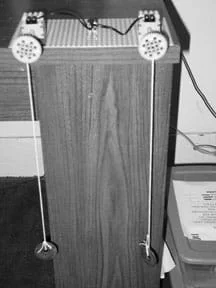 Figure 1. Setup for the electromechanical efficiency activity.
What does a motor do? (Be prepared to offer some examples or show motors [such as a hand drill] that have electricity input and transform that into mechanical energy [such as rotating a shaft.])
How do motors feel if you touch them after operating for a while? (They get warm.) Why?
Do we want to heat? (No)
What does it represent? (A loss of energy – not the useful form we desire from a motor designed to do work.)
What happens to the terminals when the motor shaft is turned manually (for example, running the motor backwards)? (Show that the motor can turn into an electricity "generator" and make it light a LEGO light bulb.) Ask about the forms (mechanical to electromagnetic). Tell students that they will be powering their own generators to power a motor that lifts a weight.
Before class:
- Set up LEGO motor-generator apparatus for each group (see Figure 1).
- Two critical features to note:
- Use thin string or heavy thread so that the layers of string wrapping around the axle do not change its diameter.
- The washers should hang to the same height when completely unwound.
With the students:
- Divide the class into groups of three students each.
- Have teams initially play with the apparatus to get a sense of how it works.
- Work through the activity procedures 1-5.
- Pause to discuss student observations.
- Explain that you can never have both washers reach the top at the same time because then the system would be 100% efficient. If a system is 100% efficient, all of the energy is being used. Even if the light from the LEGO bulb was useful to us, heat is also escaping in the lamp and in the wire.
- If appropriate for students, go through the derivation that shows how to calculate efficiency from the height each washer raised (see the lesson). Otherwise, just provide the equation: efficiency = height L / height R
- Complete the activity and calculations.
- Go through the rest of the procedure.
- Go through calculations and questions on the activity sheet. The least efficient trial should be trial 3 during, which loss goes through the wires, 2 bulbs, the motor, and the generator. The most efficient trial should be trial 2 during which energy is only lost in the wires, motor and generator.
- Fun Extra: Have groups connect all of their modules together, and watch the efficiency decrease from motor to motor.
- Complete all discussion questions and have students hand in their completed worksheets.
The student worksheet is attached. Expected findings are included below.
- Work in groups of 3-4 students at each station.
- Turn the left gear. What do you notice happening to the gear on the right? Expected: The gear on the right should also move up. Throughout this activity, it is important that students strive to turn the gears quickly but at a fairly constant rate.
- Which side is acting like a generator? Which side is acting like a motor? The side that you are turning (in this case left side) is acting like a generator. The other side is acting like a motor.
- Unwrap the string and bring the washers back down to the same height.
- Turn the left gear again until the left washer reaches the motor. This time, try to get both of the washers to reach the top at the same time. Is this possible? Why or why not? Expected: This should not be possible because the energy used to lift the left washer is not completely sent to the right washer, some energy is lost along the way. Energy is lost in the generator, the electrical connectors, the motor, the strings, and whatever other components make up the system.
- Is your generator-motor system 100% efficient? Expected: No, the system is not 100% efficient since the left washer reached the top before the right washer during the same time period. If it was 100% efficient, they would reach the top at the same time. Achieving 100% efficiency is next to impossible.
- Unwrap the string and bring the washers back down to the same height. Put 2 LEGO lamps on top of each over and on top of the black connector. What do you think is going to happen this time? Expected: The right washer should go up even less.
- Based on what you saw, which trial do you think was the most efficient? Which trial do you think was the least efficient? Expected: Most efficient: generator-motor trial, Least efficient: generator-double lamp-motor trial.
Discussion Questions:
What do you think would happen if you connected the motor on the right to yet another motor with a weight attached?
You would lose efficiency with each new component. Each washer from left to right should be a little lower.
Worksheets: Collect the completed student worksheets to check to see if the calculations are correct and answers to discussion questions show appropriate insight.
This activity was originally published by the Clarkson University K-12 Project Based Learning Partnership Program and may be accessed at http://internal.clarkson.edu/highschool/k12/project/energysystems.html.
Contributors
Nate Barlow; Susan Powers; Jan DeWaters; Clarkson and St. Lawrence University Students (K-12 Project Based Learning Partnership Program)
Supporting Program
Office of Educational Partnerships, Clarkson University, Potsdam, NY
Acknowledgements
This activity was developed under National Science Foundation grant nos. DUE 0428127 and DGE 0338216. However, these contents do not necessarily represent the policies of the National Science Foundation, and you should not assume endorsement by the federal government.
Copyright
2013 by Regents of the University of Colorado; original © 2008 Clarkson University