
Energy Conversions
Students evaluate various everyday energy conversion devices and draw block flow diagrams to show the forms and states of energy into and out of the device. They also identify the forms of energy that are useful and the desired output of the device as well as the forms that are not useful for the intended use of the item. This can be used to lead into the law of conservation of energy and efficiency. The student activity is preceded by a demonstration of a more complicated system to convert chemical energy to heat energy to mechanical energy. Drawing the block energy conversion diagram for this system models the activity that the students then do themselves for other simpler systems.
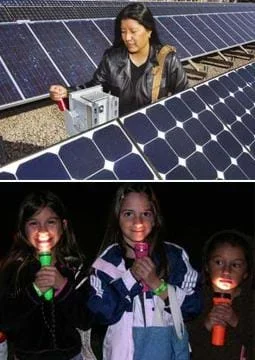 Everyday energy conversions include the Sun's radiant light to electrical energy, and the chemical reaction in batteries to radiant-light energy.Copyright (left) Sandia National Laboratories http://www.sandia.gov/news-center/news-releases/2005/renew-energy-batt/tewa.html (right) City of Round Rock, TX http://www.roundrocktexas.gov/home/index.asp?page=1547
Energy exists in many forms all around us. Engineers have determined how to capture and release that energy in forms that are most useful to create heat where required and the work done in many engineered devices. Process flow charts that show the inflow and outflow of energy through a process are a tool that engineers use to help design and evaluate different systems and processes.
After this activity, students should be able to:
- Describe at least three examples of how energy is converted from one form to another.
- Demonstrate and diagram the conversion of energy into usable forms using a flowchart.
- State the law of conservation of energy.
- Identify seven forms and two states of energy.
- Identify the forms and states of energy in everyday items as we use them to do useful energy.
- Energy is the capacity to do work.
Grades 6-8
Do you agree with this alignment? - STEL-2N Illustrate how systems thinking involves considering relationships between every part, as well as how the system interacts with the environment in which it is used.
Grades 6-8
Do you agree with this alignment?
- Energy is a property of many substances and is associated with heat, light, electricity, mechanical motion, sound, nuclei, and the nature of a chemical. Energy is transferred in many ways.
Grades 5-8
Do you agree with this alignment? - Electrical circuits provide a means of transferring electrical energy when heat, light, sound, and chemical changes are produced.
Grades 5-8
Do you agree with this alignment? - In most chemical and nuclear reactions, energy is transferred into or out of a system. Heat, light, mechanical motion, or electricity might all be involved in such transfers.
Grades 5-8
Do you agree with this alignment?
- MS-PS3-5 Construct, use, and present an argument to support the claim that when work is done on or by a system, the energy of the system changes as energy is transferred to or from the system.
Grades 6-8
Do you agree with this alignment?
- MS-PS3-5 Construct, use, and present arguments to support the claim that when the kinetic energy of an object changes, energy is transferred to or from the object.
Grades 6-8
This resource focuses on the following Three Dimensional Learning aspects of NGSS:
Science & Engineering Practices- Construct, use, and present oral and written arguments supported by empirical evidence and scientific reasoning to support or refute an explanation or a model for a phenomenon.Do you agree with this alignment?
- Science knowledge is based upon logical and conceptual connections between evidence and explanations.Do you agree with this alignment?
Disciplinary Core Ideas- When the motion energy of an object changes, there is inevitably some other change in energy at the same time.Do you agree with this alignment?
Crosscutting Concepts- Energy may take different forms (e.g. energy in fields, thermal energy, energy of motion).Do you agree with this alignment?
Do you agree with this alignment? - Construct, use, and present oral and written arguments supported by empirical evidence and scientific reasoning to support or refute an explanation or a model for a phenomenon.
For the combustion demo:
- sterno or other heating source
- 250 ml erlemeyer flask with a 1-hole stopper
- pre-heated water (near boiling) in a thermos
- ring stand to hold pinwheel and flask above heating source
- pinwheel
- various electrical, mechanical or battery-operated devices (one per group); examples: battery-operated flashlight, shaking flashlight, light-solar panel-LEGO motor set-up, personal heat packet, Genecon generator, hairdryer, glow stick
- Energy Conversion Student Worksheet
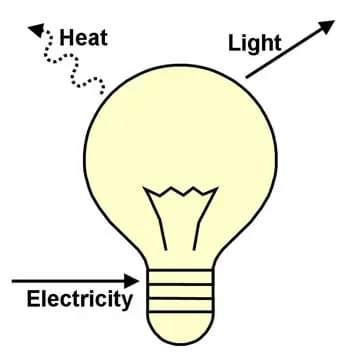 In a light bulb, electromagnetic energy (electricity) converts into heat and light.
Energy exists in many forms all around us. The development of our modern society has been accomplished because scientists and engineers have learned to capture some of that energy and transform it into ways to do useful work. The conversion of energy from a chunk of coal into steam and then into mechanical engines that could do heavy work was a critically important role of engineers in the 19th century that helped to start the industrial revolution. An engineer needs to know where to "find" energy resources and then how to convert them into forms that are more useful for all of the machines and gadgets we use in our daily lives.
The law of conservation of energy states: Energy can neither be created nor destroyed... But, it can be converted! (Relate back to the energy forms and energy flow diagrams discussed earlier. In some cases, the items had different starting and ending energy forms, so conversions were going on.) The truck was an example of chemical energy converted to mechanical and heat through the COMBUSTION of fuel.
Energy conversions are necessary when we desire a certain form or state of energy, perhaps heat for our homoes, when the only form available is different, perhaps chemical energy in fuel. Conversions are also useful for transporting energy to where it is needed. For example a hydropower plant may be miles from our homes, so how do we use its energy? We convert its mechanical energy (flowing water) to electric energy, which is easily transported to our home via wires, and then back to mechanical energy in our blenders.
(Next, conduct the combustion demo to illustrate how we can add conversion processes to our energy flow diagrams.)
Before the Activity:
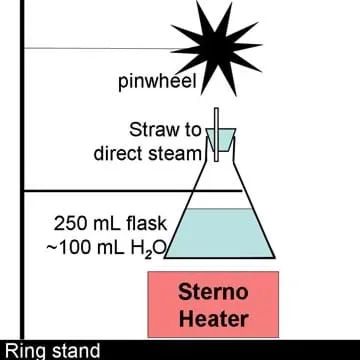 Figure 1. Schematic drawing of combustion energy conversion demonstration.
- Set up the various energy conversion devices around the classroom. They do not need to be plugged in as long as they are familiar to students.
- Make copies of the Energy Conversion Student Worksheet.
- Pre-heat the water to near boiling point to speed up the combustion demo and store in a thermos or other insulated container.
- Set up the combustion demonstration (see Figure 1).
With the Students
After the Introduction:
- Start the combustion demo by transferring water to flask and lighting the Sterno. Explain the system and that it represents components of a fossil fuel power plant.
- Draw energy flow diagrams starting with various forms of energy. Expect students to be able to help define the energy forms and states.
- We already know about forms of energy in this process (on left of block diagram), now let's define the conversion processes (see added words on right). This model is similar to a coal fired power plant, which would have one more step: the steam would rotate a turbine that has magnets and coils of copper wire. The moving magnetic field causes electrons in the copper to wiggle, thereby creating an electric potential (voltage).
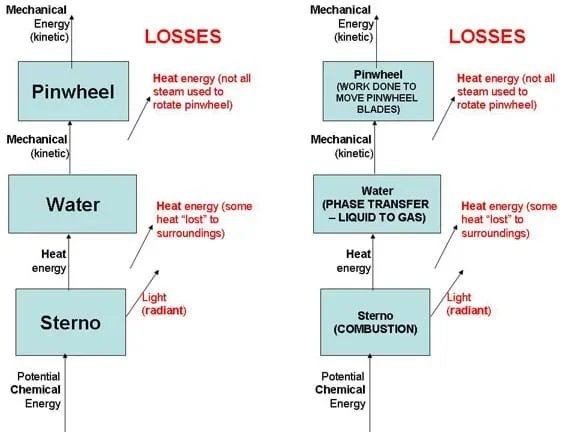 Block diagrams for combustion demonstration.
Discussion Questions
- Who knows what important process is happening between the different forms of energy? State that this conversion is something we use today. Relate it to our use of fossil fuels and the specific combustion process.
- Make sure students understand that energy "losses" occur (energy is converted to an undesired form) as energy is converted from one form to the next.
- Explain that we can model many different energy conversions in household appliances.
Student Activity:
- Hand out the worksheets and explain that students will now do the same diagramming for several common appliances.
- Have students look at four different energy conversions and fill in the appropriate information on the worksheet for each conversion.
- Select different objects for each station, depending on what is available at the moment. Examples:
- flashlight (chemical [chemical reaction inside battery] to radiant [light])
- shaking flashlight (mechanical [work to move magnet] to electrical to light [electrical resistance in light bulb])
- light-solar panel-LEGO motor set-up (radiant [light] to electrical to mechanical)
- personal heat packet (chemical to heat [exothermic chemical reaction])
- Genecon generator (mechanical [do work to move magnet] to electrical)
- hairdryer (electrical to heat and mechanical [electrical resistance in wire to create heat, work done by fan to move air])
- glow stick (chemical to radiant [light] [chemical reaction])
- Closure
- Stress that conversions end with '"usable" and "unusable" forms of energy. Reiterate that energy is never lost.
- Once students have the information for their stations (or all stations) have group each present a station to the rest of the class.
- Make sure that students are able to identify energy forms and states. Require them to show where potential energy loses may occur.
Worksheet: Have students complete and turn in the activity worksheet and discussion questions. Review their answers to gauge their comprehension of the material.
This activity was originally published by the Clarkson University K-12 Project Based Learning Partnership Program and may be accessed at http://internal.clarkson.edu/highschool/k12/project/energysystems.html.
Contributors
Susan Powers; Jan DeWaters; Clarkson and St. Lawrence University Students (K-12 Project Based Learning Partnership Program)
Supporting Program
Office of Educational Partnerships, Clarkson University, Potsdam, NY
Acknowledgements
This activity was developed under National Science Foundation grant nos. DUE 0428127 and DGE 0338216. However, these contents do not necessarily represent the policies of the National Science Foundation, and you should not assume endorsement by the federal government.
Copyright
2013 by Regents of the University of Colorado; original © 2008 Clarkson University