
Energy Forms, States and Conversions
 Energy conversion enables the many forms and states of energy in our world.Copyright (top) City of Winchester VA http://www.winchesterva.gov/gogreen/transportation.php (bottom) 2004 Microsoft Corporation, One Microsoft Way, Redmond, WA 98052-6399 USA. All rights reserved.
Students participate in many demonstrations during the first day of this lesson to learn basic concepts related to the forms and states of energy. This knowledge is then applied the second day as students assess various everyday objects to determine what forms of energy are transformed to accomplish the object's intended task. Students use block diagrams to illustrate the form and state of energy flowing into and out of the process.
Energy exists in many forms all around us. Engineers have determined how to capture and release that energy in forms that are most useful to create heat where required and the work done in many engineered devices. Process flow charts that show the inflow and outflow of energy through a process are one tool that engineers use to help design and evaluate different systems and processes.
After this lesson, students should be able to:
- Describe at least three examples of how energy is converted from one form to another.
- Demonstrate and diagram the conversion of energy into usable forms using a flow chart.
- State the law of conservation of energy.
- Identify five forms and two states of energy.
- Identify the form and state of energy in everyday items as we use them to do useful work.
- CCSS.Math.Content.6.NS.B.3 Fluently add, subtract, multiply, and divide multi-digit decimals using the standard algorithm for each operation.
Grade 6
Do you agree with this alignment? - CCSS.Math.Content.7.EE.B.4 Use variables to represent quantities in a real-world or mathematical problem, and construct simple equations and inequalities to solve problems by reasoning about the quantities.
Grade 7
Do you agree with this alignment?
- Students will develop an understanding of the relationships among technologies and the connections between technology and other fields of study.
Grades K-12
Do you agree with this alignment? - Energy can be used to do work, using many processes.
Grades 6-8
Do you agree with this alignment?
- Energy is a property of many substances and is associated with heat, light, electricity, mechanical motion, sound, nuclei, and the nature of a chemical. Energy is transferred in many ways.
Grades 5-8
Do you agree with this alignment? - Electrical circuits provide a means of transferring electrical energy when heat, light, sound, and chemical changes are produced.
Grades 5-8
Do you agree with this alignment? - In most chemical and nuclear reactions, energy is transferred into or out of a system. Heat, light, mechanical motion, or electricity might all be involved in such transfers.
Grades 5-8
Do you agree with this alignment?
- 6.NS.3 Fluently add, subtract, multiply, and divide multi-digit decimals using the standard algorithm for each operation.
Grade 6
Do you agree with this alignment? - 7.EE.4 Use variables to represent quantities in a real-world or mathematical problem, and construct simple equations and inequalities to solve problems by reasoning about the quantities.
Grade 7
Do you agree with this alignment?
- MS-PS3-5 Construct, use, and present an argument to support the claim that when work is done on or by a system, the energy of the system changes as energy is transferred to or from the system.
Grades 6-8
Do you agree with this alignment?
- MS-PS3-5 Construct, use, and present arguments to support the claim that when the kinetic energy of an object changes, energy is transferred to or from the object.
Grades 6-8
This resource focuses on the following Three Dimensional Learning aspects of NGSS:
Science & Engineering Practices- Construct, use, and present oral and written arguments supported by empirical evidence and scientific reasoning to support or refute an explanation or a model for a phenomenon.Do you agree with this alignment?
- Science knowledge is based upon logical and conceptual connections between evidence and explanations.Do you agree with this alignment?
Disciplinary Core Ideas- When the motion energy of an object changes, there is inevitably some other change in energy at the same time.Do you agree with this alignment?
Crosscutting Concepts- Energy may take different forms (e.g. energy in fields, thermal energy, energy of motion).Do you agree with this alignment?
Do you agree with this alignment? - Construct, use, and present oral and written arguments supported by empirical evidence and scientific reasoning to support or refute an explanation or a model for a phenomenon.
1. Energy can be neither created nor destroyed, but converted from one form to another. This can be represented as the first law of thermodynamics.
2. Energy can be classified by its form or state.
3. The forms of energy defined in NYS educational standards include: sound, chemical, radiant (light), electrical, atomic (nuclear), mechanical, thermal (heat). Remembered as "SCREAM Today". Refer to the Energy Forms and States Demonstrations activity to further explain the concepts of energy forms.
- Sound – from vibration of sound waves
- Chemical (fuel, gas, wood, battery)
- Radiant (light) (note – this is part of the broader "electromagnetic" group)
- Electrical energy (electrons move among atoms, as in the conductive wire of an electrical cord)
- Atomic (nuclear, from nucleus of atom)
- Mechanical (walk, run)
- Thermal (heat, such as rubbing hands together)
4. The two states of energy are potential and kinetic
- Potential (stored energy due to elevation): PE = mass*gravity*height
- Kinetic (energy in motion): KE = 1/2*mass*velocity2
5. Energy is stored in a variety of ways and must be released to do useful work
6. Energy can be converted to useful forms by various means, we often convert the form of energy to make it more useful to us. For example, we transform chemical energy in gasoline into mechanical energy to move an automobile. Refer to the Energy Conversions activity to have students evaluate various everyday energy conversion devices.
7. Energy and its conversion between forms can be expressed quantitatively.
8. When converting energy, a significant fraction of that energy can be lost from the system (in the form of heat, sound, vibration, etc.). But of course energy is never really lost. "Lost" in this context means that it is not recovered for effective use by humans or machines.
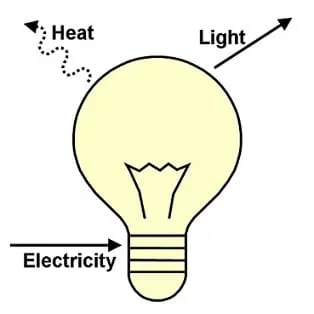 In a light bulb, electromagnetic energy (electricity) converts into heat and light.
Energy exists in many forms all around us. The development of our modern society has been accomplished because scientists and engineers have learned to capture some of that energy and transform it into ways to do useful work. The conversion of energy from a chunk of coal into steam and then into mechanical engines that could do heavy work was a critically important role for engineers in the 19th century that helped to start the industrial revolution. An engineer must know where to "find" energy resources and then how to convert them into forms that are more useful for all of the machines and gadgets we use in our daily lives. Look around this room, what tools or devices are using energy? Light fixtures are a good example. They convert electrical energy into light (radiant) energy. What about this cup of water (hold up a cup of water), does it have energy? It has a state of energy called potential energy because it is held up at an elevation. If the water is poured into a pail, the potential energy is released as the water now is moving with some velocity. This is a kinetic state of energy.
The goal of this class is to explore some critical terms that are needed for energy – forms of energy and states of energy. Tomorrow, that information will be used as we evaluate several items, like the lights in this class, to see how they convert energy from one form to another.
- block process flow diagram
- A physical representation of inputs and outputs of a process, used by engineers.
- chemical energy
- Energy stored within chemical bonds.
- combustion
- The process of burning organic chemicals to release heat and light.
- conservation
- Careful use of resources with the goal of reducing environmental damage or resource depletion.
- efficiency
- Ability of a process or machine to convert energy input to energy output, efficiency is always less than 100% in real processes. Efficiency of a system can be quantified as the ratio of the useful output energy (or power) to the input energy (or power).
- electrical energy
- Energy made available by the flow of electric charge through a conductor.
- energy conversion
- Transformation of one form of energy into another, usually to convert the energy into a more useful form.
- first law of thermodynamics
- Energy can neither be created nor destroyed.
- form of energy
- Forms of energy include heat, light, electrical, mechanical, nuclear, sound and chemical.
- heat
- A form of energy related to its temperature. (thermal energy)
- input
- Matter or energy going into a process.
- kinetic energy
- Energy of motion, influenced by an objects mass and speed.
- mechanical energy
- A form of energy related to the movement of an object.
- nuclear energy
- (atomic) Energy produced by splitting the nuclei of certain elements.
- output
- Matter or energy coming out of a process.
- potential energy
- Energy that is stored and that comes from an object's position or condition.
- state of energy
- States of energy include kinetic and potential.
Post-Introduction Assessment: Plan on a lot of dialogue and student participation in the first day of this lesson. Use the many probing questions included in the forms and state demonstration activity to assess if students understand the concepts.
Homework: Use the turned-in student activity worksheet completed during the conversion activity as a means of assessing if students correctly identified the forms involved in each conversion process and can include those forms correctly in a block diagram form.
Worksheet & Quiz: Have students complete the activity worksheet and discussion questions and turn them in. The quiz after Lesson 5 also includes concepts from this lesson.
Practice Problems:
- If the mass of an object is 10 kg, and it is dropped from a height of 5 m, what is its potential energy? (Answer: PE=(10 kg)(9.8 m/s2)(5 m)=490 Nm) (A Nm (newton-meter) is equivalent to a (kg*m2)/s2)
- If the kinetic energy of an object is 100 Nm, and its velocity is 10m/s, what is the mass of the object? (Answer: m=2KE/v2 =2*100 Nm/〖10 m/s〗2 =2 kg)
Biggs, A., Burns, J., Daniel, L.H., Ezralson, C., Feather, R.M., Horton, P.M., McCarthy, T.K., Ortleb, E., Snyder, S.L., Werwa, E. Science Voyages: Exploring Life, Earth and Physical Science, Level Red., Glencoe/McGraw Hill: New York, 2000.
Intermediate Level Science Core Curriculum, Grades 5-8, New York State Education, Department, accessed December 31, 2008. http://www.emsc.nysed.gov/ciai/mst/pub/intersci.pdf
- Energy Conservation & Efficiency
- Energy Forms, States and Conversions
- Household Energy Conservation and Efficiency
- Energy Efficiency
- Problem Solving
This lesson was originally published by the Clarkson University K-12 Project Based Learning Partnership Program and may be accessed at http://internal.clarkson.edu/highschool/k12/project/energysystems.html.
Browse the NGSS Engineering-aligned Physics Curriculum hub for additional Physics and Physical Science curriculum featuring Engineering.
Contributors
Susan Powers; Jan DeWaters; Clarkson and St. Lawrence University Students (K-12 Project Based Learning Partnership Program)
Supporting Program
Office of Educational Partnerships, Clarkson University, Potsdam, NY
Acknowledgements
This lesson was developed under National Science Foundation grants no. DUE 0428127 and DGE 0338216. However, these contents do not necessarily represent the policies of the National Science Foundation, and you should not assume endorsement by the federal government.
Copyright
2013 by Regents of the University of Colorado; original © 2008 Clarkson University