
Energy Systems
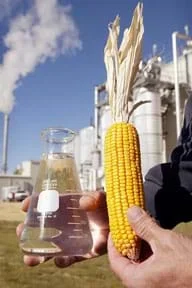 Corn-based ethanol is a biofuel that could ultimately help supply U.S. transportation fuel needs.Copyright U.S. Department of Energy https://www.eere-pmc.energy.gov/PMC_News/EERE_Program_News_3-08.aspx
Posters are provided for several different energy conversion systems. Students are provided with cards that give the name and a description of each of the components in an energy system. They match these with the figures on the diagram. Since the groups look at different systems, they also describe their results to the class to share their knowledge.
Energy "systems" developed by engineers are comprised of numerous components that work together to get the energy content of the energy resource converted into a form that is useful to the user and delivered to the customer. All of the components in the system must be carefully designed to work together effectively.
After this activity, students should be able to"
- Identify and describe the parts of an energy system.
- Identify their respective environmental impacts.
- Technological systems can be connected to one another.
Grades 6-8
Do you agree with this alignment? - Energy can be used to do work, using many processes.
Grades 6-8
Do you agree with this alignment?
- Energy is a property of many substances and is associated with heat, light, electricity, mechanical motion, sound, nuclei, and the nature of a chemical. Energy is transferred in many ways.
Grades 5-8
Do you agree with this alignment?
- CCC.5.6-8.6 Energy may take different forms (e.g. energy in fields, thermal energy, energy of motion).
Grades 6-8
Do you agree with this alignment? - CCC.5.6-8.8 The transfer of energy can be tracked as energy flows through a natural system.
Grades 6-8
Do you agree with this alignment?
Each group needs:
- 1 energy system poster
- cards with labels and explanations of system components
- worksheet, one per student
- Energy Systems Environmental Impacts (PDF) sheet
We just learned about energy sources. The systems you looked at were generally one component of an overall energy system that is comprised of many components.
- Go over the system diagram for one of the systems the class will not be doing. (For example, reviewing coal combustion relating to the sterno/pinwheel combustion demo would be appropriate; see lesson 4.)
- Indicate that the real-life energy system also includes coal mining and transportation and the electricity distribution grid to get the energy from its real source (coal in the ground) into electricity to power your TV.
- Instruct the class to keep in mind the environmental impacts of their respective energy source/system during the course of the activity.
Before class:
- Print and cut apart system cards.
- Print system diagram posters (large poster size format is best) and post around the room. (we laminate them for repeated use in different classes and years)
- Make copies of the worksheet.
- Print and cut apart the Energy Systems Environmental Impacts (PDF) sheet.
With the students:
1. Energy System Diagram Activity
- Explain that the students will have to match the system component and its description with its location on the diagram they are given.
- They will also have to draw a block diagram for their system, identifying the starting and ending form and state for each system component.
- Divide the class into groups of three students each.
- In most classes, we only used the wind, solar, and hydro diagrams, but other diagrams can also be used.
- Go around and assist each group as needed.
- Once all students have figured out their diagrams, have each group present it to the class.They can do the block diagram on the board. Have each group briefly discuss the environmental impacts of their system to the class.
- (optional) Pass out the completed handouts for each system.
2. Close with overall assessment of what an energy system is and its general attributes (input, output, conversion process, efficiency).
3. Discuss again how this overall lesson on sources can be used for the unit project.
Presentations: Have students present their posters to the class and describe the system components, functions and environmental impacts.
Worksheets: Have students turn in their completed worksheets with block flow diagrams showing the energy forms and conversions for each component.
"Environmental Impact by Energy Source." Energy4me RSS. N.p., n.d. Web. 13 Aug. 2014. http://www.energy4me.org/energy-facts/environmental-protection/environmental-impact-by-source/.
Energy Information Administration, EIA Kid's Page – Energy Facts. US Department of Energy. Accessed December 29, 2008. http://www.eia.doe.gov/kids/energyfacts/index.html
This activity was originally published by the Clarkson University K-12 Project Based Learning Partnership Program and may be accessed athttp://internal.clarkson.edu/highschool/k12/project/energysystems.html.
Contributors
Susan Powers; Jan DeWaters; Clarkson and St. Lawrence University Students (K-12 Project Based Learning Partnership Program)
Supporting Program
Office of Educational Partnerships, Clarkson University, Potsdam, NY
Acknowledgements
This activity was developed under National Science Foundation grant nos. DUE 0428127 and DGE 0338216. However, these contents do not necessarily represent the policies of the National Science Foundation, and you should not assume endorsement by the federal government.
Copyright
2013 by Regents of the University of Colorado; original © 2008 Clarkson University