
Energy Perspectives
 Everyday energy consumption usually involves kitchen appliances. This man in a hospital kitchen cooks with a high-speed oven that is 10x faster than a conventional oven while using less energy. Engineers design new buildings to be more efficient in their use of energy, which includes heating, cooling and lighting.Copyright (left) NIH Clinical Center http://www.cc.nih.gov/about/news/newsletter/2008/mar08/newsletter.html (right) Energy Star http://www.energystar.gov/ia/partners/downloads/consumer_brochure.pdf
Students utilize data tables culled from the US DOE Energy Information Agency to create graphs that illustrate what types of energy we use and how we use it. An MS Excel workbook with several spreadsheets of data is provided. Students pick (or the teacher assigns) one of the data tables from which students create plots and interpret the information provided. Student groups share with the class their interpretations and new perspectives on energy resources and use.
Engineering analysis is an important part of the overall engineering design process. Analysis is often done to interpret data that helps us to understand the nature of particular problems. This understanding is critically important before effective solutions can be suggested. In most cases, the analysis is very quantitative (mathematical) in nature. In this activity, students use a spreadsheet for the analysis; engineers often use this tool for their analyses and communicating findings in graphical format.
After this activity, students should be able to:
- Define the primary forms of energy we use and produce.
- Describe specific trends and changes in energy generation and consumption.
- CCSS.Math.Content.8.F.B.5 Describe qualitatively the functional relationship between two quantities by analyzing a graph (e.g., where the function is increasing or decreasing, linear or nonlinear). Sketch a graph that exhibits the qualitative features of a function that has been described verbally.
Grade 8
Do you agree with this alignment? - CCSS.Math.Content.8.SP.A.1 Construct and interpret scatter plots for bivariate measurement data to investigate patterns of association between two quantities. Describe patterns such as clustering, outliers, positive or negative association, linear association, and nonlinear association.
Grade 8
Do you agree with this alignment? - CCSS.Math.Practice.MP2 Reason abstractly and quantitatively.
Grades K-12
Do you agree with this alignment? - CCSS.Math.Practice.MP5 Use appropriate tools strategically.
Grades K-12
Do you agree with this alignment?
- Energy can be used to do work, using many processes.
Grades 6-8
Do you agree with this alignment? - STEL-8J Use devices to control technological systems.
Grades 6-8
Do you agree with this alignment?
- recognize and apply mathematics in contexts outside of mathematics
Grades -1-12
Do you agree with this alignment? - select, create, and use appropriate graphical representations of data, including histograms, box plot, and scatterplots
Grades 6-8
Do you agree with this alignment? - model and solve contextual problems using various representations, such as graphs, tables, and equations
Grades 6-8
Do you agree with this alignment? - select appropriate methods and tools for computing with fractions and decimals from among mental computation, estimation, calculators, or computers, and paper and pencil, depending on the situation, and apply the selected methods
Grades 6-8
Do you agree with this alignment?
- Causes of environmental degradation and resource depletion vary from region to region and from country to country.
Grades 5-8
Do you agree with this alignment? - Science and technology have advanced through contributions of many different people, in different cultures, at different times in history. Science and technology have contributed enormously to economic growth and productivity among societies and groups within societies.
Grades 5-8
Do you agree with this alignment?
- 8.F.5 Describe qualitatively the functional relationship between two quantities by analyzing a graph (e.g., where the function is increasing or decreasing, linear or nonlinear). Sketch a graph that exhibits the qualitative features of a function that has been described verbally.
Grade 8
Do you agree with this alignment? - 8.SP.1 Construct and interpret scatter plots for bivariate measurement data to investigate patterns of association between two quantities. Describe patterns such as clustering, outliers, positive or negative association, linear association, and nonlinear association.
Grade 8
Do you agree with this alignment? - MP.2 Reason abstractly and quantitatively.
Grades -1-12
Do you agree with this alignment? - MP.5 Use appropriate tools strategically.
Grades K-12
Do you agree with this alignment?
- MS-ESS3-4 Construct an argument supported by evidence for how increases in human population and per-capita consumption of natural resources impact Earth's systems.
Grades 6-8
Do you agree with this alignment?
- MS-ESS3-4 Construct an argument supported by evidence for how increases in human population and per-capita consumption of natural resources impact Earth's systems.
Grades 6-8
This resource focuses on the following Three Dimensional Learning aspects of NGSS:
Science & Engineering Practices- Use mathematical representations to describe and/or support scientific conclusions and design solutions.Do you agree with this alignment?
- Analyze and interpret data to determine similarities and differences in findings.Do you agree with this alignment?
Disciplinary Core Ideas- Typically as human populations and per-capita consumption of natural resources increase, so do the negative impacts on Earth unless the activities and technologies involved are engineered otherwise.Do you agree with this alignment?
Crosscutting Concepts- All human activity draws on natural resources and has both short and long-term consequences, positive as well as negative, for the health of people and the natural environment.Do you agree with this alignment?
- Graphs and charts can be used to identify patterns in data.Do you agree with this alignment?
Do you agree with this alignment? - Use mathematical representations to describe and/or support scientific conclusions and design solutions.
- computers with Microsoft Excel, one per student pair
- MS Excel workbook file with data, on each computer
Familiarity with MS Excel and procedure for graphing data, as well as the most appropriate use of various types of graphs (pie, bar, line, etc.).
Americans use a lot of energy! Even though our population is only about 5% of our planet's total, we use almost 30% of the world's energy resources! The energy we use comes from a variety of resources, some provided within our own borders and some imported from other countries. Every year we need to import larger and larger amounts of resources to meet our growing energy demand. Even though we are beginning to develop renewable energy resources, they still provide only a small fraction (about 7%) of our energy demand. Most of our energy (about 85%) comes from non-renewable fossil fuels.
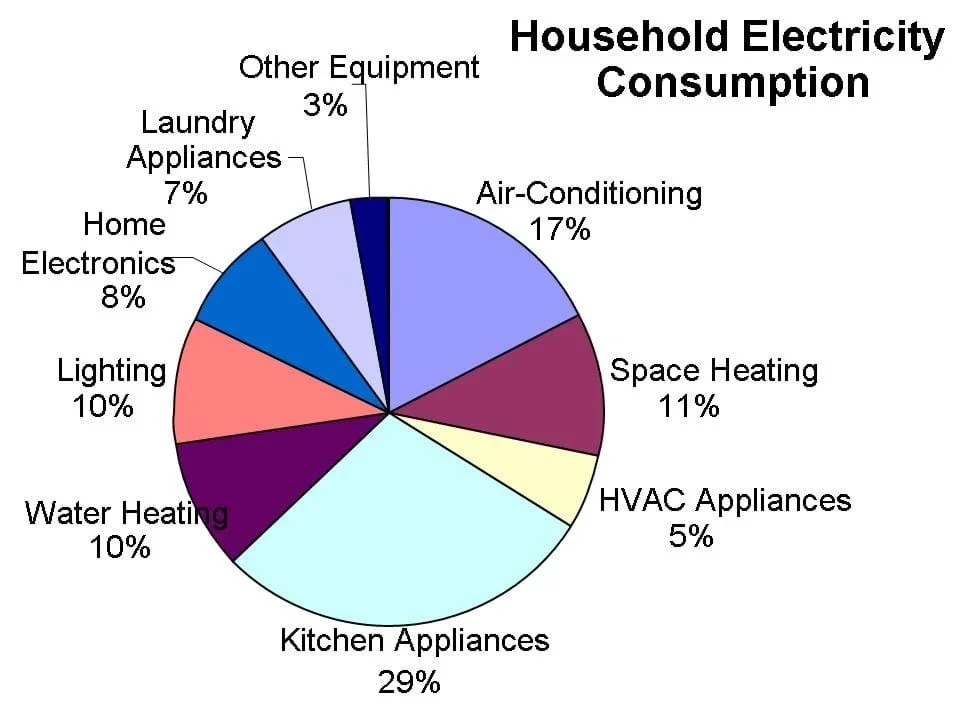 U.S. household electricity consumption.Copyright (data) US Department of Energy's Energy Information Agency
We rely on energy for almost everything we do. Different types of energy resources are used for different end uses – transportation, which is the fastest growing of all the energy consumption sectors in the US, mainly uses petroleum (and in 2007 we imported about 60% of our total petroleum used). Energy is used in our homes for many things, including heating and cooling, cooking, lighting and appliances. Our homes use a lot of electric energy, and most of that is produced by burning fossil fuels (mainly coal). Industries are the third highest energy consumption sector.
Graphs are tools that we use to help us understand, analyze, and present information. In this activity, you will prepare graphs of energy resource consumption or development data.
You will receive a table that contains information about energy consumption or energy resource development. Your task is to create a graph (bar, pie, or line) of your data, so that you can present and describe the information to the rest of the class.
Before the Activity
- Review data and graphs (see attached workbook with solutions) to determine which of the graphs your students should complete.
- Load the MS Excel workbook on to computers for student use and open file. The file is in MS2003 so should be compatible with both 2003 and 2007 versions of MS Excel.
With the Students
1. Review facts compiled during first-day activities regarding how we use energy and how much to convey – we use energy in all aspects of our lives and we use a lot of energy in the USA (Canada too!).
2. Explain goals of today's class – use data from the U.S. Department of Energy – Energy Information Agency (EIA) to graph information about how we use energy and how much we use. Why do you think the country keeps track of its energy production and consumption data?
3. Demonstrate the generation of one of the graphs and what interpretation can be made.
4. Review key components of graphing and/or graphing with Excel to refresh students' memories. Could include axis choices (X vs. Y axis for independent and dependent variables), labeling axes, type of graph appropriate for different types of data, and interpretation needs.
5. Have students work in pairs; each group can create one graph. Each pair should print or project their graph and be able to describe their interpretation to the class.
6. Explore the following discussion questions:
- Which energy use sector is increasing the fastest? What energy resource does this sector primarily use? From where does most of this energy resource come?
- Which type of fuel is used most in the U.S.? Which is used the least?
- Which country consumes the most oil? The least oil?
- Compare how much oil the U.S. consumes with the amount we produce.
- How much oil does the U.S. need per day? How much do we produce? Where does the rest come from?
- What uses the most energy in the average U.S. household? What energy resource does this activity typically use?
- How does energy consumption, by source, compare between New York State and the U.S. average? What are some reasons for the differences?
- Identify the dependent and independent variables in the given data set.
- What portion of our household energy use is provided by electricity? How do the New York numbers compare with average U.S.?
- And what uses most of that electricity? Do you think this is comparable to your household? How can we use this information to save energy?
- Notice the difference between the "primary electric energy" (generated at the utility plant) and the electricity consumed in the household. Why such a big difference?
7. Close with a discussion of what real problems they see in our energy consumption; describe any results they might have found surprising
8. Look forward to the next class and the rest of unit – the goal is to come up with ways we can actually contribute to the solution of the problem.
Data sets included in the MS Excel file:
Group 1. Energy Imports and Exports
Prepare a line graph that shows energy imports and energy exports over time. You may use a different color for each energy source, or you may choose to just plot the total imports and total exports. Be sure to include units! Identify the dependent and independent variables.
Group 2. Energy Production and Energy Consumption
Prepare a line graph that shows energy production and energy consumption in the U.S. over time. You may use a different color for each energy source, or you may choose to just plot the total amounts. (Hint: you may want to plot "total renewables" and then prepare a separate graph showing each renewable, because of the difference in scale.) Be sure to include units! Identify the dependent and independent variables.
Group 3. Energy Consumption by the Different "Energy Sectors"
Prepare a graph that shows the relative energy (total) use by the four major sectors for 2006 (include residential, commercial, industrial, and transportation - the "total" numbers already include their portion of the electric power sector column). You may use a pie or bar graph. Then prepare a line graph that shows the change in energy use over time for the different sectors -- note the differences in the rates that each sector increases. Which is increasing the most? Identify the dependent and independent variables.
Group 4. Residential Energy Consumption, by Source
Prepare a graph that shows the types of fuel that provided energy in the residential sector (household energy use) in 2006. Plot the different fossil fuels and total renewables in a bar graph, and then make a separate plot of the different renewables (all for 2006). What about the electrical energy - where do you think that should fit into your graph? Identify the dependent and independent variables.
Look at the numbers for the electricity retail sales (that is the amount you pay for on your bill) compared to the system losses. About what percentage of the total electricity generated at the utility plant is usable to the consumer?
Group 5. Residential Energy Consumption, by Source and User
Prepare a graph (or a few graphs) to show the amount of energy used by each source in the average household, both in the US and in New York State. Would you use a bar or a PIE chart? Why? Identify the dependent and independent variables.
Look at the numbers for the electricity retail sales (that is the amount you pay for on your bill) compared to the system losses. About what percentage of the electricity generated at the plant do you use in your home? Does this surprise you?
Group 6. Household Energy Consumption, by End-Use
Prepare a graph that shows the ways we use energy in our homes, both in the U.S. and in New York State. Do you think a PIE or a BAR chart would be better? Identify the dependent and independent variables.
Group 7. Household Electricity Consumption, by End-Use
Prepare a graph that shows the ways we use electricity in our homes. Do you think a PIE or a BAR chart would be better? Identify the dependent and independent variables.
Prepare a graph that shows the electricity use by kitchen appliances. What is the biggest electricity user in the kitchen?
Group 8. Energy Consumption by House Type, Size, and Year of Construction (note – you have 2 excel worksheets)
Prepare a graph that shows the relationship between energy use and type of house (a line graph would be best). How does your graph show possible reasons why our energy use in the U.S. is so much higher than other parts of the developed world?
Prepare a graph that shows the relationship between size of house and energy use (a line graph would be best). Identify the dependent and independent variables.
Prepare a graph that shows the relationship between energy use and the year in which the house was built (again, a line graph). Identify the dependent and independent variables.
Compare your graphs. What does the information tell us about the trends in new home construction?
Group 9. Oil Importers and Exporters
Prepare two bar graphs that show the major oil exporters and importers. Where does the U.S. stand on each graph? Identify the dependent and independent variables.
Group 10. Oil Producers and Consumers
Prepare two bar graphs that show the major oil producers and consumers. Where does the U.S. stand on each graph? Identify the dependent and independent variables.
Activity Embedded Assessment:
Work with students as they graph their data to determine if they understand the nature of the data they are graphing and appropriate graphing procedures. Pose questions such as the following:
- What does your data describe?
- What type of plot could be used to best illustrate these data? Why? (X-Y or line graph to show time dependent trends; bar graph to show absolute value and relative magnitude of differences; pie chart [or stacked bar] to show relative contribution on a % basis)
- Which country (use, etc.) consumes (produces) the most? (least?) Why? Do you know anything about that ________ that could explain these data?
- What trends do you see in these data? What do you know about this system that might explain the changes in energy production (consumption) over time?
The final graphs and written answers to discussion questions can also be collected to evaluate comprehension of graphing and data interpretation.
Energy Information Administration/Monthly Energy Review, December 2007; US Department of Energy. Accessed February 2008. http://www.eia.doe.gov
Energy Information Administration, 2001 Residential Energy Consumption and Expenditure Tables. Accessed February 1, 2008. http://www.eia.doe.gov/pub/consumption/residential/2001ce_tables/enduse_consump2001.pdf
Energy Information Administration, Country Energy Profiles, US Department of Energy. Accessed February 1, 2008. http://www.eia.doe.gov/emeu/cabs/topworldtables1_2.html
This activity was originally published by the Clarkson University K-12 Project Based Learning Partnership Program and may be accessed at http://internal.clarkson.edu/highschool/k12/project/energysystems.html.
Contributors
Jan DeWaters; Susan Powers
Supporting Program
Office of Educational Partnerships, Clarkson University, Potsdam, NY
Acknowledgements
This activity was developed under National Science Foundation grant nos. DUE 0428127 and DGE 0338216. However, these contents do not necessarily represent the policies of the National Science Foundation, and you should not assume endorsement by the federal government.
Copyright
2013 by Regents of the University of Colorado; original © 2008 Clarkson University