
Energy Resources and Systems
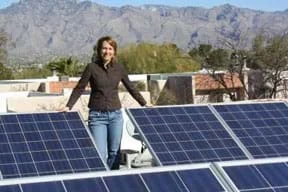 Rooftop photovoltaic panels provide a low-cost, renewable energy source to homes and buildings.Copyright Congresswoman Gabrielle Giffords, House of Representatives, US Congress http://giffords.house.gov/legis/solar-events.shtml
Several activities are included to teach and research the differences between renewable and non-renewable resources and various energy resources. Students work with a quantitative, but simple model of energy resources to show how rapidly finite, non-renewable energy sources can be depleted, compared to the ongoing availability of renewable resources. Then they complete a homework assignment (or a longer, in-depth research project) to learn how various technologies capture energy resources for human uses, and their pros and cons. Fact sheets help them get started on their investigations of assigned energy sources.
Engineers are primarily responsible for the research, development and design of the equipment that captures energy from renewable and fossil fuel resources for human use. Given the eventual decline in the availability of fossil fuel resources, engineers are currently designing technologies for capturing renewable energy resources that are more efficient, reliable and economically competitive.
After this lesson, students should be able to:
- Identify at least five sources of energy.
- Explain why an increased dependence on renewable energy sources is an inevitable part of our future.
- Describe how the depletion of fossil fuels is a serious global issue.
- Graphically represent data and explain the trends.
- Use and explain a mathematical model of a real-life phenomenon.
- Identify and describe the parts of an energy system.
- CCSS.Math.Content.6.EE.C.9 Use variables to represent two quantities in a real-world problem that change in relationship to one another; write an equation to express one quantity, thought of as the dependent variable, in terms of the other quantity, thought of as the independent variable. Analyze the relationship between the dependent and independent variables using graphs and tables, and relate these to the equation.
Grade 6
Do you agree with this alignment? - CCSS.Math.Content.6.RP.A.3c Find a percent of a quantity as a rate per 100 (e.g., 30% of a quantity means 30/100 times the quantity); solve problems involving finding the whole, given a part and the percent.
Grade 6
Do you agree with this alignment? - CCSS.Math.Content.6.SP.B.4 Display numerical data in plots on a number line, including dot plots, histograms, and box plots.
Grade 6
Do you agree with this alignment? - CCSS.Math.Content.8.SP.A.1 Construct and interpret scatter plots for bivariate measurement data to investigate patterns of association between two quantities. Describe patterns such as clustering, outliers, positive or negative association, linear association, and nonlinear association.
Grade 8
Do you agree with this alignment? - CCSS.Math.Practice.MP2 Reason abstractly and quantitatively.
Grades K-12
Do you agree with this alignment?
- Energy is the capacity to do work.
Grades 6-8
Do you agree with this alignment? - STEL-3E Analyze how different technological systems often interact with economic, environmental, and social systems.
Grades 6-8
Do you agree with this alignment?
- recognize and apply mathematics in contexts outside of mathematics
Grades -1-12
Do you agree with this alignment? - select, create, and use appropriate graphical representations of data, including histograms, box plot, and scatterplots
Grades 6-8
Do you agree with this alignment? - use representations to model and interpret physical, social, and mathematical phenomena
Grades -1-12
Do you agree with this alignment? - work flexibly with fractions, decimals, and percents to solve problems
Grades 6-8
Do you agree with this alignment? - develop, analyze, and explain methods for solving problems involving proportions, such as scaling and finding equivalent ratios
Grades 6-8
Do you agree with this alignment? - understand and use ratios and proportions to represent quantitative relationships
Grades 6-8
Do you agree with this alignment?
- Energy is a property of many substances and is associated with heat, light, electricity, mechanical motion, sound, nuclei, and the nature of a chemical. Energy is transferred in many ways.
Grades 5-8
Do you agree with this alignment? - Think critically and logically to make the relationships between evidence and explanations. Thinking critically about evidence includes deciding what evidence should be used and accounting for anomalous data. Specifically, students should be able to review data from a simple experiment, summarize the data, and form a logical argument about the cause-and-effect relationships in the experiment. Students should begin to state some explanations in terms of the relationship between two or more variables.
Grades 5-8
Do you agree with this alignment? - Use mathematics in all aspects of scientific inquiry. Mathematics is essential to asking and answering questions about the natural world. Mathematics can be used to ask questions; to gather, organize, and present data; and to structure convincing explanations.
Grades 5-8
Do you agree with this alignment?
- 6.EE.9 Use variables to represent two quantities in a real-world problem that change in relationship to one another; write an equation to express one quantity, thought of as the dependent variable, in terms of the other quantity, thought of as the independent variable. Analyze the relationship between the dependent and independent variables using graphs and tables, and relate these to the equation.
Grade 6
Do you agree with this alignment? - 6.RP.3.c Find a percent of a quantity as a rate per 100 (e.g., 30% of a quantity means 30/100 times the quantity); solve problems involving finding the whole, given a part and the percent.
Grade 6
Do you agree with this alignment? - 6.SP.4 Display numerical data in plots on a number line, including dot plots, histograms, and box plots.
Grade 6
Do you agree with this alignment? - 8.SP.1 Construct and interpret scatter plots for bivariate measurement data to investigate patterns of association between two quantities. Describe patterns such as clustering, outliers, positive or negative association, linear association, and nonlinear association.
Grade 8
Do you agree with this alignment? - MP.2 Reason abstractly and quantitatively.
Grades -1-12
Do you agree with this alignment?
- MS-ESS3-4 Construct an argument supported by evidence for how increases in human population and per-capita consumption of natural resources impact Earth's systems.
Grades 6-8
Do you agree with this alignment?
- MS-ESS3-4 Construct an argument supported by evidence for how increases in human population and per-capita consumption of natural resources impact Earth's systems.
Grades 6-8
This resource focuses on the following Three Dimensional Learning aspects of NGSS:
Science & Engineering Practices- Use mathematical representations to describe and/or support scientific conclusions and design solutions.Do you agree with this alignment?
- Analyze and interpret data to determine similarities and differences in findings.Do you agree with this alignment?
Disciplinary Core Ideas- Typically as human populations and per-capita consumption of natural resources increase, so do the negative impacts on Earth unless the activities and technologies involved are engineered otherwise.Do you agree with this alignment?
Crosscutting Concepts- All human activity draws on natural resources and has both short and long-term consequences, positive as well as negative, for the health of people and the natural environment.Do you agree with this alignment?
- Graphs and charts can be used to identify patterns in data.Do you agree with this alignment?
Do you agree with this alignment? - Use mathematical representations to describe and/or support scientific conclusions and design solutions.
- Powerpoint File with Energy Source Photos (ppt)
- Energy Sources and Conversion Worksheet (doc; for introduction)
- Energy Sources and Conversion Worksheet (pdf; for introduction)
- Fossil Fuel Graphing Homework (doc)
- Fossil Fuel Graphing Homework (pdf)
- Renew-a-Bead Game Worksheet (doc)
- Renew-a-Bead Game Worksheet (pdf)
- Energy Sources Research Activity Student Worksheet (doc)
- Energy Sources Research Activity Student Worksheet (pdf)
- Optional - Energy Research Homework (doc)
- Energy Research Homework (pdf)
- Energy Source Fact Sheets (doc)
- Energy Source Fact Sheets (pdf)
- Energy Sources Trivia (ppt)
- Energy Systems Diagrams (pdf)
- Energy Systems Resources (doc)
- Energy Systems Resources (pdf)
- Energy Systems Activity Worksheet (doc)
- Energy Systems Activity Worksheet (pdf)
- Energy Sources and Conversions Quiz (doc)
- Energy Sources and Conversions Quiz (pdf)
- Energy Sources and Conversions Quiz Answers (doc)
- Energy Sources and Conversions Quiz Answers (pdf)
Most of our energy is originally derived from the sun.
Environmental impacts differ depending upon the energy source and conversion process.
Energy sources can be classified as renewable, nonrenewable or inexhaustible resources.
- An energy source can be considered renewable if it is replenished within a short period of time.
- Renewable resources include solar, wind (including offshore), hydro (including micro-hydro), geothermal and biomass.
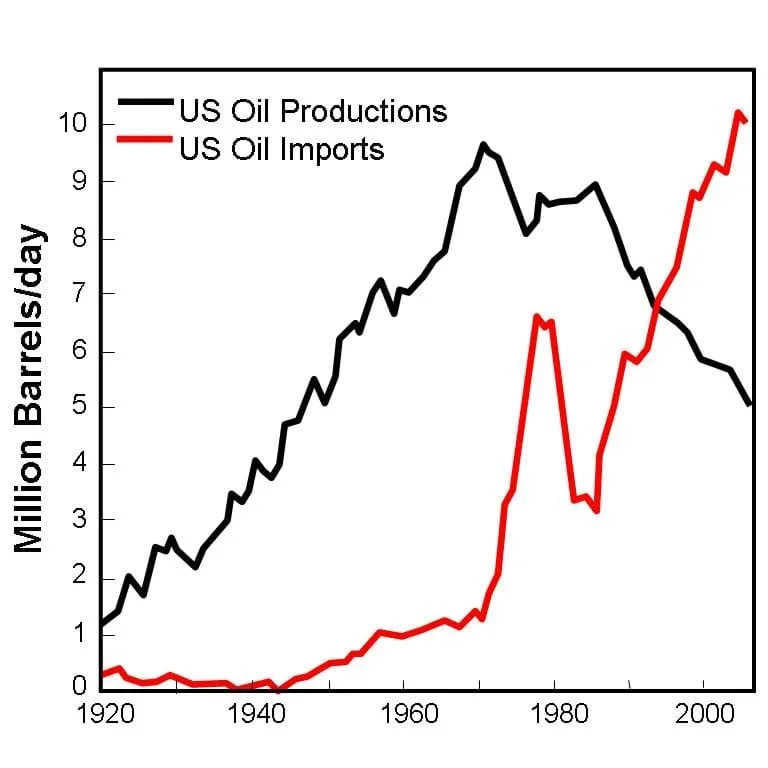 Figure 1. US oil production and imports show the concept of peak oil.Copyright Graph data from US Dept. of Energy EIA
The world's supply of nonrenewable fossil fuel resources is limited. Their combustion can negatively affect our environment. Currently, our society is heavily dependent upon nonrenewable fossil fuel energy resources, and our lives could be negatively impacted if the demand for these resources exceeds the supply. This "peak" in the oil supply occurred in the US in the 1970s (see Figure 1). Our country survived that peak by increasing its imports of oil from other countries. As the entire globe faces the next peak in oil production, we'll have to change to other energy sources (and reduce the amount of oil that we consume).
- For more on how fossil fuels were formed: https://www.kqed.org/quest/64950/how-were-fossil-fuels-formed-part-1-of-5
- For a poster and information on "peak oil": https://www.pinterest.co.uk/pin/438749188670758431/
Different energy sources have different costs.
A system is made up of a sequence of conversions. A basic description of an energy conversion is: Energy from a source provides input to another system component, which converts the form and/or state of energy and provides output to another system component.
In the conversion of energy, a significant fraction of that energy can be "lost" from the system (in the form of heat, sound, vibration, etc.). This energy is not really lost, it is just not converted to the desirable or intended form.
The components of an energy system must work together to transform energy into a form that can be used in our society. Systems can be divided into inputs, processes, outputs and feedback.
(Note: Enough information is provided here for the first day and into the second class period of this lesson.)
(Begin the class with a brainstorm discussion. Students are already familiar with some of these issues.)
- Where does the energy we use come from? Energy comes from an energy source. (Write the heading, Sources, on the board and brainstorm with the class for examples of energy sources.)
- What do we know about these energy sources? (Show pictures provided in the attached PowerPoint file.) Each of these sources has a starting form and is converted into a different form for our convenient use. (Hand out the Sources and Conversion Worksheet for students to use to take notes). Refer to the Energy Systems activity to have students solidify their understanding by reviewing diagrams of energy systems and labeling components.
- Fossil fuels – chemical (petroleum, natural gas, coal)
- Uranium – nuclear
- Biomass – chemical
- Geothermal – heat (generated from nuclear processes within the Earth)
- Hydro – mechanical
- Wind – mechanical
- Solar - electromagnetic
Can we use this energy in its form? For example, can sunlight be directly used to power a radio? No, a solar photovoltaic panel must be used for energy conversion. An energy system is a set of conversion technologies that convert energy resources, such as energy from the sun, into forms that we can utilize for human needs. Have students reasearch an energy question of their own with the Energy Sources Research actvity.
Energy resources are available in our natural world. Solar energy is responsible for almost all of these resources. The sun is responsible for the uneven heating of the Earth that causes wind and sunlight and plant photosynthesis creates biomass materials such as wood or corn that we can convert into useable energy. The exceptions are nuclear and geothermal.
Energy resources that are replenished at the same rate that we use them are defined as renewable energy resources. Solar, wind, geothermal and tidal energy are examples of renewable energy. Biomass can be renewable if we use the plant material at the same rate that it regrows. But, if we chop down and burn all the trees in a short period of time, that resource is not considered renewable. Refer to the Enough Energy? Play the Renew-a-Bead Game to illustrate how non-renewable resources are depleted over time.
Fossil fuels are also a form of solar energy because they were generated from biomass materials millions of years ago. They are not renewable because we are using them at a much faster rate than they are being regenerated.
- biomass energy
- Energy released from plants (wood, corn, etc.) through combustion or other chemical process.
- energy system
- An energy system is made up of a sequence of conversions with inputs and outputs that transform an energy resource into a form usable for human work or heating.
- fossil fuel
- A non-renewable energy resource that began to form millions of years ago from the remains of once living plants and animals. Its current forms include petroleum, coal and natural gas.
- geothermal energy
- Heat energy from the Earth.
- hydropower
- Transformation of the energy stored in a depth of water into electricity.
- non-renewable energy
- Resources, such as fossil fuels, that cannot be replaced by natural processes at the same rate it is consumed.
- peak oil
- The point at which the rate that a non-renewable resource (oil) can be produced declines due to the limitations of extraction processes and the availability of the resource.
- photovoltaic
- A chemical process that releases electrons from a semi-conductor material in the presence of sunlight to generate electricity.
- renewable energy
- Resources, such as wind and water, that can be recycled or replaced at a rate faster than they are consumed.
- solar energy
- Energy from the sun; often captured directly as heat or as electricity through a photovoltaic process.
- system component
- One process in a system comprised of many processes or components.
- uranium
- An element that releases heat as it undergoes radioactive decay.
- wind energy
- Energy transferred with the motion of air in the lower atmosphere that arises from differential heating of the Earth. The energy in the wind can be extracted as mechanical energy to do work such as grind grains (a wind mill) or generate electricity (wind turbine).
Class Discussion: At the beginning of the lesson, lead a class discussion to evaluate what students already know about energy sources. Through this brainstorming session, see at what level the students need concepts reinforced.
Worksheet: Have students complete the questions and hand in the Renew-a-Bead Worksheet. Review their answers to gauge their comprehension of the subject matter.
Homework: The fossil fuel graphing activity reinforces the concept that these are non-renewable resources.
Quiz: At the end of this lesson, administer the quiz, which covers materials in lessons 4 and 5.
Research Project (or Homework): The research project on energy sources requires students to read and synthesize information to understand and answer questions related to a particular energy source
R.E.A.C.T. Renewable Energy Activities – Choices for Tomorrow Teacher's Activity Guide, National Renewable Energy Laboratory Education Programs, Golden, CO. Accessed December 29, 2008. http://www.nrel.gov/docs/gen/fy01/30927.pdf
Energy Information Administration, EIA Kid's Page – Energy Facts. US Department of Energy. Accessed December 29, 2008. http://www.eia.doe.gov/kids/energyfacts/index.html
Biggs, A., Burns, J., Daniel, L.H., Ezralson, C., Feather, R.M., Horton, P.M., McCarthy, T.K., Ortleb, E., Snyder, S.L., Werwa, E. Science Voyages: Exploring Life, Earth and Physical Science, Level Red., Glencoe/McGraw Hill: New York, 2000.
Intermediate Level Science Core Curriculum, Grades 5-8, New York State Education, Department, accessed December 31, 2008. http://www.emsc.nysed.gov/ciai/mst/pub/intersci.pdf
General Teaching Plan:
This is a multi-day lesson that includes an introduction to energy sources, an activity to understand the value of renewable energy resources, and research on specific sources and their conversions.
Day 1: Intro to Sources
- Brainstorm and present PowerPoint photos to introduce this lesson (see introductory materials).
- Assign the Fossil Fuel Graphing Homework.
Day 2: Renewable/Non-renewable resources
- Complete the Renew-a-Bead Activity.
Day 3: Discuss the results of the Renew-a-Bead Activity and Fossil Fuel Graphing Homework.
Day 4: Energy Sources Research Activity
Day 5: Energy Sources Research (continued)
Day 6: Energy Sources Research presentations and summary (+energy sources trivia, if time)
Day 7: Energy Systems Activity
Day 8: Energy Sources, Systems and Conversions Assessment Quiz
This lesson was originally published by the Clarkson University K-12 Project Based Learning Partnership Program and may be accessed at http://internal.clarkson.edu/highschool/k12/project/energysystems.html.
Contributors
Susan Powers; Jan DeWaters; Clarkson and St. Lawrence University Students (K-12 Project Based Learning Partnership Program)
Supporting Program
Office of Educational Partnerships, Clarkson University, Potsdam, NY
Acknowledgements
This lesson was developed under National Science Foundation grants no. DUE 0428127 and DGE 0338216. However, these contents do not necessarily represent the policies of the National Science Foundation, and you should not assume endorsement by the federal government.
Copyright
2013 by Regents of the University of Colorado; original © 2008 Clarkson University