
The Energy Problem
 How do you use energy in your everyday activities?Copyright 2004 Microsoft Corporation, One Microsoft Way, Redmond, WA 98052-6399 USA. All rights reserved.
This six-day lesson provides students with an introduction to the importance of energy in their lives and the need to consider how and why we consume the energy we do. The lesson's associated activities engage students in general energy issues, including playing an award-winning Energy Choices board game, and an optional graphing activity that provides experience with MS Excel graphing and perspectives on how we use energy and how much energy we use.
Devices that engineers design often convert energy into forms that help us do every day activities—from drying our hair to powering the school bus. In the developed world, energy consumption is close to our technological capacity to produce energy useful to consumers. Engineers and all other people must now reconsider how we use energy. We must make and use products that help society, all while consuming less energy.
After this lesson, students should be able to:
- Explain how the depletion of fossil fuels is a serious global issue.
- List three decisions and actions they can make/take to reduce their personal energy consumption.
- Use mathematics in other fields, using graphs, computation and models.
- Much of the energy used in our environment is not used efficiently.
Grades 6-8
Do you agree with this alignment? - STEL-3E Analyze how different technological systems often interact with economic, environmental, and social systems.
Grades 6-8
Do you agree with this alignment?
- Causes of environmental degradation and resource depletion vary from region to region and from country to country.
Grades 5-8
Do you agree with this alignment? - Human activities also can induce hazards through resource acquisition, urban growth, land-use decisions, and waste disposal. Such activities can accelerate many natural changes.
Grades 5-8
Do you agree with this alignment?
- MS-ESS3-4 Construct an argument supported by evidence for how increases in human population and per-capita consumption of natural resources impact Earth's systems.
Grades 6-8
Do you agree with this alignment?
- MS-ESS3-4 Construct an argument supported by evidence for how increases in human population and per-capita consumption of natural resources impact Earth's systems.
Grades 6-8
This resource focuses on the following Three Dimensional Learning aspects of NGSS:
Science & Engineering Practices- Construct an explanation that includes qualitative or quantitative relationships between variables that describe phenomena.Do you agree with this alignment?
Disciplinary Core Ideas- Typically as human populations and per-capita consumption of natural resources increase, so do the negative impacts on Earth unless the activities and technologies involved are engineered otherwise.Do you agree with this alignment?
Crosscutting Concepts- All human activity draws on natural resources and has both short and long-term consequences, positive as well as negative, for the health of people and the natural environment.Do you agree with this alignment?
Do you agree with this alignment? - Construct an explanation that includes qualitative or quantitative relationships between variables that describe phenomena.
People in the US use, on average, six times the energy consumed by the average of all other people in the world. This energy is consumed in three primary ways: buildings (residential and commercial), transportation, and industry (see Figure 1). Each of these sectors is responsible for approximately one-third of the total energy our nation consumes.
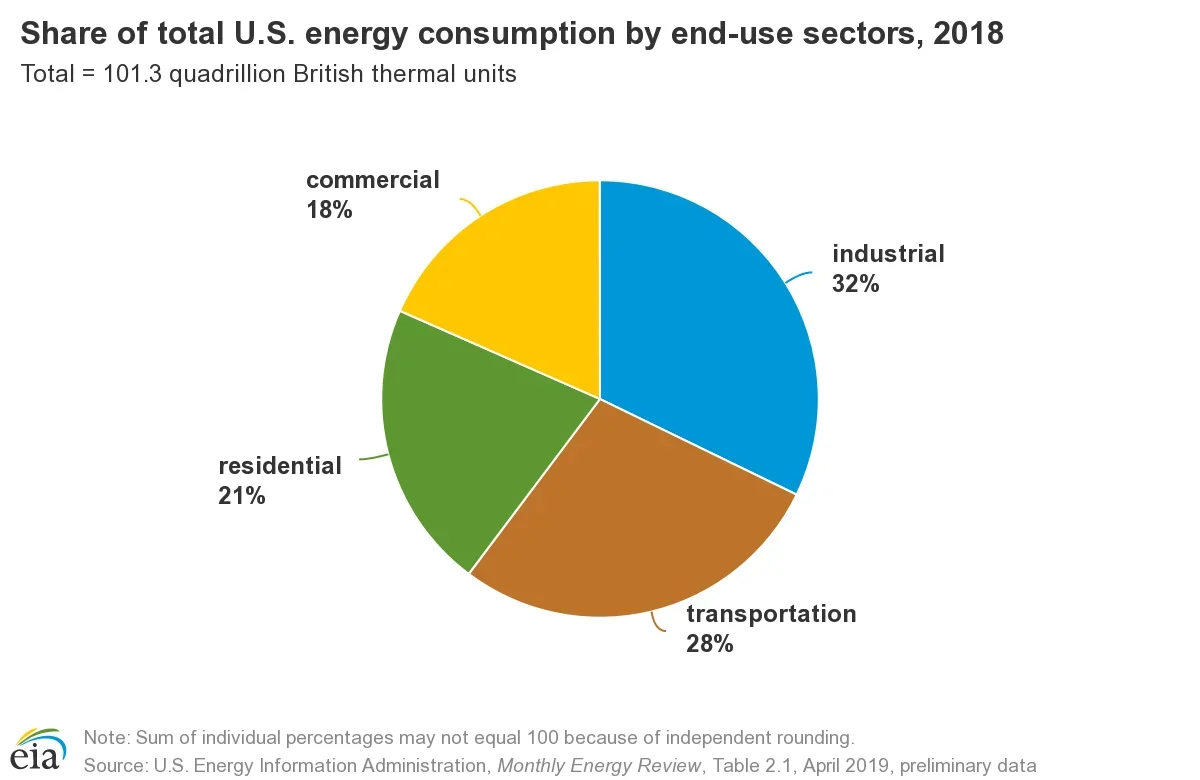 Figure 1. Relative energy use by sector (data from US DOE EIA).Copyright https://www.eia.gov/kids/using-and-saving-energy/homes.php
This national energy consumption includes all the energy we use as individual consumers, and all of the energy required to run businesses and industry. Figure 2 shows how our energy usage has changed from 1993 to 2009. Heating and cooling still contributes the most to household energy consumption. Thus, insulating a house is often the most effective way to reduce household energy consumption.
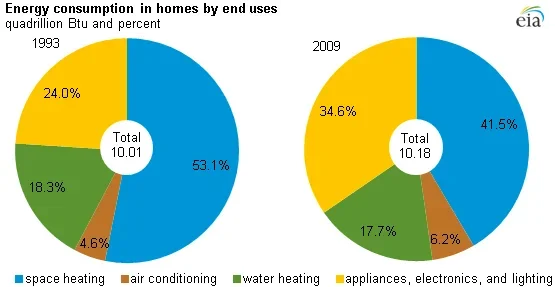 Figure 2. Household energy use in the U.S.Copyright US DOE EIA (data)
https://www.eia.gov/todayinenergy/detail.php?id=10271
Figure 2. Household energy use in the U.S.Copyright US DOE EIA (data)
https://www.eia.gov/todayinenergy/detail.php?id=10271
When we buy items, whether it's food grown on the opposite side of the country, or an automobile, a lot of energy is consumed in the production and manufacturing of these goods. The energy that is consumed in the "upstream" processes, is often called the embodied energy. It is important to consider this energy ,too, not just the energy consumed when using a product. For example, consuming food requires energy for growing the food (producing fertilizer, tractor fuel), transportation (refrigerated trucking), processing, storage, and cooking, among others.
Overall, the key concepts that are most critical for this lesson include:
- Energy is a critical resource that is used in all aspects of our daily lives.
- Currently, society is highly dependent upon nonrenewable energy resources, mainly fossil fuels.
- The world's supply of nonrenewable resources is limited and their use can negatively affect our environment and economy.
- Our personal choices affect the future of the world's energy.
- Making smart energy decisions today are beneficial later.
- Energy is consumed not only when we plug an appliance into an outlet or turn on our cars (direct energy use), but also through the production and transportation of material goods that we purchase and consume every day (indirect energy use).
We currently are highly dependent on fossil fuels for most of our energy supply—this energy is instrumental for maintaining our current society. However, our supply of non-renewable energy sources is being depleted and may even reach a point at which its limited supply adversely affects our lives. The rapid depletion of fossil fuels stems in part from our current energy use habits. For example, the average American uses six times the amount of energy as the global average. Another way to describe this is that we use one million dollars worth of energy every minute in the US.
We can work to continue to use energy as appropriate in our everyday lives, but we need to make changes to conserve energy, use energy more efficiently or provide additional renewable energy resources that are technologically available to consumers. As individuals, we can make changes in our own lives and we can make decisions about our future profession to help solve our growing energy crisis.
(Introducing these statistics and the importance of energy in our lives can be accomplished with one of two engaging activities. It is critical for students to appreciate the importance of energy in their lives early in the unit. Starting the class with questions like "How did you get to school today?" or "What energy did you use this morning to get ready for school?" and "Where did that energy come from?" are good ways to get the students started thinking about energy topics. The associated activities: Energy Intelligence Agency and Energy in Our Lives Carousel, are excellent ways to begin this discussion and further explore facts about energy usage. Students can then further their understanding of types of energy used as well as futher quantify their usage with the fun and engaging associated activities: Energy Choices Game and Energy Perspectives.
Information published by the US DOE on their kids' energy web page is the best place to find information and interesting energy facts for middle school aged students.)
See discussion questions throughout all activity sheets that provide insightful questions to assess if the class as a whole understands the basic concepts.
Lesson Summary Assessment: After game discussion is completed, have students complete a five-minute quiz: "List three energy choices that you would make the next time you played this game (or in your own lives) to reduce the cost and impact of your energy consumption."
Homework: Have students pass in graphs and answers to discussion questions related to the graphing activity.</
Energy Information Administration, EIA Kid's Page – Energy Facts. US DOE, Accessed December 29, 2008. http://www.eia.doe.gov/kids/energyfacts/index.html
This lesson was originally published by the Clarkson University K-12 Project Based Learning Partnership Program and may be accessed at http://internal.clarkson.edu/highschool/k12/project/energysystems.html.
Contributors
Susan Powers; Jan DeWaters; Clarkson and St. Lawrence University Students (K-12 Project Based Learning Partnership Program)
Supporting Program
Office of Educational Partnerships, Clarkson University, Potsdam, NY
Acknowledgements
This lesson was developed under National Science Foundation grants no. DUE 0428127 and DGE 0338216. However, these contents do not necessarily represent the policies of the National Science Foundation, and you should not assume endorsement by the federal government.
Copyright
2013 by Regents of the University of Colorado; original © 2008 Clarkson University