
Model Earth Core Samples: What’s Down There?
How do engineers find oil? Students learn how fossil fuels are formed over time and where under the Earth's crust we find them. Then student teams use six colors of modeling clay to make models of the planet Earth (or teachers prepare in advance). They use clear plastic drinking straws to take core samples as if they are looking for fossil fuels. Will they strike oil? Teams analyze their samples and make informed decisions as to whether or not they should "drill for oil" in a specific location. A student worksheet is provided.
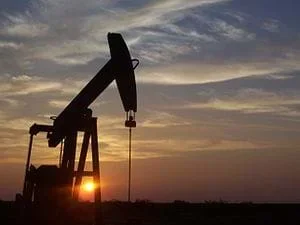 What's down an oil well? What is below the Earth's crust?Copyright Microsoft Corporation 1983-2001
One tool engineers use to find oil is core drilling. Huge drills extract cylinders of rock or sediment from below the Earth's surface. Petroleum engineers use microscopes to study these cores in a laboratory, looking for the presence of fossil fuels. They use their understanding of the composition of the layers of the Earth to analyze the (potential) reservoir rock properties (porosity, permeability, saturations, compressibility, etc.) to make informed decisions about where to drill, and minimize the number of costly wells they must drill to obtain oil.
After this activity, students should be able to:
- Describe the layers under the Earth's surface.
- Understand how fossil fuels are formed and where they come from.
- Understand the important role that engineers have in finding and extracting oil.
- Identify and describe the variety of energy sources
Grade 4
Do you agree with this alignment? - Describe the energy transformation that takes place in electrical circuits where light, heat, sound, and magnetic effects are produced
Grade 4
Do you agree with this alignment? - Investigate and identify two or more ways that Earth's materials can be broken down and/or combined in different ways such as minerals into rocks, rock cycle, formation of soil, and sand
Grade 3
Do you agree with this alignment?
- Energy comes in different forms.
Grades 3-5
Do you agree with this alignment?
- 4-ESS3-1 Obtain and combine information to describe that energy and fuels are derived from natural resources and their uses affect the environment.
Grade 4
This resource focuses on the following Three Dimensional Learning aspects of NGSS:
Science & Engineering Practices- Obtain and combine information from books and other reliable media to explain phenomena.Do you agree with this alignment?
Disciplinary Core Ideas- Energy and fuels that humans use are derived from natural sources, and their use affects the environment in multiple ways. Some resources are renewable over time, and others are not.Do you agree with this alignment?
Crosscutting Concepts- Cause and effect relationships are routinely identified and used to explain change.Do you agree with this alignment?
- Knowledge of relevant scientific concepts and research findings is important in engineering.Do you agree with this alignment?
- Over time, people's needs and wants change, as do their demands for new and improved technologies.Do you agree with this alignment?
Do you agree with this alignment? - Obtain and combine information from books and other reliable media to explain phenomena.
Each group needs:
- 6 different colors of Play-Doh® or modeling clay; such as 3 different colors for 3 different layers of the Earth; light brown for cap rock; black or dark brown to represent oil, dark blue or another color for sides (see Figures 2 and 3)
- 3 clear plastic drinking straws
- scissors (groups may share)
- Core Sample Worksheet (PDF), one per student
What do you know about oil and other fossil fuels? (Listen to some student ideas.) Currently, oil, coal and natural gas provides much of our nation's energy. Although, engineers and geologists are trying to find new ways of harnessing energy, the U.S. still depends greatly on oil and coal to power our cars and generate heat and light. And, oil is used to make the many kinds of plastic materials we depend on every day. These fossil fuels are combusted in large power plants that release pollutants into the air, land and water. Some of these emissions include carbon dioxide (CO2), particulate matter (PM) and heavy metals such as lead (Pb) and mercury (Hg). Furthermore, gasoline (a product made from oil) is combusted in car motors and these emissions also enter the atmosphere (eventually settling onto water or soil or remaining in parts of the atmosphere forever). The extraction of fossil fuels is also disruptive to the natural environment, sometimes fracturing underground rock and contaminating groundwater that may be needed for drinking water. Furthermore, the gases released from drilling are potent greenhouse gases that contribute to the polluting of our planet's atmosphere—affecting the air we breathe as well as the weather and climate around the world.
Oil is only found in sedimentary rocks. Organic matter (from dead marine organisms) was deposited millions of years ago and then trapped under an impermeable layer of hard rock, or sedimentary layers. After many years, and after an increase sedimentary layers resulted in intense pressure and heat, the microorganisms trapped under these layers formed fossil fuels—of which oil is one form. When the layers of rock faulted (or folded) from tectonic plate movement or earthquakes, wells or reservoirs of oil were created (see Figure 1). Engineers tap into these reservoirs to extract oil for all sorts of purposes around the world.
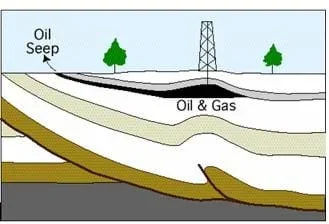 Figure 1. A cut-away diagram shows large oil deposits in pockets where rocks have folded beneath the Earth.Copyright U.S. Geologic Survey http://seeps.wr.usgs.gov
We cannot see oil under the ground, so how do we find it? How do engineers find oil? (Listen to student ideas.) One method used to find oil is core drilling, in which long cylinders of rock or sediment, called cores, are removed from deep below the Earth's surface. Once these cores are brought up to the surface, they are analyzed by engineers and geologists to find the presence of oil. Clearly, the Earth's surface cannot be poked with holes until drillers get lucky and hit oil; so instead, geologists and engineers use their knowledge about the Earth's layers to determine the best, most logical place to drill for oil. Can you name the layers of the Earth? (Answer: Inner core, outer core, mantle, crust.)
In this activity, we will take core samples from a model of the Earth and look for oil, as represented by black or brown clay. Some of you will strike oil and some may not!
Before the Activity
- Gather materials and make copies of the Core Sample Worksheet (PDF), one per student.
- Prepare a layered model of the Earth for each student group. Either have the teacher or aides make them in advance, or have the groups each make a model Earth and put them all into a grocery bag and randomly pass them back out to the teams. Steps to make the Earth models (refer to Figures 2 and 3):
- Take equal, quarter-size balls of each clay color of the clay.
- Flatten each color to represent a single layer of the Earth.
- Stack three of the layers on top of each other.
- For half of the samples insert an "oil" layer (of black or brown clay) somewhere between the layers. (Note: Make sure all samples are the same height.)
- Cap all the samples with light brown clay on top and dark blue clay on the sides (to hide the interior colors) to make the globe.
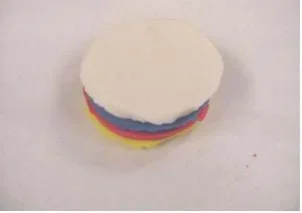 Figure 2. An example layers of the Earth model with the top cap layer, but without clay around the outside.Copyright 2004 Jessica Todd, ITL Program, College of Engineering and Applied Science, University of Colorado Boulder
With the Students
- Conduct the pre-activity assessment and present the Introduction/Motivation content to the class.
- Divide the class into groups of three students each.
- If prepared in advance, hand out a clay Earth model to each group. If not prepared in advance, guide the teams to each prepare a clay model as described in the Before the Activity section. Put all the models in a grocery bag and randomly hand them back to each team.
- Tell the students to imagine that this small model represents the big oil fields of the world such as in Texas or the Middle East.
- As a class, review the layers of the Earth by sketching and labeling the layers of the clay model on the classroom board: inner core, outer core, mantle, crust (see Figure 3).
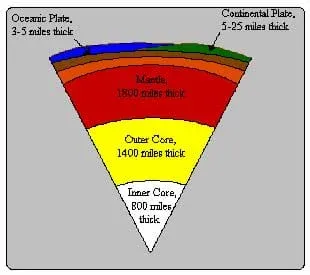 Figure 3. A simple diagram of the layers of the Earth.Copyright http://volcano.und.nodak.edu/vwdocs/vwlessons/lessons/Earths_layers/Earths_layers3.html
- Have students fill out worksheet Part A.
- Next have each group take its three straws (each student manipulates one straw) and plunge them into the model Earth. Next, they carefully remove the straws to reveal three core samples.
- Have students use scissors to carefully cut open the plastic straw. Have them use caution when cutting near the clay plug, so as to not smash the clay layers.
- Remove the clay plug.
- Instruct students to fill out worksheet Part B.
- As a class, go over the worksheet.
- Assign students to individually write a short journal entry from the point of view of an engineer who has just discovered the layers of the Earth at one location through core sampling. Ask students to include their questions, concerns, feelings and any other thoughts about the experience.
Pre-Activity Assessment
Brainstorming: Ask a question and solicit student answers. Remind students that in brainstorming, no idea or suggestion is "silly." All ideas should be respectfully heard. Encourage wild ideas and discourage criticism of ideas. At this point, do not provide the "right answer." Just tell students that they will find out during the activity. Ask:
- How do engineers find oil? Any ideas?
Activity Embedded Assessment
Predictions: Have students predict whether or not they expect to strike oil while taking core samples, recording their predictions on the Core Sample Worksheet (PDF). Later, when going over the worksheets with the class, revisit their predictions.
Worksheet/Pairs Check: Have students work individually on the Core Sample Worksheet (PDF). Then direct students to exchange their worksheets with another group member to check and compare answers.
Post-Activity Assessment
Journaling: To conclude, assign students to individually write a short journal entry from the point of view of an engineer who has just discovered the layers of the Earth at one location through core sampling. Ask students to include their questions, concerns, feelings and any other thoughts about the experience. Review their journal paragraphs to gauge their depth of comprehension.
What should happen: Students obtain a nice core sample with clearly defined layers contained in the straw.
Oops, it did not happen. Why?
- If the layers mixed or smashed together, the clay is too soft. Let the clay dry for a short time after creating the model Earths. But do not let the clay become too dry or the straws will be unable to cut through it.
- After cutting the straw, the core sample got smashed. Since this is a delicate process, it may help to have an adult try it again using a razor blade.
Simulate the creation of fossil fuels in a soda bottle. See details about this the coal formation lesson at http://teachcoal.org/lesson-plan-coal-formation. Simplified instructions:
- Remove the label from a 2-liter plastic soda bottle.
- Add a 2-inch layer of sand or silt on the bottom.
- Add about 4 inches of water.
- Let the sand settle and then add some twigs, leaves and other organic matter on top.
- After two weeks, add a second 2-inch layer of silt or sand to the top.
- Wait another two weeks and then pour out any remaining water.
- Wait another week and observe the fossil fuel you have made.
ACF Lesson Plan: Coal Formation, grade level K-6. American Coal Foundation. Accessed 2004. (Students conduct a simulation of the formation of coal and practice the lab skills of hypothesizing, observing and explaining their findings.) Originally found at http://teachcoal.org/lesson-plan-coal-formation
Educational resources for students and teachers. Office of Fossil Energy, U.S. Department of Energy. Accessed 2004. Originally found at http://www.fe.doe.gov/education/
- Non-renewable Energy: Fossil Fuels
- Harvesting Oil from the Earth
- Model Earth Core Samples: What’s Down There?
- A Closer Look at Oil and Energy Consumption
- Powering the U.S.
- Harvesting Oil from the Earth
Contributors
Jessica Todd; Melissa Straten; Malinda Schaefer Zarske; Janet Yowell
Supporting Program
Integrated Teaching and Learning Program, College of Engineering, University of Colorado Boulder
Acknowledgements
The contents of this digital library curriculum were developed under grants from the Fund for the Improvement of Postsecondary Education (FIPSE), U.S. Department of Education and National Science Foundation (GK-12 grant no. 0338326). However, these contents do not necessarily represent the policies of the Department of Education or National Science Foundation, and you should not assume endorsement by the federal government.
Copyright
2004 by Regents of the University of Colorado