
Powering Smallsburg
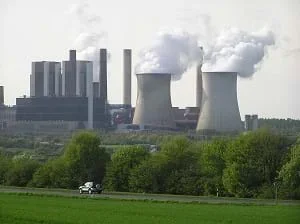 Students take a closer look at power plants.Copyright Wikimedia Commons http://upload.wikimedia.org/wikipedia/commons/e/ee/20060502_Lignite_powerplant_Weisweiler_Rhineland_Germany.jpg
Students act as engineers by specifying the power plants to build for a community. They are given a budget, an expected power demand from the community, and different power plant options with corresponding environmental effects. Guided by a worksheet, teams work through the hypothetical real-world scenario to arrive at recommendations that they present to the class; group "answers" vary widely, depending on their identified city priorities.
Many different types of engineering are needed to bring electric power to communities. This is a technical process—how can you transform a fuel or water or wind or sunlight to electricity—as well a societal process with societal impacts—air quality, land use, water use and security. For these reasons, chemical, mechanical, structural, electrical, environmental and civil engineers all have roles to play in power engineering.
After this activity, students should be able to:
- Define renewable and non-renewable energy.
- List some renewable and non-renewable energy sources.
- Use what they learn about energy sources to act as engineers and decide the best power plants for a (hypothetical) small community.
- Describe the energy transformation that takes place in electrical circuits where light, heat, sound, and magnetic effects are produced
Grade 4
Do you agree with this alignment? - Use multiple resources – including print, electronic, and human – to locate information about different sources of renewable and nonrenewable energy
Grade 4
Do you agree with this alignment?
- CCSS.Math.Content.3.OA.D.8 Solve two-step word problems using the four operations. Represent these problems using equations with a letter standing for the unknown quantity. Assess the reasonableness of answers using mental computation and estimation strategies including rounding.
Grade 3
Do you agree with this alignment?
- Energy comes in different forms.
Grades 3-5
Do you agree with this alignment? - Tools, machines, products, and systems use energy in order to do work.
Grades 3-5
Do you agree with this alignment?
- 3-5-ETS1-2 Generate and compare multiple possible solutions to a problem based on how well each is likely to meet the criteria and constraints of the problem.
Grades 3-5
This resource focuses on the following Three Dimensional Learning aspects of NGSS:
Science & Engineering Practices- Generate and compare multiple solutions to a problem based on how well they meet the criteria and constraints of the design problem.Do you agree with this alignment?
Disciplinary Core Ideas- Research on a problem should be carried out before beginning to design a solution. Testing a solution involves investigating how well it performs under a range of likely conditions.Do you agree with this alignment?
- At whatever stage, communicating with peers about proposed solutions is an important part of the design process, and shared ideas can lead to improved designs.Do you agree with this alignment?
Crosscutting Concepts- Engineers improve existing technologies or develop new ones to increase their benefits, to decrease known risks, and to meet societal demands.Do you agree with this alignment?
Do you agree with this alignment? - Generate and compare multiple solutions to a problem based on how well they meet the criteria and constraints of the design problem.
Each group needs:
- pencils
- Powering Smallsburg Worksheet (PDF), one per student
For the entire class to share:
- Powering Smallsburg Overhead 1 (PDF)
- overhead projector
Reviewing the Powering the U.S. lesson is strongly recommended. Students need to know how to add whole numbers. Some background on electricity is helpful, too.
Why do lights turn on when you flip the light switch? (Answer: You connect the lights to a source of power or electricity when you turn on the switch.) From where does that electricity come? Depending on where you live, many answers could be correct since electricity may be generated in many different ways and from many different sources. Electricity can be generated from water, wind, solar (the sun), nuclear and coal power. An electric power plant is a collection of buildings and structures inside which electricity is made.
An electrical power plant uses either renewable or non-renewable energy sources. A renewable energy source is energy that is replaced at the same rate or faster than it is used. One example is a hydroelectric dam that uses moving water to make electricity. (Though it would not be renewable during a drought and the water level behind the dam dried up!) Photovoltaic (PV) panels convert sunlight (solar) to electricity, which is a renewable energy source for the next billion years or so (or at least until the sun becomes a white dwarf star!). Do you think wind turbines are a renewable or non-renewable energy source? Well, as long as the planet has wind, then wind is a renewable energy source. Both wind and solar energy sources need to be able to be stored in order to work during times when it not windy or sunny. How about a biomass power plant, where trees or other plant materials are burned to make electricity? (Answer: Biomass is renewable because you can plant more trees to replace the ones you use for energy.)
Currently, most electricity in the U.S. (~80%) is generated from non-renewable energy sources, such as natural gas, coal, and nuclear (uranium) and about 18% of the electricity in the U.S. comes from renewable energy sources, such as wind, hydropower and solar. Remember that non-renewable energy resources are used at a much faster rate than they can be created.
Of the non-renewable energy sources, more than 60% comes from fossil fuels—mostly coal and natural gas, and about 20% of the U.S.'s electricity is generated from nuclear energy.
- Coal: The U.S. has some of the largest coal reserves in the world. We could continue providing electricity from our coal for the next 100-200 years, depending on how much our electricity use grows. Does this mean that coal is a renewable or non-renewable energy resource? (Answer: Coal is a non-renewable energy source because the amount of coal in the Earth is also limited.)
- Natural gas: Natural gas is found in the subsurface of the Earth. Most of the "proven" (i.e., areas that geological and engineering data demonstrate to be recoverable under existing economic and operating conditions) are found in Russia, although the U.S. has its own proven resources. Of these natural gas reserves, we have approximately 50 years of gas left (at current consumption levels and excluding unproven reserves). Natural gas is a limited resource.
- Nuclear: Nuclear power plants provide electricity using uranium. Estimates for how many years remain in the world's uranium reserves range from less than 100 years to several hundred years. On Earth, the amount of uranium is limited, which is why we consider it a non-renewable energy source.
In order to figure out which type of energy is best to power a community, engineers learn about the different types of energy sources. Renewable energy sources have many benefits but the technology to use them tends to be more expensive right now. Non-renewable energy sources, like nuclear and coal, are not as expensive, yet they typically pollute the environment and affect people's health. Today, we are going to act like engineers and help the new community of Smallsburg decide on which type or energy source is best for them.
Before the Activity
- Make copies of the Powering Smallsburg Worksheet (PDF) (one per student) and the Powering Smallsburg Overhead 1 (PDF)(to show the class). Make an additional copy of the worksheet for yourself as a reference.
- Set up the overhead projector (or other projection device).
With the Students
- Hand out the worksheets and organize the class into pairs.
- Have students write the name of their engineers in the first box on the worksheet.
- Next, place the overhead up for students to see. Discuss this overhead with the students. Tell them that when selecting a power plant to make electricity, several things need to be considered besides whether the energy source is renewable or non-renewable.
- Tell students that the decision for what type of power plant to use is often made by community leaders and power engineers. Discuss what they think is most important, providing inexpensive power that puts out emissions (pollution) that affect the environment and people's health but allows the community to buy other improvements, or focusing on the development of clean energy at the expense of other improvements? Perhaps the best choice is a mixture of the two. Let the students know that when they do the worksheet, s/he will decide.
- Next, use the following discussions (steps 6-8) to go through the worksheet with your students. (For older students, you can have them try the worksheet on their own first.)
- Have students write their answers to Question 1 on their worksheets.
- Next, tell students: Power plants are sized by the amount of electricity that they are expected to cover. For example, a mall may require 20 MW (MW means mega-watts, which is a measure of electrical power) for all the lights, air conditioning, cash registers, escalators and etc., inside. So, the power plant that services the community must have at least a 20 MW capacity to service the mall. The same community may have a school needing 1 MW, a sports stadium uses 10 MW, a hospital 15 MW, and a few offices need 4 MW. Therefore, the power plant, or a combination of power plants, needs to provide a total of how many MW of power to the whole community? Answer: 50 MW, the sum of all the community needs.
- Read the explanation provided and have the students answer worksheet Questions 2-6.
- Next, tell students: The community of Smallsburg has $250 million to spend. They need to provide power to the community, but they have other uses for that money as well, such as providing social services, making road improvements, making clean water, and building public parks. Can you think of other things a community might spend its money on? Your worksheet provides you with some power plant options and how much they cost.
- Have students think about what they would do with their leftover money and then answer worksheet Question 7.
- Lead a short class discussion. What combination of power plants do you advise the community leaders and the power engineers pick for Smallsburg?
- If time permits, have student draw pictures of their community, including the power plants, the buildings, the community improvements, and the environment.
Pre-Activity Assessment
Discussion Question: Solicit, integrate and summarize student responses. Ask students to name different sources of energy that we can use for electricity in our homes and schools.
Activity Embedded Assessment
Activity Worksheet: Have students complete the Powering Smallsburg Worksheet (PDF); review their answers to gauge their mastery of the subject.
Post-Activity Assessment
Student Presentation: Have student teams present their power plant choices for Smallsburg and explain the logic of why they chose the power plants that they did in the activity. Ideally, expect a range of community designs, some focusing on reducing emissions and using renewable energies, while others focused on spending less on power production so as to be able to spend on development but with increased pollutant emissions.
Activity Discussion: Review and discuss the hypothetical engineering and community activity with the entire class. Ask students to think about what changes they would make as the power engineer for the city if they had less money to spend. How about more money? Student answers reveal their mastery of the subject and concepts.
If any students have difficulty, have them work with other students.
Have students research a particular type of power plant. Specifically, research the type(s) of plant(s) in their region that fuels their homes and schools.
Have students develop of list of renewable and non-renewable energy sources. Then, have them research in order to rank the list in order of most to least expensive. What are some requirements for each type of energy source to work?
For upper grades, have students complete the worksheet on their own. Then, have students defend their choices in a journal entry or class discussion.
For lower grades, go through the worksheet scenario as a class. Also, consider simplifying the problem by reducing the number of power plant options.
Canine, Craig. Natural Resources Defense Council, onearth, Fall 2005, "How to Clean Coal." Accessed January 8, 2007. Formerly found at http://www.nrdc.org/onearth/05fal/coal1.asp. Text can be found here: http://www.precaution.org/lib/nrdc_how_to_clean_coal.051101.htm. Accessed on October 30, 2020.
U.S. Department of Energy, Energy Information Administration, Energy Kids' Page. Accessed October 30, 2020. http://www.eia.doe.gov/kids/
U.S. Department of Energy, Fossil Energy, Clean Coal & Natural Gas Power Systems, "Clean Coal Technology & the President's Clean Coal Power Initiative." Last updated October 25, 2006. Accessed January 9, 2007. Originally found at http://www.fossil.energy.gov/programs/powersystems/cleancoal/
U.S. Department of Energy, Fossil Energy, Clean Coal & Natural Gas Power Systems, "FutureGen - Tomorrow's Pollution-Free Power Plant." Last updated December 14, 2006. Accessed January 8, 2007. Originally found at http://www.fossil.energy.gov/programs/powersystems/futuregen/
Wikimedia Foundation, Inc. Wikipedia – The Free Encyclopedia, "Coal." Accessed October 30, 2020. http://en.wikipedia.org/wiki/Coal
Contributors
Frank Burkholder; Malinda Schaefer Zarske; Janet Yowell
Supporting Program
Integrated Teaching and Learning Program, College of Engineering, University of Colorado Boulder
Acknowledgements
The contents of this digital library curriculum were developed under grants from the Fund for the Improvement of Postsecondary Education (FIPSE), U.S. Department of Education and National Science Foundation (GK-12 grant no. 0338326). However, these contents do not necessarily represent the policies of the Department of Education or National Science Foundation, and you should not assume endorsement by the federal government.
Copyright
2006 by Regents of the University of Colorado