
Glaciers, Water and Wind, Oh My!
Through this hands-on activity, students explore five different forms of erosion: chemical, water, wind, glacier and temperature. They rotate through stations and model each type of erosion on rocks, soils and minerals. They record their observations and discuss the effects of erosion on the Earth's landscape. Students learn about how engineers are involved in the protection of landscapes and structures from erosion. Math problems are included to help students think about the effects of erosion in real-world scenarios.
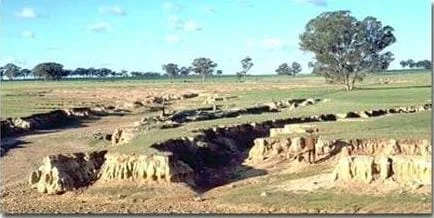 An example of gully erosion.Copyright Department of Primary Industries, Victoria State Government, Australia http://www.dpi.vic.gov.au/
Civil engineers carefully study the surrounding environment and soil types in order to safely build any sort of structure. Buildings, roads and bridges require solid foundations and, if possible, an area not prone to erosion (such as a flood plain). Engineers choose materials that resist the type of erosion that a particular area is exposed to, such as waterproof materials or materials not affected by acid rain. Environmental engineers plant trees and other vegetation in order to help prevent wind and water erosion; plants and their roots stabilize the soil and make it less exposed to erosion. Vegetation can also help to neutralize acid rain. Engineers also design roads, bridges and sidewalks in a way that permits them to expand and contract with temperature changes to minimize any cracking, for example, sidewalk grooves and bridge expansion joints.
After this activity, students should be able to:
- List several different types of erosion.
- Compare and contrast the effects of various types of erosion.
- Discuss how engineers work to prevent erosion.
- 4.1.3.b Use the four operations with whole numbers to solve problems.
Grade 4
Do you agree with this alignment? - 5.1.3 Formulate, represent, and use algorithms to add and subtract fractions with flexibility, accuracy, and efficiency
Grade 5
Do you agree with this alignment?
- Analyze and interpret data identifying ways Earth's surface is constantly changing through a variety of processes and forces such as plate tectonics, erosion, deposition, solar influences, climate, and human activity
Grade 5
Do you agree with this alignment? - Develop and communicate an evidence based scientific explanation around one or more factors that change Earth's surface
Grade 5
Do you agree with this alignment?
- CCSS.Math.Content.4.OA.A.3 Solve multistep word problems posed with whole numbers and having whole-number answers using the four operations, including problems in which remainders must be interpreted. Represent these problems using equations with a letter standing for the unknown quantity. Assess the reasonableness of answers using mental computation and estimation strategies including rounding.
Grade 4
Do you agree with this alignment? - CCSS.Math.Content.5.NBT.B.5 Fluently multiply multi-digit whole numbers using the standard algorithm.
Grade 5
Do you agree with this alignment? - CCSS.Math.Content.5.NF.B.7 Apply and extend previous understandings of division to divide unit fractions by whole numbers and whole numbers by unit fractions.
Grade 5
Do you agree with this alignment?
- Modern communities are usually planned according to guidelines.
Grades 3-5
Do you agree with this alignment? - Structures need to be maintained.
Grades 3-5
Do you agree with this alignment?
- 4-ESS2-1 Make observations and/or measurements to provide evidence of the effects of weathering or the rate of erosion by water, ice, wind, or vegetation.
Grade 4
This resource focuses on the following Three Dimensional Learning aspects of NGSS:
Science & Engineering Practices- Make observations and/or measurements to produce data to serve as the basis for evidence for an explanation of a phenomenon.Do you agree with this alignment?
Disciplinary Core Ideas- Rainfall helps to shape the land and affects the types of living things found in a region. Water, ice, wind, living organisms, and gravity break rocks, soils, and sediments into smaller particles and move them around.Do you agree with this alignment?
- Living things affect the physical characteristics of their regions.Do you agree with this alignment?
Crosscutting Concepts- Cause and effect relationships are routinely identified, tested, and used to explain change.Do you agree with this alignment?
Do you agree with this alignment? - Make observations and/or measurements to produce data to serve as the basis for evidence for an explanation of a phenomenon.
To share with the entire class:
Chemical Erosion Station
- glass tray or Petri dish
- rock samples that contain calcite mineral (calcium carbonate), such as limestone, marble, certain cements/mortars
- other rock samples, such as brick, granite, most gravels
- weak acid, such as lemon juice or vinegar
- eyedropper
- magnifying glass
- paper towels
Water Erosion Station
- large container, such as a deep plastic bin at least 18 x 9 inches (46 x 23 cm)
- moist soil
- 12 coins or poker chips
- paper towels
- watering can that has several holes in the spout
- water
- ruler
Wind Erosion Station
- sand
- small-size motorized fan, handheld is preferred
- large bin or box with no top
Glacier Erosion Station
- ice cubes, enough for one per group
- modeling clay; NOT Play-Doh®
- tray
- sand
- paper towels
Temperature Erosion Station
- heat source, such as a burner or hot plate
- 3 glass beakers
- ice
- water
- plastic tongs
- goggles
- marbles, one per group
Each group needs:
- Erosion Worksheet (PDF), one per student
- Erosion Math Worksheet (PDF), one per student
The teacher needs:
- stopwatch, clock or wristwatch, to time 7-8 minute rotation intervals
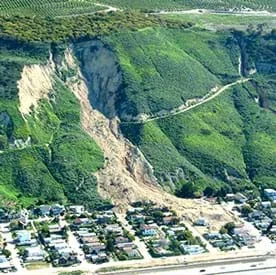 A landslide caused by water erosion.Copyright U.S. Department of the Interior, U.S. Geological Survey http://landslides.usgs.gov/
What is erosion? Have you heard that word before? Erosion is the process of wearing away the surface of the Earth in different ways. Erosion can happen from wind, water, ice, temperature and even chemicals found in nature. Erosion is all around us. You have probably seen some type of erosion without even realizing it. Have you noticed bits of sand and dirt being carried away by water after a rainfall? How about the side of a building or a statue that has become smooth or worn down as it ages? How about a crack in the sidewalk or road that was not there before? Or a sidewalk crack that you noticed getting larger by the week? All of these changes can happen from erosion. Wind and water can carry away dirt, sand and soil from one area, rub it against an object (similar to the effects of sandpaper) that it moves over, and deposit it somewhere entirely different. Temperature changes can cause some materials to contract (shrink) and expand, which causes them to crack over time. Acid rain from pollution causes chemicals in the air to slowly break down buildings, trees and statues. Even ice in the form of huge glaciers can drag away piece of land as they move downhill with the force of gravity.
Erosion is constantly shaping the Earth's surface. Our Earth looks different than it did 100 years ago and will look even more different 100 years in the future. Erosion has built mountains and carved out deep valleys. All this erosion takes a toll on human-made structures as well. Significant landmarks, like the Sphinx in Egypt or pyramids in South America, can be destroyed if not protected from erosional forces. Damage caused by erosion can cost a lot of money to repair. Large-scale erosion is often dangerous to people when it results in landslides and flooding.
Engineers study erosion so that they can protect the environment, structures, landmarks and people's lives. Engineers design and build structures such as houses, buildings and roads for people to live and work in and, of course, on which to drive their vehicles. They intentionally develop designs that help to protect people from landslides and flooding, like levees and barriers. Engineers are also involved in protecting existing land formations and landmarks that people want to keep around, such as ancient pyramids and national monuments.
Today, we are going to look at five types of weathering. We are going to learn about the effects of each type on our surroundings on Earth. Then, we will be one step closer to working out problems like engineers, who need to know about erosion for so many things!
Before the Activity
- Gather materials and make copies of the Erosion Worksheet (PDF) and Erosion Math Worksheet (PDF).
- Since some of the stations can be messy, consider conducting the entire activity outside to make for easier cleanup.
- Set up five stations and disperse the materials to each.
- For the chemical erosion station, make sure to label the rock samples.
- For the water erosion station, make sure to place soil in the container.
- For the wind erosion station, make sure to set up a pile of sand in the large box, or outside, and place the fan far enough away from the sand so that it does not blow it all over the place. The purpose of the fan is to move a layer of sand from the center to the another side of the box, gradually moving the entire "sand dune."
- For the temperature station, decide if you want to conduct it as a demonstration or arrange for an adult helper.
With the Students
Station 1: Chemical Erosion Station
- Place one of the rocks in the glass tray.
- Use the eyedropper to slowly add drops of lemon juice/vinegar to the rock.
- Use the magnifying glass to observe the rock.
- Record your observations on the worksheet. Did the rock bubble when you placed the weak acid on it?
- Discuss with your partners why you think such a reaction occurred.
- Remove the rock, dry it off, and set it off to the side with the rest of the rocks.
- Pour into the sink any liquid in the glass tray.
- Repeat steps 1-7 with all the remaining rocks.
Station 2: Water Erosion Station
- In a large container, form a mountain of soil that is about 3 inches across (wide) at the top and about 5 or 6 inches tall.
- Press the coins/chips into the surface of the dirt/clay. Place them at different angles with an edge protruding out; leave about half the coin showing.
- Use the watering can to create a rainstorm by pouring water on the "mountain."
- Record your observations. Are the coins sticking out more or less? What does the bottom of the mountain look like?
- Remove the coins and place them onto a paper towel to dry.
- Drain the water into a sink.
Station 3: Wind Erosion Station
- Form a pile of sand in the center of the box that is approximately 5 or 6 inches tall.
- Turn on the fan so it blows air lightly over the sand from one end of the box to the other.
- Record your observations. Did the pile of sand move?
Station 4: Glacier Erosion Station
- Take some clay from the container—about a ball that is ~1-2 inches in diameter.
- Flatten the clay onto the surface on the tray.
- Press an ice cube against the flattened clay and move it back and forth several times.
- Record your observations. Does anything happen to the clay when you rub the ice cube on it?
- Place a small pile of sand on the clay and then place the ice cube on top of the sand for 1-2 minutes.
- Pick up the ice cube and observe the surface of the cube that was touching the sand and record your observations. What does the bottom of the ice cube look like?
- Place the same side of the ice cube on the sandy part of the clay and move it back and forth several times.
- Remove the ice cube and wipe away the sand from the surface of the clay.
- Record your observations. What does the texture of the surface of the clay feel like?
- Place the clay back where it came from and throw away the remaining ice and sand.
Station 5: Temperature Erosion Station (conduct as a demo or with an adult helper)
- PUT ON SAFETY GOGGLES!!
- Use the tongs to place a marble into a beaker.
- Turn the burner on about ¾ of the way.
- Leave the marble in the beaker for 5 minutes.
- While you are waiting, make sure you have enough water in one beaker and ice in the other beaker.
- After 5 minutes, turn off the burner.
- Use the tongs to place the marble briefly into the water and then into the beaker of ice.
- Look at the marble and record your observations.
- Take off your safety goggles.
- acid rain
- Rain containing acids that form in the atmosphere when industrial gas emissions (especially sulfur dioxide and nitrogen oxides) combine with water.
- deposition
- The act or process by which an agent of erosion, such as wind or water, lays down matter (sediment).
- erosion
- The wearing away of the surface of the Earth by natural processes (weathering, dissolution, abrasion, corrosion, etc.).
- geology
- The scientific study of the origin, history and structure of the Earth.
- glacier
- A huge mass of ice slowly flowing over a land mass, formed from compacted snow in an area where snow accumulation exceeds melting.
- limestone
- A type of sedimentary rock consisting of the mineral calcium carbonate.
- sediment
- Material that settles to the bottom of a liquid.
- weathering
- Gradual physical and chemical wearing away of rocks.
Pre-Activity Assessment
Discussion Questions: Solicit, integrate and summarize student responses.
- What is erosion?
- What is an example of erosion that you have seen in nature?
Activity Embedded Assessment
Worksheet: As students work through the five stations, have them record their observations on the Erosion Worksheet (PDF). Review their answers to gauge their mastery of the subject.
Post-Activity Assessment
Math Word Problems: Hand out the Erosion Math Worksheet (PDF)and direct students to calculate the effect of erosion in each of the five scenarios. Discuss how engineers might need to solve similar problems when working to protect the environment, structures, landmarks and people's lives.
Define It! Drawing: Have students draw pictures of each of the five types of erosion that were discussed and write their own definitions of erosion (and its effects) at the bottom of the page. Review their answers to gauge the depth of their comprehension of the topic.
- Use eye protection (goggles or safety glasses) whle conducting the experiment at the Temperature Erosion Station.
- If students are not accustomed to using hot plates/burners, have an adult supervise the Temperature Erosion Station—or conduct this station as a class demonstration.
Consider conducting the Acid Rain Effects activity to look at how chemical erosion can affect living and non-living things.
Have students become "erosion detectives" and develop a list of things in their area (school, home, park) that show evidence of erosion at work.
Have students design a way to show the effects of multiple types of erosion on one piece of land (or pile of soil). Does adding more types of erosion (wind AND water) to the land increase the landscape changes? Next, have the students imagine and then sketch designs for how they might protect their land (or pile of soil) from the various types of erosion, which is what engineers are asked to do.
For upper grades, have students complete the Erosion Math Worksheet (PDF) when they finish the stations.
For lower grades, conduct all the stations as class demonstrations with student volunteers to help at each. Then discuss student observations as class.
Cavers, Curtis. "Soil Management on Potato Land." March 2006. Crops, Food and Rural Initiatives, Manitoba Agriculture. Accessed November 9, 2020. https://www.gov.mb.ca/agriculture/crops/crop-management/potatoes-soil-management-on-potato-land.html.
"Acid Rain." Unit 5: The Wonderful Solvent: Water, Articles, Science (S1-3), Science Education Section, Education and Manpower Bureau, Government of the Hong Kong Special Administrative Region of the People's Republic of China. Accessed July 25, 2006. Originally found at http://resources.ed.gov.hk/~s1sci/R_S1Science /sp/en/syllabus/unit5/article-ar.htm
"Erosional Landforms." May 3, 2005. Natural Hazards, National Geophysical Data Center, NOAA Satellite and Information Services. Accessed August 1, 2006. Originally found at http://www.ngdc.noaa.gov/seg/hazard/slideset/24/24_slides.shtml
Erosion. Natural Resource Conservation Service, U.S. Department of Agriculture. Accessed August 1, 2006. Originally found at http://www.mo.nrcs.usda.gov/news/MOphotogallery/erosion.html
Erosion. Natural Resource Conservation Service, U.S. Department of Agriculture. Accessed August 1, 2006. Oringially found at http://www.ctenvirothon.org/studyguides/soil_docs/wind_water_erosion_pics.pdf
"USGS Landslide Hazards." November 28, 2005. Landslide Hazards Program, U.S. Geological Survey, U.S. Department of the Interior. Accessed November 9, 2020. http://landslides.usgs.gov/
"Does This Material React with Acid?" July 3, 2001. Activity 9, Activities to Explore Acid Rain and Building Stones, U.S. Geological Survey, U.S. Department of the Interior. Accessed August 1, 2006. Originally found at http://geology.er.usgs.gov/eastern/acid9.html
Contributors
Teresa Ellis; Malinda Schaefer Zarske; Janet Yowell
Supporting Program
Integrated Teaching and Learning Program, College of Engineering, University of Colorado Boulder
Acknowledgements
The contents of this digital library curriculum were developed under grants from the Fund for the Improvement of Postsecondary Education (FIPSE), U.S. Department of Education and National Science Foundation (GK-12 grant no. 0338326). However, these contents do not necessarily represent the policies of the Department of Education or National Science Foundation, and you should not assume endorsement by the federal government.
Copyright
2006 by Regents of the University of Colorado