
An Inflated Impression of Mars
Students use scaling from real-world data to obtain an idea of the immense size of Mars in relation to the Earth and the Moon, as well as the distances between them. Students calculate dimensions of the scaled versions of the planets, and then use balloons to represent their relative sizes and locations.
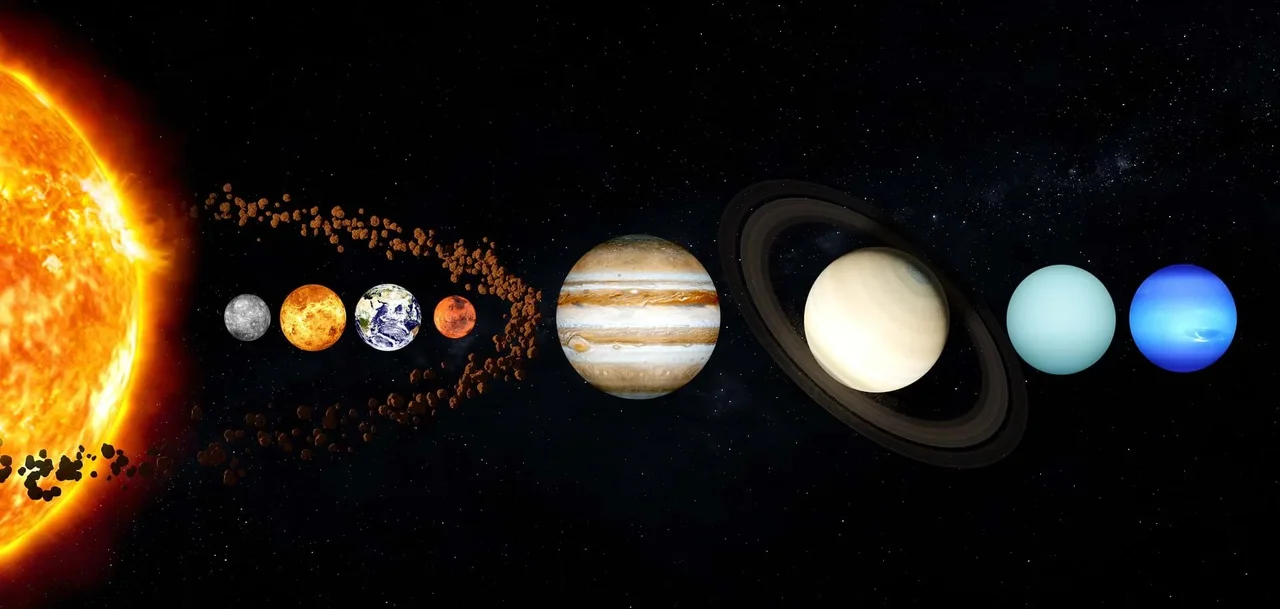 Students model the distance between Earth and MarsCopyright Image by Daniel Roberts from Pixabay
https://pixabay.com/photos/space-universe-solar-system-4641363/
Accessed August 5, 2020
Students model the distance between Earth and MarsCopyright Image by Daniel Roberts from Pixabay
https://pixabay.com/photos/space-universe-solar-system-4641363/
Accessed August 5, 2020
Scaling is frequently used by engineers to resize large (or small) objects, such as factories, dams, or airplanes (or microscopic surgery tools), into manageable sizes for purposes of design and testing. By scaling down (or up) an object, engineers can more easily experiment with how the parts interact and how the finished product will function and look. Engineers also make scaled prototypes to test the design of the product.
After this activity, students should:
- Describe how engineers and scientists use scaling and models to investigate problems.
- Use data and apply scales to grasp the sizes of the Earth, Mars and the Moon.
- Compute an appropriate scaling ratio from real-world data.
- Use a model of Earth, Mars and the Moon to explain why scaling is useful when we want to know about objects that are too big or too small to see.
- 6.1.1.c.viii Use ratio reasoning to convert measurement units.
Grade 6
Do you agree with this alignment? - 6.1.2.b Fluently add, subtract, multiply, and divide multidigit decimals using standard algorithms for each operation.
Grade 6
Do you agree with this alignment? - 7.1.2 Formulate, represent, and use algorithms with rational numbers flexibly, accurately, and efficiently.
Grade 7
Do you agree with this alignment? - 6.1.2.a Fluently divide multi-digit numbers using standard algorithms.
Grade 6
Do you agree with this alignment? - 7.4.1.a.i Solve problems involving scale drawings of geometric figures, including computing actual lengths and areas from a scale drawing and reproducing a scale drawing at a different scale.
Grade 7
Do you agree with this alignment?
- Construct a scale model of the solar system, and use it to explain the motion of objects in the system such a planets, Sun, Moons, asteroids, comets, and dwarf planets
Grade 8
Do you agree with this alignment?
- CCSS.Math.Content.6.NS.B.2 Fluently divide multi-digit numbers using the standard algorithm.
Grade 6
Do you agree with this alignment? - CCSS.Math.Content.6.NS.B.3 Fluently add, subtract, multiply, and divide multi-digit decimals using the standard algorithm for each operation.
Grade 6
Do you agree with this alignment? - CCSS.Math.Content.6.RP.A.3d Use ratio reasoning to convert measurement units; manipulate and transform units appropriately when multiplying or dividing quantities.
Grade 6
Do you agree with this alignment? - CCSS.Math.Content.7.G.A.1 Solve problems involving scale drawings of geometric figures, including computing actual lengths and areas from a scale drawing and reproducing a scale drawing at a different scale.
Grade 7
Do you agree with this alignment?
- STEL-3G Explain how knowledge gained from other content areas affects the development of technological products and systems.
Grades 6-8
Do you agree with this alignment?
- MS-ESS1-3 Analyze and interpret data to determine scale properties of objects in the solar system.
Grades 6-8
This resource focuses on the following Three Dimensional Learning aspects of NGSS:
Science & Engineering Practices- Analyze and interpret data to determine similarities and differences in findings.Do you agree with this alignment?
Disciplinary Core Ideas- The solar system consists of the sun and a collection of objects, including planets, their moons, and asteroids that are held in orbit around the sun by its gravitational pull on them.Do you agree with this alignment?
Crosscutting Concepts- Time, space, and energy phenomena can be observed at various scales using models to study systems that are too large or too small.Do you agree with this alignment?
- Engineering advances have led to important discoveries in virtually every field of science, and scientific discoveries have led to the development of entire industries and engineered systems.Do you agree with this alignment?
Do you agree with this alignment? - Analyze and interpret data to determine similarities and differences in findings.
Each group should have:
- 3 balloons: 1 red, 1 white and 1 blue (approximately 2.5" in diameter when deflated)
- 1 meter or yard stick (groups may share)
- 1 12" ruler
- 1 calculator
- Three copies of the Planet Facts Worksheet (PDF) (one per student)
How far do you think the Moon is from the Earth? (Answer: About 387,000 km or 240,000 miles.) What does this distance mean to us? Let's think of a landmark outside the classroom that is about a kilometer (about 0.6 miles) away. (As a class, agree on a few known locations that are about a kilometer away.) Now — can you imagine a distance of 387,000 kilometers? This is nearly an incomprehensible number!
No task that we deal with during a typical day is on the same scale as 387,000 kilometers. We can understand one kilometer because it is easy to see and can be traveled in a short amount of time. Even 10 kilometers or 100 kilometers is still easy to grasp since we frequently travel these distances or see objects that far away. But, as we try to imagine 1,000, 10,000 or 100,000 kilometers, it becomes difficult to comprehend the magnitude of these distances.
If you thought the distance to the Moon was far, guess how far the distance is from Earth to Mars. When Earth and Mars are at their closest, they are 78,000,000 kilometers apart. When they are at their farthest, they are about 377,000,000 kilometers apart. These are even more difficult numbers to comprehend!
One way that engineers put distances and sizes into a manageable perspective is to use scaling. Scaling is the act of shrinking or expanding distances or objects so that we can examine them at a comprehensible size. A good example of scaling is a map. You might say that a map is the world around us reduced to the size of a piece of paper (of a manageable size) so that we can better identify with our location. Would it be a good idea to have a map that is the actual size of a city? Or a state? Or a country? Obviously, this is not practical since the map would be enormous and so it would not really benefit us. We use scaled drawings of the world so they can fit in our hands or on our desks, allowing us to see a large area of land that we cannot typically see. Engineers use scaled models of what they are building so they can see what their finished project is going to look like and how everything is going to fit together — without building the actual project. Scaled models are often used to test for other factors. For example, scaled models of cars, planes and structures are often placed in wind tunnels to see how they respond to air flowing over and around them. The advantage of testing a model is that it is easier and less expensive to design and create a new model, as opposed to rebuilding full-size products. Once engineers find a model that works, they scale up the model to the actual size of the product.
So how do we know how much a model is scaled up or down? All scaled models have a scaling ratio; for example, 1:5. This means that for every one unit of length on the model, five units of length exist in the real object. Furthermore, any unit of length can be inserted, and the scaling factor still holds true (for example, meters, centimeters, inches, feet, miles, etc.). If a model car has a scaling ratio of 1:5, then each inch on the model car represents five inches on the actual car. If the actual car is 10 feet long, what is the length the model car should be? (Answer: Using the ratio, for every five feet on the actual car, there is one foot on the model car; therefore, if the actual car is 10 feet long, the model car should be two feet long.)
Objects can be scaled up as well. For instance, let's assume we want to study an ant. We could look through a magnifying glass to see an enlarged image of an ant, or we could make a scaled model of an ant that is bigger than the actual ant. In this case, we could use a scaling ratio of 10:1. This ratio tells us that for every 10 units of length on the model, one unit of length exists on the actual object. Basically, we have made a model that is 10 times larger than the actual object.
(Optional: A good way to demonstrate scaling ratios to the class is to show them a map, since most maps have a scaling ratio printed on them. For example 1:40,000 means that every inch on the map represents 40,000 inches in the real world.)
If we revisit the question of the distance between the Earth and the Moon and the Earth and Mars, we can use a scaled model to get an idea of the size of the celestial bodies as well as the distances between them. In our activity today, we will use balloons as scaled models to represent the Earth, Moon and Mars.
Before the Activity
- Gather materials.
- Make copies of the Planet Facts Worksheet (PDF), one per student.
With the Students
- Distribute balloons so each team of three gets one blue (Earth), one white (Moon) and one red (Mars) balloon.
- Distribute Planet Facts Worksheet (PDF), one per student. (Please note: the following numbered steps do not match the numbers on the handout and answer key.) Have the students use the data in the fact sheet table to apply scaling in the following steps. Discuss astronomical units (AU) with the students and how scientists developed this unit and why. Discuss why this data is useful to us and how we will analyze this data to complete the rest of our activity.
- Have students follow the worksheet. Get them started by telling students that the Earth balloon will have a diameter of 20 cm (approximately 7¾"). Have them figure out the scale (divide the Earth's actual diameter by 20 cm. Earth is about 63,800,000 times larger than 20 cm, this is a ratio of 1:63,800,000). They should tie off their balloon when the appropriate size is reached.
- Ask students to follow the worksheet, and calculate the size that the Moon and Mars should be to make a scale equal to that of their Earth model. (Using a scale of 1:63,800,000, or dividing the diameter of the object by 63,800,000, the Moon should be about 5 cm, Mars about 11 cm).
- Ask the student with the white and red balloon to inflate their Moon and Mars models.
- Have students demonstrate how far apart they think the Earth and the Moon are by holding their balloons in the air. Have them use scaling to estimate the actual distance between the balloons (Earth, Moon).
- Now have the students calculate the actual distance between the Earth and the Moon at the same scale they used to size them. Dividing the distance (384,000,000) by 63,800,000, they should discover that the balloons should actually be about 600 cm or 6 meters apart.)
- Point out to students that they now have a scaled model of the Earth-Moon system. The distance between the two is the distance traversed by the Apollo astronauts who went to the Moon in the 1960s and 70s.
- Compare the size of the Mars model with the Earth and Moon models. Look at the distance between the Earth and the Moon. Note similarities and differences between the three solar system objects. Discuss how creating the model helped students better compare these three components of the solar system.
- Ask students how far away they think Mars will be at this scale. Have students attempt to demonstrate it in the classroom.
- Have students calculate the distance from the Earth to Mars at this scale. The answer is about 122,300 cm, which in more familiar terms is ¾ of a mile! Have students identify a local landmark that is about ¾ of a mile away (1.2 km).
- Discuss the relative distance between Earth and Mars in the context of a human trip. How long did it take for Apollo astronauts to get to the Moon? (Answer: Three days.) How long would it take for astronauts using similar technology to get to Mars? (Answer: A really long time, but not as long as you might think. While a simple calculation using the distances indicated results in a time closer to a year and a half, due to planetary rotation and a variety of other factors, the time is actually significantly less than this. The Mars Pathfinder, which launched in December 1996, arrived at Mars on July 4, 1997, seven months later! Mars Global Surveyor, which launched in November 1996, arrived at Mars in September 1997, 11 months later!). [Additional information/reasoning: The speed travelled by the Mars Pathfinder relative to the Earth began at 23,000 mph. Its speed relative to the Sun (and the one that should be used to calculate time to arrival), however, began at 75,000 mph and eventually decreased to 47,640 mph. The actual distance travelled by the Pathfinder was around 312 million miles or 500 million kilometers even though the distance between the two planets when it landed was only 120 million miles or 200 million kilometers (somewhere in between the minimum and maximum values). The difference in actual miles travelled was due to the fact the Pathfinder was "catching up" to Mars during its journey. These two facts combined to impact the actual time it took to arrive.]
- Students can repeat the activity calculations for other planets listed in the table using the respective data. If additional balloons are available they can attempt to make some of the other scaled model planets (although some may be too large).
- model
- (noun) A representation of something, usually on a smaller scale.
- scaling
- The act of shrinking or expanding distances or objects so that we can examine them at a comprehensible size.
Pre-Activity Assessment
Voting: Ask a true/false question and have students vote by holding thumbs up for true and thumbs down for false. Count the votes, and write the totals on the board. Give the right answer.
- Is the Earth closer or further from the Sun than Mars? (Answer: Closer. The Earth is approximately 149,600,000 kilometers from the Sun, while Mars is about 227,900,000 kilometers from the Sun.)
Activity Embedded Assessment
Discussion Question: Solicit, integrate and summarize student responses.
- Were you surprised by how close or how far apart the Moon and Earth and Mars and Earth models were apart? Did you expect them to be closer or further apart? How did the scale model help you understand this? Was it more useful than seeing the numbers on paper?
Post-Activity Assessment
Question/Answer: Ask the students and discuss as a class:
- What does the scaling ratio 1:63,800,000 mean? (Answer: For every one unit of length on the scale model there are 63,800,000 units of length in the real world
- How long does it take a spaceship to get from Earth to the Moon? (Answer: 3 days)
- How long does it take a spaceship to get from Earth to Mars? (Answer: About 7 months)
Discussion Question: Solicit, integrate and summarize student responses.
- Why are scales a convenient tool for engineers as well as for us in our everyday lives? (Answers: They allow us to see things that are too small or too big to see normally; we can understand how objects are related, such as the size and distance between planets; and engineers use scale models to test and analyze their designs so they don't have to build a bunch of real sized models.)
Students should be careful when tying off balloons. If they let go of them, they will fly around the room, possibly hitting other students.
Students should not put the balloons in their mouths.
Remind students to be cautious when measuring the size of their inflated balloons as the sharp edges on rulers could puncture the balloons.
Hand out the balloons after explaining the first steps so that the students stay focused and are not distracted by the balloons.
Solar System in a Classroom – With the previous scaling factor, the Mars balloon was ¾ of a mile from the Earth balloon. If we wanted to fit the models in the classroom, what would the scaling factor need to be? Have the students calculate a scaling factor so that both planets fit into the classroom. (To do this, have the students divide the distance between the Earth and Mars by the length of the classroom. When the Earth and Mars are at their very closest, they are about 78,340,000 km apart. Let's say the classroom is 10 meters long. This gives us a scaling ratio of 1:7,834,000,000.) Now have the students calculate how large the planets would be if they were scaled down to fit in the classroom. (Using the above example, Earth would be one millimeter in diameter.) You can have the students calculate how big they would be at this scale (approximately 20 millionths of a millimeter). They can also calculate how big the Sun is at this scale. The diameter of the Sun is 1,390,000 km. You can also have them calculate the sizes of other planets and how far apart they are. Instead of the classroom, you could even have the students fit Earth and Mars into the school yard. This way the Earth will be larger than a millimeter, by how much? You'll have to find out.
- For younger students, provide the scaling ratio and have them calculate the sizes and distances on their own.
- For older students, have them figure out scales that can be used to compare the Sun and Mars or the Sun and Earth.
Mars Activities: Teacher Resources and Classroom Activities. Last updated March 22, 2006. Mars Education Program, Jet Propulsion Laboratory, Arizona State University. Accessed October 5, 2008. http://marsprogram.jpl.nasa.gov/classroom/pdfs/MSIP-MarsActivities.pdf
Mars Pathfinder FAQs, Pre-Launch, Launch and Cruise. Updated 11 February 1997. Mars Pathfinder, Mars Program, JPL, NASA. Accessed July 30, 2009. http://marsprogram.jpl.nasa.gov/MPF/mpf/faqs_launch.html
Contributors
Geoffrey Hill; Daria Kotys-Schwartz; Chris Yakacki; Malinda Schaefer Zarske; Janet Yowell
Supporting Program
Integrated Teaching and Learning Program, College of Engineering, University of Colorado Boulder
Acknowledgements
The contents of this digital library curriculum were developed under a grant from the Fund for the Improvement of Postsecondary Education (FIPSE), U.S. Department of Education, and National Science Foundation GK-12 grant no 0338326. However, these contents do not necessarily represent the policies of the Department of Education or National Science Foundation, and you should not assume endorsement by the federal government.
Copyright
2004 by Regents of the University of Colorado.