
The Amazing Red Planet
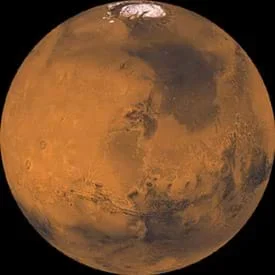 Figure 1. Mars, the Red Planet.Copyright U.S. Geological Survey www.nwrc.usgs.gov/world/ content/others2.html
Students are introduced to the planet Mars. They begin by discussing the location and size of Mars relative to Earth, as well many interesting facts about this "red planet" such as its size relative to other planets in the solar system. Next, the history of Martian exploration is reviewed and students discover why researchers are so interested in studying this mysterious planet. The lesson is accompanied by the associated activity to have students gain a better understanding of Mars' positioning through scaling techniques. The lesson concludes with students learning about future plans to visit Mars.
Engineers have played various roles in the long history of exploring the red planet. One of the earliest, Galileo, provided us with a closer view of Mars by his invention of the telescope. In the 1950-60s, engineers developed rockets and probes that provided the first, up-close visuals of the planet. Engineers also designed and fabricated surface exploration equipment. Engineers continue to work with scientists to develop reliable orbiters, rovers, aircraft and human transport for future missions.
After this lesson, students should be able to:
- Discuss the environment on Mars.
- Give examples of how technology has allowed us to study Mars.
- Explain the challenges in exploring Mars.
- Give examples of how technology is changed as new knowledge of Mars is acquired.
- Describe methods and equipment used to explore the solar system and beyond
Grade 8
Do you agree with this alignment?
- STEL-1J Develop innovative products and systems that solve problems and extend capabilities based on individual or collective needs and wants.
Grades 6-8
Do you agree with this alignment? - STEL-6D Engage in a research and development process to simulate how inventions and innovations have evolved through systematic tests and refinements.
Grades 6-8
Do you agree with this alignment?
- MS-ESS1-3 Analyze and interpret data to determine scale properties of objects in the solar system.
Grades 6-8
This resource focuses on the following Three Dimensional Learning aspects of NGSS:
Science & Engineering Practices- Analyze and interpret data to determine similarities and differences in findings.Do you agree with this alignment?
Disciplinary Core Ideas- The solar system consists of the sun and a collection of objects, including planets, their moons, and asteroids that are held in orbit around the sun by its gravitational pull on them.Do you agree with this alignment?
Crosscutting Concepts- Time, space, and energy phenomena can be observed at various scales using models to study systems that are too large or too small.Do you agree with this alignment?
- Engineering advances have led to important discoveries in virtually every field of science, and scientific discoveries have led to the development of entire industries and engineered systems.Do you agree with this alignment?
Do you agree with this alignment? - Analyze and interpret data to determine similarities and differences in findings.
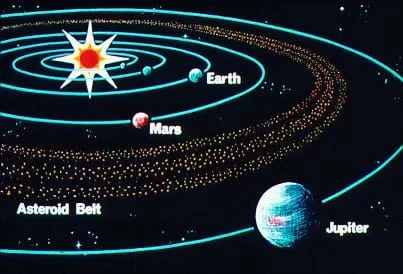 Figure 2. The position of Mars in the solar system.Copyright http://www-curator.jsc.nasa.gov/
(Optional: Teachers may want to hand out the following background information to students to read individually or in groups. The information is adapted from http://www.astroverde.org/observing_mars.htm.)
Facts about Mars
Mars is the fourth planet from the Sun. It orbits around the Sun between the Earth and the asteroid belt (see Figure 2). It is about one and a half times as far from the Sun as the Earth. Mars is a little more than half the size of Earth, and has two small moons, which are basically asteroids captured in its gravitational pull. Refer to An Inflated Impression of Mars activity to have students explore the proportions and spatial relation of the planet to the rest of the solar system. The atmosphere is very thin, having about 1/180 the atmospheric pressure of the Earth. It is chiefly composed of carbon dioxide (95.3%), nitrogen (2.7%), and argon (1.6%).
Mars has a reddish-orange color caused by the iron-rich minerals in its soil (see Figure 1). A fine-grained reddish dust blankets the planet and can be lifted into the atmosphere when blown by the wind. Martian dust storms range from small dust devils to an occasional spectacular event that shrouds the entire planet for months! The surface includes many intriguing features such as volcanoes and canyons. The highest point on the planet is Olympus Mons, a huge shield volcano about 26 km (16 miles) high and 600 km (370 mi) across—about the same size as the state of Arizona. How does Olympus Mons compare to Mt. Everest? (Listen to student guesses or estimates about its size compared to Everest. Mt. Everest is 20,029 feet tall. Ask students to convert feet into miles. Olympus Mons is about three times as tall as Everest.) The canyon system of Valles Marineris is the largest and deepest known in the solar system. It extends more than 4,000 km (2,500 miles) and reaches depths of 5 to 10 km (3 to 6 miles) below the surface. Another feature on the planet are polar caps composed primarily of frozen carbon dioxide and ice that grow and shrink with the changing seasons.
History of Martian Observation and Exploration
Humans have been observing Mars since ancient times. Around 400 BC, the Babylonians started studying astronomy and named named the planet Nergal, which means king of conflict. Later, the name Mars came from the Roman god of war.
People knew that the planets were not the same as the stars since they traveled differently across the night sky. However, no one could explain their unique motion. The problem stemmed from the early belief that we lived in a geocentric universe. This means we thought the Earth was located at the center of the universe. In 1543, Nicolaus Copernicus wrote a book that stated that the Sun was at the center of our solar system (heliocentric). As scientists realized that the Sun was at the center and the planets revolved around it, they began to learn more about Mars. In 1576, the Danish astronomer Tycho Brahe—using only his naked eyes and a few crude instruments—calculated that Mars is ~ 200,000,000 kilometers from the sun. Much to the advancement of technology, Galileo invented the telescope in the early 1600s, which became crucial to further discoveries about the Red Planet. Another important discovery was made by Johannes Kepler in 1609. He discovered that all of the planets orbited around the Sun in ellipses as opposed to perfect circles—knowledge that Sir Isaac Newton used half a century later in explaining the physics of planetary motion. Later in the 17th century, Christiaan Huygens and Giovanni Cassini calculate that a Martian day is around 24 hours and 40 minutes long. Many of the mysteries surrounding Mars were uncovered throughout the 18th and 19th centuries. Giancomo Miraldi discovered that Mars has polar ice caps in 1704, and in 1809, Honore Flaugergues observed yellow clouds on the surface of Mars. In 1877, Giovanni Schiaparelli discovered that Mars has two moons, which he named Phobos and Deimos after the horses of the Greek war god Ares.
Fun Fact: The yellow clouds that Honore Flaugergues observed turned out to be dust storms.
Eventually, not much more could be learned about Mars from telescopes on Earth. With the engineering development of large rockets in the 1950s and 1960s, it became possible to send probes to Mars to explore the planet up close. From 1960 to the present day, the U.S. and Russia have sent many Mars exploration missions. The first successful mission to Mars was the Mariner 4 spacecraft, which was launched by the U.S. in November 1964. Seven and a half months later, the craft did a flyby of Mars, taking pictures of the surface and measurements of the magnetic field, atmosphere, and radiation. Mariner 6 and 7 flew past Mars in 1969 taking even more, detailed pictures of the planet's surface. While all previous missions had just flown past Mars, the Mariner 9 mission, in 1971, became the first spacecraft to ever orbit a planet other than Earth. Mariner 9 was the last of the Mariner series. Mariner missions 1, 2, 3, 5 and 8 were not mentioned because they all failed for one reason or another; some did not get off the ground successfully, while another failed en route, and another failed once it reached Mars).
The next spacecraft to reach the Red Planet—and the first to successfully land on the surface of Mars—were the Viking spacecraft launched in 1975. Both Viking 1 and Viking 2 were comprised of an orbiter and a lander. The purpose of orbiters is to gather high resolution images of the surface and perform further studies of Mars from space. The purpose of the landers is to study the soil and atmosphere of Mars and search for signs of life. The Viking missions were very successful and taught scientists a lot about the surface of Mars.
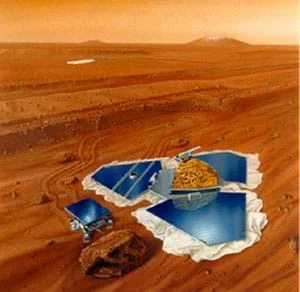 Figure 3. The 1997 Pathfinder mission with the Sojourner Rover.Copyright NASA http://nssdc.gsfc.nasa.gov/planetary/mesur.html
After the Viking missions, it wasn't until 1997 that another American spacecraft successfully reached Mars. That year, the Mars Global Surveyor and the Mars Pathfinder reached the Red Planet. The Mars Global Surveyor photographed the Martian surface as well as measured the gravity and the magnetic field of the planet. The Mars Pathfinder was another successful mission. The Mars Pathfinder mission consisted of a lander and a small robotic rover, called Sojourner, whose purpose is to investigate the structure of the Martian atmosphere, weather and geology. Pathfinder landed on the surface of Mars, and the Sojourner rover left the lander and drove around the Martian surface. The rover took samples of rocks and tested them for signs of water and life. Figure 3 shows the Pathfinder lander with its three triangular solar panels and the small Sojourner rover.
In early 2004, two rovers landed on the surface of Mars. They were named Opportunity and Spirit. These rovers will be discussed in more detail in Lesson 2 of the Mission to Mars unit. NASA's Dawn and MarCO both had successful Mars flyovers in 2009 and 2018, respectively. Also NASA's Curiosity Rover landed in 2012 and the Insight Lander landed in 2018.
Inspite all these successful missions, there have been even more failures. Many vehicles lose contact with Earth, crash into Mars, or even miss Mars altogether. Much is learned from failed missions. Engineers are constantly trying to find better and more reliable ways to explore Mars. While getting to Mars successfully is very difficult, the challenge is partly what makes getting there so exciting.
What Is So Great About Mars?
So why do we care so much about Mars anyway? What makes it worth spending millions of dollars to send spacecraft there? Well, the most intriguing aspect of Mars is that of all the other planets in our solar system, besides Earth, it is the one most likely to have life on it or to have supported life at one time. Despite the fact that humans cannot live on Mars since the atmosphere is too thin and does not contain oxygen, Mars very well could have water on it, which is an important component to supporting life. Some meteorites found on Earth came from Mars and contain potential signs of very basic life. While fanciful stories abound about little green men on Mars, most scientists believe that if life is present on Mars, it exists at a very simple level such as single celled organisms and bacteria.
Other than Earth, Mars is also the most hospitable planet to humans. Mercury is so close to the Sun that the radiation and heat make it a very hostile environment. While Venus is the closest planet to Earth, it has a thick atmosphere of sulfuric acid that is poisonous and creates a very hot and high pressure atmosphere. Jupiter, Saturn, Uranus and Neptune are all gas giants, which means no solid surface exists to stand on or the surface is under incredible atmospheric pressure. This leaves Mars as the best candidate for exploration. It is relatively close and has a fairly friendly environment with the potential for life.
Aside from the prospect of life, an understanding about the origin of our solar system can be gained by visiting Mars. The scientific information taken from Mars can be compared to Earth in order to make conclusions about the solar system. Mars has changed a lot over time. Evidence suggests that Mars was once warmer—with volcanoes and possibly rivers. What happened to make Mars the cold desert it is today? If we can answer this question about Mars, we can predict what might be in store for the future of Earth. Clearly, many mysteries about Mars have not yet been solved.
One of the most basic reasons for visiting Mars is just for the sake of exploring. Humans are naturally curious, and a distant planet represents one of the most intriguing explorations. Mars is very different from Earth, and we have so much to learn about it. The challenge and excitement of exploring other planets—coupled with the potential for new information and how it relates to Earth and the rest of the solar system—makes Mars a very tempting place to visit.
What Does the Future Hold?
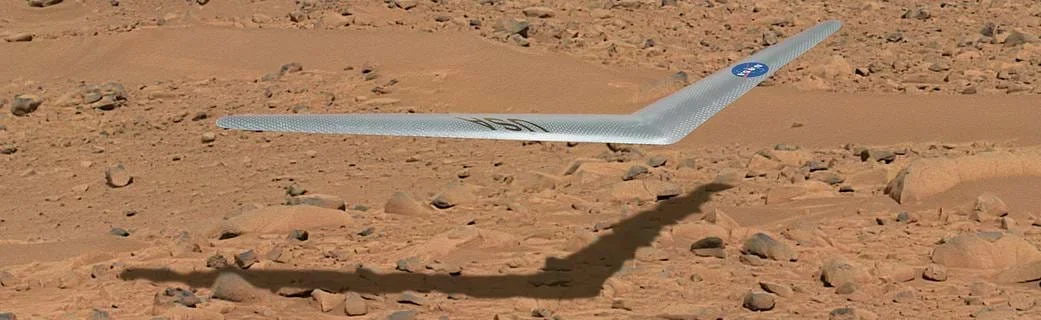 What a future plane over Mars could look like according to NASA.Copyright Dennis Calaba, NASA Illustration
https://www.nasa.gov/centers/armstrong/features/mars_airplane.html
Accessed August 5, 2020
What a future plane over Mars could look like according to NASA.Copyright Dennis Calaba, NASA Illustration
https://www.nasa.gov/centers/armstrong/features/mars_airplane.html
Accessed August 5, 2020
The Mars Reconnaissance Orbiter, which launched in 2005, has taken many high-resolution pictures of the Martian surface. These images have been used to determine the best landing points for future landers. The Mars Reconnaissance Orbiter is also equipped with a sounding device that can locate water under the surface of the planet. So far, data gathered by the Orbiter suggests that some of the surface features of Mars, such as gullies, may have been created by the seasonal freezing of carbon dioxide gas into dry ice instead of from liquid water freezing. Other recent Mars missions have included the Mars Science Laboratory that launched in 2011 and was designed to look for signs of past or present microbial life and the MAVEN mission that launched in 2013 to study Mars' outer atmosphere and how it interacts with the Sun and solar wind. The future of Martian exploration is very exciting. The ExoMars program, led by the European Space Agency, continues to study whether life has ever been present on Mars, while the NASA InSight (Interior Exploration using Seismic Investigations, Geodesy and Heat Transport) Discovery Program mission, scheduled to launched and landed in 2018, studies the deep interior of Mars, including its seismology. In July of 2020 there were 5 launches to Mars: the Emirates Mars Mission orbiter from the United Arab Emirates, the Tianwen-1 orbiter and Tianwen-1 lander/rover from China, the Perseverance rover and Ingenuity helicopter from NASA/USA. Talk about advances in technology!18th century explorers probably never would have imagined such sophisticated engineering feats. Some plans include sending airplanes or airships to Mars that can explore the atmosphere. This is a difficult and thrilling engineering challenge since the thin Mars air requires the aircraft to be designed to cope with these conditions. Figure 4 is an artist's rendition of what such an airplane might look like.
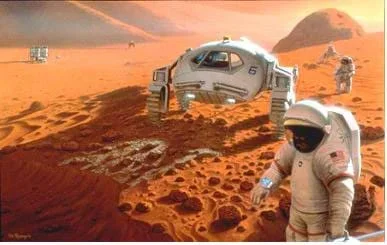 Figure 5. A vision of future human exploration of Mars.Copyright NASA http://marsprogram.jpl.nasa.gov
Beyond 2018 are plans to send a vehicle that can pick up samples of the Martian surface and bring them back to Earth to be analyzed. The most exciting and ambitious mission involves taking humans to Mars, which is incredibly difficult since it takes six months just to get there! Once there, people will have to land safely, find a place to live and work, and then strategize a way to get back to Earth. One of the most difficult challenges is having enough food, water and oxygen for a multi-year mission. Currently, mock Martian habitats on Earth simulate living on Mars, but scientists and engineers are continuously researching ways to keep people alive in the harsh Martian environment for extended periods of time. This involves recycling water and oxygen and growing food on the planet in special greenhouses. In order to put humans on Mars, many engineering challenges must be overcome; but, as technology improves, it is only a matter of time before we send human missions and make permanent residence on Mars (see Figure 5).
Mars is a fascinating place. What do you know about this mysterious planet? What movies, cartoons or television shows have you seen about Mars? How was it portrayed? Were aliens involved? (Listen to some student responses.)
Many people have imagined Mars with little green men who are sometimes friendly and sometimes hostile. Do you think Martians really exist? (Answer: Probably not.) Researchers have been observing Mars for a long time and have not found any conclusive evidence of a civilized society on Mars. That does not mean, however, that life never existed on Mars or that no life exists on Mars now—it means we still do not know for sure.
While humans cannot survive on Mars without special suits and habitats, that is not to say that other forms of life could not. The most likely form of life on Mars is bacteria. We have found signs of water on Mars, which is one of the most important building blocks for life. While tales of little green men are captivating, the real story behind Mars and its secrets is just as interesting.
In today's lesson, we will explore what has been learned about Mars, how we are currently exploring Mars, and how engineers and scientists are working to unlock the mysteries of the red planet.
In this lesson, we learned why Mars is such an interesting place. It is a relatively close planet that is rather hospitable to rovers and humans. All sorts of exciting discoveries about Mars are waiting to be made. We know that Mars has incredible features such as the amazingly long and deep canyon, Valles Marineris, and the huge volcano, Olympus Mons. We know it is possible that life exists or existed on Mars. Over the years, engineers have come up with all sorts of ways to explore Mars, from telescopes to complex rovers. In the future, engineers are challenged to develop methods for getting rock samples to Earth from Mars, getting an aircraft to fly in the Martian atmosphere, and getting humans there and back.
- astronomy
- The study of the universe outside of the planet Earth, including planets and stars.
- geocentric
- Meaning the Earth is the center. Ancient astronomers used to think Earth was the center of the universe—a geocentric universe.
- heliocentric
- Meaning the Sun is the center. This refers to our solar system in which the Sun is at the center.
- lander
- A spacecraft that lands on another celestial body. Example: a planetary rover.
- microbial
- Of or pertaining to a microscopic organism (such as bacteria).
- mock
- Something that is simulated. A mock Martian habitat is one that is not on Mars, but provides similar conditions so that researchers can learn what it might be like to live on Mars.
- orbit
- The path of a celestial body or an artificial satellite as it revolves around another body.
- orbiter
- A spacecraft that only orbits a planet and does not land on it.
- resolution
- The fineness of detail that can be distinguished in an image, as on a video display terminal. A high-resolution image contains more details than a low-resolution image.
- rover
- A lander that moves around on the surface of the planet or moon on which it lands.
- seismology
- The study of earthquakes and related phenomena.
Pre-Lesson Assessment
Discussion Question/Answer: One way to start to learn about Mars is to compare it to Earth. Ask the class:
- What do you know about Mars? How do scientists research Mars? (Possible answers: Telescopes, probes, meteorites, spacecraft.)
- Is Mars bigger or smaller than the Earth? (Answer: It is a little more than half the size of Earth with about 15% of the Earth's volume.)
- Is Mars farther or closer to the Sun than the Earth? (Answer: Farther)
- Does Mars have oceans? (Answer: No)
- Does Mars have moons? (Answer: Yes, there are two.)
- Is it colder/warmer on Mars than on the Earth? (Answer: Colder)
- What have you seen about Mars in movies, TV and books? How much of this is true and how much is fantasy?
Voting: Ask a true/false question and have students vote by holding thumbs up for true and thumbs down for false. Tally the votes and write the number on the board. Give the right answer.
- Is there life on Mars? (Answer: We do not know—yet. That is why engineers are working to design rovers and satellites to answer these unknown questions.)
Post-Introduction Assessment
Discussion Question/Answer: See how much students retained from the lesson background content presentation by asking them:
- Why do we want to go to Mars? (Answers: To learn more about our solar system and how it was formed; determine if water is present on Mars; conclude whether or not life exists/existed on Mars; just to explore.)
Lesson Summary Assessment
Community Debate: In teams, have students write and perform a short play or debate about Mars missions. Make the setting is a town meeting about a relevant issue. The people present are an engineer, industry manager, local politician and various citizens. Possible scenarios include:
- Should we try to send humans to Mars? Why or why not?
- What information do we need to gather about Mars before we can send humans there?
Numbered Heads: Have students on each team pick number off so each person has a different number. Ask students a question (give them a time frame for solving it, if desired). Have the members of each team work together to answer the question. Everyone on the team must know the answer. Call a number at random. Students with that number raise their hands to give the answer. If not all the students with that number raise their hands, give the teams time to work a little longer. Ask the students:
- Where did Mars get its name? (Answer: The Roman god of War)
- Nicolaus Copernicus theorized that the solar system was not geocentric, but heliocentric. What do geocentric and heliocentric mean? (Answer: Heliocentric means Sun-centered; geocentric means Earth-centered.)
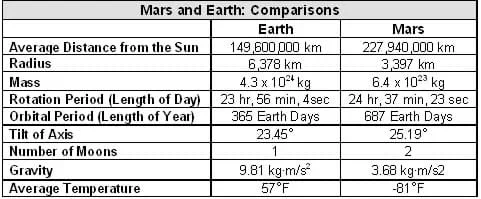
- Have students look at the "Mars and Earth: Comparisons" table. Point out that the radius of Mars is roughly half that of the Earth. Next have students calculate the approximate difference between the volume of the planets using the equation for the volume of a sphere: V = 4/3 * π *r3. (Answer: the Earth's volume is about 6.6 times larger than that of Mars [assuming the planets are perfect spheres, which they are not]. For comparison, point out that the radius of Jupiter, at nearly 70,000 km is 20.6 times that of Mars with a resultant volume that is almost 9,000 times larger than the volume of Mars.)
- Is the Martian day longer or shorter than the Earth day? (Answer: Longer by about 40 minutes.)
- Is Mars closer or farther from the Sun than the Earth? (Answer: Mars is farther.)
- What is the name of the giant volcano on Mars? (Answer: Olympus Mons)
Qs/As Revisited: As a class, revisit the pre-lesson assessment questions to determine what students have learned to be true and false about Mars. Then ask: How does this differ from the movie and science fiction depiction of Mars?
Martian Surface: Have students make dioramas of what they believe could be the surface of Mars. Encourage them to be creative in using a variety of resources for their Martian project.
Have students research how planets received their names. For more advanced students, have them research the names for the moons of the planets.
Williams, Davis R. "A Crewed Mission to Mars." January 5, 2006. National Aeronautics and Space Administration. Accessed February 28, 2012. http://nssdc.gsfc.nasa.gov/
Mars Exploration Program. Jet Propulsion Laboratory, National Aeronautics and Space Administration. Accessed February 28, 2012. http://mars.jpl.nasa.gov
The Mars Institute. Accessed February 28, 2012. http://www.marsinstitute.info
Programs and Missions: InSight. Mars Exploration, National Aeronautics and Space Administration (NASA). Accessed online 7/31/3014 http://mars.jpl.nasa.gov/programmissions/missions/future/insight/
Programs and Missions: NASA in 2016 ExoMars Orbiter. Mars Exploratino, National Aeronautics and Space Administration (NASA). Accessed July 31, 2014. http://mars.jpl.nasa.gov/programmissions/missions/future/exomarsorbiter2016/
Programs and Missions: Mars Science Laboratory. Mars Exploration, National Aeronautics and Space Administration (NASA). Accessed July 31, 2014. http://mars.jpl.nasa.gov/programmissions/missions/present/msl/
NASA Science Missions: MAVEN. National Aeronautics and Space Administration (NASA). Accessed July 31, 2014. http://science.nasa.gov/missions/maven/
Smith, Pamela R., Athena: Mars Exploration Rover. Jet Propulsion Laboratory. Accessed February 28, 2012, http://athena.cornell.edu/
Mars Space Flight Facility, Arizona State University, National Aeronautics and Space Administration. Accessed February 28, 2012. http://marsed.asu.edu
Contributors
Geoffrey Hill; Daria Kotys-Schwartz; Chris Yakacki; Malinda Schaefer Zarske; Janet Yowell
Supporting Program
Integrated Teaching and Learning Program, College of Engineering, University of Colorado Boulder
Acknowledgements
The contents of this digital library curriculum were developed under grants from the Fund for the Improvement of Postsecondary Education (FIPSE), U.S. Department of Education and National Science Foundation (GK-12 grant no. 033832). However, these contents do not necessarily represent the policies of the Department of Education or National Science Foundation, and you should not assume endorsement by the federal government.
Copyright
2004 by Regents of the University of Colorado