
Are We Alone?
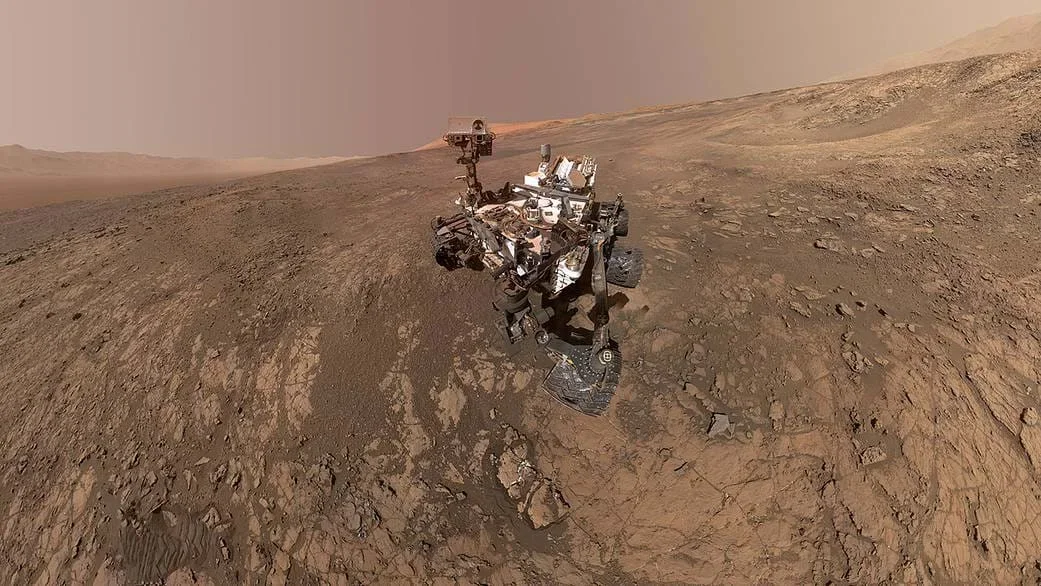 Is there life on Mars?Copyright NASA, Mars Curiosity Image Gallery
https://www.nasa.gov/mission_pages/msl/images/index.html
Accessed August 9, 2020
Is there life on Mars?Copyright NASA, Mars Curiosity Image Gallery
https://www.nasa.gov/mission_pages/msl/images/index.html
Accessed August 9, 2020
The year is 2032 and your class has successfully achieved a manned mission to Mars! After several explorations of the Red Planet, one question is still being debated: "Is there life on Mars?" The class is challenged with the task of establishing criteria to help look for signs of life. Student explorers conduct a scientific experiment in which they evaluate three "Martian" soil samples and determine if any contain life.
Engineers design equipment and devices that can explore environments that are unsafe for people, such as inside an unexplored cave, many miles under the ocean, inside a fiery volcano, or in outer space. In looking for signs of life (water?) on Mars, engineers designed rovers armed with many scientific instruments to investigate specific rock and soil targets. A microscopic imager provided close-up images of rocks, an alpha-particle-x-ray-spectrometer gathered information about the elements making up the rocks, and a rock abrasion tool ground the rock or soil surface.
After this activity, students should be able to:
- Define the characteristics of a living thing.
- Explain why some living things survive better in certain places than other living things.
- Systematically investigate and analyze soil samples.
- Record observations and conclude if life on Mars exists utilizing the given simulated Martian soil samples.
- Explain why engineers and scientists are interested in being able to find life in soil samples.
- Describe methods and equipment used to explore the solar system and beyond
Grade 8
Do you agree with this alignment?
- CCSS.Math.Content.7.SP.A.2 Use data from a random sample to draw inferences about a population with an unknown characteristic of interest. Generate multiple samples (or simulated samples) of the same size to gauge the variation in estimates or predictions.
Grade 7
Do you agree with this alignment?
- STEL-3G Explain how knowledge gained from other content areas affects the development of technological products and systems.
Grades 6-8
Do you agree with this alignment?
- 3-LS4-3 Construct an argument with evidence that in a particular habitat some organisms can survive well, some survive less well, and some cannot survive at all.
Grade 3
This resource focuses on the following Three Dimensional Learning aspects of NGSS:
Science & Engineering Practices- Construct an argument with evidence.Do you agree with this alignment?
Disciplinary Core Ideas- For any particular environment, some kinds of organisms survive well, some survive less well, and some cannot survive at all.Do you agree with this alignment?
Crosscutting Concepts- Cause and effect relationships are routinely identified and used to explain change.Do you agree with this alignment?
- Knowledge of relevant scientific concepts and research findings is important in engineering.Do you agree with this alignment?
Do you agree with this alignment? - Construct an argument with evidence.
- 5-PS1-3 Make observations and measurements to identify materials based on their properties.
Grade 5
This resource focuses on the following Three Dimensional Learning aspects of NGSS:
Science & Engineering Practices- Make observations and measurements to produce data to serve as the basis for evidence for an explanation of a phenomenon.Do you agree with this alignment?
Disciplinary Core Ideas- Measurements of a variety of properties can be used to identify materials. (Boundary: At this grade level, mass and weight are not distinguished, and no attempt is made to define the unseen particles or explain the atomic-scale mechanism of evaporation and condensation.)Do you agree with this alignment?
Crosscutting Concepts- Standard units are used to measure and describe physical quantities such as weight, time, temperature, and volume.Do you agree with this alignment?
Do you agree with this alignment? - Make observations and measurements to produce data to serve as the basis for evidence for an explanation of a phenomenon.
Each group should have:
- 2 Are We Alone? Data Worksheets (PDF)
- 1 Styrofoam cup
- 3 beakers or baby food jars
- magnifying lens
- 3 soil samples (recipes follow); place one soil sample in each beaker/jar:
Soil Sample A: 1 tsp. (5 ml) of sugar mixed with a little less than ¼ cup (50 ml) of sand or sandy soil.
Soil Sample B: 1 tsp. (5 ml) of sugar and 5 ml of active dry yeast mixed with a little less than ¼ cup (50 ml) of sand or sandy soil.
Soil Sample C: 1 tsp. (5 ml) of sugar and 1 crushed Alka-Seltzer tablet mixed with a little less than ¼ cup (50 ml) of sand or sandy soil.
For the class to share:
- Hot tap water
- Examples of living and non-living items (about 10 items for the class to discuss). Possible examples are: a pencil, a book, a rock, a plant, an apple, a grasshopper or other bug, etc.
An introduction to life science.
Explain to the students that today is (state the current month and day), 2032, and they have just successfully completed a manned mission to Mars. Also, they are currently at the Mars Science and Engineering Research Station. Ask the class if they are tired after their long journey? (Possible answer: yes, or puzzled looks)
Express to students that there have been several explorations of the Red Planet and one question is still being debated: "Is there life on Mars?" Explain to the students that it is their responsibility to analyze the soil samples that were collected by the previous manned mission to Mars and left at the Mars Science and Engineering Research Station. It is the hope that by the end of the class period they will be able to bring closure to the question about life on Mars that has been haunting scientists and engineers for decades.
But first, what are some things that might be found on Mars that would indicate the existence of life? [Possible answers: water, fossils, vegetation or other life itself]. Could you expect to find remnants of these things within soil samples? [Answer: Yes]. Why are there so many different types of soil and why might some have evidence of life while others do not? [Possible answers: the existence of life may depends on – nutrient content of soil, subsurface profile of the soil, water content of the soil, etc].
Show the students the examples of living and non-living things that you have collected and ask students, "What characteristics make an individual item alive or not alive?" (Answers: growth; reproduction, replication or cell division; independent movement; evidence of metabolic processes (respiration, gas or solid material exchange); response to stimuli.) List the answers on the board as students answer. Lastly, distribute the Are We Alone? Data Worksheets, and have students write down the criteria for Living Organisms.
Before the Activity
- Prepare soil samples for each group:
- The beaker/jar with just sugar, label as "A" (1 tsp., or 5 ml, of sugar mixed with a little less than ¼ cup, or 50 ml, of sand or sandy soil)
- The beaker/jar with sugar and yeast label as "B" (1 tsp., or 5 ml, of sugar and 5 ml of active dry yeast mixed with a little less than ¼ cup, or 50 ml, of sand or sandy soil)
- The beaker/jar with sugar and Alka-Seltzer label as "C" (1 tsp., or 5 ml, of sugar and 1 crushed Alka-Seltzer tablet mixed with a little less than ¼ cup, or 50 ml, of sand or sandy soil)
- Gather multiple items that are living and non-living.
With the Students
- Pass out Are We Alone? Data Worksheets (PDF) to students.
- Before beginning the activity, have students complete the Criteria For Life table on the first page of the Are We Alone? Data Worksheet. Students should list functions that that they think are key to life in the left column. They should describe each function in the right column.
- Distribute the beakers/jars to each group. Every group should have one sample labeled "A," one sample labeled "B" and one sample labeled "C."
- Each research group should formulate a hypothesis regarding their soil sample experiment. Students should write their hypothesis in the space provided (below the Criteria For Life table) on the worksheet.
- Next, have research groups observe soil samples A, B and C. Students may touch and smell the samples. However, ask students not to taste any of the samples. Have groups record their observations in Question 1 of the worksheet.
- Give each group a Styrofoam cup of hot tap water.
- Tell students to slowly and carefully pour the water over soil sample A until the sample is covered with water.
- Repeat step 7 for sample B and C.
- Now, have research groups observe soil samples A, B and C for five minutes after the hot water is added. Have students record any observations in Question 2 of the worksheet.
- Ask students to analyze their data and conclude if any of the Martian soil samples have evidence of life. Remind students that they must provide reasoning for their stated conclusions.
- Have the research groups complete questions 3 and 4 on the worksheet.
- Discuss worksheet questions as a class, after all research groups have completed the worksheet.
Pre-Activity Assessment
Brainstorming: Have students engage in open discussion to determine the characteristics of a living thing. Remind students that no idea or suggestion is "silly." All ideas should be respectfully heard. Encourage wild ideas and discourage criticism of ideas. Have each student fill in the table at the beginning of the Are We Alone? Data Worksheets.
Hypothesis: Have students state their hypothesis regarding the experiment using an "if, then, because" format. It is essential that this task be completed before the experiment is conducted.
Activity Embedded Assessment
Data Analysis: Students analyze data and support a conclusion regarding the experiment, recording their findings on their data worksheet.
Post-Activity Assessment
Conference Presentation: Often, scientists and engineers have to be able to present their research to a group of their peers or interested persons in a way that is understandable and clearly expresses the conclusions of their research. Have students pretend to be engineers at a NASA conference who are presenting their recent findings around life on Mars. Have student groups/pairs create a 5 minute presentation of their findings for another class which includes a description of their trip to Mars, their experiment procedures, whether or not they believe there is life on Mars and what that means to future explorations.
- Topic: Is there life on Mars?
Question/Answer: Ask students questions and have them raise their hands to respond. Write answers on the board and discuss as a class. Review the life criteria concepts introduced at the beginning of class by asking students to give an example of a living thing that performs each function.
- Name a living thing that grows? (Possible answers: plants, animals)
- Name a living thing that reproduces, replicates or has cell division? (Possible answers: bacteria, single celled organisms, plants, animals)
- Name a living thing with independent movement? (Possible answers: any animal)
- Name a living thing with metabolic processes (respiration, gas or solid material exchange)? (Possible answers: any bacteria, plant, animal)
- Name a living thing with a response to stimuli? (Possible answers: any plant, animal, etc)
Warn students not to rub their eyes after handling the soil samples. It is possible to irritate their eyes with fine particles of sand, yeast or Alka-Seltzer.
It is very important that students not taste any of the soil samples; remind them before and during the activity.
Water hotter than 122°F or 50°C may kill the yeast.
Notes to teacher:
- Sample A involves physical change of sugar dissolving.
- Sample B (Alka-Seltzer) contains a non-living chemical reaction.
- Sample C (yeast) contains a living chemical reaction. This should be a long term reaction.
Have students create a poster that they will leave at the Mars Science and Engineering Research Station. Explain to students that subsequent manned missions to Mars will use the posters they make. The poster should list the criteria that they used during their research to define something as "living." Colorful illustrations or photos showing living and non-living things will also be helpful for the scientists and engineers on the next mission.
- For 6th grade, have students formulate a hypothesis as a class. If the class is not in agreement, then more than one hypothesis may be formulated. Also, answer questions 4, 5 and 6 from the Are We Alone? Data Worksheet as a class.
- For 7th and 8th grade, conduct activity as is.
Activity adapted from Searching For Life On Mars, https://solarsystem.nasa.gov/docs/destmarsLes5.pdf
and from Destination Mars. http://ares.jsc.nasa.gov/ares/education/program/destinationmars.cfm October 27, 2004
Contributors
Daria Kotys-Schwartz; Geoffrey Hill; Chris Yakacki; Malinda Schaefer Zarske; Janet Yowell
Supporting Program
Integrated Teaching and Learning Program, College of Engineering, University of Colorado Boulder
Acknowledgements
The contents of this digital library curriculum were developed under a grant from the Fund for the Improvement of Postsecondary Education (FIPSE), U.S. Department of Education, and National Science Foundation GK-12 grant no 0338326. However, these contents do not necessarily represent the policies of the Department of Education or National Science Foundation, and you should not assume endorsement by the federal government.
Copyright
2004 by Regents of the University of Colorado.