
Destination Outer Space
Students acquire a basic understanding of the science and engineering of space travel as well as a brief history of space exploration. They learn about the scientists and engineers who made space travel possible and briefly examine some famous space missions. Finally, they use the fun and hands-on associated activities to learn the basics of rocket science (Newton's third law of motion), the main components of rockets and the U.S. space shuttle, and how engineers are involved in creating and launching spacecraft.
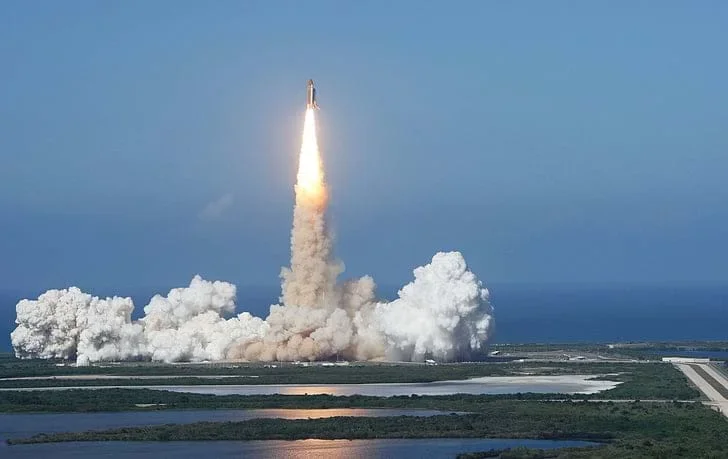 Students explore space travelCopyright PickPik, 2020. Royalty Free. https://www.pickpik.com/discovery-space-shuttle-launch-mission-astronauts-liftoff-rockets-122463
Engineers make it possible for humans to explore beyond our planet. Many different types of engineers work together to further space exploration: mechanical, aerospace, electrical, computer, materials, chemical, etc. Engineers use their combined knowledge of physics, materials, electronics, mathematics, structures and biology to get humans into outer space. Engineers are responsible for rocket design, propulsion systems, robotic arms, parachutes and landing gear, heat shielding, solar energy systems, computers, astronaut life support systems, guidance systems, scientific instruments, communication systems, etc.
After this lesson, students should be able to:
- Name at least three important figures involved with space flight.
- Explain how engineers have made it possible to travel to space.
- Explain that a rocket flies according to the natural behavior described in Newton's third law of motion.
- List at least three different elements that make spaceflight possible.
- Gather, analyze, and interpret data about components of the solar system
Grade 4
Do you agree with this alignment? - Utilize direct and indirect evidence to investigate the components of the solar system
Grade 4
Do you agree with this alignment?
- The use of transportation allows people and goods to be moved from place to place.
Grades 3-5
Do you agree with this alignment? - A transportation system may lose efficiency or fail if one part is missing or malfunctioning or if a subsystem is not working.
Grades 3-5
Do you agree with this alignment?
- DCI.PS2.A.3-5.2 The patterns of an object's motion in various situations can be observed and measured; when that past motion exhibits a regular pattern, future motion can be predicted from it. (Boundary: Technical terms, such as magnitude, velocity, momentum, and vector quantity, are not introduced at this level, but the concept that some quantities need both size and direction to be described is developed.)
Grade 3
Do you agree with this alignment?
Early History
In Greece around 100 BCE, Hero of Alexandria invented a rocket-like device called an aeolipile that used steam as a propulsive gas. Hero mounted a sphere on top of a water kettle. A fire below the kettle turned the water into steam, and the gas traveled through pipes to the sphere. Two L-shaped tubes on opposite sides of the sphere allowed the gas to escape, and in doing so gave a thrust to the sphere, causing it to rotate.
The first rockets to use combustible fuel were exploding bombs and fireworks used in Asia. Rockets were part of warfare in 1232 when the Chinese used rocket-powered arrows against the Mongols during the battle of Kai-Keng. These fire-arrows were a simple form of a solid-propellant rocket. A tube, capped at one end and left open at the other, was filled with gunpowder. The tube was attached to a long stick. When the powder was ignited, the rapid burning of the powder produced fire, smoke and gas that escaped out the open end, producing thrust. The stick acted as a simple guidance system that kept the rocket headed in the general direction of the enemy as it flew through the air.
Between 1609 and 1903, Johannes Kepler, Isaac Newton and Konstantin Tsiolkovsky made revolutionary discoveries that contributed immensely to rocketry and the future of space flight. Major contributions of each scientist are described below.
Johannes Kepler
- In 1609 discovered that the paths of the planets around the Sun were elliptical.
- Determined the relative velocity of a planet as it travels around the Sun as well as a method for determining its period (the amount of time it takes to make one orbit).
- Proved that our Sun was the center of the solar system.
Isaac Newton
- In 1687 published a book that stated his basic laws of motion that not only govern the movement of objects on Earth, but also objects in space.
- Formulated a universal law of gravitation that explains the orbit of objects around stars and planets.
- Was a pioneer of calculus, which is a type of mathematics critical for space flight (as well as many other applications).
Konstantin Tsiolkovsky
- In 1903 figured out all the basic equations of rocketry. He was a rocket visionary who thought space travel was possible and solved problems that would come up later.
- He drew pictures of rockets and predicted how the Saturn V rocket would operate for the first landing of humans on the moon 65 years later.
First Steps into Space
The father of modern rocketry is Robert Goddard. He designed, built and launched rockets. Goddard proved Tsiolkovsky's theories on rockets and in 1926 launched the first liquid fueled rocket. He received more than 200 patents for rocket components and design. While his rockets never reached space, his discoveries were used to design the first space-going rockets in the late 1950s.
Another pioneer was Hermann Oberth, who wrote a book, "The Rocket into Interplanetary Space," that influenced the modern world to take rocketry seriously and opened avenues for the exploration of space.
Wernher Von Braun and Oberth launched the first rocket capable of reaching space, called the German V2 rocket, and after World War II, worked in the US to develop the Saturn rockets. His developments enabled the US to eventually go to the moon.
The first spacecraft to leave Earth's atmosphere was the Soviet-built Sputnik. Sputnik 1 was launched on October 4, 1957. During its three-week mission it transmitted radio signals back to Earth that were used to determine the temperature of the spacecraft as well as measure the electron density of the ionosphere (a layer of the atmosphere). The first American spacecraft to reach orbit was the Explorer 1, which was launched on January 31, 1958. Explorer 1 measured the radiation in orbit.
Manned Spaceflight
Since the days of Sputnik 1 and Explorer 1, thousands of spacecraft have gone into space. Some of them have carried human passengers. The first person to orbit the Earth was a Russian man named Yuri Gagarin, on April 12, 1961. The first American to orbit was John Glenn, who completed three orbits on February 20, 1962. Glenn returned to space again at the age of 77 aboard the US space shuttle.
Glenn's flight was one of the manned Mercury Project missions. After Mercury came Gemini whose two-person capsules were launched by the more powerful Titan rocket. Following Gemini were the Apollo missions. On July 20, 1969, Apollo 11 was the first manned mission to the Moon. Altogether, six successful landings on the moon were achieved, all Apollo capsules on top of the giant (2,700 ton or 2,449 metric ton) Saturn V rocket. One such engine is displayed in the National Air and Space Museum of the Smithsonian Institution in Washington, DC, as is John Glenn's Mercury capsule, a moon lander and many other mementos from the early days of spaceflight.
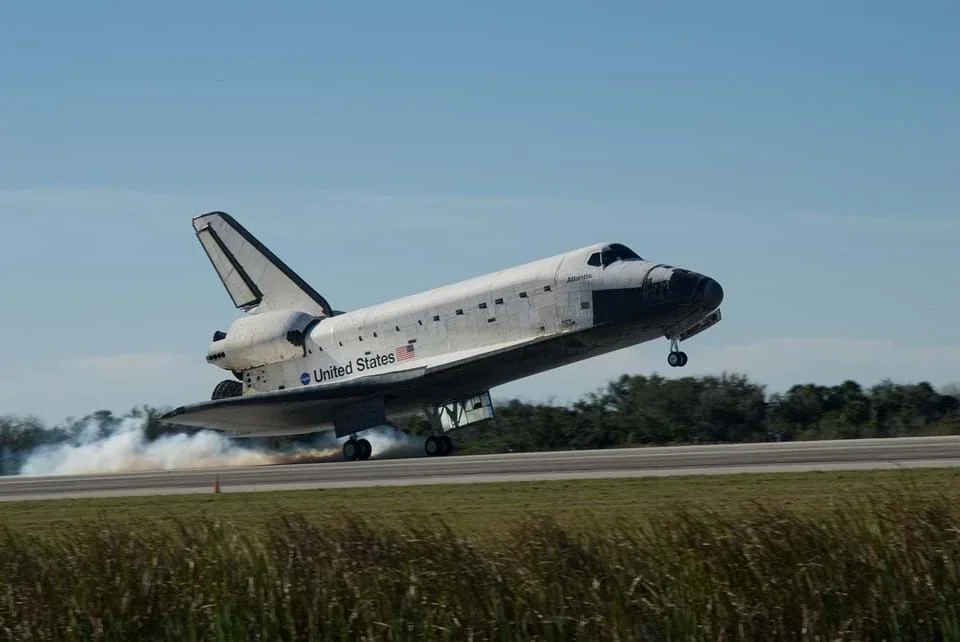 Copyright Pixabay, 2010. Free for commercial use.
https://pixabay.com/photos/space-shuttle-landing-astronautics-973/
Copyright Pixabay, 2010. Free for commercial use.
https://pixabay.com/photos/space-shuttle-landing-astronautics-973/
American manned spaceflight was based on the space shuttle, a re-usable rocket vehicle with short wings that allow it to land on a runway like an airplane from 1981-2011. The shuttle's rockets used about 700 tons (635 metric tons) of liquid hydrogen and oxygen, a most effective fuel; in addition it carries two strap-on solid fuel rockets, each weighing about 600 tons (544 metric tons). Since 2011 the Russian spacecraft, the Soyuz, has taken people and supplies to and from the International Space Station (ISS). In 2020 SpaceX's Crew Dragon first took astronauts to the ISS. The Boeing Starliner is expected to carry crew to the ISS.
Manned spaceflight has also included various "space stations" intended for long-term residence. In the past, the US flew "Skylab," which was launched in 1973 and burned up during atmospheric re-entry in 1980. The USSR launched space stations of gradually increasing size, the Soyuz, Salyut and (in 1986) the Mir space station. Over the years, Mir was extended by additional modules and was still operating in 2000. It finally re-entered the atmosphere on March 23, 2001, near the Fiji islands in the Pacific Ocean. Its re-entry was observed from the ground and fragments that did not burn up splashed harmlessly into the ocean. Construction of the ISS began in November 1998. It was started with the Russian module "Zarya" being placed in orbit and was followed by NASA's "Unity" in December. At the end of 2000, a US-Russian crew was performing science experiments aboard the station. The International Space Station program is a multi-national project between five space agencies: NASA (United States), Roscosmos (Russia), JAXA (Japan), ESA (Europe), and CSA (Canada). By September 2019, 239 astronauts, cosmonauts and space tourists from 19 countries had visited the ISS.
Any manned mission faces the problem of a safe return to Earth. This requires getting rid of the huge amount of energy associated with orbital motion. A spacecraft in low Earth orbit moves at about 8 km per second. To slow down, the spacecraft uses the friction of the atmosphere. The air hitting the spacecraft slows it down, but the friction also creates an immense amount of heat. Enough heat is generated to melt or even evaporate the re-entering material, even if it is a tough metal. To eliminate this heat, the vehicle re-enters the atmosphere at a shallow angle. Still, a great amount of heat reaches the spacecraft, requiring its forward-facing part to be lined with heat-resistant material. Mercury, Gemini and Apollo used shields that gradually were worn down (ablated), sparing the spacecraft, which then landed by parachute. The shuttle's bottom is lined with lightweight heat-resistant tiles of a special ceramic.
Unmanned Spacecraft
So great is the variety of unmanned spacecraft that (as with manned spaceflight) it is impossible to describe all of it here. Unmanned spacecraft can be divided into five types:
- Satellites that observe our Sun, the solar system or the universe (such as the Japanese Yohkoh that observes the Sun, or the Hubble orbiting telescope). Orbiting observatories can sense wavelengths that the atmosphere does not let pass through, such as ultra-violet light or X-rays.
- Satellites that observe the Earth from above, for scientific, military and commercial purposes — such as those that provide global images of cloud patterns for weather reports.
- Satellites that sample their local environment, for instance, those that monitor the radiation belts and the solar wind.
- Satellites used for the benefit of humanity, such as communication satellites and the GPS system used for determining position.
- Spacecraft that are not tied to Earth's gravitational field, but explore other planets and the far reaches of the solar system.
Basic Rocket Science and Rocket Components
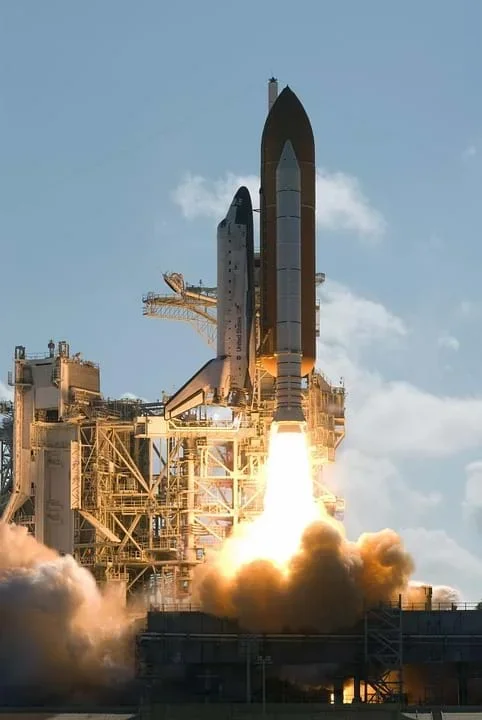 Copyright Pixabay, 2015. Free for commercial use.
https://pixabay.com/photos/space-shuttle-discovery-launch-878913/
Copyright Pixabay, 2015. Free for commercial use.
https://pixabay.com/photos/space-shuttle-discovery-launch-878913/
Rockets are essentially a massive sustained explosion in which the hot gases from the combustion process are directed to create thrust. Of course, it is a very carefully controlled and directed explosion — no small engineering feat! Engineers must design fuel tanks and nozzles that are just the right size, shape and thickness to withstand the pressure of the explosion and accelerate the fuel away. Engineers also design materials and components that can handle the heat and vibrations generated. If their design is too heavy, the rocket may be strong but will not fly; if it is too light, the rocket structure may be too weak and explode.
Rockets move according to the natural behavior described in Newton's third law of motion: for every action there is an equal and opposite reaction. This means that a rocket moves forward by pushing hot gas backwards. The hot gas moving backward is the action, while the rocket moving forward is the equal and opposite reaction. How much power the rocket provides is called "thrust." To create thrust, volatile fuel is placed in a combustion chamber and ignited. When the fuel is ignited, it creates super-heated gas that expands, creating incredible pressure in the combustion chamber. A small opening in the combustion chamber lets the high pressure gasses escape, and a nozzle directs the gas into the desired direction. This is why we see fire and smoke coming from a rocket as it lifts off.
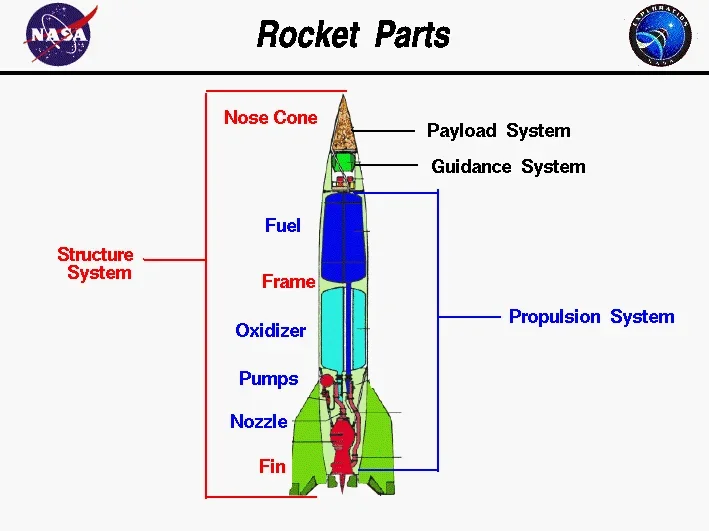 Copyright NASA http://exploration.grc.nasa.gov/education/rocket/rockpart.html
Other common rocket elements include fins, fuel tanks and nose cones. The fins are small wings that keep a rocket moving straight ahead. The great amount of energy required to leave the Earth's surface comes from fuel stored in huge fuel tanks. The nose cone on the tip of the rocket helps the rocket slice through the air. Without the nose cone, it would be much harder for the rocket to move though the atmosphere on the way to space.
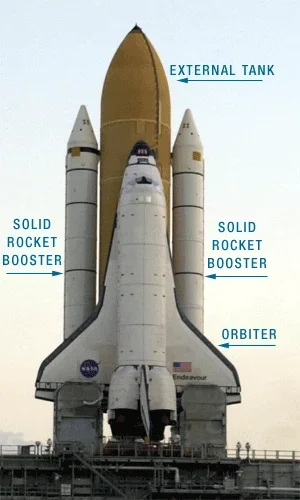 Main components of the space shuttle.Copyright NASA http://www.nasa.gov/returntoflight/system/system_STS.html
On a typical spacecraft, we might also see heat shields, antennae, parachutes, computers, scientific instruments, solar panels and thrusters. The heat shield protects the spacecraft from the heat of re-entry, while parachutes are often employed to ensure a safe landing. Antennae are important for communicating with the ground and sending scientific data. Computers monitor the spacecraft and help the astronauts operate the craft and perform experiments. Thrusters are small rockets that maneuver the spacecraft while it is in space. Solar panels help provide the craft with power; they turn the Sun's rays into electrical power.
The US space shuttle was designed to transport people and cargo to and from orbit around Earth. The main space shuttle components were two solid rocket boosters (contains solid fuel used to push the shuttle into the air), an external tank (holds liquid fuel) and the orbiter (includes a crew cabin for up to seven people; a cargo bay for supplies and equipment, and three engines). A great amount of the space shuttle is devoted to providing fuel. After liftoff, when the solid rocket fuel is gone, the boosters fall back down to Earth. Next, when empty, the external tank comes off. Then, the orbiter reaches space; it is able to return to Earth and land like an airplane. Everything except the external fuel tank is used for another shuttle flight.
Engineers are responsible for all these rocket, spacecraft and shuttle elements. Without them, space travel would not be possible. It is when all these carefully-designed elements work together that we have a successful space mission.
(Optional: Turn off the lights and play some space-age music [that is, sounds of flying through space, etc.] For example, listen to the sounds provided when you run your mouse cursor over the three images on the home page of NASA for Kids at: https://www.nasa.gov/kidsclub/index.html)
Tell the students: Close your eyes. I want you to think about being in space. Don't yell out any answers or ideas; just keep these thoughts in your head. (Make sure to give ample time for students to process and think.) Now, how did you get into space? Think about all the things that needed to happen to get you into space. What kinds of things do you need in space to keep you alive? Why are you in space? Are you visiting another planet? Are you performing science experiments aboard a space station? Are you on vacation? What special parts of your spaceship help you get your job done? What does your space suit look like?
(Now have the students open their eyes and share some of their thoughts about space flight. Also have them give you some of the answers to the questions. Where did you go? What did your do there? What are some things you needed in your space suit? (Ideas: Heat shield fabric, air to breathe, tethers and/or weights to keep you from floating away.) What are some elements of a spacecraft? (Possible answers: Rocket, fin, nose cone, heat shield, parachute, fuel tank, etc.) There is a reason rockets look the way they do. What are the purposes of each of these elements? (Answers: A rocket provides thrust, fins help control our direction, the nose cone cuts through the air to minimize drag, a heat shield protects us from the heat of re-entry into our planet's atmosphere, a parachute slows us so we land safely, and fuel tanks store the great amount of fuel required by rockets.)
So, how do rockets fly? Do they push off the air in order to move? The answer is no, a rocket does not fly by pushing off the air. If this were the case, a rocket would not work in space where there is no air. Rockets work by following the natural behavior described by Newton's third law of motion. Newton's third law states that for every action there is an equal and opposite reaction. Students can explore this concept with the exploratory Rocket Power activity to model a rocket moving through air with balloons. Students can then further their exploration with the hands-on design challenge Pop Rockets activity to create their own rocket!
Let's say you are standing on a skateboard. If you push against a wall, the skateboard moves in the opposite direction. This is a simple demonstration of Newton's third law. The action is the push against the wall; the equal and opposite reaction is the skateboard moving in the opposite direction. This is the same principle as a rocket, but a rocket uses high-pressure gas instead of a push against a wall. In a rocket, fuel is ignited, which creates high-pressure exhaust. The exhaust is directed out of the back of the rocket. All this hot gas moving backwards is the action; the equal and opposite reaction is the rocket moving forward. Engineers work to maximize the action of the hot gas in order to get the rocket out of our planet's atmosphere.
It takes a lot of work and knowledge to get people into space. Humans have been dreaming about visiting the stars since the dawn of time, but it was not until the twentieth century that this dream became a reality. Scientist and engineers have been working on solving the challenges of space flight for centuries. Scientists such as Kepler and Newton discovered important facts about our solar system and the physics that would later allow us to operate vehicles in space. Kepler proved the Sun was the center of the solar system and also discovered that the planets followed elliptical paths around the Sun. Newton's third law of motion describes the natural behavior that makes rocket flight possible. Konstantin Tsiolkovsky imagined how rockets might work and used math to predict their performance while Robert Goddard built small rockets that would be the basis for future rockets. Then, people like Wernher von Braun helped to create some of the first rockets to reach space as well as those that would take humans to the moon. The first human in space was the Soviet cosmonaut, Yuri Gagarin. The first American to orbit the Earth was John Glenn. Eventually, humankind made it to the moon when astronaut Neil Armstrong landed there in 1969. All the spacecraft that enable humankind to visit the stars are designed and built by engineers, as well as the unmanned vehicles, support equipment on Earth, and the scientific equipment and spacesuits used in space.
Space travel is an amazing feat that is only possible with the many discoveries of scientists and the designs of engineers. Who were some of the scientists, engineers and astronauts who made space travel possible? (Johannes Kepler, Isaac Newton, Konstantin Tsiolkovsky, Robert Goddard, Wernher von Braun, Hermann Oberth, John Glenn, Yuri Gagarin.) Now, can anyone tell me how a rocket works? What natural behavior does Newton's third law of motion describe that makes rocket travel possible? (Make sure students understand the concept of action and reaction.) Finally, let's list some elements of a space mission and talk about the use of each of these components (rocket, fuel tank, fin, nose cone, solar panel, computer, antennae, thruster, heat shield, parachute, etc.)
- chemical reaction
- A process in which one type of substance is chemically converted to another substance involving an exchange of energy.
- gas
- Tiny particles with enough energy to remain isolated and free floating (as opposed to liquids and solids in which particles group together).
- engineer
- A person who applies his/her understanding of science and math to creating things for the benefit of humanity and our world.
- newton's third law of motion
- For every action there is an equal and opposite reaction. (This is why rockets work!)
- rocket
- A vehicle that moves by ejecting fuel.
- pressure
- The exertion of force upon a surface by an object, fluid, gas (etc.), in contact with it. Force per area. Measured in units of pounds per square inch (psi) or newtons per square meter (N/m^2) or pascals (Pa). Pressure results from collisions of gas molecules with a surface
- thrust
- The forward-directed force on a rocket in reaction to the ejection of fuel.
Pre-Lesson Assessment
Brainstorming: As a class, have students engage in open discussion. Remind them that in brainstorming, no idea or suggestion is "silly." All ideas should be respectfully heard. Take an uncritical position, encourage wild ideas and discourage criticism of ideas. Have them raise their hands to respond. Write their ideas on the board. Ask the students: How do rockets work?
Post-Introductory Assessment
Rocket Design: Standing at the chalk board, direct students to draw a space vehicle, adding components necessary for the mission, one element at a time. Components might include: rocket, fins, nose cone, antenna, computer, windows, landing gear, parachute, scientific instruments, robotic arm, heat shielding, fuel tanks. There are no wrong elements as long as they can explain their reasoning for having the element on the vehicle. Decide on a mission before you start, for example, a moon landing, mission to Mars, unmanned probe, launching a satellite, space tourism, etc.
Lesson Summary Assessment
Rocket Motion Poster: Have students create a poster to teach other students about Newton's third law of motion. The posters should identify the rocket, thrust, the action, and the reaction. Students might also add other components to their spacecraft drawing, such as fins, fuel tanks, landing gear, heat shielding, life support and any other elements necessary to create a successful space mission.
Homework
Homework Worksheet: Assign the Rocket Worksheet (PDF) as a take-home quiz.
Have students draw their own designs for a rocket or spacecraft. Get them to think about the purpose of the craft. Is it to transport satellites into orbit? Will it carry people or be operated remotely from the Earth? Can it send humans to another planet?
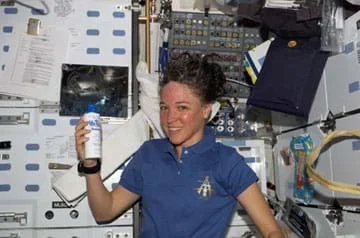 Astronaut Sandra Magnus holding a towel on the mid-deck of the Space Shuttle Discovery while docked with the International Space Station.Copyright Pixabay, 2015. Free for commercial use.
https://pixabay.com/photos/female-astronaut-washing-hair-space-604176/
Astronaut Sandra Magnus holding a towel on the mid-deck of the Space Shuttle Discovery while docked with the International Space Station.Copyright Pixabay, 2015. Free for commercial use.
https://pixabay.com/photos/female-astronaut-washing-hair-space-604176/
What do you wear in space? Ask students to brainstorm, investigate, describe and design (on paper) clothing that would be suitable for people to wear in space. What are the requirements? (Ideas: Life support; protection from the space environment, ability to eat, drink, walk or move; etc.) How would it work? What would your space gear look like? Draw detailed designs and present to the class.
For a fun activity to help younger students learn about the different parts of the space shuttle, conduct NASA's Edible Space Shuttle activity described at: https://www.lpi.usra.edu/education/space_days/activities/spaceShuttle/edibleShuttle.pdf.
For more curricular material and activities on the topic of rockets, see the grade 4 (K-5) Rockets unit at TeachEngineering.org.
Have students with access to the Internet watch a 20-minute video, Space Basics, for an introduction to human space travel and information about spaceflight: How do spacecraft travel into space? How do spacecraft remain in orbit? Why do astronauts float in space? How do spacecraft return to Earth?
Couper, Heather and Nigel Henbest. How the Universe Works. London, UK: Dorling Kindersley Limited, 1994.
Culp, Randy. Pioneers of Space Travel, Boy Scout Space Exploration Merit Badge. Last updated November 5, 2006. Space Exploration, Randy Culp's Home Page. Accessed January 15, 2007. http://my.execpc.com/~culp/space/history.html
Human Space Flight. Last updated July 16, 2002. National Aeronautics and Space Administration (NASA). Accessed January 3, 2007. http://spaceflight.nasa.gov/history/
Introduction to Space Shuttle. Space Travel Guide, Thinkquest. Accessed January 13, 2007. (great description of space shuttle components, naming history and images) http://library.thinkquest.org/03oct/02144/spacecraft/intro.htm
Lafontaine, Bruce. Exploring the Solar System. A Dover Coloring Book. New York, ON: General Publishing Company, Ltd., 1998.
NASA Kids' Club Home Page. Last updated December 22, 2006. National Aeronautics and Space Administration (NASA). Accessed January 3, 2007. https://www.nasa.gov/kidsclub/index.html
Stern, David P. Spacecraft: Manned Space Flight. Last updated September 24, 2004. NASA Goddard Space Flight Center, Greenbelt, MD. Accessed January 3, 2007. http://www-spof.gsfc.nasa.gov/stargaze/Spaccrft.htm
Contributors
Jessica Todd; Sam Semakula; Jessica Butterfield; Geoff Hill; Denise W. Carlson
Supporting Program
Integrated Teaching and Learning Program, College of Engineering, University of Colorado Boulder
Acknowledgements
This digital library content was developed by the Integrated Teaching and Learning Program under National Science Foundation grant no. 0338326. However, these contents do not necessarily represent the policies of the Department of Education or National Science Foundation, and you should not assume endorsement by the federal government.
Copyright
2006 by Regents of the University of Colorado.