
Lunar Lollipops: Reproducing the Moon Phases
Students work in teams of two to discover the relative positions of the Earth, Sun and Moon that produce the different phases of the Moon. Groups are each given a Styrofoam ball that they attach to a pencil so that it looks like a lollipop. In this acting-out model exercise, this ball on a stick represents the Moon, the students represent the Earth and a hanging lightbulb serves as the Sun. Students move the "Moon" around them to discover the different phases. They fill in the position of the Moon and its corresponding phase in a worksheet.
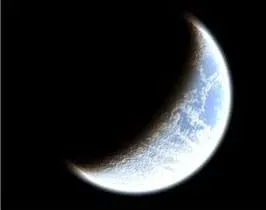 What causes the various phases of the Moon?Copyright 2004 Microsoft Corporation, One Microsoft Way, Redmond, WA 98052-6399 USA. All rights reserved. http://office.microsoft.com/en-us/images/results.aspx?qu=moon&ex=1#ai:MP900422254|mt:0|
The Apollo Moon landings were one of the most important engineering achievements of the 20th century, and a thorough understanding of the positions of the Earth, Moon and Sun in space made it possible.
After this activity, students should be able to:
- Explain why the Moon is visible from Earth.
- Describe the placement of the Earth, Sun and Moon during the different phases of the moon.
- Explain why the Moon appears slightly different in shape each night.
- Models are used to communicate and test design ideas and processes.
Grades 3-5
Do you agree with this alignment?
- MS-ESS1-1 Develop and use a model of the Earth-sun-moon system to describe the cyclic patterns of lunar phases, eclipses of the sun and moon, and seasons.
Grades 6-8
This resource focuses on the following Three Dimensional Learning aspects of NGSS:
Science & Engineering Practices- Develop and use a model to describe phenomena.Do you agree with this alignment?
Disciplinary Core Ideas- Patterns of the apparent motion of the sun, the moon, and stars in the sky can be observed, described, predicted, and explained with models.Do you agree with this alignment?
- This model of the solar system can explain eclipses of the sun and the moon. Earth's spin axis is fixed in direction over the short-term but tilted relative to its orbit around the sun. The seasons are a result of that tilt and are caused by the differential intensity of sunlight on different areas of Earth across the year.Do you agree with this alignment?
Crosscutting Concepts- Patterns can be used to identify cause and effect relationships.Do you agree with this alignment?
- Science assumes that objects and events in natural systems occur in consistent patterns that are understandable through measurement and observation.Do you agree with this alignment?
Do you agree with this alignment? - Develop and use a model to describe phenomena.
- 3.E.1 Recognize the major components and patterns observed in the earth/moon/sun system.
Grade 3
Do you agree with this alignment? - 4.E.1 Explain the causes of day and night and phases of the moon.
Grade 4
Do you agree with this alignment? - 4.E.1.2 Explain the monthly changes in the appearance of the moon, based on the moon's orbit around the Earth.
Grade 4
Do you agree with this alignment? - 6.E.1 Understand the earth/moon/sun system, and the properties, structures and predictable motions of celestial bodies in the Universe.
Grade 6
Do you agree with this alignment? - 6.E.1.1 Explain how the relative motion and relative position of the sun, Earth and moon affect the seasons, tides, phases of the moon, and eclipses.
Grade 6
Do you agree with this alignment?
- a large hanging lightbulb or a lamp without a shade; this works especially well with a high-wattage bulb, 75 watts or higher; for small classes, have students cluster around one lamp; for large classes, have several lamps with 3-4 teams around each lamp
- Styrofoam ball or other spherical object such as fruit that is ~3-4 inches in diameter, one per team
- sharpened pencil, one per team
- plenty of room for students to move around
- pencils, to fill in the worksheets
- Moon-Earth-Sun Positions Worksheet (PDF), one per student
Why does the Moon appear different on different nights? (Listen to student explanations. Have students come to the classroom board and draw the various phases of the Moon that they have observed themselves. If students have completed a "Moon Log" as suggested in the associated lesson, Lunar Learning: Moon Phases Always on the Move, have a few them might draw on the board some examples from their moon logs.)
Before the Activity
- Gather materials and make copies of the Moon-Earth-Sun Positions Worksheet, (PDF) one per student.
- Familiarize yourself with what positions of the Moon, Earth and Sun engenders what Moon phases so you are able to guide students and judge whether they have aligned themselves correctly.
With the Students
 Copyright 2004 Microsoft Corporation, One Microsoft Way, Redmond, WA 98052-6399 USA. All rights reserved. http://office.microsoft.com/en-us/images/results.aspx?qu=moon&ex=1#ai:MC910215972|mt:0|
- Divide the class into groups of two students each. Hand out the Styrofoam balls and sharpened pencils, one each per group.
- Tell students to work together to carefully pierce the ball with the pencil to make a "lollipop" out of it.
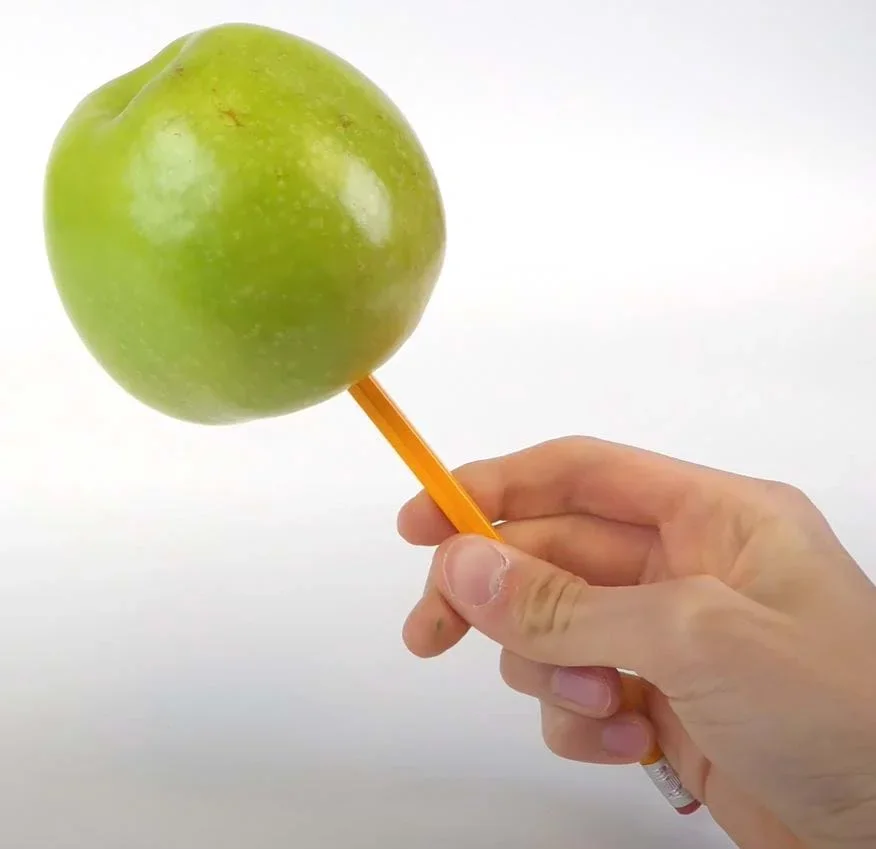 An example of a lunar lollipop using an apple.Copyright TeachEngineering.org, 2021.
 - Clear the area around where the lightbulb hangs and explain that the light bulb represents the Sun, the "lollipop" represents the Moon, and they represent the planet Earth. This representation is called a "model."
- Turn off all the classroom lights and then turn on the model Sun (it is most dramatic if the lights are all off before the "Sun" is turned on, but students might not be able to handle the lights being off completely.) Direct students to stand with their lollipops at arm's length in front of the Sun. Then have them rotate the Moon counterclockwise around the Earth (their bodies) so that they can see how the movement of the Moon around the Earth makes different parts of the Moon visible. Students must turn their bodies to be able to see the phases of the Moon that occur when the Moon is where their backs would be if they had stayed stationary.
- Hand out the worksheets. Give students time to draw in the phases they see at each of the positions of the Moon relative to the Earth and Sun to produce each phase. The worksheet has a set number of positions of the Moon so students know how to orient their bodies relative to the Moon and the Sun. They simply have to discover what the phase of the Moon is in that particular position. As necessary, guide students in understanding how the worksheet relates to the activity.
- Once students have finished, have them look up the name of each phase that they discovered in their textbooks and review with them the eight major phases and the positions of the Moon that engender each phase.
New Moon: Moon is between the Sun and the Earth and the shadowed side of the Moon is seen. A solar eclipse occurs in this phase when the Moon blocks light from the Sun from reaching a portion of the Earth. Have students close one eye to simulate a solar eclipse event.
Waxing Crescent: Rotating from a new Moon toward a first quarter, a backwards "C" shape appears on the Moon.
First Quarter: Right half of the side of the Moon facing Earth is lit. The right shoulder is pointed towards the Sun.
Waxing Gibbous: Rotating from a first quarter to a full Moon.
Full Moon: The Earth is between the Moon and the Sun, the entire lit side of the Moon is visible on Earth, (students' backs are to the Sun and Moons are above and in front of them so that they are fully lit). A lunar eclipse occurs when the Moon passes through the Earth's shadow. Have students simulate this event.
Waning Gibbous: Rotating from a full Moon to a last quarter, less and less of the Moon is lit each night
Last Quarter: Left half of the side of the Moon facing the Earth is lit, left shoulder is pointing to the Sun.
Waning Crescent: Rotating from a last quarter to a new Moon, a "C" shape of light is seen on the left side of the Moon.
- Have students repeat the phases on their own as you circulate through the room to correct any problems.
- Test students' comprehension. Name a Moon phase and have the students all rotate until they are in the correct position to generate that phase. Judge whether or not students have aligned themselves correctly. If students have trouble, go around to help them adjust positions and clarify any confusion. Jumble the phases to make it more of a challenge. Also include the two eclipses and the correct Moon phases present when these events occur.
- moon
- The name given to the natural satellite of the Earth, and sometimes applied to the satellites of the other planets in the solar system.
- phases
- The different shapes the Moon seems to have in the sky, as observed from the Earth.
- rotation
- The spinning of an object on its axis.
- axis
- An imaginary line that goes through the north and south poles.
- revolution
- The movement of one object around another object.
- full moon
- The phase when the entire lit side of the Moon is visible.
- new moon
- The phase when the entire Moon appears dark because the Sun is lighting the opposite side.
- crescent moon
- When only a small lit edge of the Moon can be seen.
- waxing
- The lit portion of the Moon increasing, progressing from new Moon to full Moon, this is when the Moon is "getting bigger" in the night sky.
- waning
- The lit portion of the Moon is decreasing, progressing from full Moon to new Moon, this is when the Moon is "getting smaller" in the night sky.
- lunar eclipse
- When the Earth's shadow blocks sunlight from reaching the Moon. At night, the moon appears dark instead of light when it should be a full Moon.
- solar eclipse
- When the Moon passes between the Earth and the Sun, blocking sunlight from reaching the Earth.
Worksheet: Have students complete the worksheet during the activity. Review their answers to assess their comprehension of the activity concepts.
Observations: During the activity, observe the students and ask yourself the followoing questions:
- Were students able to see the different phases of the Moon and accurately fill in the worksheet?
- Were students able to find each phase when called out as in Step 8 of the activity?
Theones, Hank. Lunar Lollipops activity. Last updated September 2000. Windows to the Universe, National Earth Science Teachers Association. Accessed 6/17/04. http://www.windows2universe.org/teacher_resources/lunar_edu.html
- Lunar Learning: Moon Phases Always on the Move
- Lunar Lollipops: Reproducing the Moon Phases
Contributors
Catie Liken; Teresa Tetlow
Supporting Program
Engineering K-PhD Program, Pratt School of Engineering, Duke University
Acknowledgements
This content was developed by the MUSIC (Math Understanding through Science Integrated with Curriculum) Program in the Pratt School of Engineering at Duke University under National Science Foundation GK-12 grant no. DGE 0338262. However, these contents do not necessarily represent the policies of the NSF, and you should not assume endorsement by the federal government.
Copyright
2013 by Regents of the University of Colorado; original © 2004 Duke University