
Mercury and Venus
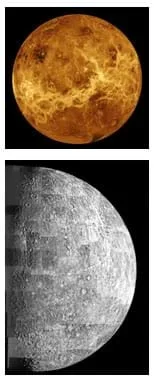 Mercury and Venus.Copyright (Mercury image) NASA, http://photojournal.jpl.nasa.gov/jpegMod/PIA03104_modest.jpg (Venus image) NASA, http://photojournal.jpl.nasa.gov/jpegMod/PIA00104_modest.jpg.
Students explore Mercury and Venus, the first and second planets nearest the Sun. They learn about the planets' characteristics, including their differences from Earth. Students also learn how engineers are involved in the study of planets by designing equipment and spacecraft to go where it is too dangerous for humans.
Exploring space beyond our planet has intrigued humans for centuries. During modern times, space exploration has become a reality through manned and unmanned spacecraft missions. NASA engineers have launched spacecraft to discover more about the planets Venus and Mercury. Many types of engineers work with scientists to design, install, test, launch and remotely operate systems for space-bound instruments and craft to creatively gather data in harsh conditions. Contributors to successful missions include aerospace, mechanical, electrical, computer, materials, thermal, systems, structural and communications engineers.
After this lesson, students should be able to:
- List several characteristics of Mercury, including nearest planet to our Sun, fastest planet to rotate the Sun, and from there the Sun looks larger than from Earth.
- List several characteristics of Venus, including second planet from the Sun, hottest surface temperatures, and spins in the opposite direction than Earth.
- Explain that engineers design things that help us travel into outer space.
- Describe how we can learn about the planets without sending people to them.
- 3.1.3.c Multiply and divide within 100.
Grade 3
Do you agree with this alignment? - 5.1.1.c Use place value understanding to round decimals to any place.
Grade 5
Do you agree with this alignment?
- Gather, analyze, and interpret data about components of the solar system
Grade 4
Do you agree with this alignment?
- CCSS.Math.Content.3.OA.C Multiply and divide within 100.
Grade 3
Do you agree with this alignment? - CCSS.Math.Content.5.NBT.A.4 Use place value understanding to round decimals to any place.
Grade 5
Do you agree with this alignment?
- STEL-3D Explain how various relationships can exist between technology and engineering and other content areas.
Grades 3-5
Do you agree with this alignment?
Mercury
Mercury is the closest planet to the Sun and the second smallest of our planets. Mercury was named for the Roman messenger of the gods, because it seemed to move faster than any of the other planets in the sky. In fact, Mercury travels around the Sun every 88 days.
Engineers and scientists built the Mariner 10 spacecraft and it passed within 12,000 miles from the surface of Mercury in 1974. Mariner 10 relayed detailed information about Mercury's surface conditions, such as temperature, to the Earth. Mariner 10 was only able to view part of the planet. A spacecraft named Messenger was launched in 2004 to fly by Mercury three times, with the mission to map the entire planet and study its shape, interior and magnetic field. It circled Mercury 3 times during its lifetime, which concluded in 2015.
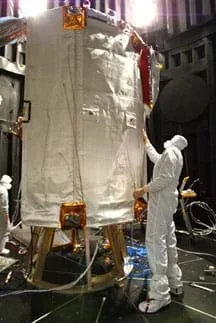 Before sending it to space, a thermal engineer checks the condition of the Messenger spacecraft's ceramic-fabric sunshade after testing it in a vacuum heat chamber to make sure it will keep its instruments and systems at room temperature while the spacecraft orbits Mercury, the planet closest to the Sun.Copyright NASA/Johns Hopkins University Applied Physics Laboratory/Carnegie Institution of Washington, http://messenger.jhuapl.edu/the_mission/pictures/MESSENGER1.html.
Mercury's surface has been hit many times by meteorites; thus, it resembles our Moon. Mercury does not have plate tectonics, but has lava flows. According to NASA, ice caps appear to exist on the North and South Poles, and deep inside of craters. Scientists believe that the ice can exist because the areas where it always remain in shadow. Mercury is thought to have a dense iron core and a thin mantle and crust. The core's radius is approximately 1,800-1,900 km, while its crust and mantle are only about 500-600 km thick.
Mercury's surface is a lot like the Earth's Moon: it has a barely detectable atmosphere, no known life, and craters of all sizes. Unlike the Moon, the temperature ranges from 800 oF (430 oC) in the day to 280 oF (140 oC) at night. If you were to stand on Mercury, the Sun would appear two to three times larger than it looks to us when standing on Earth.
Venus
Venus is the second planet from the Sun and its size is similar to the Earth. Venus was named after the Roman goddess of love. While Venus is almost the same size of Earth, it rotates retrograde. So, on Venus, the Sun rises in the west and sets in the east. During its orbit of the Sun, it comes within 26 million miles (42 million km) of the Earth.
To further explore the conditions on Venus, over the years engineers have designed a few probes to enter its atmosphere. But they do not last long, as surface conditions are extremely hostile! A thick atmosphere of carbon dioxide encloses Venus, and the atmospheric pressure is 90 times that of the Earth's. It rains sulfuric acid. Daytime temperatures reach up to 900 oF (480 oC) year round. Probes that have landed on Venus have not survived more than a few hours before being destroyed by the incredibly high temperatures. It is a greenhouse gone wild! These thick atmospheric clouds also reflect sunlight, making Venus often the brightest planet in our sky.
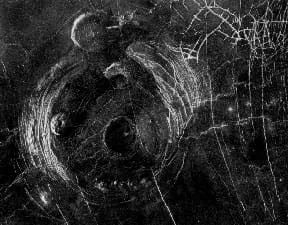 Aine Corona with Pancake Domes, 1991: To see past the thick atmospheric clouds on Venus, engineers designed the Magellan spacecraft to use radar to collect data as it flew by the planet. They used the data to create images to map the planet, such as this 300-km (180-mi) wide area that reveals to us the planet's surface texture of circular corona fractures and flat-topped lava domes.Copyright NASA, http://www2.jpl.nasa.gov/magellan/image15.html.
Venus's gray rocks appear tinted yellow from the Sun shining through the atmosphere. The many volcanoes on Venus vary in size from large mountains to small domes. Volcanic eruptions shape the surface of Venus. With very little surface wind and no water (so unlike the Earth), these factors play little part in erosion. But, the winds at high elevations are stronger, and are known as super-rotation; they circulate Venus every four days. Like Earth, Venus has atmospheric circulation patterns between the equatorial and polar areas. Venus shows no evidence of plate tectonics, which on Earth are an important way for planetary heat release. Instead, large, circular patterns called coronae form on the surface, causing surface warps as they release hot material from below the surface.
Engineering and the Planets
Learning about the fascinating planets that are so far from Earth and so inhospitable to human life requires great creativity by engineers and scientists to devise ways to conduct remote investigations. Since even our most powerful telescopes are not able to see through Venus' cloudy atmosphere, engineers designed unmanned spacecraft to use radar to image Venus' surface, and infrared mapping to view mid-level cloud structure. Engineers carefully design spacecraft and instruments to withstand the harsh space and planetary conditions for years while they collect and relay scientific information and imagery. Unmanned probes sent to the planet surfaces gather data that is communicated back to Earth before the probes succumb to extreme conditions.
Quick Facts
Amazing facts about Mercury and Venus may be found in Table 1.
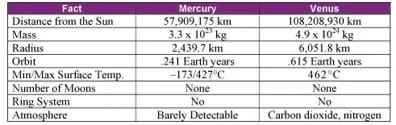 Table 1. Facts about Mercury and Venus.Copyright Source of facts from NASA, http://solarsystem.jpl.nasa.gov/planets/charchart.cfm
Now that we have learned about space travel and the Sun, we are going to learn about the eight planets closest to our Sun. Can anyone name one of the planets? (Write them on the board as the students call them out). Great work! Now let's write them all down on in the order of how far away they are from the Sun: Mercury, Venus, Earth, Mars, Jupiter, Saturn, Uranus and Neptune. (Optional: Show students an image of all the planets in our solar system, so they understand their relative position from the Sun; see Figure 1 and the attached Solar System Map Visual Aid (PDF).)
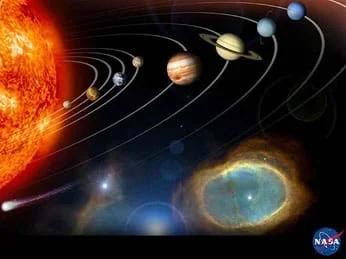 Figure 1: Relative location of the planets from the Sun, from closest to furthest from the Sun: Mercury, Venus, Earth, Mars, Jupiter, Saturn, Uranus, Neptune.Copyright NASA, http://photojournal.jpl.nasa.gov/index.html.
We are going to learn about all eight planets, but today we are just going to focus on the first two – Mercury and Venus. Did you know that Mercury is the second smallest planet in our solar system? It travels faster around the Sun than any other planet; it takes only 88 days to rotate around the Sun. Mercury looks a lot like Earth's Moon. It has cliffs and valleys and craters. What do you think the Sun looks like from Mercury? Well, it looks two to three times larger than how we see it from Earth. Depending where you are on Mercury, you would see the Sun move in a strange pattern during the day. The Sun would rise, then seem to set (appearing to grow smaller), and then start to rise again. The same thing happens in reverse when the Sun sets. This is due to Mercury's egg-shaped orbit and the number of times it rotates in a given year.
Venus is the second planet from the Sun. It is also the second brightest object in our night sky, besides our Moon. If you were to sit on the surface of Venus, it would look like a cloudy, drizzly day. Scientists think that Venus once had water, but that it has long since evaporated; now it rains sulfuric acid. The temperature on Venus is in excess of 900 oF (480 oC) during the day, because the clouds trap in heat from the Sun instead of releasing it to the atmosphere. In fact, it is hotter on the surface of Venus than Mercury, because Mercury does not have the thick clouds. Venus's atmosphere is thick and poisonous, with strong winds and lightening. The atmospheric pressure on the surface would crush metal spacecraft in a few hours. Venus is not a friendly place for humans to visit. One more interesting thing about Venus is that it spins in the opposite direction than the Earth spins, so for us it would look like the Sun moves backwards across the sky.
We know that Mercury and Venus are the first and second planets nearest the Sun, and we know that they have some characteristics that are pretty different from Earth, but who can tell me how we find out about the planets? Since Venus is so hot on its surface, it is way too dangerous to send people there. So, how do we know what it is like? That's right; we have to design something to remotely investigate the planet for us. From Earth, we can observe the planets through telescopes. However, to get more details and measurements of temperature and atmosphere and surface conditions, we must send a spacecraft to the planet. Who do you think gets to design systems to tell us about the planets? That's right – engineers do! Engineers design special space equipment and spacecraft to help us learn more about outer space and the planets. Students can explore their own engineering project with the associated activity Spacecraft Design: Beat the Heat where they design and test model spacecraft that are able to endure the extreme heat and atmospheric pressure of the Mercury and Venus atmospheres.
Where do Mercury and Venus fall in the order of planets from the Sun? (Answer: Mercury is the first planet nearest the Sun, and Venus is the second planet nearest the Sun.) What are some of the characteristics of Mercury and Venus? (Possible answers: Mercury is the fastest planet to rotate the Sun, has cliffs and valleys and craters, the Sun appears to rise, set then rise again from the surface of Mercury, and from Mercury the Sun looks larger than it does on Earth. Venus has extremely hot surface temperatures, a cloudy and poisonous atmosphere, high atmospheric pressure, and spins in the opposite direction than Earth.)
Could you live on Mercury or Venus? Probably not, because of the extreme temperatures. How do we find out all this information about the planets, including the surface temperature and what the weather is like there? (Answer: Engineers design technologies that can investigate the planets from a distance, such as telescopes, spacecraft, space missions and probes.) Engineers design special equipment and spacecraft to help us learn more about space and the planets.
- coronae
- On Venus, circular patterns of fractures on the surface resulting from the release of interior planet heat.
- engineer
- A person who applies his/her understanding of science and math to creating things for the benefit of humanity and our world.
- erosion
- The wearing away of a surface by any natural process.
- greenhouse effect
- When a dense carbon dioxide atmosphere traps heat from the Sun and raises a planet's surface temperature.
- plate tectonics
- Movement of large pieces of a planet's crust that helps release interior heat.
- remotely
- Operating or controlled from a distance, as by remote control
- retrograde
- Moving in a backward direction.
- sulfuric acid
- A highly corrosive acid made from sulfur dioxide (H2SO4).
Pre-Lesson Assessment
Discussion Questions: Ask discussion questions to get students to think about the upcoming lesson.
- How many planets are in our solar system?
- Who can name any of the planets?
Post-Introduction Assessment
Venn Diagram: Draw or show as an overhead transparency, the attached Triple Venn Diagram (PDF). Activate prior knowledge by asking students to name differences between Earth, Venus and Mercury. Next, see what similarities students know. Bring a beach ball and throw it to a random student. Have each student state a difference, a similarity, or a "not sure" when passed the ball.
Lesson Summary Assessment
Travel to the First Two Planets: Have the students draw a creative picture of a spacecraft that could be sent on the next NASA mission to Mercury and Venus. What important features would this spacecraft require? Write the words temperature, atmosphere and pressure on the board, and ask students to think about these conditions on Mercury and Venus. Have them label special parts of their spacecraft that would address these three environmental factors.
Think about the Math: We have talked about all sorts of facts that we have learned about Mercury and Venus because engineers developed spacecraft to help us study the planets. How many of the things we have learned have something to do with numbers? Have students list all of the things they learned (or are listed on their Venn diagram) that use numbers. Examples include: temperature, orbit, rotation, measurements of atmospheric gases, size, distance from the Sun, atmospheric pressure, speed around the Sun, etc. Then, ask students to think about the math that engineers use to design spacecraft to reach the planets. Engineers use math to design the size, speed, orbit and instruments on the spacecraft. Have students write three sentences on how important math is to the study and exploration of the planets and outer space.
Think about the Distance: Have students calculate how much farther Venus is from the sun than Mercury. For simplicity, have students use 108 million km for the distance from the Sun to Venus and 58 million km for the distance from the Sun to Mercury. Have students round their answer to the nearest whole number. (Answer: 108 million km / 58 million km = 1.86 ~ 2. Thus, Venus is approximately twice the distance from the sun as Mercury).
Make a list of past, present and future space missions to Mercury and Venus and hang them up in your classroom.
See many excellent images of Mercury and Venus on the Internet. Print some of the pictures to help the students really understand what the planets look like.
Have students visit the NASA website and learn how much they would weigh on Mercury. https://www.exploratorium.edu/explore/solar-system/weight
Have students visit the NASA website and learn how much they would weigh on Venus. https://www.exploratorium.edu/explore/solar-system/weight
Aine Corona with Pancake Domes. Image dated May 21, 1991. Magellan Images, P38340, Jet Propulsion Laboratory, California Institute of Technology, NASA. Accessed February 28, 2007. http://www2.jpl.nasa.gov/magellan/image15.html
Couper, Heather and Nigel Henbest. How the Universe Works. London, UK: Dorling Kindersley Limited, 1994.
Lafontaine, Bruce. Exploring the Solar System. A Dover Coloring Book. New York, ON: General Publishing Company, Ltd., 1998.
Merriam-Webster Online. 2005-2006. Merriam-Webster, Incorporated. Accessed May 2, 2007. (Source of some vocabulary definitions, with some adaptation) http://www.m-w.com
Solar System Exploration: Planets: Mercury: Overview. Updated October 6, 2006. NASA. Accessed February 28, 2007. (Click on "Kid's Eye View" tab for good information.) http://solarsystem.jpl.nasa.gov/planets/profile.cfm?Object=Mercury&Display=Overview
Solar System Exploration: Planets: Venus: Overview. Updated August 29, 2006. NASA. Accessed February 28, 2007. (Click on "Kid's Eye View" tab for good information.) http://solarsystem.jpl.nasa.gov/planets/profile.cfm?Object=Venus&Display=Overview
Contributors
Jessica Todd; Sam Semakula; Jessica Butterfield; Malinda Schaefer Zarske; Denise W. Carlson
Supporting Program
Integrated Teaching and Learning Program, College of Engineering, University of Colorado Boulder
Acknowledgements
The contents of these digital library curricula were developed by the Integrated Teaching and Learning Program under National Science Foundation GK-12 grant no. 0338326. However, these contents do not necessarily represent the policies of the National Science Foundation, and you should not assume endorsement by the federal government.
Copyright
2006 by Regents of the University of Colorado