
Slingshot to the Outer Planets
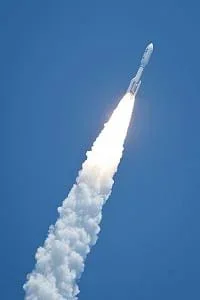 Students examine spacecraft launches and their "slingshot" effectCopyright NASA. Wikimedia Commons http://commons.wikimedia.org/wiki/File:Launch_of_Juno.jpg
Students are introduced to the engineering challenges involved with interplanetary space travel. In particular, they learn about the gravity assist or "slingshot" maneuver often used by engineers to send spacecraft to the outer planets. Using magnets and ball bearings to simulate a planetary flyby, students investigate what factors influence the deflection angle of a gravity assist maneuver.
Since the discoveries of Jupiter, Saturn, Uranus and Neptune, humans have become increasingly intrigued with these planets located so far from Earth. Until recently, scientists and engineers relied on telescopes to observe and understand the outer planets. Today, engineers use large rockets to send satellites deep into space to probe the unknown. However, since rocket fuel is costly and heavy, engineers invent creative ways, such as the gravity assist or "slingshot" maneuver, to propel their spacecraft to greater distances.
After this activity, students should be able to:
- Describe why spacecraft need so much energy to travel to and explore the outer planets.
- Explain what the gravity assist or "slingshot" effect is and how engineers use this technique to launch spacecraft greater distances.
- Identify and describe the variety of energy sources
Grade 4
Do you agree with this alignment?
- Energy comes in different forms.
Grades 3-5
Do you agree with this alignment? - STEL-1H Design solutions by safely using tools, materials, and skills.
Grades 3-5
Do you agree with this alignment?
- 3-PS2-2 Make observations and/or measurements of an object's motion to provide evidence that a pattern can be used to predict future motion.
Grade 3
This resource focuses on the following Three Dimensional Learning aspects of NGSS:
Science & Engineering Practices- Make observations and/or measurements to produce data to serve as the basis for evidence for an explanation of a phenomenon or test a design solution.Do you agree with this alignment?
- Science findings are based on recognizing patterns.Do you agree with this alignment?
Disciplinary Core Ideas- The patterns of an object's motion in various situations can be observed and measured; when that past motion exhibits a regular pattern, future motion can be predicted from it. (Boundary: Technical terms, such as magnitude, velocity, momentum, and vector quantity, are not introduced at this level, but the concept that some quantities need both size and direction to be described is developed.)Do you agree with this alignment?
Crosscutting Concepts- Patterns of change can be used to make predictions.Do you agree with this alignment?
Do you agree with this alignment? - Make observations and/or measurements to produce data to serve as the basis for evidence for an explanation of a phenomenon or test a design solution.
- 4-PS3-1 Use evidence to construct an explanation relating the speed of an object to the energy of that object.
Grade 4
This resource focuses on the following Three Dimensional Learning aspects of NGSS:
Science & Engineering Practices- Use evidence (e.g., measurements, observations, patterns) to construct an explanation.Do you agree with this alignment?
Disciplinary Core Ideas- The faster a given object is moving, the more energy it possesses.Do you agree with this alignment?
Crosscutting Concepts- Energy can be transferred in various ways and between objects.Do you agree with this alignment?
Do you agree with this alignment? - Use evidence (e.g., measurements, observations, patterns) to construct an explanation.
Each group needs:
- 10-inch (25-cm) square, 1-inch (2.54-cm) thick piece of transparent Plexiglas to serve as a baseboard (available at hardware stores)
- 4 small wooden pieces or books to serve as corner supports for the Plexiglas baseboard
- 1 strong magnet (available at hardware stores)
- 2-3 steel ball bearings (various sizes, 1/18-inch and larger; available at hardware stores, auto parts stores, bicycle shops)
- 2 pieces of angle aluminum, a right-angle V cross-section 6-10-inches (15-25-cm) long (available at hardware stores)
- 1 large magnetic ball (this may be difficult to find at some hardware stores; magnetic tennis balls are available online at http://www.stevespanglerscience.com/product/1312)
- Trajectory Deflection Worksheet (PDF)
A familiarity with the concepts of kinetic and potential energy, and work.
Have you ever wondered how engineers send satellites and probes out to faraway planets like Jupiter and Saturn so they can discover more about them? Actually, sending satellites to the outer planets is a complicated process. To help understand this process, think of what it's like on our planet Earth: If you want to send an object very high into the sky, you must give it a lot of energy. You can throw it really hard or use something to help launch it. But either way, lots of energy is required because the object must overcome the Earth's gravity in order to go higher and higher. The same idea applies to interplanetary travel, but instead of overcoming Earth's gravitational field, a satellite must overcome the pull of the Sun's gravity in order to rise higher and higher. Typically, a satellite gets this great amount of energy by being attached to a large rocket that pushes it at very high speeds out to its intended destination. However, rocket fuel is expensive and engineers always want to save on fuel requirements whenever possible, so they are always looking for alternative ways to propel spacecraft.
One source of energy is actually the planets themselves. Since the planets orbit the Sun at incredible speeds, they have a tremendous amount of kinetic energy (not to mention potential energy due to their distance from the Sun). Engineers recently discovered how to take some of this energy from the planets and transfer it to the spacecraft as a way to speed its journey to its planned destination. This technique is called the gravity assist maneuver, also known as the "slingshot" effect. This maneuver is commonly used for spacecraft heading for the outer planets, like Jupiter, Saturn, Uranus and Neptune, because so much energy is required to overcome the Sun's gravitational pull to get that far away. Without this maneuver, spacecraft visiting the outer planets would take far too long to get there and use way too much fuel.
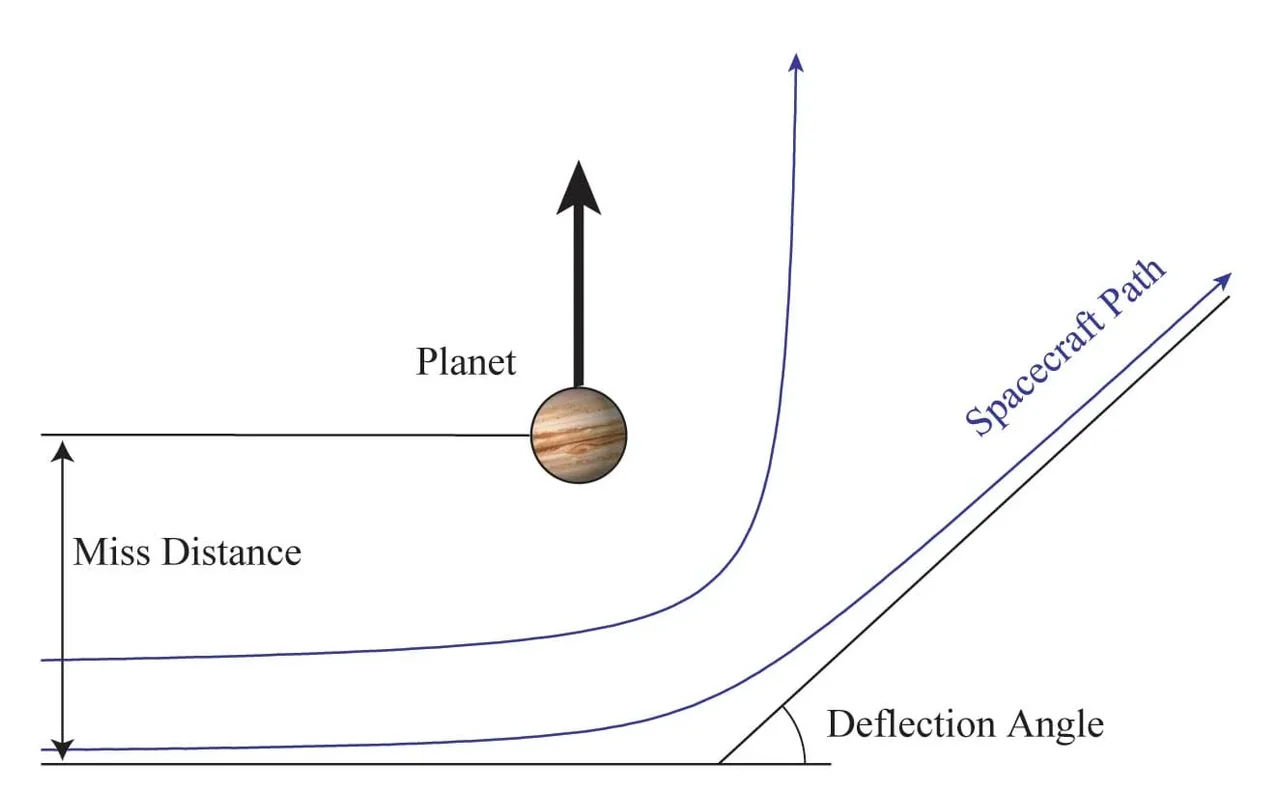 Figure 1. Trajectories of different flyby maneuvers.Copyright Jake Lewis, ITL Program, University of Colorado at Boulder.
The key to the gravity-assist (or slingshot) maneuver is to pass the spacecraft pretty close to a moving planet so that it enters that planet's gravitational field. As the spacecraft approaches the planet, the planet's gravitational pull begins to bend or change the spacecraft's path. Even though the spacecraft's speed (relative to the planet) remains unchanged, its speed relative to the Sun becomes faster. The amount of energy gained depends on several things, including the distance by which the spacecraft misses the planet, the approach speed of the spacecraft, and the masses of the spacecraft and planet (see Figure 1).
The slingshot technique has been used by many spacecraft such as Voyager 1 and the Cassini Probe. Voyager 1 performed slingshot maneuvers around both Jupiter and Saturn in 1979 to escape our solar system and explore interstellar space. The Cassini probe used multiple gravity assist maneuvers when it passed by Venus twice, then Earth, and finally Jupiter on its way to Saturn (see Figure 2). This path greatly reduced the amount of rocket fuel needed to send Cassini to explore Saturn. Also, the Ulysses probe used this technique not to gain energy but to change its path so that the poles of the Sun could be studied.
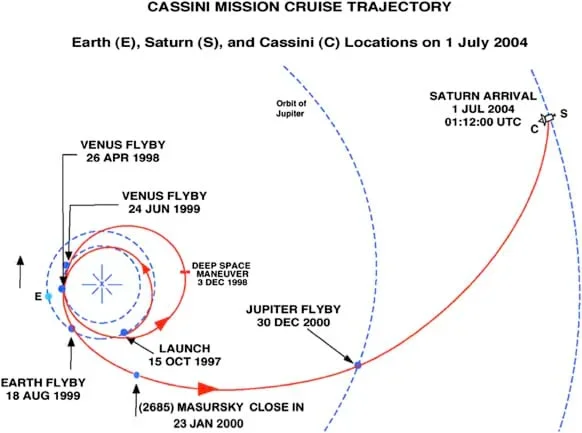 Figure 2. The cruise phase of Cassini–Huygens' route to Saturn is shown, with major planetary flyby maneuver milestones during more than six years indicated by their dates.Copyright https://www.sciencedirect.com/topics/earth-and-planetary-sciences/huygens-probe
To understand how the slingshot effect works, we are going to work in engineering teams to determine how we want to launch our spacecraft to get to the outer planets. We will use a ball bearing to represent our spacecraft and a magnet to represent the gravitational field of the planet. We will set up a model to help us predict the path of our spacecraft during different launches. First, we will roll the ball bearing close to the magnet and observe how its path is changed by the magnetic field. This shows us the change in the path of the ball — the same as when a spacecraft approaches a planet. Several factors affect the angle of the spacecraft's path after it passes near a planet — called the deflection angle. You will test to find out what factors change the path and deflection angle. For example, perhaps the size of the ball (spacecraft), the speed of the ball as it approaches the planet or the size of the magnet (planet).
Before the Activity
- Gather materials and make copies of the Trajectory Deflection Worksheet.
- Free up enough classroom desktop, tabletop or floor space to lay down a baseboard for each group, propped up under each corner (see Figure 3). Or, conduct the activity outside or in the gym.
With the Students
- Divide the class into teams of five or six students each. Each student in the group will get a chance to test different spacecraft travel paths.
- Pass out a worksheet to each group and review it with the class.
- Distribute materials (except the large magnetic ball and second piece of angle aluminum) to each group.
- Guided by the worksheet, have students start testing which factors affect the path of their spacecraft magnet. Direct students to place the magnet under the middle of the baseboard and use the angle aluminum to guide the steel balls toward the magnet, as shown in Figure 3.
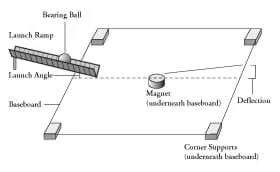 Figure 3. Activity set-up for demonstrating the slingshot maneuver via magnetism-governed flybys of steel balls. An inclined launch ramp guides a steel ball towards a magnet.Copyright Planetary Billiards, JPL, NASA, http://saturn.jpl.nasa.gov/education/pdfs/Planetary_Billiards.pdf
- After trying several tests, give each team a large magnetic ball and another piece of angle aluminum so that they can simulate an actual planet flyby. Place the large magnetic ball on a second launch ramp and set it in motion. Have students experiment with timing. When should the spacecraft be launched so that it increases it maximum velocity without actually "hitting" the moving planet?
- As a class, discuss the test results. Observation points: Students should have observed that the mass of the ball (spacecraft), initial speed of the ball (spacecraft), mass of the magnet (planet), and the miss distance were all contributing factors that affect the spacecraft's path as it performs a gravity assist maneuver around a planet. In addition, students should have discovered that if the ball is passed in front of a moving planet, the overall velocity is reduced, whereas if the ball is passed behind a moving planet, the overall velocity is increased.
- Conclude by asking the post-activity questions provided in the Assessment section.
- energy
- A measure of the ability to do work. For example, to lift an object against gravity or drag it against friction.
- engineer
- A person who applies her/his understanding of science and mathematics to creating things for the benefit of humanity and our world.
- gravity assist maneuver
- A spaceflight technique in which the gravitational field of a planet is used to increase the speed and alter the path of a spacecraft without using fuel.
- kinetic energy
- The energy of motion.
- launch window
- The time period during which a spacecraft must be launched to achieve its given mission course.
- potential energy
- The energy of position, or stored energy.
- work
- The energy it takes to move an object some distance.
Pre-Activity Assessment
Prediction: Have students predict activity outcomes by asking:
- Do you think it is possible for a planet to give some of its energy to a spacecraft? If so, how is this possible?
Activity Embedded Assessment
Group Questions: During the activity, have teams predict the performance of their spacecraft during different testing scenarios:
- What factors affect the path of the spacecraft? Why? (Answers: The mass of the spacecraft, the mass of the planet, the approach velocity of the spacecraft, and the approach distance all affect the final spacecraft path.)
Post-Activity Assessment
Discussion Question: Solicit, integrate and summarize student responses.
- Why is it necessary for engineers to use the flyby technique to reach the outer planets? (Answer: Since the outer planets are so far from the Sun, it takes a lot of energy to overcome the pulling force of the Sun to reach them. A creative solution is to use the flyby technique as an energy source, instead of rocket fuel.)
- If the spacecraft takes energy from the planet, does that mean the planet slows down? (Answer: Technically yes. However, because the planet is much larger than the passing spacecraft, the energy lost to the planet is very small compared to its total energy. A good example is when a bug hits a school bus, head on. Technically speaking, the school bus loses energy due to the collision, but it cannot even feel it.)
- If Neodymium magnets are used, practice caution because they are extremely powerful. For this activity, these magnets should not be used without a protective covering.
Since they are easy to lose, get a few extra ball bearings and magnetic balls.
Darling, David. The Encyclopedia of Astrobiology, Astronomy, and Spaceflight. Updated July 16, 2007. Accessed July 16, 2006. http://www.daviddarling.info/encyclopedia/ETEmain.html
Edberg, S. Educational Brief: Planetary Billiards. Educational Brief, Cassini Science Investigation, NASA Jet Propulsion Laboratory. 2001. Accessed November 13, 2007. http://saturn.jpl.nasa.gov/education/pdfs/Planetary_Billiards.pdf
Contributors
Jake Lewis; Malinda Schaefer Zarske; Denise W. Carlson
Supporting Program
Integrated Teaching and Learning Program, College of Engineering, University of Colorado Boulder
Acknowledgements
The contents of this digital library curriculum were developed under a grant from the Fund for the Improvement of Postsecondary Education (FIPSE), U.S. Department of Education, and National Science Foundation GK-12 grant no 0338326. However, these contents do not necessarily represent the policies of the Department of Education or National Science Foundation, and you should not assume endorsement by the federal government.
Copyright
2006 by Regents of the University of Colorado.