
Beyond the Milky Way
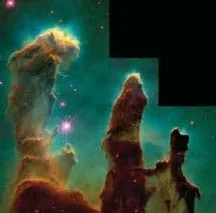 This spectacular Hubble Space Telescope image shows the pillar structure and embryonic stars in the Eagle Nebula.Copyright Copyright © NASA http://history.nasa.gov/SP-4312/ch4.htm.
When we look at the night sky, we see stars and the nearby planets of our own solar system. Many of those stars are actually distant galaxies and glowing clouds of dust and gases called nebulae. The universe is an immense space with distances measured in light years. The more we learn about the universe beyond our solar system, the more we realize we do not know. Students are introduced to the basic known facts about the universe, and how engineers help us explore the many mysteries of space. Then using the hands-on associated activities, students are able to further investigate relevant engineering concepts such as navigation and light in space.
Engineers design tools that help us analyze the mysteries of the universe. They design instruments and spacecraft to explore and investigate our solar system and beyond, including black holes and other universe phenomena. The spacecraft Voyager 1, for example, is exploring space beyond the outer planets to the outer limits of the Sun's sphere of influence. The spacecraft is equipped with tools for measuring the solar winds and Sun's outermost magnetic fields. We are able to explore our solar system and the universe due to the creative work of thousands of engineers.
After this lesson, students should be able to:
- Describe our solar system as just one tiny part of the Milky Way galaxy and the universe beyond.
- List two tools that help in the exploration for other planets.
- Explain several ways in which engineers help advance the exploration of the universe.
- Gather, analyze, and interpret data about components of the solar system
Grade 4
Do you agree with this alignment? - Gather, analyze, and interpret data about the Sunrise and Sunset, and Moon movements and phases
Grade 4
Do you agree with this alignment?
- STEL-2J Demonstrate how tools and machines extend human capabilities, such as holding, lifting, carrying, fastening, separating, and computing.
Grades 3-5
Do you agree with this alignment? - STEL-3D Explain how various relationships can exist between technology and engineering and other content areas.
Grades 3-5
Do you agree with this alignment?
- MS-ESS1-2 Develop and use a model to describe the role of gravity in the motions within galaxies and the solar system.
Grades 6-8
This resource focuses on the following Three Dimensional Learning aspects of NGSS:
Science & Engineering Practices- Develop and use a model to describe phenomena.Do you agree with this alignment?
Disciplinary Core Ideas- Earth and its solar system are part of the Milky Way galaxy, which is one of many galaxies in the universe.Do you agree with this alignment?
- The solar system consists of the sun and a collection of objects, including planets, their moons, and asteroids that are held in orbit around the sun by its gravitational pull on them.Do you agree with this alignment?
- The solar system appears to have formed from a disk of dust and gas, drawn together by gravity.Do you agree with this alignment?
Crosscutting Concepts- Science assumes that objects and events in natural systems occur in consistent patterns that are understandable through measurement and observation.Do you agree with this alignment?
- Models can be used to represent systems and their interactions.Do you agree with this alignment?
Do you agree with this alignment? - Develop and use a model to describe phenomena.
The universe is the sprawling Cosmo polis ("cosmos" = universe; "polis" = city) we call home. Our "neighborhood" is our solar system, which in turn is part of a "suburb" in our local galaxy, which we call the Milky Way. The universe contains billions of other galactic neighborhoods, made up of trillions of stars, nebulas, quasars, planets, moons, asteroids, comets, etc. With all those neighborhoods out there, we might well wonder if we have any neighbors.
Cosmic Sprawl
No one knows exactly how big the universe is, but some of the furthest distances measured are two pulsating stars called Cepheids, which are more than 65 billion light years from Earth. Since light travels about 6 trillion miles (9.5 trillion km) in a year, that is an unthinkably great distance. Refer to the activity The North (Wall) Star to give students an understanding of navigation in space and determining distances between stars.
Some scientists speculate that the universe is infinite. Others think that it may have boundaries like a box, but they wonder what might be outside the box. Some scientists hypothesize the universe is a huge curved space, like a multi-dimensional Moebius strip that curves back on itself, making the universe an endless loop with no "inside" or "outside," both infinite and unbounded.
Origin of the Universe: The Big Bang Theory and the Expanding Universe
The current theory of how the universe came into being is that somewhere between 10 and 20 billion years ago a huge explosion occurred that caused the universe to expand suddenly, projecting matter outward from the center. This theory, called the "Big Bang" theory, was first proposed in 1927, by George LeMaitre, a Belgian priest and scientist. He based his theory on spectroscopic observations of the "red shift" of distant nebulae in the universe. Two years later, Edwin Hubble (the Hubble telescope is named after him) confirmed and expanded on these observations. The question is: Will the universe keep expanding or will it reverse directions and begin contracting again?
Galaxies and Stars
Galaxies are clusters of billions of stars, nebulae, planets and other objects held together by gravity. They can range in size from 1,000 light years across to a million light years across. Some are shaped like spirals, others are elliptical, while others are called "irregular" or "peculiar" because they have no definite shape. Scientists are discovering that black holes form the center of many if not most galaxies, including our own Milky Way.
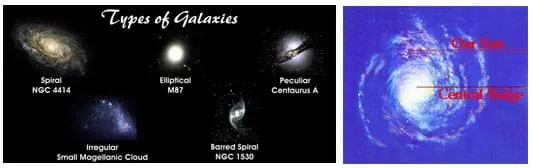 (left) Examples of different types of galaxies. (right) Our spiral-shaped galaxy, the Milky Way.Copyright Copyright © (left) NASA http://imagine.gsfc.nasa.gov/docs/teachers/galaxies/transparencies/trans1.jpg (right) NASA http://starchild.gsfc.nasa.gov/docs/StarChild/universe_level1/milky_way.html.
Our galaxy, the Milky Way, is spiral in shape, contains more than 100 billion stars, and is about 90,000-100,000 light years across. A large bulge at its center contains many stars. Our solar system is comfortably situated in one of the arms of the spiral where the neighborhood is a little less "crowded," about 25,000 light years away from the center.
In addition to stars, galaxies contain clouds of dust and gas known as nebulae. Nebulae give birth to stars as the dust and gas (mostly hydrogen) and are pulled closer and closer together by gravity until they start to spin. As the atoms are compressed, heat energy is generated until the gas cloud gets so hot that nuclear fusion of the hydrogen atoms takes place and the cloud begins to glow, forming a protostar. When the protostar stops growing it becomes a full-fledged star.
Stars may live for millions or even billions of years but they do not last forever. Students can learn more about how stars are composed of different light forms in the hands-on activity Building a Fancy Spectrograph. For a time, the star is held in balance as the expansive energy of nuclear fusion counteracts the contractive force of gravity that would tend to pull the gases of the star inward. When the fuel of a smaller star, like our Sun, begins to be used up, it starts to shrink and becomes a "white dwarf." When all the fuel is used, it does not shine any longer and becomes a "black dwarf."
Larger stars have a different fate. They burn hotter and brighter for a longer time. Eventually nuclear fusion causes iron to form in the star. The iron absorbs energy, making the star like a ticking bomb that eventually explodes to become a "supernova." Depending on its size, it then becomes either a "neutron star" or a black hole. The largest stars become black holes after they explode, collapsing under the pressure of the tremendous gravity created by the massive object.
Black Holes
A black hole gets its name because its gravitational pull is so powerful that not even light can escape. The two main types of black holes are stellar and supermassive. Stellar black holes are formed when massive stars use up all their fuel and die, collapsing inward due to the pull of their own gravity. Supermassive black holes have been detected at the center of many galaxies. We think that massive gravity at the core of the galaxy, where stars are closely packed together, causes the black hole to form. The reverse could also be true — the black hole causes the stars to become closely packed as they approach the event horizon of the black hole. Only after more and more black holes are detected and studied will we understand.
With the right instruments and equipment, black holes are proving to be fairly easy to detect because as objects fall toward the black hole, they get very hot and glow brilliantly. What we see is actually the luminous gas cloud that surrounds the event horizon of the black hole, the donut-shaped zone of "no return." Any object that comes within the event horizon is sure to be pulled into the black hole.
When students first hear about black holes (often through science fiction films or video games), they may become concerned that they could be pulled into a black hole. Even if our Sun were able to become a black hole (and that is impossible because it is not massive enough), a black hole only has a gravitational pull equal to the object that created it. So, it would exert no greater pull on Earth than the Sun does. As far as supermassive black holes are concerned, one news report proclaimed that one was supposed to be headed our way, but miss us by 1,000 light years. If you multiply 9.5 trillion km (the distance traveled by light in a year) by 1,000, you get a better idea of how far away that black hole is!
Quasars
Quasars are massive objects larger than our solar system that give off huge amounts of energy and reside in galaxies that have black holes. Examining quasars may provide us with clues to how the universe was formed. Since they are billions of light years away from the Earth, when we look at quasars we are essentially looking billions of years into the past!
Dark Matter
Matter is usually something we can see and touch; it takes up space and has mass. So-called "dark matter" is one of the greatest mysteries in the universe because it cannot be seen. We only know it is there because it exerts a gravitational effect on objects nearby. Scientists think that more than 90% of the matter in the universe is dark matter, which is significant in understanding the origin and destiny of the universe. The amount of matter the universe contains affects how much gravity it has, and the more matter, the more gravity to counteract the forces of expansion.
Engineers are helping scientists investigate black holes, galaxy formation, the evolution of the universe, the recycling of matter and energy, and the nature of "dark matter." Engineers are advancing the tools that enable scientists to gather data from space, travel in space and peer into the universe beyond our solar system. In the process, they help us get closer to answering some of those unanswered questions. When was the universe formed? How was it formed? How big is it? Why are some stars in our own galaxy apparently older than the universe itself? What happens to all the matter that gets pulled into a black hole? As the mysteries of space are solved and new questions arise; it is the challenge of engineers to continue developing even better technologies to help answer them.
Ever since Galileo peered through one of the earliest telescopes and observed spots on the Sun, humans have been making observations and asking a lot of questions about the nature of the universe. When was the universe formed? How was it formed? How big is it? Are there other planets out there?
Our solar system, with planets that orbit the Sun, is just a tiny part of the Milky Way galaxy, which is just a tiny part of the entire universe. Until 1991, the eight planets in our solar system were the only ones that we knew existed. Well, we now know better! With engineers designing more advanced equipment, we have found more than 200 other planets orbiting around different stars in our galaxy! Some of these stars might even be bigger than our own Sun. It is difficult to know if other planets are out there because they are so far away. It is harder to find planets the size of Earth, because Earth is really a very small planet. Imagine trying to find another planet the size of Mercury!
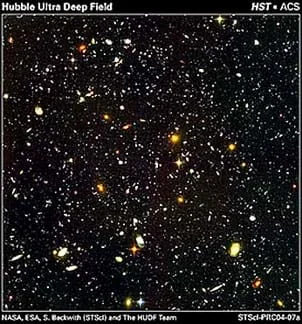 This is the deepest (most sensitive) astronomical optical image ever taken. The faint light spots in this Hubble Space Telescope image are distant galaxies about 13 billion years from Earth. The image is a composite exposure combining ~400 observations over a year's time.Copyright Copyright © NASA http://rst.gsfc.nasa.gov/Sect20/A2a.html.
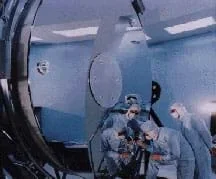 A mirror from a backyard telescope that you might buy at a store is small enough to hold in your hand. The orbiting Hubble Space Telescope is a much bigger telescope; its primary mirror is 2.4 m (8 ft) in diameter and weighs about 826 kg (1,820 lbs)!Copyright Copyright © NASA http://pds.jpl.nasa.gov/planets/welcome/hubble.htm.
We can make many mathematical measurements to determine if a planet is orbiting around a distant star. Engineers design spectroscopes that help scientists look for changes in reflected light and radiation. A spectroscope is basically a tool that allows the different wavelengths and colors of light to be seen with the human eye. Engineers also design high-powered telescopes (such as the Hubble Space Telescope) that can detect changes in patterns of orbit and brightness of the objects in the sky. In fact, one way a planet can be detected is by observing if a star wobbles, which might be due to the gravitational pull of an orbiting planet. Spectroscopes and telescopes are two tools that help us find other planets and galaxies from Earth or on board spacecraft.
Do you think any of these other planets outside our solar systems could support life like we know it on Earth? We have not found any yet. For a planet to support life like on Earth, it would need to be very similar to Earth. It would need to be solid for humans to stand on. It would also need to be the right distance from its sun to have the right temperatures and pressure to support water for humans to drink!
Engineers and scientists do not let great distances stop them from exploring the universe, though. In fact, engineers have used the knowledge of the universe to design spacecraft to travel far distances away from our solar system. Voyager 1 is the fist human-made spacecraft designed to leave our solar system to explore the Milky Way.
Next time you look out at the distant stars in the night sky, remember that you may actually be looking at another solar system that has its own planets. Or, maybe even another planet that could (or does) support human life.
Have you ever looked outside at the dark sky on clear night? What do you see? You may have seen millions of star. Now we understand that some of those stars may be other planets located way beyond our solar system. Some of those twinkling lights far off in the distance may even be another planetary system like our own. Our solar system, with planets that orbit the Sun, is just a tiny part of the Milky Way galaxy, which is just a tiny part of the entire universe. Are our eight planets the only ones out there? (Answer: No, more than 200 other planets have been observed.) What kinds of questions do you have about the other planets, stars and galaxies in the universe?
Engineers design ingenious tools for scientists to use when exploring space. What are two instruments that help scientists look for other planets? (Answer: Spectroscopes and telescopes.) How else do engineers help us explore space and the universe beyond our solar system? (Answer: Engineers design spacecraft to travel great distances away from our solar system.) Remember, next time you are outside looking at the night sky, think about how you may be looking at other stars with planets; maybe even planets where humans could live.
- big bang
- The theory that the universe was created by a giant explosion.
- black hole
- An object in space so dense that no light can escape from its intense gravitational pull; it is believed to be formed when a star collapses on itself; it is detected indirectly by means of radiation emitted as stars and other objects are ripped apart as they are pulled into black holes.
- doppler effect
- An apparent shift in the frequency of a wave of electromagnetic radiation due to relative motion between the source of radiation and the observer.
- dark matter
- Matter that does not reflect or generate light on its own; its exact nature is not known, but its presence is inferred from the observed effects on stars and gas clouds in its vicinity.
- engineer
- A person who applies his/her understanding of science and math to creating things for the benefit of humanity and our world.
- event horizon
- The area surrounding the "point of no return" of a black hole, beyond which no object can escape being captured by the black hole.
- galaxy
- A gravitationally bound group of hundreds of billions of stars, planets and nebulae; various types include elliptical, spiral and irregular.
- gravity
- The phenomenon by means of which bodies having mass are attracted to one another; the attraction a body experiences near or on the surface of large massive bodies, such as a planet or a star.
- light year
- The distance light travels in a year at the rate of 300,000 kilometers per second (186,000 miles per second), ~9.5 trillion kilometers (6 trillion miles).
- milky way
- The spiral-shaped galaxy in which our solar system, Sun and planet reside. History of our galaxy's name: Before telescopes, the night sky stars looked like a blurry white streak across the sky. An ancient Greek myth called it a "river of milk." The ancient Romans called it a "road made of milk." Source: http://starchild.gsfc.nasa.gov/docs/StarChild/universe_level1/milky_way.html
- nebula
- A diffuse, luminous mass of interstellar gas or dust, thought to be both the birthplace and graveyard of stars: stars explode and from their dust and gases, new stars form. (plural: nebulae)
- plasma
- The fourth state of matter (in addition to solid, liquid and gas), formed when an electro-magnetic charge passes through a gas, ionizing the molecules of the gas and freeing electrons; more than 99% of matter in the universe exists in the plasma state, in nebulae, for example.
- quasar
- A compact source of enormous electro-magnetic energy (quasi-stellar or "quasar"); quasars are characterized by significant red shift, indicating that they are moving away (from Earth) faster than other nearer objects; they are thought to be the most distant objects in the universe, created just after the Big Bang.
- red shift
- A Doppler shift toward longer wavelengths of an object moving outward at increasing rates of speed, suggesting that the universe is expanding.
- remote sensing
- The science of gathering data on an object or area from a considerable distance, as with radar or infrared photography, to observe the Earth or areas of the universe.
- singularity
- The center of a black hole where matter is crushed to infinite density because the pull of gravity is infinitely strong.
- spectroscope
- An optical device for producing and observing a spectrum of light or radiation from any source.
- star
- A huge burning sphere of gas, made up of ~90% hydrogen and 10% helium, powered at its core by nuclear fusion that converts the hydrogen into helium; a star is held in balance by the outward pressure of the burning gas working against gravity that holds the star together.
- sun
- The middle-aged, middle-sized star in our solar system.
- telescope
- An optical instrument for making distant objects appear larger and therefore nearer.
Pre-Lesson Assessment
Know / Want to Know / Learn (KWL) Chart: Create a classroom KWL chart to help organize learning about a new topic. On a large sheet of paper or on the classroom board, draw a chart with the title "The Universe." Draw three columns titled, K, W and L, representing what students know about the universe, what they want to know about the universe and what they learned about the universe. Fill out the K and W sections during the lesson introduction as facts and questions emerge. Fill out the L section at the end of the lesson.
Post-Introduction Assessment
Voting: Ask true/false questions and have students vote by holding thumbs up for true and thumbs down for false. Tally the votes and write the totals on the board. Give the right answer.
- True or False: There are no planets beyond our solar system (Answer: False. We have observed more than 200 planets beyond our solar system.)
- True or False: Engineers help us explore the universe by designing telescopes, spectroscopes and spacecraft. (Answer: True)
- True or False: We cannot send spacecraft into the universe beyond our solar system. (Answer: False. Voyager 1 is the fist human-made spacecraft to leave our solar system to explore the Milky Way galaxy.)
- True or False: Our solar system is just a small part of the Milky Way galaxy. (Answer: True)
Lesson Summary Assessment
KWL Chart (Conclusion): As a class, finish column L of the KWL Chart as described in the Pre-Lesson Assessment section. List all of the things they learned about the universe. Were all of the W questions answered? What new things did they learn?
Class Discussion: Ask the students and discuss as a class:
- Do you think any of the other planets beyond our solar systems could support life like here on Earth?
- What does a planet need to support life like on Earth?
- How could engineers help us find out if another planet could support life like on Earth?
Cosmic Address: Have students write letters to NASA engineers with questions that they would like answered about the universe beyond our solar system. Have students create a cosmic address for their return address, such as:
Hermione Sapiens (or Harry Sapiens)
101 Your Street
Yourtown, Yourstate 10001 USA
Earth, Solar System, Milky Way, The Universe
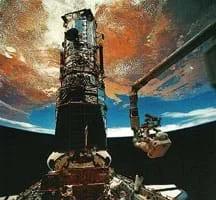 Astronaut Musgrave, on the end of the remote manipulator arm, moves to the top of the Hubble Space Telescope to install protective covers on magnetometers. Astronaut Hoffman (bottom of frame) assists with telescope repair and maintenance tasks during five days of space walks.Copyright Copyright © NASA http://history.nasa.gov/SP-4219/Chapter16.html.
Have students assemble a gallery of images of the cosmos for a classroom display. Start by looking at NASA's many remarkable images, many from the Hubble Space Telescope, at the NASA Solar System Exploration: Multimedia website: https://solarsystem.nasa.gov/resources/all/.
Have students research to find out more about the orbiting Hubble Space Telescope system. Start by looking at a labeled diagram of the telescope. Assign teams of students to research different aspects and components (such as mirrors, light shield, solar panels, instruments, guidance sensors, shuttle bay, communication, overall size and orbit path, advantages compared to large telescopes on Earth, etc), and report back to the class for a joint presentation so everyone learns about all aspects of this amazing telescope. Start with a Hubble Space Telescope diagram at: http://quest.nasa.gov/hst/images/HSTdigram.gif
Show the "Power of Ten" video to take students on a fascinating journey to explore their place in the cosmos, midway between quarks and stars. Borrow the video from the school media center or local library.
For more hands-on activities about spectrography, see Teach Engineering's Spectrography unit.
Zoom in on the spectacular Eagle Nebula image (on page 1 of this lesson) taken with the Hubble Space Telescope in 1995. Click on "About this Image" to learn what the colors mean. See http://oposite.stsci.edu/pubinfo/pr/95/44.html Learn much more about black holes at a highly recommended STSCI Amazing Space website. Includes an interactive feature, "Anatomy of a Black Hole." See the No Escape: The Truth about Black Holes website at: http://amazing-space.stsci.edu/resources/explorations/blackholes/lesson/
Anatomy of a Black Hole. Last updated November 5, 1995. Expo/Science & Industry/Spacetime Wrinkles, National Center for Supercomputing Applications (NCSA), University of Illinois. Accessed April 11, 2007. (Useful teacher background)http://archive.ncsa.uiuc.edu/Cyberia/NumRel/BlackHoleAnat.html
Basics of Space Flight: Chapter 12: Typical Science Instruments. Jet Propulsion Laboratory, NASA. Accessed April 18, 2007. (Useful information on remote- and direct-sensing science instruments, their characteristics, examples, and active or passive sensors – all designed by engineers) http://www2.jpl.nasa.gov/basics/bsf12-1.html
Challenger Center. Challenger Learning Centers. Accessed April 11, 2007. (Realistic mock-ups of mission and control and an orbiting space station) http://www.challenger.org/clc/index.cfm
Constellation X-Ray Mission. Last updated March 22, 2007. Smithsonian Astrophysical Observatory, Goddard Space Flight Center, NASA. Accessed April 11, 2007. http://constellation.gsfc.nasa.gov/
Dictionary.com. Lexico Publishing Group, LLC. Accessed April 11, 2007. (Source of some vocabulary definitions, with some adaptation) http://www.dictionary.com
The Hubble Space Telescope. Last updated February 22, 2007. NASA. Accessed April 11, 2007. http://asd.gsfc.nasa.gov/archive/hubble/
Journey to the Universe. Challenger Center for Space Science Education, Challenger Learning Centers. Accessed April 11, 2007. (Collection of classroom resources for science educators focusing on the Earth, solar system and universe) http://www.journeythroughtheuniverse.org/organization/to_ph.html
NASA Kids Home. Last updated March 28, 2007. NASA. Accessed April 11, 2007. http://www.nasa.gov/audience/forkids/home/index.html
No Escape: The Truth about Black Holes, Teacher Science Background. Amazing Space, Space Telescope Science Institute's Office of Public Outreach. (Useful teacher background) Accessed April 18, 2007. http://amazing-space.stsci.edu/resources/explorations/blackholes/teacher/sciencebackground.html
Seaborg NASA Educator Resource Center. Last updated March 17, 2006. NASA. Accessed April 11, 2007. (Links to online resources; free activity booklets to order by mail) http://www.nasa.gov/centers/glenn/education/ERC_GRC.html
Short, Nicholas, M., Sr. Galaxies, Dr. Nicholas Short's Remote Sensing Tutorial. Last updated January 25, 2007. Remote Sensing Tutorial, Section 20, Cosmology, NASA. Accessed April 11, 2007. http://landsat.gsfc.nasa.gov/education/tutorials.html
Solar System Exploration: Planets Beyond Our Solar System. Last updated March 27, 2006. National Aeronautics and Space Administration. Accessed April 5, 2007. http://solarsystem.jpl.nasa.gov/planets/profile.cfm?Object=Beyond&Display=Overview
StarChild: A Learning Center for Young Astronomers. High Energy Astrophysics Science Archive Research Center, NASA. Accessed April 11, 2007. http://starchild.gsfc.nasa.gov/docs/StarChild/StarChild.html
Stenger, Richard. Posted November 22, 2002. Runaway black hole headed our way. Science & Space, Cable News Network. Accessed April 11, 2007. http://www.cnn.com/2002/TECH/space/11/22/runaway.blackhole/index.html
Contributors
Jessica Todd; Jane Evenson; Sam Semakula; Jessica Butterfield; Malinda Schaefer Zarske; Denise W. Carlson
Supporting Program
Integrated Teaching and Learning Program, College of Engineering, University of Colorado Boulder
Acknowledgements
The contents of these digital library curricula were developed by the Integrated Teaching and Learning Program under National Science Foundation GK-12 grant no. 0338326. However, these contents do not necessarily represent the policies of the National Science Foundation, and you should not assume endorsement by the federal government.
Copyright
2006 by Regents of the University of Colorado.