
Moon Walk
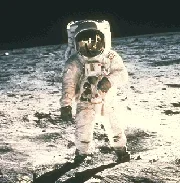 Moon explorationCopyright NASA, http://apod.gsfc.nasa.gov/
Students learn about the Earth's only natural satellite, the Moon. They discuss the Moon's surface features and human exploration. They also learn about how engineers develop technologies to study and explore the Moon, which also helps us learn more about the Earth.
On July 20, 1969, humans took their first steps on the Moon. The Apollo 11 mission was the culmination of one of the most ambitious projects in space exploration engineering design, testing and troubleshooting undertaken to that point. Because of the inventions and designs of engineers, humans have been able to explore places formerly unimaginable. Studying the conditions of a moon or planet and then testing prototype versions of spacecraft for safety before an actual launch is important in engineering.
After this lesson, students should be able to:
- Describe several characteristics of the Moon, such as a natural satellite, reflects the Sun's light, and has no atmosphere.
- Describe the features of the Moon that can be seen by the naked eye from Earth.
- Explain why seasons occur.
- Describe different types of eclipses.
- Explain that engineers develop technologies to study and explore the Moon.
- Gather, analyze, and interpret data about components of the solar system
Grade 4
Do you agree with this alignment? - Utilize direct and indirect evidence to investigate the components of the solar system
Grade 4
Do you agree with this alignment?
- STEL-3D Explain how various relationships can exist between technology and engineering and other content areas.
Grades 3-5
Do you agree with this alignment?
- DCI.ESS1.B.3-5.2 The orbits of Earth around the sun and of the moon around Earth, together with the rotation of Earth about an axis between its North and South poles, cause observable patterns. These include day and night; daily changes in the length and direction of shadows; and different positions of the sun, moon, and stars at different times of the day, month, and year.
Grade 5
Do you agree with this alignment?
The Moon is the Earth's only natural satellite. The current leading theory about the formation of the Moon is that a Mars-sized rock once collided with the Earth and the resulting debris accumulated and merged under high temperatures to form the Moon. The Moon has remained relatively unchanged over billions of years, except for a steady stream of impacts from comets and meteorites. A fine-grained "soil" or dust called regolith covers the surface, caused by this constant bombardment by lunar rocks.
Moon Phases
Depending on the angle at which the Sun's light strikes the Moon, the Moon appears to go through phases in the course of a lunar month, which is actually 29.5 days because the Earth also moves in relation to the Sun. Moon phases are: waxing crescent, first quarter, waxing gibbous, full moon, waning gibbous, third quarter (last quarter), waning crescent, new moon (not visible). Refer to the hands-on associated activity Lunar Lollipops: Reproducing the Moon Phases to help students discover the relative positions of the Earth, Sun and Moon that produce the different phases of the Moon.
Exploring the Moon
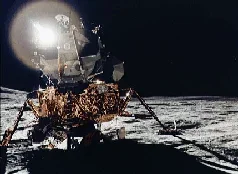 The Sun reflects off the lunar module of the Apollo 14 mission to the Moon as it rests on the lunar surface in February 1971.Copyright Copyright © NASA, http://apod.gsfc.nasa.gov/
On July 20, 1969, humans took their first steps on the Moon. The Apollo 11 mission was the culmination of the most ambitious project in engineering design, testing and troubleshooting undertaken to that point.
The Apollo program (1963-72) was designed to land humans on the Moon and bring them safely back to Earth. The six Apollo missions that landed on the Moon returned a wealth of scientific data and almost 400 kilograms of lunar rock and soil samples. Experiments included soil mechanics, meteoroids, seismic, heat flow, lunar ranging, magnetic fields, and solar wind experiments. More recent missions have discovered ice at the poles of the Moon, deposited during comet impacts.
Eclipses
Eclipses There are two main types of eclipses: solar and lunar. In a solar eclipse, the moon moves between the Earth and the Sun, which results in a blocking (or eclipse) of the Sun's light.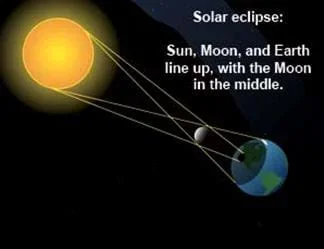 In a solar eclipse, the Sun, Moon and Earth align in a way that makes the moon block us from the sunlight.Copyright http://spaceplace.nasa.gov/venus-transit/en/
In a lunar eclipse, the Earth moves between the Moon and the Sun, which results in the Earth blocking (or eclipse) of sunlight from hitting the moon.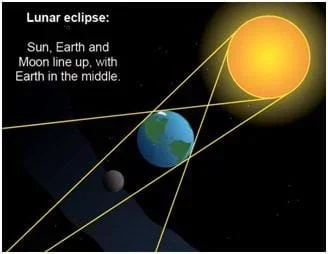 In a lunar eclipse, the Sun, Earth, and moon are aligned in a way that blocks sunlight from reaching the moon's surface.Copyright http://spaceplace.nasa.gov/venus-transit/en/
Seasons
Our Earth is tilted 23.5 degrees on it's axis (see figure). Due to this, as the Earth revolves around the Sun, different hemispheres receive different amounts of light. For instance, during the summer (June, July, Aug), the northern hemisphere is facing the Sun and receiving the most amount of sunlight for the year, hence the summer weather. The Earth is at the opposite side of the orbit during the winter months (Dec, Jan, Feb) facing away from the Sun and consequently receiving the least amount of sunlight all year, hence the winter weather we receive.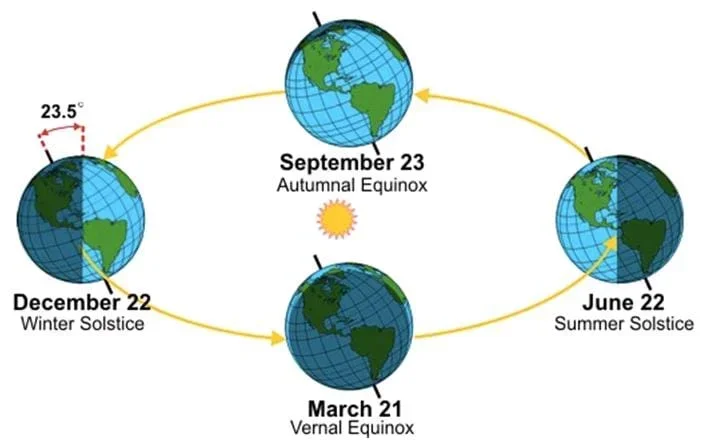 This diagram shows the four seasons and explains why we have the weather we do during those seasons. The seasonal cycle is due to the tilt of the Earth's axis and the resulting change in solar radiation each hemisphere receives as the Earth orbits around the Sun.Copyright http://www.srh.noaa.gov/jetstream/global/global_intro.htm
Quick Facts
Amazing facts about the Moon may be found in Table 1.
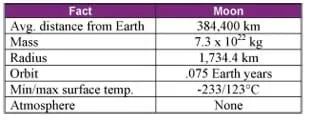 Table 1. Facts about the Moon.Copyright Copyright © Source of facts from NASA, http://solarsystem.jpl.nasa.gov/planets/profile.cfm?Object=Moon&Display=Facts&System=Metric.
The Moon is the Earth's only natural satellite. This means that the Moon rotates, or orbits, around the Earth, much like the TV and cell phone satellites that we have launched into space from Earth ourselves. The difference is that the Moon came to orbit around the Earth without our help.
Did you know that the Moon has no atmosphere? Well, it doesn't. (That means there is no air for you to breathe!) Because the Moon has no atmosphere, sound does not carry. Also, there is no weather on the Moon. In fact, the Moon basically stays the same, except for when a comet or meteor hits it. The footprints that the astronauts made when they first stepped on the Moon's surface on July 20, 1969, are still there today! That's a long time!
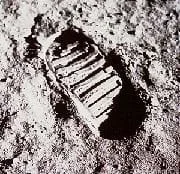 Photo of an astronaut's footprint on the Moon.Copyright NASA, http://nssdc.gsfc.nasa.gov/imgcat/html/object_page/a11_h_40_5878.html.
Have you gone outside to look at the Moon on a clear night? Well, the Moon is so close to us that its main features are easily visible from Earth with just our eyes. What do you see when you look at the Moon? Can you see dark spots and bright spots? Although the Moon has no water, early observers thought the dark areas might be water on the surface of the Moon and named them the maria or "seas" of the Moon ("mare" is the Latin word for "sea"). These are really wide sunken plains that are thought to have formed by the impact when a meteorite or comet hit the Moon. We can also see light areas on the surface of the Moon from Earth. These are highlands or mountains that were formed as a result of these impacts. If you use a good pair of binoculars, it is also possible to view round craters on the surface caused by more recent impacts.
The Moon is the second brightest object in the sky after the Sun. However, it does not make its own light but shines with the reflected light of the Sun. Have you noticed how sometimes the Moon looks full and other times like a sliver? Depending on the angle at which the Sun's light strikes the Moon, it goes through phases in the sky. That is what makes a full moon vs. a quarter moon.
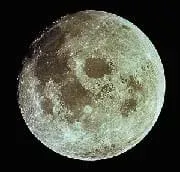 A color photo of the full moon seen from the spaceship Apollo 11.Copyright Copyright © NASA, http://nssdc.gsfc.nasa.gov/
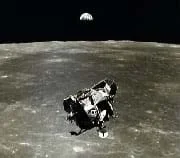 The Earth is visible above the Moon's western horizon and Apollo 11 on July 21, 1969.Copyright Copyright © NASA, http://apod.gsfc.nasa.gov/
The Moon rotates once on its axis in the same amount of time as it revolves around the Earth – 27.3 days. Because of this, the Moon always shows the same side to the Earth. From Earth we are not able to see the "dark side" of the Moon. However, we are able to observe the dark side of the Moon using spacecraft designed by engineers. Engineers also design tools to measure earthshine, or the glow from the dark side of the Moon caused by the light that is reflected by the Earth back into space. The data collected helps scientists study the climate on Earth.
Ever since people began to think about other planets, engineers have been trying to invent ways to explore the Moon. Would you want to live on the Moon? As construction of the International Space Station progresses, Earth's inhabitants are getting another step closer to a permanent Moon base and further exploration of our nearest neighbor in the solar system. You have an excellent chance of visiting the Moon in your lifetime!
The Moon is Earth's only natural satellite. It reflects the light of the Sun, appearing to have phases (or change shape) to the person watching it from Earth. We also learned that the Moon has no atmosphere. No sound travels on the Moon because there is no atmosphere for the sound waves to bounce off of. What else happens on the Moon without an atmosphere? (Possible answers include: There is no weather and the surface of the Moon does not change much over time. There is no air to breathe. There is no wind. There is no sound.)
What does the Moon's surface look like at night from Earth? Have you ever looked at it? The Moon has dark and light spots and sometimes you can even see round crater shapes. What causes the different areas of light and dark on the Moon? (Answer: The texture of the Moon's surface, as impacted by space rocks, such as meteors and comets.)
Engineers help us explore the Moon by creating the technologies — such as spacesuits and spacecraft — that enable astronauts to visit the Moon. Engineers also develop and improve the tools to help us study the Moon from a distance (from Earth), and learn more about the climate of the Earth and how the solar system was formed.
- crater
- A bowl-shaped depression caused by a meteor impact.
- engineer
- A person who applies his/her understanding of science and math to creating things for the benefit of humanity and our world.
- eclipse
- An obscuring of the light from one body (i.e. sun) by the passage of another between it and the observer (i.e. moon passing between Sun and Earth).
- gibbous moon
- A rounded moon, more than half-moon stage but not quite full (waxing) or less than full and approaching half-moon stage (waning).
- lunar month
- The Moon revolves around the Earth every 27.3 days but the lunar month is actually 29.5 days because the Earth is also moving in relation to the Sun.
- maria (plural)
- Large sunken plains on the surface of the Moon that look like dark areas (making the facial features we call the "man in the Moon"); from the Latin word "mare" for "sea"; though the Moon has no surface water, the first observers to view the Moon through telescopes speculated that the dark areas were oceans, hence the name.
- orbit
- The path of a celestial body or human-made satellite as it revolves around another body.
- phases
- Stages marked as the Moon's shape appears to change through the course of the lunar month: waxing crescent, first quarter, waxing gibbous, full moon, waning gibbous, third quarter (last quarter), waning crescent, new moon (not visible).
- regolith
- The fine-grained soil that makes up much of the Moon's surface.
- satellite
- An object (natural or artificial) that orbits around a larger object. For example, the Moon is a natural satellite of the Earth.
- waning
- Getting smaller in appearance.
- waxing
- Getting larger in appearance.
Pre-Lesson Assessment
Discussion Questions: Solicit, integrate and summarize student responses. Ask the students:
- Have you ever looked at the Moon at night?
- Does it look the same every night?
- What does it look like?
- What changes?
Post-Introduction Assessment
Matching: Write the following terms on the left side of the classroom board. Randomly write their definitions on the right side of the board. As a class, have students match the correct sides together (see Figure 1).
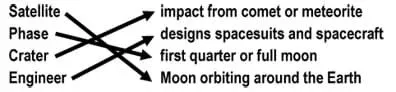 Figure 1. Matching assessment example.Copyright Copyright © ITL Program, College of Engineering, University of Colorado at Boulder. All rights reserved.
Lesson Summary Assessment
Engineering a Moon Walk: We learned that the Moon as no atmosphere, which means that sound waves do not travel on the Moon. So, how do astronauts communicate? The absence of atmosphere also affects gravity or weight; it is easier for astronauts to explore the surface while wearing a heavy spacesuit that it would be on Earth. The Moon reflects the Sun's light, so it is brighter on the Moon than the Earth. These are things that engineers must think about when they design the spacesuits and protective gear for astronauts to wear while exploring the Moon. Using what we learned today the lack of atmosphere on the Moon, draw a picture of a spacesuit you would design for astronauts to wear if you were an engineer. Make sure to label the special parts of the space suit and how they will help the astronauts explore the Moon.
Have students learn more about the Apollo project, which culminated in the first landing of humans on the Moon with the Apollo 11 mission. Students might also be interested in learning more about the near-disaster of the Apollo 13 mission and how engineers saved the day. See the film "Apollo 13" or view episodes of the HBO miniseries "From the Earth to the Moon," produced by Tom Hanks.
Have the students explore the Moon's affect on the Earth's ocean tides.
Have students calculate how much they would weigh on the Moon. A person's weight on the moon is 16.5% what it would be on Earth. To calculate a person's weight on the moon, multiply their weight on Earth by 0.165.
Have students research what the phase of the Moon was on the day they were born using a US Navy website, Virtual Reality Moon Phase: https://stardate.org/nightsky/moon. Make this into a math activity by tallying the number of students born under each moon phase and calculating the percent of the class born under a full moon vs. a new moon, etc.
Show students an animation that illustrates the positions of the Sun, Earth and Moon that result in the various Moon phases. See: https://starchild.gsfc.nasa.gov/docs/StarChild/questions/question3.html.
Designed for elementary school students, this Java applet shows the phases of the Moon for any each day of a selected month. See: https://stardate.org/nightsky/moon. .
Montana State University's Center for Educational Resources (CERES) Project (https://btc.montana.edu/ceres/) provides an extensive library of online and interactive K-12 science education materials for teaching astronomy. The Moon Quest materials provide age-appropriate activities for multi-disciplinary exploration of the Moon in fact and legend
Exploring the Moon. Lunar and Planetary Institute. www.lpi.usra.edu/expmoon/. Accessed February 28, 2007.
Moon Fact Sheet. Updated DATE. Moon Quest, Center for Educational Resources (CERES) Project, Montana State University. btc.montana.edu/ceres/html/MoonQuest/Quemoonfacts.html. Accessed February 28, 2007.
The Moon: Lunar and Planetary Science. Last updated October 31, 2006. National Space Science Data Center, NASA. nssdc.gsfc.nasa.gov/planetary/planets/moonpage.html. Accessed February 28, 2007.
NASA'S Solar System Exploration: Planets: Earth's Moon: Overview. Last updated July 24, 2006. National Aeronautics and Space Administration. solarsystem.jpl.nasa.gov/planets/profile.cfm?Object=Moon&Display=Overview. Accessed February 28, 2007.
Contributors
Jessica Todd; Jane Evenson; Sam Semakula; Jessica Butterfield; Malinda Schaefer Zarske; Denise W. Carlson
Supporting Program
Integrated Teaching and Learning Program, College of Engineering, University of Colorado Boulder
Acknowledgements
The contents of these digital library curricula were developed by the Integrated Teaching and Learning Program under National Science Foundation GK-12 grant no. 0338326. However, these contents do not necessarily represent the policies of the National Science Foundation, and you should not assume endorsement by the federal government.
Copyright
2006 by Regents of the University of Colorado.