
Solar System!
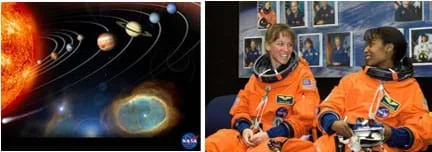 Students explore the solar systemCopyright NASA http://photojournal.jpl.nasa.gov/index.html http://spaceflight.nasa.gov/gallery/images/shuttle/sts-121/html/jsc2006e09832.html
Students are introduced to our solar system—the planets, our Sun and Moon. To begin, students learn about the history and engineering of space travel. They make simple rockets to acquire a basic understanding of Newton's third law of motion.
Engineers apply their understanding of science (laws of motion, energy transfer, solar energy, water cycle, moon phases, gravity, spectroscopy, materials science, human body, chemical analysis) and math (geometry, data collection, velocity calculations, navigation, satellite tracking, fuel efficiency, calculating spacecraft maneuvers) to creating the spacecraft vehicles, equipment, tools and methods to explore our solar system.
If students are interested in astronauts, space walks, rockets, rockets and images of the distant universe, they might want to pursue their dreams and become engineers. More than just aerospace engineers work in the space industry. Biomedical, chemical, mechanical, electrical and computer (and other) engineers work together to make spacesuits, design life support systems, create new materials for spacecraft, and design control systems, cameras, communications, etc. The space industry provides endless opportunities—requiring a wide range and depth of study and expertise. Teams of engineers follow the steps of the engineering design process to create telescopes, deep space antennas, spacecraft, planetary rovers and even how to eat in microgravity, as well as conduct research and cultivate international cooperation.
- 3-5-ETS1-1 Define a simple design problem reflecting a need or a want that includes specified criteria for success and constraints on materials, time, or cost.
Grades 3-5
This resource focuses on the following Three Dimensional Learning aspects of NGSS:
Science & Engineering Practices- Define a simple design problem that can be solved through the development of an object, tool, process, or system and includes several criteria for success and constraints on materials, time, or cost.Do you agree with this alignment?
Disciplinary Core Ideas- Possible solutions to a problem are limited by available materials and resources (constraints). The success of a designed solution is determined by considering the desired features of a solution (criteria). Different proposals for solutions can be compared on the basis of how well each one meets the specified criteria for success or how well each takes the constraints into account.Do you agree with this alignment?
Crosscutting Concepts- People's needs and wants change over time, as do their demands for new and improved technologies.Do you agree with this alignment?
Do you agree with this alignment? - Define a simple design problem that can be solved through the development of an object, tool, process, or system and includes several criteria for success and constraints on materials, time, or cost.
- MS-ESS1-1 Develop and use a model of the Earth-sun-moon system to describe the cyclic patterns of lunar phases, eclipses of the sun and moon, and seasons.
Grades 6-8
This resource focuses on the following Three Dimensional Learning aspects of NGSS:
Science & Engineering Practices- Develop and use a model to describe phenomena.Do you agree with this alignment?
Disciplinary Core Ideas- Patterns of the apparent motion of the sun, the moon, and stars in the sky can be observed, described, predicted, and explained with models.Do you agree with this alignment?
- This model of the solar system can explain eclipses of the sun and the moon. Earth's spin axis is fixed in direction over the short-term but tilted relative to its orbit around the sun. The seasons are a result of that tilt and are caused by the differential intensity of sunlight on different areas of Earth across the year.Do you agree with this alignment?
Crosscutting Concepts- Patterns can be used to identify cause and effect relationships.Do you agree with this alignment?
- Science assumes that objects and events in natural systems occur in consistent patterns that are understandable through measurement and observation.Do you agree with this alignment?
Do you agree with this alignment? - Develop and use a model to describe phenomena.
The following schedule provides a suggested order of the lessons and activities. However, you may choose to only teach some of the activities – as your time and priorities permit.
- Destination Outer Space lesson
- Rocket Power activity
- Blazing Gas lesson
- Our Sun and Heat Transfer Basics: Heat It Up! activity
- Mercury and Venus lesson
- Spacecraft Design: Beat the Heat activity
- Our Big Blue Marble lesson
- The Great Gravity Escape activity
- What Happened to the Water? Designing Ways to Get and Clean Water activity
- Moon Walk lesson
- Lunar Lollipops activity
- Mars and Jupiter lesson
- A Roundabout Way to Mars activity
- Are We Alone? activity
- Edible Rovers activity
- The Outer Planets lesson
- Slingshot to the Outer Planets activity
- Life in Space: The International Space Station lesson
- Lunch in Outer Space! activity
- Muscles, Muscles Everywhere activity
- Beyond the Milky Way lesson
- Building a Fancy Spectrograph activity
- The North (Wall) Star activity
Supporting Program
Integrated Teaching and Learning Program, College of Engineering and Applied Science, University of Colorado Boulder
Acknowledgements
This digital library content was developed under National Science Foundation GK-12 grant no. 0338326. However, these contents do not necessarily represent the policies of the NSF, and you should not assume endorsement by the federal government.
Copyright
2006 by Regents of the University of Colorado