
The Outer Planets
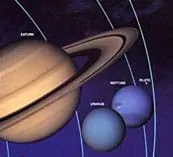 Exploring the solar systemCopyright NASA, http://spacekids.hq.nasa.gov/osskids/animate/mac.html.
Students explore the outermost planets of our solar system: Saturn, Uranus and Neptune. They also learn about characteristics of Pluto and its interactions with Neptune. Students learn a little about the history of space travel as well as the different technologies that engineers develop to make space travel and scientific discovery possible.
The outer planets and Pluto are difficult to study. Their surface features are not easily visible from Earth without the help of modern equipment. Even if these planets were closer, their extreme pressure and weather would not allow humans to visit them. The information that we have so far about the outer planets is due to technologies designed by engineers, such as powerful telescopes and spacecraft with cameras and atmosphere-measuring equipment.
After this lesson, students should be able to:
- List several characteristics of Saturn, including that it is the sixth planet from the Sun, made of gases, and is known for its rings.
- List several characteristics of Uranus, including that it is the seventh planet from the Sun, looks blue-green, and is tilted on its side.
- List several characteristics of Neptune, including that it is the eighth planet from the Sun, looks bright blue, and is very windy.
- List several characteristics of Pluto, including that it is categorized as a dwarf planet, and has an odd-shaped orbit.
- Explain that engineers have made it possible to explore the planets in space.
- Gather, analyze, and interpret data about components of the solar system
Grade 4
Do you agree with this alignment? - Gather, analyze, and interpret data about the Sunrise and Sunset, and Moon movements and phases
Grade 4
Do you agree with this alignment?
- CCSS.Math.Content.4.OA.A.3 Solve multistep word problems posed with whole numbers and having whole-number answers using the four operations, including problems in which remainders must be interpreted. Represent these problems using equations with a letter standing for the unknown quantity. Assess the reasonableness of answers using mental computation and estimation strategies including rounding.
Grade 4
Do you agree with this alignment? - CCSS.Math.Content.6.EE.A.2 Write, read, and evaluate expressions in which letters stand for numbers.
Grade 6
Do you agree with this alignment?
- STEL-2J Demonstrate how tools and machines extend human capabilities, such as holding, lifting, carrying, fastening, separating, and computing.
Grades 3-5
Do you agree with this alignment? - STEL-3D Explain how various relationships can exist between technology and engineering and other content areas.
Grades 3-5
Do you agree with this alignment?
- 5-ESS1-1 Support an argument that differences in the apparent brightness of the sun compared to other stars is due to their relative distances from Earth.
Grade 5
This resource focuses on the following Three Dimensional Learning aspects of NGSS:
Science & Engineering Practices- Support an argument with evidence, data, or a model.Do you agree with this alignment?
Disciplinary Core Ideas- The sun is a star that appears larger and brighter than other stars because it is closer. Stars range greatly in their distance from Earth.Do you agree with this alignment?
Crosscutting Concepts- Natural objects exist from the very small to the immensely large.Do you agree with this alignment?
Do you agree with this alignment? - Support an argument with evidence, data, or a model.
Saturn
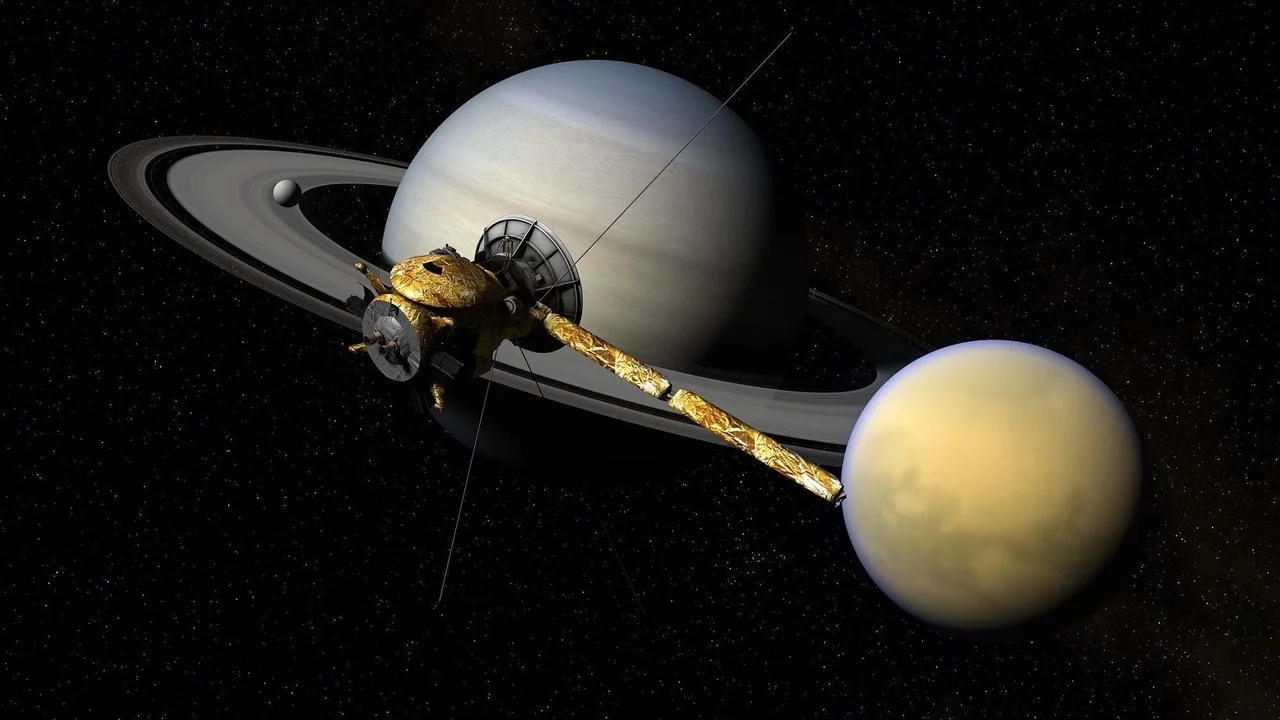 The Cassini spacecraft took seven years to reach Saturn.Copyright Kevin Gill, 2014. https://commons.wikimedia.org/wiki/File:Cassini,_Titan,_%26_Saturn_(15676229671).jpg
Saturn is the sixth planet from the Sun. It is the second largest planet and has rings that were discovered by Galileo in 1610, although he was not able to clearly distinguish that they were rings. Instead, he thought they were arms or handles. Saturn's rings stretch 2.5 times the distance from the Earth and the Moon, but are only a half-mile thick. Saturn is made up of helium and hydrogen and, in 1979, a spacecraft called Pioneer 11 was the first spacecraft to visit Saturn. During this mission, we learned that Saturn has a magnetic field 500 times stronger than Earth's. Saturn has at least 56 moons, the largest being Titan, which has an atmosphere composed of very dense orange clouds.
In 1610, Galileo Galilei was the first to gaze at Saturn through a telescope. Christiaan Huygens, who was a mathematician and physicist in the 1600s, used a high-power telescope and suggested that Saturn was surrounded by a ring. Later, in 1675, Jean Dominique Cassini discovered a gap between an A and a B ring, which we call the Cassini Division. The gravitational influence of Saturn's moon Mimas is responsible for the Cassini Division, which is 4,800 kilometers wide. With improving technology, many more gaps have been discovered since then.
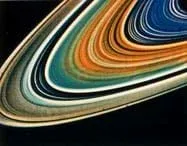 Special equipment on the Voyager 2 spacecraft created this color view of Saturn's ring system.Copyright NASA, http://photojournal.jpl.nasa.gov/catalog/?IDNumber=PIA01486.
Saturn's rings are the most complex in our solar system and are made mostly of water and ice. The ring material ranges in size from a few micrometers to several tens of meters. Two of Saturn's small moons orbit within gaps in the main rings.
Uranus
Uranus is the seventh planet from the Sun, and until the 18th century was unknown to people on Earth. Sir William Herchel discovered Uranus in 1781. Before then it was thought to be a star. He used a 15-centimeter (6-inch) telescope that he designed and built. Uranus is named after the father of Saturn in Roman mythology.
Uranus is very cold and its surface consists entirely of water. To date, we have discovered it has 15 moons. Voyager 2 discovered that Uranus has 11 rings, only nine of these rings are visible from Earth.
In 1986, Voyager 2 furthered our knowledge of Uranus. Uranus is tilted 98°, which makes it perpendicular to its orbit. It is tilted on its side! Sometimes the North Pole points to the Sun and other times the South Pole does. This causes strange days and seasons on Uranus; seasons may last more than 20 years.
Uranus's atmosphere is composed of methane gas, which gives the planet a blue-green color. Sunlight is reflected from the tops of clouds hovering above Uranus, under a layer of methane gas. As the reflected sunlight passes back through the methane layer, the red portion of the light is absorbed, allowing the blue portion we see to pass through.
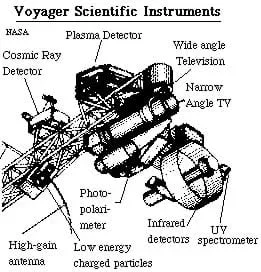 Scientific instruments on the Voyager spacecraft.Copyright NASA, http://www1.jsc.nasa.gov/er/seh/daysJul1.html.
Neptune
Neptune is the eighth planet from the Sun and is not visible with the naked eye from Earth. It was the first planet to be mathematically predicted before it was seen, due to the irregular orbit of Uranus. Neptune was first seen through a telescope in 1846 and was thought to be a twin planet with Uranus until Voyager 2 went past it. Voyager 2 discovered that, unlike Uranus, Neptune has changing weather patterns, and like Jupiter, has a giant storm—The Great Dark Spot— that comes and goes every few years. Voyager 2 also confirmed that Neptune has six rings and at least 13 moons.
At 4.5 billion kilometers from the Sun, Neptune orbits the Sun once every 165 (Earth) years and is the furthest "real" planet from the Sun. Neptune is warmer than Uranus, but its moon, Triton, is possibly the coldest place in our solar system. The composition of Neptune's atmosphere is methane, hydrogen and helium. The storm systems produce winds of 700 miles (1,127 km ) per hour and have clouds composed of frozen methane. Like Uranus, the methane causes Neptune to appear bluish; however, the brilliance of Neptune's blue color suggests that another element is also present.
Pluto
Until recently, Pluto was known as the smallest, coldest planet and the ninth planet from the Sun. On August 24, 2006, the International Astronomical Union formally downgraded Pluto from an official planet to a dwarf planet, which is a celestial body that orbits the Sun and has self-gravity, but has not cleared other things out of the way in its orbital neighborhood. Pluto is a part of a group of objects that orbit in a zone beyond Neptune called the Kuiper Belt.
In 1930, Clyde Tombaugh discovered Pluto while searching for planets because of a strange pull that Neptune and Uranus had away from the Sun. Charon, Pluto's only satellite, was later discovered (1978) rotating around Pluto. Pluto is very small and appears very faint, even when using high-power telescopes. In our solar system, Charon is the largest satellite orbiting a planet, in proportion to the planets' size. Pluto and Charon are in a locked synchronous rotation — a strange phenomenon often referred to as a "double planet system"
Pluto is covered in nitrogen, carbon monoxide and methane ice. During its closer passes to the Sun, the methane and frozen nitrogen are heated and form a thin gas layer. Pluto has the most eccentric orbit of all the planets, which results in Pluto and Neptune switching their positions relative to the Sun, so at times Pluto is closer to the Sun than Neptune. This happens every 228 years and lasts for 20 years, and happened recently, during 1979 to 1999.
Quick Facts
Amazing facts about Saturn, Uranus, Neptune and Pluto may be found in Table 1.
Fact | Saturn | Uranus | Neptune | Plato |
Distance from the Sum (km) | 1,426,725,400 | 2,870,972,200 | 4,498,252,900 | 5,906,380,000 |
Mass (kg) | 5.7 x 1026 | 8.7 x 1025 | 1.0 x 1026 | 1.3 x 10²² |
Radius (km) | 60,268 | 25,559 | 24,764 | 1,151 |
Orbit (in Earth Years) | 29.4 | 84.02 | 164.79 | 247.92 |
Min/Max Surface Temp | -178oC | -216oC | -214oC | -233/-223oC |
Number of Moons | 35 | 27 | 9 | 3 |
Ring System | Yes | Yes | Yes | No |
Atmosphere | Hydrogen, helium | Hydrogen, helium, methane | Hydrogen, helium, methane | Unknown |
Table 1
Today we are going to talk about the outer planets in our solar system — Saturn, Uranus, Neptune and Pluto. Even though Pluto is no longer considered an "official" planet, we will find out about it, too. Let's learn a little more about each of these parts of our solar system, and how engineers help us develop the systems and crafts to explore them. (Optional: Show students an image of all the planets in our solar system, so they understand their relative position from the Sun; see the attached Solar System Map Visual Aid (PDF))
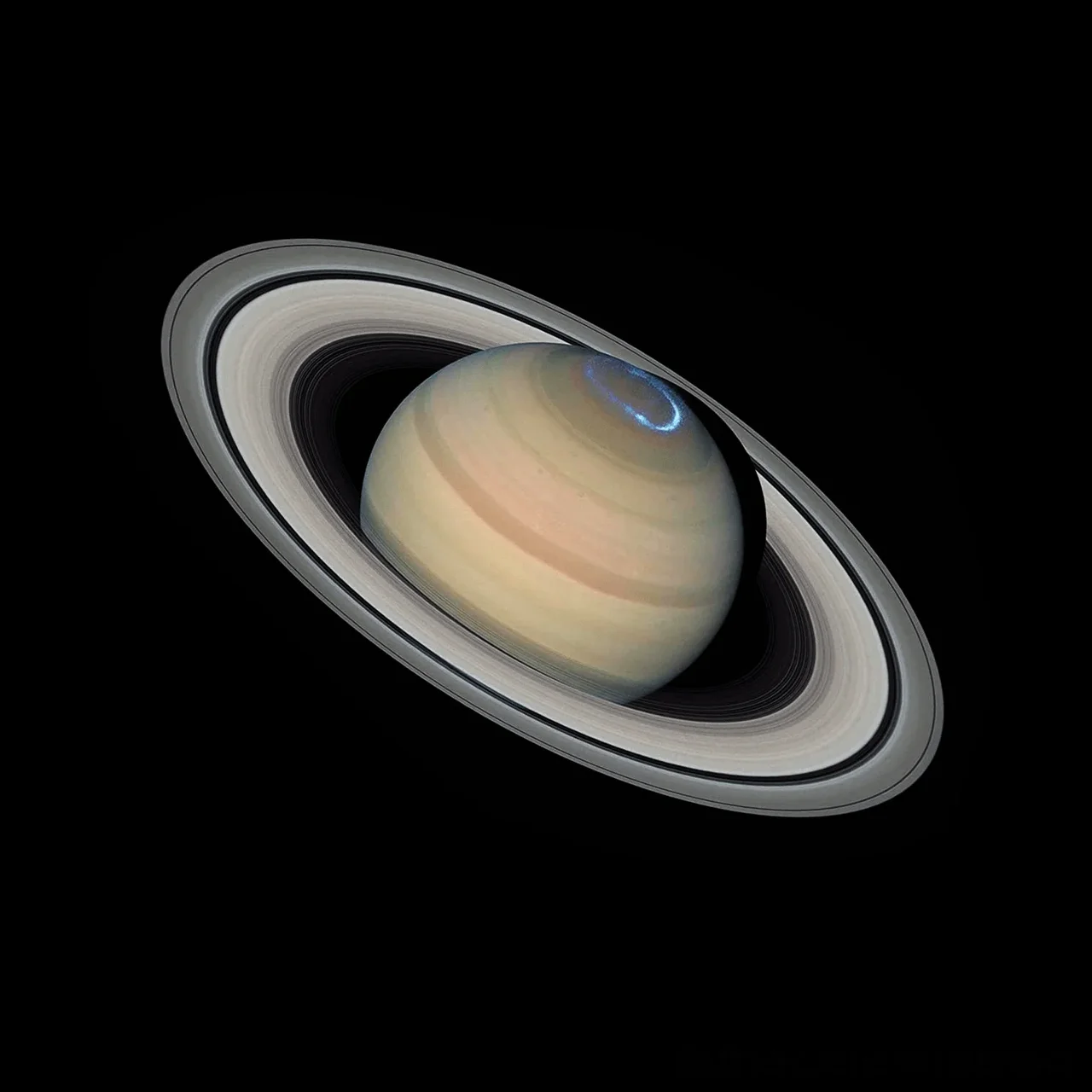 Saturn is the sixth planet from the Sun.Copyright Pablo Carlos Budassi, 2020. https://commons.wikimedia.org/wiki/File:Saturn_black_background.png
Saturn is the sixth planet from the Sun. It is the second largest planet in our solar system, behind Jupiter. Saturn is a lot like Jupiter in that it is mostly made up of gases and does not have a solid surface. It would be impossible to sit or stand on the surface of Saturn. Saturn is most known for its many rings, made of up of ice and rock. The pieces of ice and rock range in size from a grain of sugar to larger than a house, and may have come from comets, asteroids and moons that shattered before they reached the planet. The atmosphere of Saturn has storms, like Jupiter, and the atmospheric pressure is also so great that it would easily crush a spacecraft. In 1997, the Cassini spacecraft was launched to investigate Saturn and its moons. It took seven years to reach Saturn's moon, Titan (it arrived in 2004). While Cassini orbited Saturn, it sent a probe into the atmosphere of Titan to gather data about the planet.
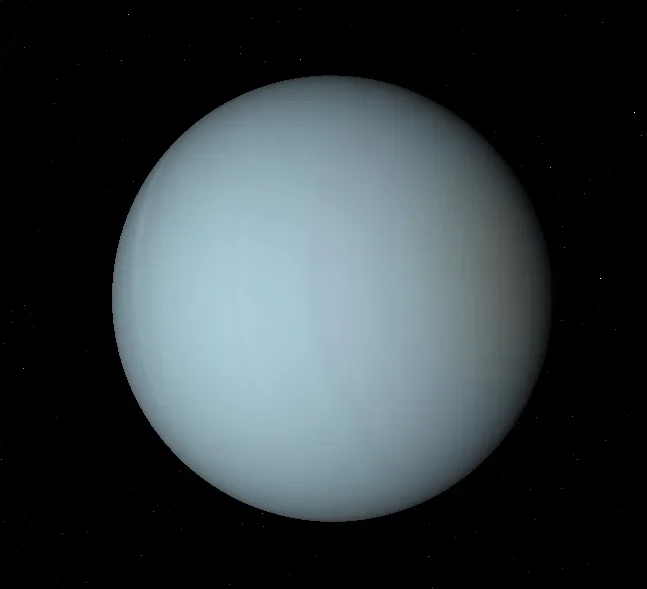 Uranus is the seventh planet from the Sun.Copyright Wikimedia, 2014. https://commons.wikimedia.org/wiki/File:Uranus.png
Uranus is the next planet in line; the seventh planet from the Sun. Uranus is cold and windy and also a gas planet, like Jupiter and Saturn. This means that there is no surface to stand on. Uranus is also like the other planets that have high enough atmospheric pressure to crush a metal spacecraft. One interesting thing about Uranus is that it is tilted, which causes the seasons to last more than 20 years at a time. (That's a long winter!) Scientists think that a long time ago the planet may have been hit by another planet, making it turn on its side. Uranus looks blue-green to us because of its methane gas that absorbs red light from sunlight.
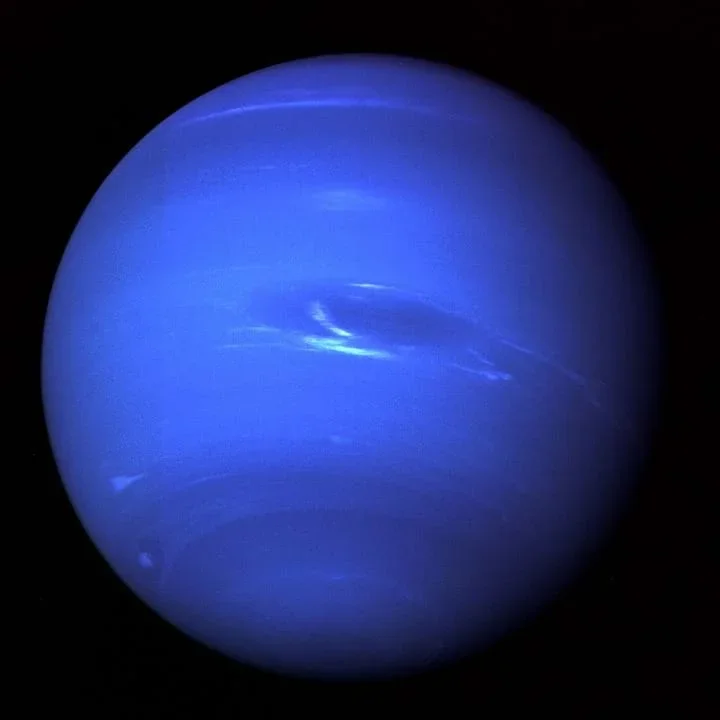 Neptune is the eighth planet from the Sun.Copyright Pixabay, 2013. https://pixabay.com/photos/neptune-planet-solar-system-67537/
Neptune is the next outer planet and the eighth planet from our Sun. It is the fourth largest planet, another gas planet, and so big that 60 Earths could fit inside it. Neptune is a very windy planet and has storms the size of our Earth on it. Inside those storms, winds can blow more 700 miles (1,127 km) per hour! Neptune also looks bluish, like Uranus, from methane gas. However, the brightness of Neptune's blue color makes scientists think another element is also involved. Neptune also has very high atmospheric pressure that makes it unfriendly for humans to visit. There may even be an ocean of super hot water under all of its clouds.
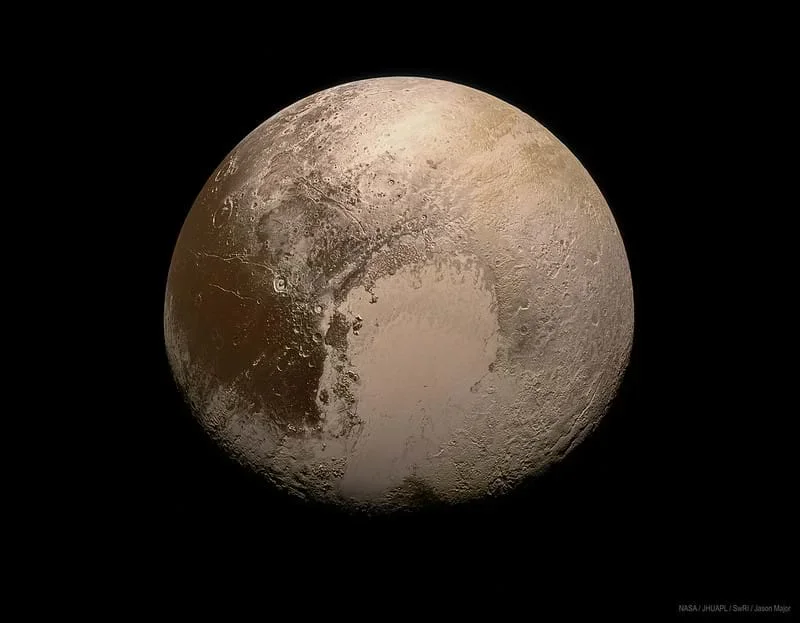 Pluto is a dwarf planet.Copyright Jason Major, 2020. https://www.flickr.com/photos/lightsinthedark/41067808315
Until recently, Pluto was considered the ninth planet from our Sun. In 2006, Pluto was determined to be a dwarf planet instead of a regular planet, because it is not big and strong enough to move other objects out of its path. One cool thing about Pluto is that it has an odd-shaped orbit around the Sun. Because of this orbit, Pluto and Neptune actually switched placed as the farthest from the Sun for 20 years; Pluto and Neptune will trade places again in about 230 years. Pluto is so far from the Sun, that if you were standing on it, the Sun would look like a star! The apparent brightness, or intensity, of a star decreases as you are further away. This relationship is not linear (like a straight line), but actually exponential (squared - a curved line) as shown in the equation below: Copyright Wyatt ChampionIn the equation, b is the apparent brightness, L is the luminosity of the star (this means how much light it gives off), and d is the distance from the star. If you move twice as far away from a star, the star appears four times dimmer than before. If you move ten times as far away from the star, the star becomes 100 times dimmer! The reason for this is that as light moves away from the star in all directions, its intensity is spread out over a larger area (hence the squared relationship).
Because the outer planets and Pluto are so far away, they are difficult to study. Even if they were closer, the extreme atmospheric pressure and weather on these planets would not be a safe environment for humans to visit. The little bit of information and photographs that we have so far about the outer planets are because of modern-day engineering technologies, such as powerful telescopes and spacecrafts with cameras, sensors and atmosphere-measuring equipment.
Engineers must be clever to find ways to gather data from such a great distance and under harsh conditions. On the Cassini–Huygens spacecraft that is investigating Saturn, a spectrometer splits light into different colors, like a glass prism or a raindrop creating a rainbow, so it can see what our eyes cannot. This instrument is special because it is sensitive to invisible heat rays (infrared light) rather than ordinary visible light. Dr. Glenn Orton, a senior research scientist said, "Our instrument looks at the world the way a snake's tongue does — always searching for heat, not light. Another way to look at it is that we're looking at what our skin feels as heat, rather than what our eyes see as light." He added, "What's cool is that CIRS can tell us how hot something is and what's in it — like finding out that there's a hot bowl of soup over there and that it's chicken noodle, not tomato."
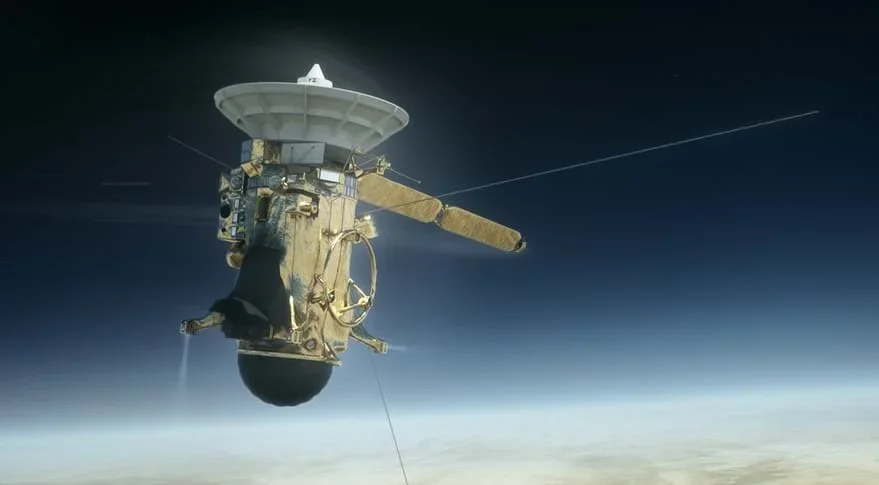 Composite infrared spectrometer (CIRS), an instrument on the Cassini spacecraft.Copyright NASA, https://spacenews.com/nasa-looks-ahead-to-future-saturn-missions-as-cassini-nears-its-end/
Engineers have only been able to send a few space missions all the way out to the planets of Saturn, Uranus and Neptune. These included the Pioneer 11 and Voyager 1 that reached Saturn and the Voyager 2 that reached all three outer planets. The Cassini–Huygens mission launched in 1997 is currently investigating Saturn and its moons. The New Horizons spacecraft launched in 2006 is scheduled for a flyby of Pluto in 2007. Teams of engineers and scientists designed New Horizons so that what it finds out will help us understand more about Pluto and how it fits into our solar system. Following the lesson, students can further investigate the challenges that engineers face with interplanetary space travel by conducting the hands-on associated activity Slingshot to the Outer Planets.
Where do the outer planets fall in the order of planets from the Sun? (Answer: Saturn is the sixth planet from the Sun, Uranus is the seventh planet from the Sun, and Neptune is the eighth planet from the Sun.) Why is Pluto no longer considered a planet? (Answer: Pluto is considered a "dwarf planet" because it acts mostly like a planet, but cannot move other things out of the way in its orbital path.) What are some of the characteristics of the outer planets? (Possible answers include: Far away, hard to explore, and specifically: Saturn is the sixth planet from the Sun, made of gases, and is known for its rings. Uranus is the seventh planet from the Sun, looks blue-green, and is tilted on its side. Neptune is the eighth planet from the Sun, looks bright blue, and is very windy. Pluto is a dwarf planet, and has an odd-shaped orbit.)
The outer planets and Pluto are so far away that they are difficult to study. How do we know as much as we do about them? (Possible answer: Engineers design and create powerful telescopes and spacecraft with cameras, sensors, scientific instruments and atmosphere-measuring equipment that collects data and images about the outer planets.) Remember, there have been only a few exploration missions to the outer planets so far. Some space missions are underway now and some are scheduled for later, during your lifetime. Will you be one of the future engineers who thinks of new ways to find out more about what it is like at the outer edges of our solar system?
- double planet system
- Objects orbiting each other.
- eccentric
- Far from circular.
- engineer
- A person who applies his/her understanding of science and math to creating things for the benefit of humanity and our world.
- locked synchronous rotation
- Rotations in exactly the same period, keeping the same face directed toward the planet of rotation.
Pre-Lesson Assessment
Discussion Question: Solicit, integrate and summarize student responses.
- What do you know about the outer-most planets?
- Have people ever traveled to those planets?
Post-Introduction Assessment
Graphic Organizer: As a class, create a visual organizer of the facts the class just learned about the outer planets. Do this by creating four columns with lists of information, or by drawing four circles (representing planets) and listing the characteristics of each planet inside a circle. Also discuss the perceived brightness of the sun on each planet, remembering that brightness decreases by a factor of the distance squared.
Lesson Summary Assessment
Exploring the Outer Planets: The outer planets and Pluto are so far away that they are difficult to visit. Even if they were closer, the extreme atmospheric pressure and weather on these planets would make them difficult to explore. Have students pretend to be part of mission control for NASA, sending an unmanned spacecraft to the outer planets. What commands would the students give the spacecraft? What things would the students want to spacecraft to check out and explore? Have the students write three simple commands they would give to their unmanned vehicle to explore the outer planets (or have them pick one planet to explore). Example commands might include: Take temperature of Saturn's rings or take a picture of a moon of Uranus.
Planet Flashcards: With the class divided into teams, give each student a blank notecard. Have each student write a question about the planets in our solar system on one side and the answer on the other. If the team members cannot agree on an answer, they should consult the teacher. Pass the flashcards to the next team where each team member reads a flashcard, and the others attempt to answer it. If they are right, they pass on the card to the next team. If they feel they have another correct answer, they should write their answer on the back of the flashcard as an alternative. Once all teams have rotated through all the flashcards, clarify any questions.
Have students find out how much they would weigh on Saturn, Uranus, Neptune and Pluto by using the online calculator at the NASA website locations provided in the Additional Multimedia Support section.
Make a list of past, present and upcoming space missions to the outer planets and hang them up in your classroom.
View some great images of the outer planets on the Internet. Print some photographs to help students really understand what they look like.
At the exploratorium website, type in your weight on Earth to learn how much you would weigh on Saturn, Uranus, Neptune and Pluto: https://www.exploratorium.edu/explore/solar-system/weight
Cassini-Huygens: Mission to Saturn & Titan: Spacecraft-Instruments-Composite Infrared Spectrometer (CIRS). Last updated November 23, 2005. Cassini Orbiter Instruments, Jet Propulsion Laboratory, NASA. Accessed April 18, 2007. http://saturn.jpl.nasa.gov/spacecraft/instruments-cassini-cirs.cfm
Couper, Heather and Nigel Henbest. How the Universe Works. London, UK: Dorling Kindersley Limited, 1994.
Exploring the Planets: GalleryEntrance. National Air and Space Museum. Accessed February 15, 2007. http://www.nasm.si.edu/ceps/etp/
Lafontaine, Bruce. Exploring the Solar System. A Dover Coloring Book. New York, ON: General Publishing Company, Ltd., 1998.
NASA'S Solar System Exploration: Planets: Neptune: Overview. Last updated December 8, 2006. National Aeronautics and Space Administration. Accessed February 15, 2007. http://solarsystem.jpl.nasa.gov/planets/profile.cfm?Object=Neptune&Display=Overview
NASA'S Solar System Exploration: Planets: Pluto: Overview. Last updated February 13, 2007. National Aeronautics and Space Administration. Accessed February 15, 2007. http://solarsystem.jpl.nasa.gov/planets/profile.cfm?Object=Pluto&Display=Overview
NASA'S Solar System Exploration: Planets: Saturn: Overview. Last updated February 13, 2007. National Aeronautics and Space Administration. Accessed February 15, 2007. http://solarsystem.jpl.nasa.gov/planets/profile.cfm?Object=Saturn&Display=Overview
NASA'S Solar System Exploration: Planets: Uranus: Overview. Last updated January 25, 2007. National Aeronautics and Space Administration. Accessed February 15, 2007. http://solarsystem.jpl.nasa.gov/planets/profile.cfm?Object=Uranus&Display=Overview
Contributors
Jessica Todd; Sam Semakula; Jessica Butterfield; Malinda Schaefer Zarske; Denise W. Carlson
Supporting Program
Integrated Teaching and Learning Program, College of Engineering, University of Colorado Boulder
Acknowledgements
The contents of these digital library curricula were developed by the Integrated Teaching and Learning Program under National Science Foundation GK-12 grant no. 0338326. However, these contents do not necessarily represent the policies of the National Science Foundation, and you should not assume endorsement by the federal government.
Copyright
2006 by Regents of the University of Colorado.