
Mars and Jupiter
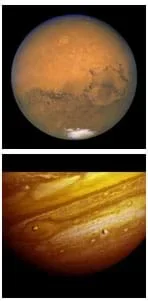 Mars (top) and Jupiter (bottom).Copyright NASA http://solarsystem.jpl.nasa.gov/planets/profile.cfm?Object=Mars&Display=Overview http://pds.jpl.nasa.gov/planets/captions/jupiter/jovian.htm
Students explore Mars and Jupiter, the fourth and fifth planets from the Sun. They learn some of the unique characteristics of these planets. They also learn how engineers help us learn about these planets with the design and development of telescopes, deep space antennas, spacecraft and planetary rovers.
Today's photographs of Mars and Jupiter are testimony to the fact that engineers have been involved in space exploration. All of our knowledge of the atmospheres of these planets was helped by the technologies developed by engineers. Aerospace engineers design airplanes and spacecraft. Astronautical engineers work specifically with spacecraft; they also design, install and test systems for space-bound equipment and ships. Mechanical and electrical engineers also work in the space field, designing and creating components, robots, instruments and computer applications that help us learn more about space. And, some engineers are astronauts!
After this lesson, students should be able to:
- List several characteristics of Mars: fourth planet from the Sun, most habitable planet for humans, called the "red planet," and it has seasons.
- List several characteristics of Jupiter: fifth planet from the Sun, largest planet, more than 60 moons, and made up of gases.
- Explain that the work of engineers makes it possible to explore the planets in space.
- Gather, analyze, and interpret data about components of the solar system
Grade 4
Do you agree with this alignment? - Gather, analyze, and interpret data about the Sunrise and Sunset, and Moon movements and phases
Grade 4
Do you agree with this alignment?
- STEL-2J Demonstrate how tools and machines extend human capabilities, such as holding, lifting, carrying, fastening, separating, and computing.
Grades 3-5
Do you agree with this alignment? - STEL-3D Explain how various relationships can exist between technology and engineering and other content areas.
Grades 3-5
Do you agree with this alignment?
- MS-ESS1-3 Analyze and interpret data to determine scale properties of objects in the solar system.
Grades 6-8
This resource focuses on the following Three Dimensional Learning aspects of NGSS:
Science & Engineering Practices- Analyze and interpret data to determine similarities and differences in findings.Do you agree with this alignment?
Disciplinary Core Ideas- The solar system consists of the sun and a collection of objects, including planets, their moons, and asteroids that are held in orbit around the sun by its gravitational pull on them.Do you agree with this alignment?
Crosscutting Concepts- Time, space, and energy phenomena can be observed at various scales using models to study systems that are too large or too small.Do you agree with this alignment?
- Engineering advances have led to important discoveries in virtually every field of science, and scientific discoveries have led to the development of entire industries and engineered systems.Do you agree with this alignment?
Do you agree with this alignment? - Analyze and interpret data to determine similarities and differences in findings.
Mars
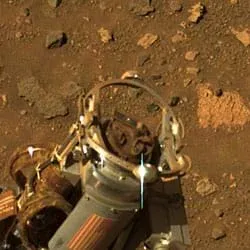 After a soil-brushing experiment, the Mars Exploration Rover Spirit took this photo that shows iron oxide dust on the rock abrasion tool at the end of its robotic arm.Copyright JPL, NASA http://marsrovers.jpl.nasa.gov/spotlight/20060807.html
Mars is the fourth planet from the Sun. It is known as the "red planet" because of its red appearance. Mars has been visited many times by unmanned spacecraft. The first satellite, Mariner 4, reached Mars in 1965. The Viking Landers landed on the surface in 1976. More recently, the Spirit and Opportunity surface rovers landed in 2004 to spend years exploring the terrain, gathering samples and conducting experiments on the soil. Refer to the associated activity Are We Alone? to challenge students to conduct a scientific experiment in which they first establish criteria and then evaluate three "Martian" soil samples looking for signs of life. Why so much interest about Mars? Other than Earth, it has been identified as the most habitable planet for humans. There are also indications that Mars once held life, which could help us better understand the origins of life on Earth as well as other on planets that we do not even know about yet.
Mars is a rocky, dusty and dry planet with red soil (contains iron oxide – rust). Like Earth, the terrain is varied with frozen polar caps that contain carbon dioxide on the South Pole and water-ice mixtures on the North Pole. Mars also has one of the largest volcanoes in the solar system, Olympus Mons. It stands at about 27 km high. For comparison, the highest mountain on Earth (Mt. Everest) is 8.9 km tall (1/3 the height of Olympus Mons!) Mars also contains a canyon system named Valles Marineris. The temperature varies from day to night and is very erratic, reaching -175oF at night and getting up to 1oF during the day. Mars is not a warm place! Mars has two moons, Phobos (fear) and Deimos (panic), named for the horses that pulled the chariot of the Greek god Ares.
Mars also has seasons. The summer temperature barely reaches above freezing and the rest of the year remains very cold and frozen with dust storms. At the North Pole is evidence of seasonal coverings of carbon dioxide on top of the water. Once, we thought there were canals on Mars, but there is not enough water left on Mars to account for the vast network of canals. The poles also have alternating dust and ice. It is speculated that the layers may be evidence of unobserved seasonal changes. Further evidence of more water on Mars is the crater impacts that show outward marks that resemble the patterns of mud being hit.
Jupiter
Jupiter has more than 60 moons. In 1610, Galileo found the four largest of the moons: lo (diameter = 3,630 km), Europa (diameter = 3,140 km), Ganymede (diameter = 5,260 km) and Callisto (diameter = 4,800 km). It is the belief of scientists that the outermost moons (the ones outside of Callisto's orbit) are asteroids captured by the gravity of Jupiter. Jupiter is the fifth planet from the Sun and the largest of all the planets in our solar system. According to NASA, it is twice as large as all of the other planets combined!
Unlike most of the other planets in our solar system, Jupiter is a gas giant made of mostly hydrogen and helium mixed with other trace elements. These gases cause the brilliant color bands on the planet. If a probe were sent through Jupiter, it would find no solid surfaces, and as it traveled further through Jupiter, the gaseous material would become denser. Jupiter has a simple ring system and a huge magnetic field. Near Jupiter are many radioactive particles that make up radioactive belts. The outer magnetosphere extends out 20 times the diameter of Jupiter. Jupiter has winds that reach an excess of 400 km per hour and cause swirling patterns of clouds that change positions quickly in as little as a few hours.
Like other planets, Jupiter has distinguishing features. Its main one is a complex storm known as the Giant Red Spot that is about the size of the entire surface area of Earth! It rotates in a continuous counter-clockwise direction. The Red Spot is made from phosphorus, which condenses five miles above surrounding clouds. This altitude is cool enough to create the red color we see.
Quick Facts
Amazing facts about Mars and Jupiter may be found in Table 1.
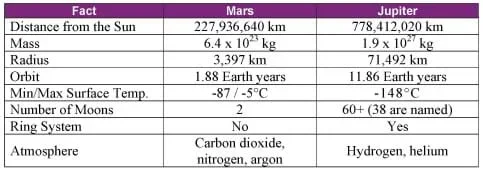 Table 1. Facts about Mars and Jupiter.Copyright NASA http://solarsystem.jpl.nasa.gov/planets/charchart.cfm.
Past Mercury, Venus and the Earth, what are the next two planets from the Sun in our solar system? You've got it! Mars and Jupiter are the fourth and fifth planets from the Sun. (Optional: Show students an image of all the planets in our solar system, so they understand their relative position from the Sun; see the attached Solar System Map Visual Aid). Between them is the asteroid belt.
Let's make a list on the board of facts about these two planets. First Mars is the fourth planet from the Sun. Have any of you seen Mars in the night sky? Well, Mars is one of the brightest objects in the night sky. Sometimes it looks red. It is actually called the "red planet" because of its red soil. If you were on Mars, its sky would look hazy and red (not blue). Even though Mars is a red and rocky planet that is cold and deserted, it is the planet that is the most like our own Earth. Mars may be the next planet that humans could go to live on, but life on Mars would be a lot different from here. While Mars has seasons like Earth, they range from very cold to even colder. In its summer, Mars barely gets above freezing! Brrrr. Also, the atmosphere on Mars is poisonous to humans. You would need to wear a protective spacesuit to breathe on Mars.
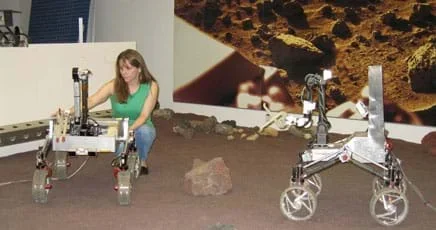 Engineers design, experiment and test prototypes of Mars rovers in an oversized sandbox before they are ready to be sent to the planet.Copyright JPL, NASA http://marsrovers.jpl.nasa.gov/spotlight/20051109.html.
Now let's talk about Jupiter. Jupiter is the fifth planet from the Sun and the largest of all the planets in our solar system. According to NASA, it is twice as large as all of the other planets combined! Jupiter has more than 60 moons. Wow! Jupiter is called a "gas giant" because it is made up of mainly hydrogen and helium. In fact, Jupiter has no solid surfaces. There is no place to stand on Jupiter. Also, Jupiter is under so much atmospheric pressure that a person trying to visit there would be crushed and melted instantly. In fact, the Galileo probe, sent to Jupiter in 1989, only lasted 59 minutes in Jupiter's atmosphere before it was crushed. Have you ever looked at Jupiter through a telescope? If you have, you may have seen the Giant Red Spot. This is one characteristic that you can see on Jupiter. What is the spot? It is actually a huge storm that's about the size of three Earths!
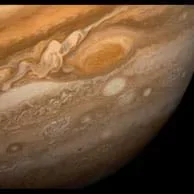 The swirling cloud patterns of the Giant Red Spot of Jupiter — an amazing image taken from the Voyager 1 spacecraft in 1979.Copyright NASA http://pds.jpl.nasa.gov/planets/captions/jupiter/febgrs.htm.
What else do we know about Mars and Jupiter? Mars is named after the Roman god of war, and Jupiter, the largest of our planets, was named after the king of the gods and ruler of Olympus. Are these planets larger or smaller than Earth? Mars is smaller than Earth while Jupiter is so large that more than 1,000 Earths could fit inside of it.
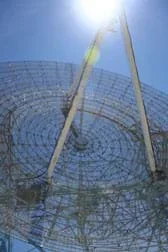 Engineers designed this deep space antenna in California to send radio waves to Mars. Even at the speed of light, it takes 10-20 minutes for a rover instruction or spacecraft data signal to travel the distance, one way!Copyright JPL, NASA http://mars.jpl.nasa.gov/odyssey/spotlight/20051024.html
How do we know all of these things about Mars and Jupiter? Scientists use equipment designed by engineers to observe and study different features of Mars and Jupiter. For example, Percival Lowell (1855-1916), the best-known observer of Mars, saw canals on Mars and hypothesized that they were built by intelligent beings to supply the desert with water from the melting icecaps (which we now know is not true).
Have we ever sent spacecraft to Mars or Jupiter? Yes, we have! The first satellite, called Mariner 4, reached Mars in 1965. Then, the Viking Landers landed on the surface in 1976. Since then, there have been several other missions to Mars to study its unique environment. In 2004, NASA engineers and scientists landed two robotic rovers, Spirit and Opportunity, on Mars to explore the terrain and gather evidence about the planet. These robots move on wheels and maneuver robotic arms to collect soil, rock and atmospheric samples and data. We have also sent spacecraft successfully to Jupiter. Most of these missions were to take photographs and test the gases, pressure, temperatures and other characteristics of Jupiter's environment.
Many different types of engineers are involved in the exploration of the planets, including Mars and Jupiter. Students can act as engineers in the associated activity Edible Rovers by designing their own exploratory rovers under the constraints of materials and budget. Aerospace engineers design the spacecraft, the telescopes and the sensitive instruments and cameras that help us study the environment of the planets. They also design, install and test systems for space-bound equipment and ships. Many other types of engineers — mechanical, electrical, computer, structural, chemical — design and create rockets, fuels, lenses, sensors, robotics, antennas, communication devices and computer programs that help humans explore space. And, some engineers are astronauts! Students can explore orbit transfers and, specifically, Hohmann transfers with the associated activity A Roundabout Way to Mars by learning about the planets' orbits around the Sun, and about a transfer orbit from one planet to the other.
Where do Mars and Jupiter fall in the order of planets from the Sun? (Answer: Mars is the fourth planet from the Sun, and Jupiter is the fifth planet from the Sun.) What are some of the characteristics of Mars and Jupiter? (Possible answers: Mars is called the "red planet," is the planet that is the most like the Earth, and has seasons like Earth, but the seasons go from very cold to even colder. Jupiter is the largest of all the planets in our solar system, has more than 60 known moons, and is made of mainly hydrogen and helium gases.)
Many people think Mars is an important planet to study because there is water and potentially life on Mars. Mars may be the planet that is the most like Earth and some people think it may be the next planet that humans could live on. Why couldn't we live on Jupiter? Well, the intense radiation, toxic gases, atmospheric pressure strong enough to crush a human, and the fact that there is no solid surface means Jupiter is not a place that is very friendly to human habitation.
What types of engineers help us learn about the planets in our solar system? (Possible answers: Aerospace, aeronautical, mechanical, electrical, computer, etc.) Engineers design the spacecraft, telescopes and the sensitive instruments and cameras that help us study the environment of the planets (and take cool pictures of them!).
- asteroid
- Any of the thousands of small bodies of from 775 km to less than a mile (1.6 km) in diameter that revolve about the Sun in orbits lying mostly between those of Mars and Jupiter; also called minor planets.
- asteroid belt
- The region of space between the orbits of Mars and Jupiter in which most asteroids are located.
- density
- The ratio of mass to volume.
- engineer
- A person who applies his/her understanding of science and math to creating things for the benefit of humanity and our world.
- galilean satellites
- The largest moons of Jupiter (Io, Europa, Ganymede and Callisto).
- jovian system
- Moons that make up a miniature solar system around Jupiter.
- magnetosphere
- The magnetic field of a planet; the volume around the planet in which charged particles are subject more to the planet's magnetic field than to the solar magnetic field (Jupiter's is many million times as intense as Earth's).
Pre-Lesson Assessment
Discussion Question: Solicit, integrate and summarize student responses. Ask students to think about the night sky:
- Have you ever looked up at a very dark sky and seen stars?
- Have they ever looked through a telescope at the night sky?
- Have you ever seen a planet among the stars?
- What do you know about Jupiter and Mars?
Post-Introduction Assessment
Voting: Ask a true/false question and have students vote by holding thumbs up for true and thumbs down for false. Tally the votes and write the totals on the board. Give the right answer.
- True or False: Jupiter is the largest planet (Answer: True)
- True or False: Jupiter has one moon. (Answer: False. It has more than 60.)
- True or False: The giant red spot on Jupiter is actually a huge storm that has been going on for centuries. (Answer: True)
- True or False: Mars has seasons like Earth. (Answer: True)
- True or False: Jupiter has a solid surface (Answer: False. It is made up of gases and has no solid surface.)
- True or False: Engineers have designed spacecraft to study Mars and Jupiter. (Answer: True)
- True or False: No spacecraft has ever reached Jupiter. (Answer: False. Many unmanned spacecraft have visited Jupiter to take photographs and learn about its atmosphere.)
Lesson Summary Assessment
Next Mission to Mars: Have students think about what they learned about Mars. What characteristics of Mars make it a possible place for humans live? What would we need to create in the Mars environment in order for humans to live there comfortably? Have students make a list of three or four inventions they would like engineers to create to enable people to live on Mars. (Ideas: Ways to provide air for people to breathe. Ways to keep people warm. Ways for people to grow their own food. Ways to manufacture enough water for drinking and cleaning. Ways to provide ongoing life support [air, water, heating/cooling, food, waste recycling]. Ways to travel on the red dirt and in the Mars atmosphere.)
Have students visit the exploratorium website and find out how much they would weigh on Mars. https://www.exploratorium.edu/explore/solar-system/weight
Have students visit the exploratorium website and learn how much they would weigh on Jupiter. https://www.exploratorium.edu/explore/solar-system/weight
Make lists of completed, existing and/or future space missions to Mars and Jupiter and hang them up in your classroom.
Find more curricular material and activities on the topic of Mars in the grade 7 Mission to Mars unit.
Show students the many great images of Mars and Jupiter available on the Internet or print a few photographs to help them really understand what the planets look like. See NASA's "Welcome to the Planets" website at https://www.gfd-dennou.org/library/wtp/welcome.htm for a collection of the best images from NASA's planetary exploration program.
Couper, Heather and Nigel Henbest. How the Universe Works. London, UK: Dorling Kindersley Limited, 1994.
Dictionary.com. Lexico Publishing Group, LLC. Accessed February 7, 2007. (Source of some vocabulary definitions, with some adaptation) http://www.dictionary.com
Exploring the Planets: GalleryEntrance. National Air and Space Museum. Accessed February 7, 2007. http://www.nasm.si.edu/ceps/etp/
Lafontaine, Bruce. Exploring the Solar System. A Dover Coloring Book. New York, ON: General Publishing Company, Ltd., 1998.
NASA'S Solar System Exploration: Planets: Jupiter: Overview. Last updated August 18, 2006. National Aeronautics and Space Administration. Accessed February 7, 2007. http://solarsystem.jpl.nasa.gov/planets/profile.cfm?Object=Jupiter&Display=Overview
NASA'S Solar System Exploration: Planets: Mars: Overview. Last updated September 20, 2006. National Aeronautics and Space Administration. Accessed February 7, 2007. http://solarsystem.jpl.nasa.gov/planets/profile.cfm?Object=Mars&Display=Overview
Welcome to the Planets. Last updated May 10, 2005. NASA. Accessed February 7, 2007. ( a collection the best images from NASA's planetary exploration program) http://pds.jpl.nasa.gov/planets/
Contributors
Jessica Todd; Geoffrey Hill; Jessica Butterfield; Malinda Schaefer Zarske; Denise W. Carlson
Supporting Program
Integrated Teaching and Learning Program, College of Engineering, University of Colorado Boulder
Acknowledgements
The contents of these digital library curricula were developed by the Integrated Teaching and Learning Program under National Science Foundation GK-12 grant no. 0338326. However, these contents do not necessarily represent the policies of the National Science Foundation, and you should not assume endorsement by the federal government.
Copyright
2006 by Regents of the University of Colorado.