
Rocket Power
By making and testing simple balloon rockets, students acquire a basic understanding of Newton's third law of motion as it applies to rockets. Using balloons, string, straws and tape, they see how rockets are propelled by expelling gases, and test their rockets in horizontal and incline conditions. They also learn about the many types of engineers who design rockets and spacecraft.
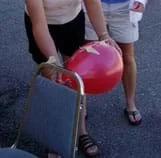 Students make their own balloon rockets
Engineers make it possible for humans to leave our planet and explore space. Every discipline of engineering works together to further space exploration. Mechanical engineers design spacecraft components; aerospace engineers design the craft; electrical and computer engineers design the computer and electrical systems; materials engineers design heat shielding materials and spacesuits; chemical engineers design the rocket fuel; etc. Engineers use their combined knowledge of physics, materials, electronics, mathematics, structures and biology to get humans into outer space.
After this activity, students should be able to:
- Explain Newton's third law of motion using words or pictures.
- Explain why a rocket must work harder to move up as opposed to across.
- List at least two different types of engineers and how they make rockets possible.
- 3.3.1.a Represent and interpret data.
Grade 3
Do you agree with this alignment? - 2.4.2.a.i Measure the length of an object by selecting and using appropriate tools such as rulers, yardsticks, meter sticks, and measuring tapes.
Grade 2
Do you agree with this alignment?
- CCSS.Math.Content.4.MD.A.1 Know relative sizes of measurement units within one system of units including km, m, cm; kg, g; lb, oz.; l, ml; hr, min, sec. Within a single system of measurement, express measurements in a larger unit in terms of a smaller unit. Record measurement equivalents in a two column table.
Grade 4
Do you agree with this alignment? - CCSS.Math.Content.4.MD.A.2 Use the four operations to solve word problems involving distances, intervals of time, liquid volumes, masses of objects, and money, including problems involving simple fractions or decimals, and problems that require expressing measurements given in a larger unit in terms of a smaller unit. Represent measurement quantities using diagrams such as number line diagrams that feature a measurement scale.
Grade 4
Do you agree with this alignment?
- A transportation system may lose efficiency or fail if one part is missing or malfunctioning or if a subsystem is not working.
Grades 3-5
Do you agree with this alignment? - STEL-2F Describe how a subsystem is a system that operates as part of another, larger system.
Grades 3-5
Do you agree with this alignment?
- 3-PS2-1 Plan and conduct an investigation to provide evidence of the effects of balanced and unbalanced forces on the motion of an object.
Grade 3
This resource focuses on the following Three Dimensional Learning aspects of NGSS:
Science & Engineering Practices- Plan and conduct an investigation collaboratively to produce data to serve as the basis for evidence, using fair tests in which variables are controlled and the number of trials considered.Do you agree with this alignment?
- Science investigations use a variety of methods, tools, and techniques.Do you agree with this alignment?
Disciplinary Core Ideas- Each force acts on one particular object and has both strength and a direction. An object at rest typically has multiple forces acting on it, but they add to give zero net force on the object. Forces that do not sum to zero can cause changes in the object's speed or direction of motion. (Boundary: Qualitative and conceptual, but not quantitative addition of forces are used at this level.)Do you agree with this alignment?
- Objects in contact exert forces on each other.Do you agree with this alignment?
Crosscutting Concepts- Cause and effect relationships are routinely identified.Do you agree with this alignment?
Do you agree with this alignment? - Plan and conduct an investigation collaboratively to produce data to serve as the basis for evidence, using fair tests in which variables are controlled and the number of trials considered.
Each group needs:
- 1 balloon (long shape works best)
- 1 plastic drinking straw (cut in half)
- 1 paperclip
- Masking tape
- Measuring tape (or a yard- or meter-stick)
- Rocket Flight Worksheet (PDF), one per person
For the entire class to share:
- Scissors
- Several pieces of fishing line (or fine, smooth string), cut into 30-foot (9-meter) lengths
- Duct tape
How does a rocket fly? Can it fly in space and in Earth's atmosphere? What comes out of the back of a rocket? Rockets fly because of Newton's third law of motion. Newton's third law states that for every action there is an equal and opposite reaction. For example: if you are standing on a skateboard and you push against a wall, what happens? The answer is that you and the skateboard would move in the opposite direction. Here the action is pushing against the wall, while the equal and opposite reaction is the movement in the opposite direction.
Let's say you're in outer space wearing a spacesuit and holding a bowling ball. What do you think would happen if you threw the bowling ball? Would anything happen to you? Think about Newton's third law of motion. What might it tell us about what would happen? The answer is that you would move away from the bowling ball in the opposite direction. In this case, throwing the bowling ball is the action and you moving in the opposite direction is the equal and opposite reaction. This is similar to how a rocket flies, but instead of throwing bowling balls, a rocket pushes lots of gas in one direction, causing the rocket to move in the opposite direction.
So, how does a rocket push this gas? Rockets combust (burn) fuels such as liquid hydrogen. The combustion process causes the fuel to get incredibly hot and expand (just like an explosion). This combustion happens inside the rocket, but the hot gas does not fit very well in the rocket and it creates a lot of pressure. Pressure is when something is pushing very hard on something else. In our case, the gas is pushing very hard on the inside of the rocket. Even though a rocket is very strong, too much pressure will cause it to explode. Since we want our rocket to move and not to explode, we let the gas escape. We put a hole in the bottom of the rocket and use a device called a nozzle to direct the gas behind us. This escaping gas is known as exhaust and it is the action in our rocket. The equal and opposite reaction is our rocket moving in the opposite direction. How much power the rocket provides is called thrust.
Do you think it is easier for the rocket to move straight up (away from Earth) or straight across the surface of the Earth? Why might it be harder to move straight up? Gravity is what makes it harder to move up. Gravity pulls objects down toward the center of the Earth. If we want our rocket to reach space, it has to move up and away from the Earth. This means that rockets have to be extremely powerful to overcome gravity. Has anyone ever seen a rocket on television, in a photograph, or in real life? Do you know what makes up most of a rocket? Do you think its suitcases or cargo or scientific equipment or crew quarters for the astronauts? In reality, it is none of these. Amazingly, most of a rocket is fuel. It takes so much work (energy) to get to outer space that most of a rocket is fuel.
So, who is responsible for designing and building rockets? The answer is engineers. Rockets are complicated and usually very large objects. It takes many different types of engineers to get a rocket to work. Mechanical engineers create the structure of the rocket and make sure it all holds together. Electrical and computer engineers make sure that all the electrical and computer systems on the rocket function. Chemical engineers design the fuels and make sure the rocket gets all the power it needs. Materials engineers design heat shielding material for the outside of the rocket, as well as the astronauts' spacesuits. Aerospace engineers make sure the rocket is shaped in the best way to cut through the atmosphere and they also make sure all the systems work together.
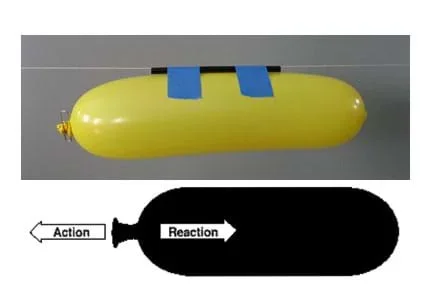 Figure 1. Using a balloon to demonstrate action and reaction.Copyright Balloon photo: Copyright © Denise W. Carlson, ITL Program, College of Engineering, University of Colorado at Boulder, 2007. Balloon diagram: Copyright © NASA, http://quest.nasa.gov/space/teachers/liftoff/basics.html.
Do all rockets require combustion? The only rockets that can make it into space right now require combustion, but some simple rockets do not require combustion. Have you ever blown up a balloon and then let it go without tying it shut? What happens? The balloon acts like a rocket. In fact a balloon is very similar to a real rocket. When you inflate a balloon you are forcing air into a small space. This creates pressure just like a space rocket creates pressure by burning fuel. Just like a rocket, a balloon lets the high pressure escape out a hole in the back. The gas escaping out of the back of the balloon is the action and the balloon moving in the opposite direction is the equal and opposite reaction (see Figure 1). Today, we are going to make balloon rockets and observe Newton's third law of motion in action. We will also see that overcoming gravity is more difficult than flying horizontally.
Before the Activity
- Gather materials and make copies of the Rocket Flight Worksheet. (PDF)
- Set up several rocket courses. Move desks, chairs and tables to create a clear area in the classroom. Tie (or attach using duct tape) each piece of fishing line or string to a classroom wall about one meter above the floor. Space apart the lines evenly, about a meter apart.
With the Students
- Divide the class into teams of two students each. Pass out supplies and worksheets.
- Have students cut the straw in half, making two shorter straws to share with other teams.
- Place an equal number of teams at each rocket course. The teams take turns using the course.
- Have one student from each team inflate the balloon. Twist the open end of the balloon and secure it closed temporarily using a paperclip.
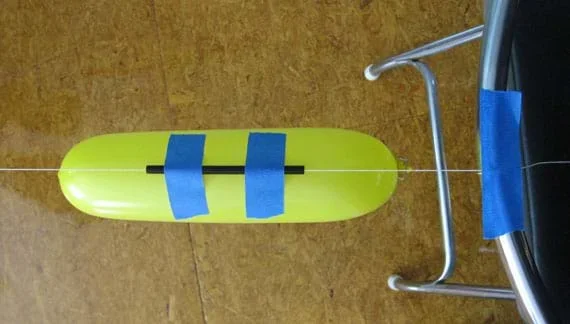
- Next, have the other teammate tape the straw to the balloon so that it is in the center of the balloon with one end facing the balloon top and the other end facing the balloon opening (nozzle). See Figure 1.
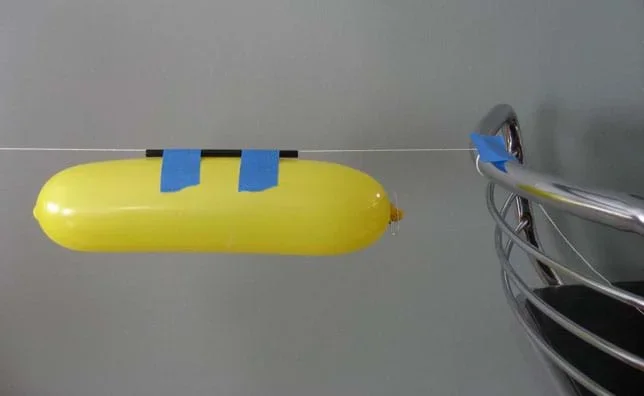 Figure 2. A balloon rocket ready for launch.Copyright Copyright © Denise W. Carlson, ITL Program, College of Engineering, University of Colorado at Boulder, 2007.
- Next, have students thread the string at the unattached end of the course through the straw so that the twisted end of the balloon faces away from the end of the line that is attached to the wall (see Figure 2).
- Instruct one team member to hold the end of the line so that it is taut and level. The other team member makes sure the balloon hangs below the line.
- With the class counting aloud down from 10, have students release the twisted ends of the balloons at zero.
- Give the students a minute to determine how far their rocket flew by measuring how far it went on the fishing line.
- Record the distance traveled on the worksheets.
- Have the teams take turns using the course until each team has launched their rocket three times, and recorded the distances traveled on their worksheets.
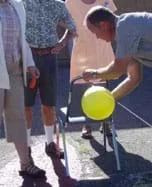 Copyright Copyright © Malinda Schaefer Zarske, ITL Program, College of Engineering, University of Colorado at Boulder, 2004.
- Detach the lines from the far end of each rocket course (from the wall or a chair), and move them up higher, so that each is between 6 and 10 feet (2 or 3 meters) above the floor (as high as you can reach).
- Next, with the lines positioned at an incline and taut, have each group launch their rocket three more times and record the length traveled on their worksheets. Have the students hold the line at the starting end near the ground so the balloons must travel up equal inclines.
- Have students finish their rocket trials and complete their worksheets.
- Conclude by holding a class discussion, comparing results, and conducting the post-activity assessment activities described in the Assessment section. See if students understand Newton's third law of motion. Talk about test results in both horizontal and incline conditions and how the expelled air created thrust.
- combustion
- The process of burning.
- gas
- Tiny particles with enough energy to remain isolated and free floating (as opposed to liquids and solids in which particles group together).
- engineer
- A person who applies his/her understanding of science and math to creating things for the benefit of humanity and our world.
- newton's third law of motion
- For every action there is an equal and opposite reaction. (This is why rockets work!)
- rocket
- A vehicle that moves by ejecting fuel.
- pressure
- The exertion of force upon a surface by an object, fluid, gas (etc.), in contact with it. Force per area. Measured in units of pounds per square inch (psi) or newtons per square meter (N/m^2) or pascals (Pa). Pressure results from collisions of gas molecules with a surface
- thrust
- The forward-directed force on a rocket in reaction to the ejection of fuel.
Pre-Activity Assessment
Question/Answer: Ask the students and discuss as a class:
- How does a rocket fly? (Answer: It expels exhaust in one direction and moves in the other.)
- Is it harder for a rocket to fly straight up or horizontally? (Answer: It is harder to fly up because it must overcome gravity.)
- Who designs rockets? (Answer: Engineers.)
- Which types of engineer? (Answer: Aerospace, mechanical, electrical, computer, materials, chemical, software, systems; it takes many types of engineers, working together, to design a rocket or spacecraft.)
Activity Embedded Assessment
Worksheet: Have students complete the activity using the Rocket Flight Worksheet (PDF). Review their answers to gauge their mastery of the subject.
Post-Activity Assessment
Drawing: Have students design and draw their own space rockets. Have them use arrows to label the action and reaction of Newton's third law of motion.
Engineering Redesign: Ask students how they might improve the design of their balloon rocket. Then have them sketch or test their ideas.
- Advise students not to over-inflate their balloons.
While balloon rockets work with any type of thin string, they work best with smooth and/or fine line because friction is minimized.
Make sure the straw piece is taped to be parallel with the nozzle and direction of the ejected air.
 Copyright Copyright © Denise W. Carlson, ITL Program, College of Engineering, University of Colorado at Boulder, 2007.
Lay down ground rules so that students do not disturb the rocket courses of the other teams.
Alternate set-up for repeated trials: Since it is sometimes hard to blow up a balloon again after a straw has been taped to it, you can save on balloons and time by taping a plastic bag (with the open end positioned away from the rocket direction) to the straw and string, and then inserting a blown-up balloon into the bag for each rocket trial. Point out that inserting the blown-up balloon into the plastic bag is like placing the fuel into the rocket structure, but the "nose cone" is not as efficient as a balloon would be.
Have students brainstorm how they might get their balloon rockets to fly further. Give them extra supplies such as more and different (shape, size) balloons, bigger straws, and paper cups (for creating nose cone shapes). Adding extra balloons is like adding more fuel. Have them design, create and test their new designs. Discuss how the new rockets performed compared to their original rockets. Have students hypothesize why some rockets performed better than others.
Using the distance travelled data from their worksheets, have students convert their distances from their specified unit of measure to other units. (i.e., convert from feet to meters). This allows students to get another representation of how far their balloon rockets travelled by using larger and smaller units. Have students compare these differences by making a two- column table with their measurement equivalents.
- For lower grades, conduct the activity as a teacher demonstration.
- For upper grades, have students experiment with different balloon shapes (rockets) as well as the opening size (straw diameter). Ask students to come up with different prototypes and work through the engineering design process to see which combination of factors produce the best balloon rocket.
- For more advanced students, have them calculate (and graph) the average rocket distance traveled for their horizontal and incline data collected. Have them hypothesize what other factors contribute to the different distances achieved.
Benson, Thomas J. Propulsion Activity. Last updated December 20, 2006. Beginner's Guide to Propulsion, Newton's Third Law and Aircraft Propulsion Activity, Glenn Learning Technologies Project, NASA. Accessed January 12, 2007. http://www.grc.nasa.gov/WWW/K-12/BGP/Shari_N/propulsion_act.htm
Liftoff to Learning: Space Basics. Space Team Online, Learning Technologies Project, NASA Quest. Accessed January 12, 2007. http://quest.nasa.gov/space/teachers/liftoff/basics.html
The Society for International Space Cooperation. Accessed January 12, 2007. http://www.spacesociety.org/
Contributors
Jessica Todd; Sam Semakula; Jessica Butterfield; Geoff Hill; Denise W. Carlson
Supporting Program
Integrated Teaching and Learning Program, College of Engineering, University of Colorado Boulder
Acknowledgements
The contents of this digital library curriculum were developed under a grant from the Fund for the Improvement of Postsecondary Education (FIPSE), U.S. Department of Education, and National Science Foundation GK-12 grant no 0338326. However, these contents do not necessarily represent the policies of the Department of Education or National Science Foundation, and you should not assume endorsement by the federal government.
Copyright
2006 by Regents of the University of Colorado