
Pop Rockets
Students design and build paper rockets around film canisters, which serve as engines. An antacid tablet and water are put into each canister, reacting to form carbon dioxide gas, and acting as the pop rocket's propellant. With the lid snapped on, the continuous creation of gas causes pressure to build up until the lid pops off, sending the rocket into the air. The pop rockets demonstrate Newton's third law of motion: for every action, there is an equal and opposite reaction. An instructions handout, worksheets (English and Spanish) and quiz are provided.
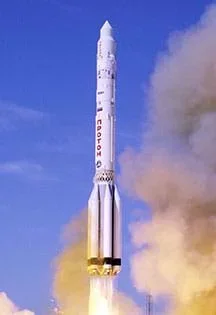 Students model rocket launchesCopyright 2000 NASA https://commons.wikimedia.org/wiki/File:Proton_Zvezda_crop.jpg
Engineers design scale models of projects to learn and experiment with how they perform. When designing rockets, engineers develop small prototypes to test fuel properties. Does the fuel burn too high? Does the fuel create enough thrust? Rocket and engine prototypes help engineers discover the balance between weight and thrust that is necessary for space flight.
After this activity, students should be able to:
- Explain that energy needed for a rocket launch is related to the size of the rocket.
- Collect and analyze data on model rocket launch height, comparing to size or weight of the rocket.
- Describe what factors an engineer must consider when designing a rocket.
- 3.3.1.a Represent and interpret data.
Grade 3
Do you agree with this alignment?
- Energy comes in many forms such as light, heat, sound, magnetic, chemical, and electrical
Grade 4
Do you agree with this alignment?
- CCSS.Math.Content.3.MD.B Represent and interpret data.
Grade 3
Do you agree with this alignment?
- Models are used to communicate and test design ideas and processes.
Grades 3-5
Do you agree with this alignment? - Energy comes in different forms.
Grades 3-5
Do you agree with this alignment?
- 3-PS2-2 Make observations and/or measurements of an object's motion to provide evidence that a pattern can be used to predict future motion.
Grade 3
This resource focuses on the following Three Dimensional Learning aspects of NGSS:
Science & Engineering Practices- Make observations and/or measurements to produce data to serve as the basis for evidence for an explanation of a phenomenon or test a design solution.Do you agree with this alignment?
- Science findings are based on recognizing patterns.Do you agree with this alignment?
Disciplinary Core Ideas- The patterns of an object's motion in various situations can be observed and measured; when that past motion exhibits a regular pattern, future motion can be predicted from it. (Boundary: Technical terms, such as magnitude, velocity, momentum, and vector quantity, are not introduced at this level, but the concept that some quantities need both size and direction to be described is developed.)Do you agree with this alignment?
Crosscutting Concepts- Patterns of change can be used to make predictions.Do you agree with this alignment?
Do you agree with this alignment? - Make observations and/or measurements to produce data to serve as the basis for evidence for an explanation of a phenomenon or test a design solution.
- 4-PS3-4 Apply scientific ideas to design, test, and refine a device that converts energy from one form to another.
Grade 4
This resource focuses on the following Three Dimensional Learning aspects of NGSS:
Science & Engineering Practices- Apply scientific ideas to solve design problems.Do you agree with this alignment?
Disciplinary Core Ideas- Possible solutions to a problem are limited by available materials and resources (constraints). The success of a designed solution is determined by considering the desired features of a solution (criteria). Different proposals for solutions can be compared on the basis of how well each one meets the specified criteria for success or how well each takes the constraints into account.Do you agree with this alignment?
- The expression "produce energy" typically refers to the conversion of stored energy into a desired form for practical use.Do you agree with this alignment?
Crosscutting Concepts- Science affects everyday life.Do you agree with this alignment?
- Energy can be transferred in various ways and between objects.Do you agree with this alignment?
- Engineers improve existing technologies or develop new ones.Do you agree with this alignment?
Do you agree with this alignment? - Apply scientific ideas to solve design problems.
Each student needs:
- 1 35-mm film canister with an internal snapping lid (available online) or 1 mini plastic food container with a snap on lid (available online)
- one-half of an antacid tablet, such as Alka-Seltzer® brand
- 1 sheet of paper
- scissors
- cellophane tape
- markers or crayons
- Pop Goes the Rocket Quiz (PDF)
- Rocket Build Instructions (PDF)
- Rocket Size/Height Worksheet (PDF) (or Rocket Weight/Height Worksheet (PDF))
For the entire class to share
- access to a sink, to obtain and dispose of tap water
- tape or chalk, to mark off the launch area
- safety glasses/goggles, enough pairs for the largest group and instructor
- paper towels, for clean-up
- (if launching inside) pitcher, from which to launch the rockets
Note: For this activity, a film canister with an internal-sealing lid must be used, not one with a lid that snaps over the outside of the rim. These are usually translucent white plastic canisters, not the black plastic ones. Sometimes these film canisters can be obtained for no cost from camera shops and film processing stores (such as grocery stores, Target, Wal-mart, Costco, etc.) where they recycle the canisters and donate them for educational use. You may have to make several trips to obtain enough canisters. Alternatively, purchase the film canisters ($16 for 30 canisters) at https://www.amazon.com/Microlab-Scientific-FCFR-224-Film-Canisters/dp/B00IMUBZFY. Or, instead of film canisters, use mini plastic food storage containers, as long as they have snap-on lids (not twist on), so they work just like the film canister lid; use containers that are small enough so that they are similar in size/volume as the film canisters (1.25-in x 2-in high; 30-mm diameter x 50-mm high). As another idea, use a cork in a bottle, building the rocket on the cork, although this increases the scale of the experiment a bit. The latter two options require some advance experimentation to verify/test/adjust the amount of fuel/antacid that works safely.
Rockets are incredible machines that are designed by engineers and used to explore space. Have you ever seen a rocket or a photograph of one? How do engineers get these heavy vehicles into space? Something very strong is needed to push the rocket upward into the atmosphere and into space. A rocket needs a lot of energy to move.
Let's think about energy. How do we have energy to move our bodies when we get out of bed in the morning or when we walk to school? We get our energy from food; essentially, food is fuel. Well, rockets use propellant, which is a mixture of fuel and an oxidizer to burn the fuel. Large rockets use a lot of propellant in order to create enough energy to reach space. What if we made a model rocket that was very light? Would we need as much energy as a regular rocket? No, probably not.
Antacid tablets have stored chemical energy in them, and this energy can be released when mixed with water. Although it is not much energy, it is enough to launch a small rocket made out of a film canister and paper. And, for our purposes, this particular chemical energy is also a lot safer than burning real fuel.
Engineers build and test rockt models, which they call prototypes, before building the real thing. Doing this helps them in creating the best designs. When designing Tess' rocket, her engineering team must consider many things, such as the weight, cost, thrust and stability of the rocket. We can use small model rockets to test the performance before Tess spends a lot of time building an expensive full-size rocket. By testing small-scale models, engineers make sure rockets will work, without wasting time and money on testing full-size huge rockets. With a scale model, they can test the thrust and stability and make modifications in order to design the best rocket they can. This is what we are going to do today—design model rockets and find out if we can propel them high into the air using simple chemical energy created from Alka-Seltzer® tablets and water.
Before the Activity
- Gather materials and make copies of the Pop Goes the Rocket Quiz (PDF), Rocket Build Instructions (PDF), and Rocket Size/Height Worksheet (PDF) (or Rocket Weight/Height Worksheet (PDF); refer to the Activity Scaling section).
- Find an inside or outside wall suitable for students to launch next to, and use tape or chalk to mark off 10 feet at 1-foot intervals.
- Remove antacid tablets from packaging and break them into halves. A half-tablet is sufficient to pop off a film canister lid; too much antacid makes the lid pop off sooner, which is not desirable for this activity.
With the Students
- Divide the class into groups of three or four students each. Give each student a film canister and sheet of paper. Hand out the various attachments, as needed, throughout the activity. (Note: Give out the antacid tablets only as needed so that you know that all tablets are accounted for and used only in the experiment.)
- Direct students to use scissors and tape to follow the instructions to build a rocket. Encourage groups to experiment with different sizes. Tips: Make sure students put the lids of their canisters at the bottom of the rocket (that is, so the canister is inverted.) Also, make sure the canister lid sticks out from the paper a little so that the paper surrounding the rocket does not interfere with the lid snapping on or popping off.
- Have students put their names and any designs on the rocket paper surface.
- One group at a time, have students move to the launch area to prepare to launch. Note: Require students to wear safety glasses/goggles during their launches and put them on BEFORE the launch begins. Have all other students watch from a safe distance away from the launch area, ready to record the results on their worksheets.
- To launch, have a student hold his/her rocket upside down, and carefully fill the canister 1/3 full of water.
NOTE: The next steps must be done quickly:
- One at a time, have a student drop the half-tablet of antacid into his/her film canister.
- Quickly, snap the lid on tightly.
- Very quickly, turn the rocket upright (which means that the film canister lid is down) into the empty pitcher or onto the flat launch site and stand back!
Expect the rocket to pop within 1-5 seconds.
- Ask students to note the maximum height reached by the rockets and have them record this information on their worksheets.
- Give the popped lid back to the student launcher and repeat steps 6-9 for each student in each group.
Pre-Activity Assessment
Concept Inventory: Have students attempt the Pop Goes the Rocket Quiz (PDF). Have students answer the first two quiz questions and then it put aside to complete after the activity.
Activity Embedded Assessment
Data Recording: As directed in the Procedure section, have students decide if the rocket is small (S), medium (M) or large (L) before it is launched. Then, after each rocket is launched, have students measure the maximum height reached by the rocket and record it on the appropriate box in their Rocket Size/Height Worksheets (PDF). Discuss any patterns in rocket size or weight versus launch height.
Post-Activity Assessment
Pairs Check/Concept Inventory Continued: Have students complete question 3 of the Pop Goes the Rocket Quiz (PDF) (begun during pre-assessment). After students finish working individually on the quiz, have them compare answers with a peer, giving all students time to finish. Finally, go over the answers as a class.
Survey: Ask the following questions (verbal or written) to survey students about the activity. Have students use what they observed in the activity to help answer the questions.
- What makes one rocket perform better than another? (Answer: Many factors such as weight, drag, thrust [rate of gas build up], canister symmetry, canister seal tightness, and wind can affect rocket performance.)
- What is creating the thrust in our pop-rockets? (Answer: The high pressure built up from the chemical reaction of the antacid tablet and water in the canister forces the cap off and downward as the rocket moves upward—an illustration of Newton's third law of motion.)
- If students previously performed a strawket activity from Lesson 2 of this unit, ask them to compare how these rockets are more "rocket-like" than those launched by a straw? (Answer: Like real rockets, these pop rockets carry their own fuel.)
- How are pop rockets related to real rockets? (Answer: Real rockets behave according to Newton's laws of motion just like pop rockets do. Also, solid propellant rockets have a similar process by releasing energy through a chemical reaction to generate thrust.)
- Use your observations and/or measurements of the motion of the pop rockets to provide evidence that a pattern can be used to predict future motion.
Sales Pitch! Have students pretend to be inventors selling their rockets to a manufacturers or consumers. Have student teams create persuasive posters or flyers, as well as 10-minute sales pitches of their rocket designs for presentation at the next class. Have them include in their advertising a description of where the energy comes from to launch the rocket.
- Make sure students wear safety glasses/goggles while they are launching their rockets.
- Make sure that students who are not launching stay a safe distance away from the launch area.
- Remind students not to put the antacid tablets in their mouths; if a student eats an entire tablet s/he could become sick.
- Hand out the antacid tablets only at launch time; do not give each group a "supply" in advance.
Common student problems when building rockets:
- Forgetting to tape the film canister to the rocket body.
- Failing to mount the canister with the lid end down.
- Not extending the canister far enough from the paper tube to make snapping on the lid easy.
It may be easier for students to build the rockets and have the teacher launch them since the chemical reaction of the antacid and water sometimes happens too fast for small hands.
Warn students to stand back when the rockets are launching, so that they do not get hit with flying canister parts.
Have students experiment with different amounts of water and tablet sizes. Make sure students wear safety glasses/goggles when launching their rockets.
Have students launch for distance instead of height. Have them measure the launch angle and record data for multiple angles.
For kindergarten and first-grade students, conduct the activity as a demonstration instead of having students individually make their own rockets. Prior to class, make several different-sized rockets with no fins and then have students each color a fin to put on the rockets. Have students count the number of fins on each rocket. Have students count out loud to see how long it takes each rocket to "pop." Instead of using the Pop Goes the Rocket Quiz as an assessment, ask students what geometric shapes they see in the pop rockets. Then, ask for a choral response to these basic questions:
- Why does the rocket come back down when shot up? (Answer: Gravity)
- Where is the energy coming from to power the rocket? (Answer: The antacid table and water reaction.)
For second-grade students, build the rockets as indicated, but help them with the launching procedure, as necessary.
For fourth- and fifth-grade students, also have them measure the mass of their rockets on a scale before launching them. Then, have them calculate the rocket weights using the equation: weight = mass × (acceleration due to gravity). Provide students with the Rocket Weight/Height Worksheet (PDF) to record their data, instead of the Rocket Size/Height Worksheet.
Fisher, Diane. National Aeronautics and Space Administration. Space Place, "Build a Bubble-Powered Rocket," September 8, 2005. http://spaceplace.nasa.gov/pop-rocket/
The Society for International Space Cooperation. Space Xpress, International Space Station Curriculum and Activities, "Film Canister Rockets." http://www.spacesociety.org/spaceexpress/Curriculum/film_canisters.html
- Rockets
- Keep in Touch: Communications and Satellites
- Newton Gets Me Moving
- Using Thrust, Weight & Control: Rocket Me into Space
- Blast Off: Generating Rocket Thrust with Propellants
- Fuel Mystery Dis-Solved!
- Aqua-Thrusters!
- Pop Rockets
- Learn to Build a Rocket in Five Days or Your Money Back
- Where Am I: Navigation and Satellites
Contributors
Jeff White; Brian Argrow; Luke Simmons; Jay Shah; Malinda Schaefer Zarske; Janet Yowell
Supporting Program
Integrated Teaching and Learning Program, College of Engineering, University of Colorado Boulder
Acknowledgements
The contents of this digital library curriculum were developed under grants from the Fund for the Improvement of Postsecondary Education (FIPSE), U.S. Department of Education and National Science Foundation (GK-12 grant no. 0338326). However, these contents do not necessarily represent the policies of the Department of Education or National Science Foundation, and you should not assume endorsement by the federal government.
Copyright
2006 by Regents of the University of Colorado