
Strawkets and Thrust
Students investigate the effect that thrust has on rocket flight. Students make two paper rockets that they can launch themselves by blowing through a drinking straw. These "strawkets" differ in diameter, enabling students to see how rockets with smaller exit nozzles provide more thrust. Students compare the distances traveled by their two strawkets after predicting where they will land. Since each student has a slightly different rocket and launching technique, they also observe which factors contribute to a strawket's thrust and performance.
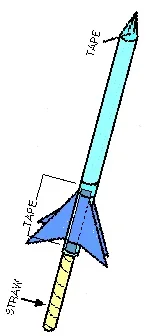 Figure 1. A strawket.Copyright 2004 Gregory Vogt, Oklahoma State University for NASA Aerospace Education Services Project http://www.grc.nasa.gov/WWW/K-12/TRC/Rockets/paper_rocket.html
Engineers must know about thrust in order to design successful rockets. And, they must understand Newton's laws of motion as well as how exhaust behaves in order to calculate the thrust needed for a rocket to reach its destination. How engineers design the shapes of rocket nozzles is very important to the performance and thrust of rockets. The nozzle size and shape effects how fast the exhaust leaves the rocket as well as how much pressure it has.
After this activity, students should be able to:
- Describe thrust and what factors can affect it.
- Identify some factors that engineers must consider when designing real rockets, including safety.
- 4.3.1 Visual displays are used to represent data.
Grade 4
Do you agree with this alignment? - 3.3.1.a Represent and interpret data.
Grade 3
Do you agree with this alignment? - 3.3.1.a.i Draw a scaled picture graph and a scaled bar graph to represent a data set with several categories.
Grade 3
Do you agree with this alignment?
- CCSS.Math.Content.3.MD.B.3 Draw a scaled picture graph and a scaled bar graph to represent a data set with several categories. Solve one- and two-step "how many more" and "how many less" problems using information presented in scaled bar graphs.
Grade 3
Do you agree with this alignment? - CCSS.Math.Content.4.MD.B Represent and interpret data.
Grade 4
Do you agree with this alignment?
- Models are used to communicate and test design ideas and processes.
Grades 3-5
Do you agree with this alignment? - Test and evaluate the solutions for the design problem.
Grades 3-5
Do you agree with this alignment?
- 3-5-ETS1-3 Plan and carry out fair tests in which variables are controlled and failure points are considered to identify aspects of a model or prototype that can be improved.
Grades 3-5
This resource focuses on the following Three Dimensional Learning aspects of NGSS:
Science & Engineering Practices- Plan and conduct an investigation collaboratively to produce data to serve as the basis for evidence, using fair tests in which variables are controlled and the number of trials considered.Do you agree with this alignment?
Disciplinary Core Ideas- Tests are often designed to identify failure points or difficulties, which suggest the elements of the design that need to be improved.Do you agree with this alignment?
- Different solutions need to be tested in order to determine which of them best solves the problem, given the criteria and the constraints.Do you agree with this alignment?
Do you agree with this alignment? - Plan and conduct an investigation collaboratively to produce data to serve as the basis for evidence, using fair tests in which variables are controlled and the number of trials considered.
Each student needs:
- 1 piece of letter-sized paper (8.5 x 11 inches), cut in half, resulting in 2 half-sized pieces each measuring 8.5 × 5.5 inches
- 1 pencil
- 1 drinking straw
- 1 cotton ball
- Thrust Quiz (PDF)
- Thrust Analysis Worksheet (PDF)
- Results from the Earth Math Sheet (PDF) or Results from the Earth Math Sheet (PDF)
For the entire class to share:
- target pictures of each of the nine planets: Inner Planets Target (PDF) and Outer Planets Target (PDF)
- cellophane tape provided in several dispensers
- tape or string, to mark a starting line
- Launch from the Earth Handout (PDF) or Launch from the Sun Handout (PDF)
- Inner Planet Targets (pdf)
- Outer Planet Targets (pdf)
- Thrust Analysis Worksheet (pdf)
- Launch from the Earth Handout (pdf)
- Launch from the Sun Handout (pdf)
- Results from the Earth Math Sheet (pdf)
- Results from the Sun Math Sheet (pdf)
- Planet Comparison Datasheet (xls)
- Color Your Own Planet Handout (pdf)
- Thrust Quiz (pdf)
- Thrust Quiz Answers (pdf)
How does a rocket make it all the way into space? It's not as easy as it looks. Rockets that fly into space are very heavy and require something powerful to "push" them. Engineers design rocket engines to do just that! The push that a rocket engine provides is called thrust. Do you remember which law helps us describe thrust? That's right, Newton's third law of motion states that for every action, there is an equal and opposite reaction. That means that as the rocket engine pushes hot gases (mass) out of the rocket, the rocket propels (pushes) forward into space. That forward push is called thrust.
In order to create a successful rocket for Tess, her engineering team must understand thrust and know how much force (push) it is creating. What do you think could affect the thrust of a rocket? Perhaps a bigger engine? Well, there are some other things that engineers can do to affect thrust as well.
How an engineer designs the shape of the rocket nozzle is very important to the performance and thrust of the rocket. The size and shape of the nozzle effects how fast the exhaust will leave the rocket as well as how much pressure it will have. Tess' engineering team must perform many complex mathematical calculations in order to design a nozzle that will create enough thrust to launch the rocket into space.
Today, we are going to design two paper rockets with different nozzle shapes. Although we will not be performing all the math calculations, we will still understand how the different sized nozzles affect thrust. And, we will use our own mouths as rocket engines! By blowing air out of our mouths, we can launch our paper rockets into the air. We are also going to put cotton balls on the end of our paper rockets. For what reason, do you think, the cotton is added? Well, engineers have to take safety into consideration when designing rockets as well, no matter what the size of the rocket. Today, with our small paper rockets, we will be taking safety into account by adding a soft cotton ball to the front of the rocket to protect its landing. Come on, let's go build some rockets!
Before the Activity
- Gather materials and make copies of the Thrust Quiz (PDF) and Thrust Analysis Worksheet (PDF).
- Print out the planet targets, Inner (PDF)and Outer (PDF). If possible, do so in color and laminate for reuse.
- Cut enough pieces of letter-sized paper into halves so that each student receives two halves. Note: Almost any size paper can be used as long as it is not longer than the straw.
- Remove the straws from their paper wrappers, if necessary.
- Mark a starting line on the floor with tape or string.
- Lay out the planet targets on the floor beyond the starting line. For a somewhat realistic layout, use one of the attached patterns: Launch from the Earth (PDF) or Launch from the Sun (PDF). Note: Refer to the Planet Comparison Datasheet (XLS) for actual planet diameters and distances.
With the Students
- Administer the pre-activity quiz, as described in the Assessment section.
- Present to the class the Introduction/Motivation content.
- Hand out materials.
- Have students wrap one half-sheet of paper around a pencil, starting from the eraser end and working up to the graphite tip. When wrapping, spiral the paper to make a cone shape (see Figure 2); it helps to hold it tighter at the eraser end and wrap upward.
 Figure 2. A cone-shaped paper tube.Copyright 2003 Jeff White, College of Engineering and Applied Science, University of Colorado at Boulder
- Have students tape the paper tube near each end so it keeps its shape. Then remove the pencil. Check the final length of paper tubing to make sure it is at least a few centimeters shorter than the straws; otherwise, students will have nothing to hold onto for the launch. If necessary, use scissors to cut the paper tube shorter.
- Have students pinch and fold the smaller end of the tube over and tape it so it is airtight. This end is the "nose" of the strawket. See Figure 1.
- Because engineers always consider safety measures in their designs, direct students to tape a cotton ball to the nose of each strawket. To prevent the cotton from falling off the strawket, place the tape over the top of the cotton ball (that is, not wrapped inside/out and placed underneath the cotton ball as it sits on the nose of the paper tubing). Note: Some cotton balls are big enough to pull apart; only use as much cotton as necessary to provide some protective padding.
- Have students personalize their strawkets. Suggest they write their names or draw designs on them so they know which one is theirs.
- Have students sketch their strawket on their worksheets.
Blast Off Procedure
- Have each student launch from the Earth or Sun (depending on the pattern you selected before the activity) using the Launch from the Earth or Launch from the Sun Sheets. To do this, have students insert their straws into their strawkets—holding onto the straw, not the paper part of their strawket—aim at a planet, and blow.
- After retrieving their strawkets, direct students to answer the three worksheet questions for the strawket they just launched.
- Next, have students make a new strawket. Take another half-sheet paper and wrap it tightly around a pencil—without spiraling into a cone shape—to make a tight paper tube that is more even in diameter along the length of the tube. See Figure 3. Again, be sure the final length is a few centimeters shorter than the straws to leave available some length of the straw to hold onto for the launch! Note: If students have trouble wrapping this tube, assure them that a slight cone-shape is acceptable as long as the tube is tighter than their first designs.
- Repeat steps 1 and 2.
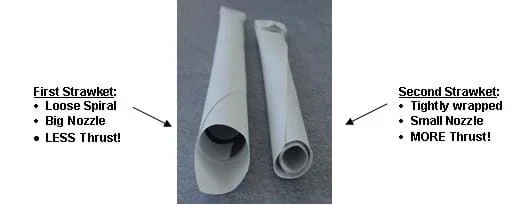 Figure 3. Strawket design comparison.Copyright 2004 Jeff White; modified by Luke Simmons, College of Engineering and Applied Science, University of Colorado at Boulder
- Guide students to create graphs, and then revisit their quiz answers, as described in the Assessment section.
- thrust
- To push (someone or something) with force. The forward-directed force of a rocket engine or jet as a reaction to the ejection of exhaust gases.
Pre-Activity Assessment
Concept Inventory: Administer the Thrust Quiz (PDF) as students' first attempt at the questions. Have students write their answers and then set it aside to review and discuss after the activity.
Activity-Embedded Assessment
Worksheet: Have students record measurements and follow along with the activity on their Thrust Analysis Worksheets (PDF). After the worksheets are completed, have them compare answers with their peers.
Roundtable: Have the class form into teams of 3–5 students each. Ask the class a question with several possible answers. Have the students on each team make a list of answers by taking turns writing down ideas on a piece of paper (that is, students pass the list around the group until all ideas are documented). Have one representative from each team read aloud the answers while another representative writes them on the board. Ask the students:
- What makes one strawket perform better than another? (Answer: Many factors, including: mass, acceleration, nozzle shape, strawket body shape, air leaks in the strawket, launch angle, and friction between the straw and paper cone.)
Post-Activity Assessment
Graphing Practice: Have students create bar graphs of the class results using either the Results from Earth (PDF) or Results from Sun (PDF) math sheet (depending on where the students started their rocket from in step 7, either the Earth or the Sun).
Concept Inventory Continued: Have students correct any answers they missed from the pre-activity Thrust Quiz (PDF). Ask the students the following question:
- Could you change the strawket nozzle (the tail end) any other way to get more thrust? (Answer: Use a smaller diameter straw and tighter paper wrap while blowing as hard as before. Another idea is to plug the back with something so the air pressure builds up before launch and then "pull the plug.")
Strawkets should not be launched while the previous student is retrieving her/his strawket. Specifically, strawkets should not be launched at another person.
Make a strawket or two in advance to confirm that your materials are suitable. Also, it is a good idea to have some extra strawkets in case someone's gets lost or crushed during the activity.
If you do not have access to enough pencils, use extra drinking straws instead to help wrap the paper cone.
Distributing tape to each student can be difficult while demonstrating how to build. If possible, have have several helpers pass out the tape or have pieces stuck on the table edges in advance.
The tape used to secure the cotton balls should be fairly long so they are adhered properly.
Make sure kids are not holding onto the bottom of the rocket when they blow through the straw!
Have students measure the distances their individual strawkets traveled and record each attempt. Have them graph the data to show that their distances improve with practice.
Try to determine how high the strawkets fly. To do this, place masking tape markers on a wall at measured distances from the floor to the ceiling. While one student launches the strawket along the wall, another student compares the height the strawket reached with the tape markers. Be sure to have the students subtract the height from where the strawket was launched from the altitude reached.
Have students create an air pressure device that will deliver a consistent force to the strawket during each launch.
Measure the angle of the launch straw and distances their strawket travels for varying angles. Plot the data to see the correlation and find the angle that gives the maximum distance.
Can students come up with any other design improvements, for example, less weight, high pressure air blower, fixed launch position, etc.?
This is a great activity for younger students. Kindergarten and first-grade students may need a little help with taping, but many can do it. Before beginning the activity, discuss air and force as a class. Ask, "Can air push things?" (Answer: Yes; wind is an example.) Then say, "This is a property of air that we can use in engineering. Today we will use air to launch rockets!" Have the students make just the first strawket and let them do several launches. Have students count down to launch and the number of strawkets that make it to each planet. Make a bar graph to help them visualize the numbers (use either the Results from the Earth Math Sheet (PDF) or Results from the Sun Math Sheet (PDF) ). If time allows, demonstrate how a small nozzle improves performance. If you wish, hand out the Color Your Own Planet Handout (PDF). Instead of using the quiz assessment, have students use their hands to show the path a rocket makes as it flies. (Answer: An arc.) Ask for choral responses to these basic questions:
- Why does the strawket come back down when shot up? (Answer: Gravity.)
- Where does the thrust come out of the strawket? (Answer: The back.)
- Does the strawket move in the same direction or the opposite direction of the thrust? (Answer: The same direction.)
For older students, such as 4th and 5th graders, have students complete the entire activity and graph the class distance data. Have them tabulate their results using the Results from the Earth Math Sheet (PDF) or Results from the Sun Math Sheet (PDF) and work out a class average for each stage of the experiment. Have them determine how the new strawket design affected the class average.
James, Donald. National Aeronautics & Space Adminstration (NASA). NASA Quest, Space Team Online. Teacher Information, "Paper Rockets." Accessed January 25, 2006. http://quest.arc.nasa.gov/space/teachers/rockets/act5.html
Vogt, Gregory. NASA Glenn Learning Technologies Project (LTP), Aerospace Education Services Project, Oklahoma State University, "Paper Rockets," edited by Roger Storm, NASA Glenn Research Center. Accessed January 25, 2006. http://www.grc.nasa.gov/WWW/K-12/TRC/Rockets/paper_rocket.html
- Rockets
- Keep in Touch: Communications and Satellites
- Newton Gets Me Moving
- Using Thrust, Weight & Control: Rocket Me into Space
- Strawkets and Thrust
- Strawkets and Weight
- Strawkets and Control
- Blast Off: Generating Rocket Thrust with Propellants
- Learn to Build a Rocket in Five Days or Your Money Back
- Where Am I: Navigation and Satellites
Contributors
Jeff White; Brian Argrow; Luke Simmons; Jay Shah; Malinda Schaefer Zarske; Janet Yowell
Supporting Program
Integrated Teaching and Learning Program, College of Engineering, University of Colorado Boulder
Acknowledgements
The contents of this digital library curriculum were developed under grants from the Fund for the Improvement of Postsecondary Education (FIPSE), U.S. Department of Education, and National Science Foundation (GK-12 grant no 0338326). However, these contents do not necessarily represent the policies of the Department of Education or National Science Foundation, and you should not assume endorsement by the federal government.
Copyright
2006 by Regents of the University of Colorado