
Newton Rocket Car
Through the use of small wooden cars, this activity demonstrates Newton's third law of motion—which states that every action has an equal and opposite reaction. The "Newton rocket cars" that students put together show how action/reaction works and how the mass of a moving object affects the acceleration and force of the system. Subsequently, the Newton cars provide students with an excellent analogy for how rockets work. In the continuing story for this unit, students' model cars help them understand the motion of rockets so that as engineers they can prepare to design a rocket to get Tess' satellite into orbit to communicate with Rohan and Tess' daughter, Maya, on her canoe trip.
 Students examine Newton's third law of motion.Copyright 2004 Microsoft Corporation, One Microsoft Way, Redmond, WA 98052-6399 USA. All rights reserved; 2006 modified by Janet Yowell, CU-Boulder
Engineers often build models to demonstrate and study the physical laws of science as they apply in different situations and applications. Engineers who design rockets might even experiment with a small wooden car to understand Newton's third law of motion. Such a car must obey the laws of motion, just as a rocket must. Observing how a toy wooden car moves forward when a small block is launched off its back is analogous to a rocket moving forward when hot gases are expelled from the back of the rocket. By studying the similarities and differences between a small model and a real-world rocket, engineers can successfully build rockets using what they learned from their experimental model demonstrations.
After this activity, students should be able to:
- Explain the concept described by Newton's third law of motion.
- Describe what happens to motion if the mass or acceleration is increased.
- Collect and analyze distance data gathered in a Newton car activity.
- Explain why engineers need to know about Newton's laws of motion.
- 3.3.1 Visual displays are used to describe data.
Grade 3
Do you agree with this alignment? - 3.3.1.a Represent and interpret data.
Grade 3
Do you agree with this alignment? - 3.3.1.a.i Draw a scaled picture graph and a scaled bar graph to represent a data set with several categories.
Grade 3
Do you agree with this alignment?
- Identify and describe the variety of energy sources
Grade 4
Do you agree with this alignment?
- CCSS.Math.Content.3.MD.B Represent and interpret data.
Grade 3
Do you agree with this alignment? - CCSS.Math.Content.3.MD.B.3 Draw a scaled picture graph and a scaled bar graph to represent a data set with several categories. Solve one- and two-step "how many more" and "how many less" problems using information presented in scaled bar graphs.
Grade 3
Do you agree with this alignment?
- Models are used to communicate and test design ideas and processes.
Grades 3-5
Do you agree with this alignment? - Energy comes in different forms.
Grades 3-5
Do you agree with this alignment?
- 3-PS2-1 Plan and conduct an investigation to provide evidence of the effects of balanced and unbalanced forces on the motion of an object.
Grade 3
This resource focuses on the following Three Dimensional Learning aspects of NGSS:
Science & Engineering Practices- Plan and conduct an investigation collaboratively to produce data to serve as the basis for evidence, using fair tests in which variables are controlled and the number of trials considered.Do you agree with this alignment?
- Science investigations use a variety of methods, tools, and techniques.Do you agree with this alignment?
Disciplinary Core Ideas- Each force acts on one particular object and has both strength and a direction. An object at rest typically has multiple forces acting on it, but they add to give zero net force on the object. Forces that do not sum to zero can cause changes in the object's speed or direction of motion. (Boundary: Qualitative and conceptual, but not quantitative addition of forces are used at this level.)Do you agree with this alignment?
- Objects in contact exert forces on each other.Do you agree with this alignment?
Crosscutting Concepts- Cause and effect relationships are routinely identified.Do you agree with this alignment?
Do you agree with this alignment? - Plan and conduct an investigation collaboratively to produce data to serve as the basis for evidence, using fair tests in which variables are controlled and the number of trials considered.
- 3-PS2-2 Make observations and/or measurements of an object's motion to provide evidence that a pattern can be used to predict future motion.
Grade 3
This resource focuses on the following Three Dimensional Learning aspects of NGSS:
Science & Engineering Practices- Make observations and/or measurements to produce data to serve as the basis for evidence for an explanation of a phenomenon or test a design solution.Do you agree with this alignment?
- Science findings are based on recognizing patterns.Do you agree with this alignment?
Disciplinary Core Ideas- The patterns of an object's motion in various situations can be observed and measured; when that past motion exhibits a regular pattern, future motion can be predicted from it. (Boundary: Technical terms, such as magnitude, velocity, momentum, and vector quantity, are not introduced at this level, but the concept that some quantities need both size and direction to be described is developed.)Do you agree with this alignment?
Crosscutting Concepts- Patterns of change can be used to make predictions.Do you agree with this alignment?
Do you agree with this alignment? - Make observations and/or measurements to produce data to serve as the basis for evidence for an explanation of a phenomenon or test a design solution.
If doing this activity as a demonstration for younger students, only one set of supplies/equipment is needed.
Each group needs:
- 1 wooden block ~10 x 20 x 2.5 cm; note: any size block works as long as it is bigger than the fuel block, described next
- 1 wooden block ~7.5 x 5 x 2.5 cm, as shown in Figures 1 and 3—the smaller wooden piece with holes drilled into it
- 1 3-inch no. 10 wood screw (round head)
- 2 1-inch no. 10 wood screws (round head)
- 3 rubber bands, all the same size and thickness
- several pieces of 3-5 inches of cotton string
- 2 lead fishing sinkers or similar weights, about 1/2 ounce each
- 1 pair of scissors
- 1 meter stick
- masking tape
- Newton Rocket Car Data Sheet (PDF), one per student
- building toys with wheels, such as LEGO® or Tinkertoy®, each group needs 4 wheels; alternative: if toy blocks and wheels are not available, simply place the Newton rocket car on four or five short cylindrical wooden dowels that are roughly ½ -3/4 inches in diameter and the same length as the car width; lining up these dowels under and in front of the car creates a relatively low-friction rolling surface for the Newton rocket car, allowing it to slide smoothly across the floor or desk
To prepare the wooden weight blocks:
- drill and bit; the bit size is determined by the diameter of the fishing sinkers or weights and screws
- vice
- screwdriver
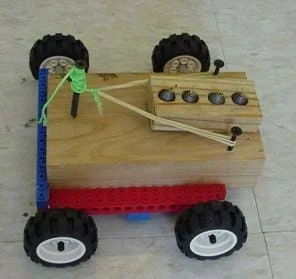 Figure 1. An example Newton rocket car.Copyright 2003 Jeff White, College of Engineering and Applied Science, University of Colorado Boulder
Students should be familiar with Newton's three laws of motion, which are presented in the associated lesson, Newton Gets Me Moving.
Today's activity provides us with an excellent demonstration of Sir Isaac Newton's three laws of motion. Can you name the three laws? (Listen to student responses.)
- Previously, we learned that a force (push or pull) must act on an object for the object to either start or stop moving. This is what Newton described in his first law of motion, and it simply means that for a rocket to start moving, a force must be involved.
- We have also learned that the force required to move an object depends on the mass of the object and how fast we want the object to move. This relationship is described by Newton's second law of motion.
- Finally, we learned that for every action there is an equal and opposite reaction. In a rocket, for example, the action is the hot gasses escaping in one direction, while the reaction is the rocket moving in the opposite direction. This is a good example of the physical law described by Newton's third law of motion.
In the following activity, we will be using Newton rocket cars to demonstrate these laws of motion. Engineers need to know these concepts when designing rockets to understand how they will get into space and move once there. The Newton rocket car moves on the same principle as a real rocket, but instead of "throwing" hot gasses like a rocket, the Newton rocket car throws a weighted block of wood. From the following experiments, we will see how Newton's laws of motion describe the motion we see in our model rocket cars.
Why would engineers need to build small-sized model cars like ours? Well, engineers often build models to demonstrate and study how science concepts affect the objects and vehicles they are designing before they build the real things. By studying the similarities and differences between small models and real-size rockets, engineers can build more successful rockets.
Tess and Rohan want to use a satellite to help communicate with their daughter, Maya, on her canoe trip. As Rohan and Tess' engineers, your models will help us understand the motion of rockets, and what may be needed to better design and build a rocket for getting Tess' communications satellite into space. Since the laws of motion are universal, the understanding of this model will also help Maya understand her canoeing motion.
Before the Activity
- Gather materials and make copies of the attached handouts that are suitable for the grade-level of your students. Refer to the Activtiy Scaling section for guidance.
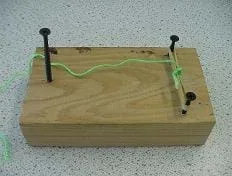 Figure 2. Construction phase 1.Copyright 20003 Jeff White, College of Engineering and Applied Science, University of Colorado Boulder
- Prepare the blocks and string:
- Screw two 1-inch screws into each side of one end of the large wood blocks, leaving enough room for the smaller block to slide between them. See Figure 2.
- Screw one 3-inch screw into the center of the other end of each of the large wood blocks, as shown in Figure 2. Try to keep the distance between screws equal on all blocks.
- Place each of the short pieces of wood into a vice and drill 3-4 holes so that sinkers (or other small weights) fit in the holes, as shown in Figures 1 and 3.
- Cut many ~3-inch pieces of cotton string. For the full worksheet, you will need 6 strings per group plus some extras. Ideally, make all the strings the same length. If the string begins to fray, tie knots in the ends.
With the Students
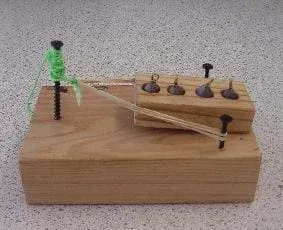 Figure 3. A finished Newton car body.Copyright 2003 Jeff White, Colllege of Engineering and Applied Science, University of Colorado Boulder
- Divide the class into groups of four students each. Give each group a large piece of wood with the screws attached, a small block of wood with the holes drilled in it (do not hand out sinkers/weights until it is time for that portion of the activity), 3 rubber bands, 1 piece of string, and a meter stick.
- Have each group place its rubber band over the two shorter screws on the end of the large wood block. Tie one end of the string to the center of the stretched rubber band. Using the string, pull the rubber band back, like a slingshot, and wrap the string around the third (larger) screw, stretching the rubber band tightly (see Figure 3). Wrap the string up high on the third screw.
- Have students create a wheel frame for the wooden platform to rest on. An simple example is shown in Figure 4. The lighter the frame, the faster the cars will go. An alternative to toy blocks and wheels is lining up four or five dowels under and in front of the car so it smoothly slides across the floor/desk.
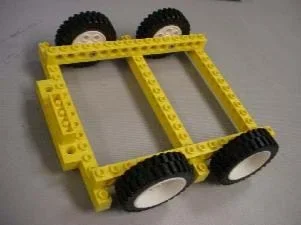 Figure 4. A finished Newton car chassis.Copyright 2003 Jeff White, College of Engineering and Applied Science, University of Colorado Boulder
- Have students place their platform (the larger block) onto the wheel frame.
- On the floor/desk, have students make a masking tape starting line. Place the car on the starting line with its back wheel on the tape line. (Note: Make sure all cars are oriented the same direction from the starting line and placed at the same distance from the line.)
- Next, have students carefully place the smaller block into the slingshot.
- Using scissors, cut the string and quickly pull the scissors away. When the string is cut, the rubber band throws the fuel block off the car and the car rolls in the other direction. Use the meter stick to measure how far the car travels along the tabletop or floor, and record this on the data sheet.
- Add a second rubber band, and attach a new string as before. Again, cut the string and record how far the car travels.
- Reset the equipment and try again with 3 rubber bands. Then try again with one rubber band and one sinker, two rubber bands and 1 sinker, etc. To shorten the length of the activity, use fewer variations of the Newton car (that is, test the car using only one rubber band or only two different weight setups).
- model
- A small object that represents another, often larger object. Often used in testing or developing a final product.
- third law of motion
- For every action, there is an equal and opposite reaction.
Pre-Activity Assessment
Poll: Before the activity, ask all students the same questions. Have students raise their hands to answer. Write answers (or key facts) on the board, and summarize (in percentages or count of students) who answered the same or similarly. Ask students:
- Which of Newton's laws of motion states that for every action there is an equal and opposite reaction? (Answer: Newton's third law of motion.) Can you give an example of this law?
- Which law of motion states that an object at rest stays at rest while an object in motion stays in motion unless there is a force acting upon the object? (Answer: Newton's first law of motion.) Can you give an example of this law?
- Which law of motion states that a force depends on the mass and the acceleration? (Answer: Newton's second law of motion.) Can you give an example of this law?
Asking Questions: Before the activity, have students come up with questions about Newton's laws that they think they can answer at the activity end.
Prediction: Have students predict the outcome of the activity before the activity is performed. Ask students to predict which will move farther: the Newton rocket car or the small weighted block.
Activity Embedded Assessment
Data Recording: As directed in the Procedure section, each time another rubber band or small weight is added to the setup, have students measure the distance the model car travels from the masking tape starting line. Have them record this data on the data sheet.
Group Question: During the activity, ask the groups:
- How far does the car move compared to the wood block? Is this surprising? What patterns do you observe? Can you use Newton's second law of motion to explain this discrepancy?
Post-Activity Assessment
Graphing: Have students work individually or in pairs to complete the age-appropriate graph worksheet. Ask students to identify any patterns. After students finish the worksheet, have them compare answers with a peer or another pair, giving all students time to finish the worksheets.
Prediction Analysis: Have students compare their initial questions and predictions with their test results.
Question/Answer: Ask the students and discuss as a class:
- How does the number of rubber bands influence the distance the car traveled? (Answer: Expect students to see that the car moves further as more rubber bands are added).
- Why is this (that the cars move further with more rubber bands added)? (Answer: Newton's second law of motion tells us that a larger force causes a larger acceleration. Also, Newton's third law of motion tells us that a larger action causes a larger reaction.)
- How does the weight of the block influence the distance the car traveled? (Answer: Expect students to see that the car moves further as more weight is added.)
- Why is this? (Answer: Newton's second law states that a larger mass causes a larger force.)
- Why do engineers need to know Newton's laws of motion when designing rockets? (Answer: Newton's laws of motion help explain what will happen when a rocket is in motion and how to get a rocket into motion. By understanding Newton's laws, engineers can design better and safer rockets.)
Since students need to cut the string and then move the scissors out of the way quickly, remind them to be very careful with the scissors. For very young students, have the teacher do the experiment while the students watch and record data.
A good way to secure the string to the tall screw is to wrap it around the screw many times and include a couple of single hitches. The single hitch tightens on itself against the pull of the rubber bands. This is best done with someone else holding the rubber bands in place while the single hitch knots are added (see Figure 5).
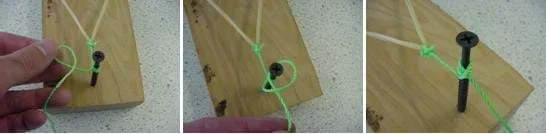 Figure 5. Tying a single hitch knot.Copyright 2003 Jeff White, College of Engineering and Applied Science, University of Colorado Boulder
Have students compete as to which team can get its car to go the furthest. This involves maximizing the amount of weight that is thrown off the car (that is, the weight block) and in turn also maximizing the force with which it is thrown off (that is, the rubber bands).
- For kindergarden and first-grade students, conduct the activity as a class demonstration. Then have students complete the Grades K-1 Color Graph Worksheet (PDF).
- For second- and third-grade students, have them record distances and make bar graphs of the distance the car traveled. Have them complete the Grades 2-3 Bar Graph Worksheet (PDF). Also draw a line graph on the classroom board for the students to see and discuss.
- For fourth- and fifth-grade students, have them complete the second of the Newton Rocket Car Data Sheet (PDF). Have students complete the Grades 4-5 Line Graph Worksheet (PDF) to graph their results and discuss trends in each variable.
Michigan Reach Out, Aerospace Education Services Project, Oklahoma State University, NASA's Teacher Resource Center: Rocket Activity, "Newton Car," edited by Roger Storm, NASA Lewis Research Center, September 1, 2005. http://www.reachoutmichigan.org/funexperiments/agesubject/lessons/other/newton_car.html
Rockets: A Teacher's Guide with Activities in Science, Mathematics, and Technology, "Teacher Information: Newton Car," #EG-108. February 1996. NASA. http://www.eric.ed.gov/ERICWebPortal/custom/portlets/recordDetails/detailmini.jsp?_nfpb=true&_&ERICExtSearch_SearchValue_0=ED406236&ERICExtSearch_SearchType_0=no&accno=ED406236
Contributors
Jeff White; Brian Argrow; Geoffrey Hill; Jay Shah; Malinda Schaefer Zarske; Janet Yowell
Supporting Program
Integrated Teaching and Learning Program, College of Engineering and Applied Science, University of Colorado Boulder
Acknowledgements
This activity was developed by the Integrated Teaching and Learning Program under National Science Foundation GK-12 grant no. 0338326. However, these contents do not necessarily represent the policies of the National Science Foundation, and you should not assume endorsement by the federal government.
Copyright
2006 by Regents of the University of Colorado