
Newton Gets Me Moving
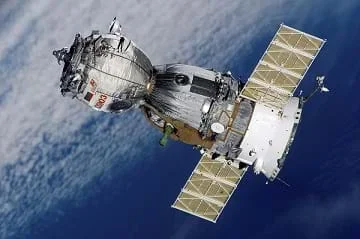 Students explore motion in space.Copyright 2006 NASA, Wikimedia Commons https://commons.wikimedia.org/wiki/File:Soyuz_TMA-7_spacecraft2edit1.jpg
Students explore motion, rockets and rocket motion while assisting Spacewoman Tess, Spaceman Rohan and Maya in their explorations. First they learn some basic facts about vehicles, rockets and why we use them. Then, they discover that the motion of all objects—including the flight of a rocket and movement of a canoe—can be described by Newton's three laws of motion.
Whenever engineers work on something that moves, they use Newton's laws of motion to help describe how it is going to move. This includes cars, trains, boats, bicycles, skateboards, roller coasters, airplanes and rockets. Really, Newton's laws of motion explain the movement of anything that is—simply—in motion. Knowing how a vehicle will move is very important when designing a successful vehicle. And, similarly, knowing how a rocket will move is very important to designing a successful rocket. Understanding Newton's laws helps engineers figure out how much fuel is needed, how big the rocket must be, how much the rocket can weigh, how long the rocket must burn, and even how fast the rocket will go.
After this lesson, students should be able to:
- Describe the characteristics and function of rockets.
- Identify and explain Newton's three laws of motion.
- Describe how Newton's laws relate to engineering, rockets and paddling.
- 4.1.3.b Use the four operations with whole numbers to solve problems.
Grade 4
Do you agree with this alignment? - 5.1.2.a Fluently multiply multi-digit whole numbers using standard algorithms.
Grade 5
Do you agree with this alignment?
- CCSS.Math.Content.4.OA.A Use the four operations with whole numbers to solve problems.
Grade 4
Do you agree with this alignment? - CCSS.Math.Content.5.NBT.B.5 Fluently multiply multi-digit whole numbers using the standard algorithm.
Grade 5
Do you agree with this alignment?
- Students will develop an understanding of the relationships among technologies and the connections between technology and other fields of study.
Grades K-12
Do you agree with this alignment?
- 3-PS2-2 Make observations and/or measurements of an object's motion to provide evidence that a pattern can be used to predict future motion.
Grade 3
This resource focuses on the following Three Dimensional Learning aspects of NGSS:
Science & Engineering Practices- Make observations and/or measurements to produce data to serve as the basis for evidence for an explanation of a phenomenon or test a design solution.Do you agree with this alignment?
- Science findings are based on recognizing patterns.Do you agree with this alignment?
Disciplinary Core Ideas- The patterns of an object's motion in various situations can be observed and measured; when that past motion exhibits a regular pattern, future motion can be predicted from it. (Boundary: Technical terms, such as magnitude, velocity, momentum, and vector quantity, are not introduced at this level, but the concept that some quantities need both size and direction to be described is developed.)Do you agree with this alignment?
Crosscutting Concepts- Patterns of change can be used to make predictions.Do you agree with this alignment?
Do you agree with this alignment? - Make observations and/or measurements to produce data to serve as the basis for evidence for an explanation of a phenomenon or test a design solution.
Newton's Laws of Motion
The basic motion of any object is described by Isaac Newton's three laws of motion. His simple laws explain how objects move and, more specifically, how rockets move in the atmosphere and in space or how canoes paddled in the water move. (Note: For more reading on Sir Isaac Newton, see the accompanying reading material.)
Newton's First Law of Motion
Newton's first law states that an object at rest tends to stay at rest and an object in motion tends to stay in motion unless a force acts upon that object. This means that for an object to speed up or slow down, a force must be present to push or pull on the object. Sometimes a force acting on an object causes that object to stay at rest or in motion. This can happen when another force cancels out the first force. For example, a person just standing on the ground has a force acting on him or her. This force is called gravity, but even though gravity is acting on this person, s/he is not moving. How can this be? The reason is because the ground is pushing up on the person with the same force as the gravity is pulling down. This upwards force cancels out gravity, resulting in no change in motion. Engineers call two forces that cancel each other out balanced forces. If the floor was not present, gravity would no longer be canceled out by upward force, and the person would start to move (fall).
An object at rest stays at rest if the forces acting on that object are balanced or no forces are acting on it. This is obvious for something that is not moving; but it also applies to moving objects in a vacuum. An object in motion stays in motion if balanced forces or no forces act on it. If a spaceship floating through deep space is moving at a constant velocity and has no forces acting on it (for example, gravity), then there is no change in motion, and the spaceship keeps moving in a straight line—forever! Continuous motion is not seen on Earth due to friction and other forces that slow things down.
Newton's Second Law of Motion
If a bowling ball and a soccer ball were both dropped at the same time from the roof of a tall building, which would hit the ground with greater force? Common sense picks the bowling ball because it is heavier. Might we believe this to be true because we naturally assume that the bowling ball will fall faster? This statement is actually NOT true. Gravity accelerates all objects at the same rate; therefore, the balls would hit the ground at the same time and with the same velocity. However, the bowling ball would hit with greater force because it has a greater mass. Newton stated this relationship in his second law: the force of an object is equal to its mass times its acceleration.
This law of motion can be expressed as a simple mathematical equation. The three parts of the equation are mass (m), acceleration (a) and force (F). Using the letters to symbolize each part, the equation can be written as follows:
F = m x a
To explain this law, consider a cannon as an example: when a cannon is fired, an explosion propels a cannonball out the open end of the barrel (top end of the cannon). It is propelled a kilometer or two to its target. At the same time, the cannon itself is pushed backward a meter or two. This is action and reaction at work (Newton's third law, which we will discuss shortly). Figure 3 shows a cannon and how Newton's laws of motion explains the movement of both the cannon ball and the cannon. The force acting on the cannon and the ball is the same force. What happens to the cannon and the ball is determined by the relative masses, according to the following equations:
Force on the cannon = mass (of cannon) x acceleration (of cannon)
Force on the ball = mass (of ball) x acceleration (of ball)
The first equation refers to the cannon and the second to the cannon ball. In the first equation, the mass is the cannon itself and the acceleration is the movement of the cannon. In the second equation, the mass is the cannon ball and the acceleration is its movement. Because the force (exploding gun powder) is the same for the two equations, the equations can be set equal to each other and rewritten as:
mass (of cannon) x acceleration (of cannon) = mass (of ball) x acceleration (of ball)
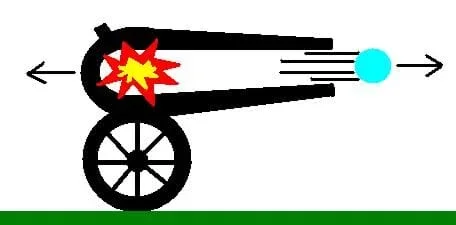 Figure 3. Cannon demonstrating Newton's laws of motion.Copyright 2004 Geoffrey Hill, College of Engineering, University of Colorado Boulder
In order to keep the two sides of the equations equal, the accelerations must balance the masses. In other words, since the cannon's mass is large and the cannon ball's mass is small, the only way the equation balances is if the cannon ball has a much larger acceleration than the cannon. This is why the cannon only rolls back a few feet and the cannon ball flies a long distance.
Now, apply this principle to a rocket. Replace the mass of the cannon ball with the mass of the gases (fuel) being ejected out of the rocket engine nozzle. Replace the mass of the cannon with the mass of the rocket moving in the other direction. The force is the pressure created by the controlled explosion taking place inside the rocket's engines (similar to the gun powder explosion inside the cannon). That pressure accelerates the fuel gases one way out the nozzle, which causes the rocket to move the other way.
Newton's Third Law of Motion
This law states that every action has an equal and opposite reaction. If you have ever run into anything in surprise or by accident, you have a experienced the essence of this law.
Think about Maya in her canoe. Maya pushes the water back using a paddle, which creates a counterforce of similar size that propels the canoe forward. When Maya wants to move forward in the canoe, she paddles in a backward motion; when she wants to move backwards in the canoe (perhaps to avoid rocks, trees or animals), she moves the paddle in a forward motion. Figure 4 illustrates this idea.
As another example, imagine Spaceman Rohan alone at home with a skateboard. He and his skateboard are in a state of rest (not moving). Spaceman Rohan jumps off the skateboard. In Newton's third law, the act of jumping is called an action. The skateboard responds to that action by traveling some distance in the opposite direction. The skateboard's opposite motion is called a reaction. When the distance traveled by the rider and the skateboard are compared, it would appear that the skateboard has been affected by a much greater force than the rider, but this is not actually the case. The reason the skateboard has traveled farther is that it has less mass than the rider (see Newton's second law).
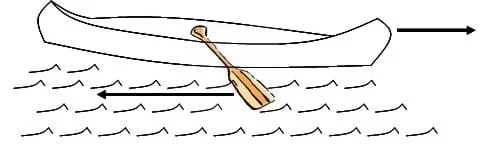 Figure 4. A canoe and paddle demonstrating Newton's laws of motion.Copyright 2005 Jay Shah, College of Engineering, University of Colorado Boulder
With rockets, the action is the expelling of gas out of the engine. The reaction is the movement of the rocket in the opposite direction. To enable a rocket to lift off from the launch pad, the action (or thrust) from the engine must be greater than the downward acceleration of gravity on the mass of the rocket. In space, when the downward acceleration of gravity is balanced, even tiny thrusts cause the rocket to change direction.
Rockets work better in space than they do in the air. The surrounding air impedes the action-reaction. In the atmosphere, both the nose of the rocket and the exhaust gases leaving the rocket engine must push away the surrounding air; this uses up some of the energy of the rocket. In space, the exhaust gases can escape freely (action) and no air friction exists to slow the rocket's reaction forward.
What are vehicles and why do we need them? (With the students, discuss their concept of a vehicle. Help them get to the conclusion that the basic definition of a vehicle is a device that enables something to move from one place to another quicker than if no vehicle existed.) Now, what is motion? What are some different ways a person can get from one place to another? (List students' answers on the classroom board. Possible answers: walk, run, bicycle, skateboard, drive/ ride in a car, train, boat, airplane or rocket.) How do these objects move? You're right! Everything that moves in one way or another involves a push or a pull, which engineers call a force. For example, an engine in a car causes the wheels to turn, which push against the ground, while a sailboat is pulled along by the wind. Every single motion is caused by a force. If no pushes or pulls existed, objects—or in this case, vehicles—would not go anywhere. This is an example of Newton's first law, which states that an object at rest tends to stay at rest and an object in motion tends to stay in motion, unless a force acts upon that object.
Let's look at our list on the board again. Which of these objects move fast and which move slowly? Now that we have separated the list into fast and slow groups, let's think about the forces (pushes and pulls) acting on the objects. Are the forces acting on the faster objects more or less than the forces acting on the slower objects? (Guide students to realize that the faster objects are faster because larger forces acts on them.) This is an example of Newton's second law, which states that the force of an object is equal to its mass times its acceleration. Larger mass equals larger force.
Which vehicles will Maya and her family be using in their explorations? Tess and Rohan will need a rocket to carry their communications satellite into space. Maya has a canoe that she will paddle to explore uncharted waters. A rocket is large and will take a large force to get it moving. A canoe is smaller and only requires a smaller force to get it moving.
So how do we create a force to move an object? Let's think about Maya in her canoe. How will she move it? (Answer: She will only move if a force acts upon her canoe.) Maya needs a force to move and that force could be present in many different forms: Maya could use the movement of the water as a force to move her canoe if the water is going in the direction she wants; she could use a paddle to move or push her canoe; or she could have a friend push her in the canoe. If Maya was holding a bowling ball in her canoe and threw it overboard, would she move? The answer is yes, throwing the bowling ball in one direction would cause Maya and her canoe to move in the opposite direction. Can you see that for every movement, some responding action happens in the opposite direction? This is an example of Newton's third law, which states that every action has an equal and opposite reaction. (optional: Demonstrate this using a skateboard or a rolling chair.)
So, what about Tess' rocket? What makes a rocket a rocket? A rocket is a device that burns fuel causing extremely hot gasses to be ejected from the rocket out the nozzle (the tailend). The action of all this hot gas moving in one direction causes the rocket to move in the opposite direction. Rockets usually burn either liquid or solid fuel. It takes a lot of engineers to build a modern rocket since they are so complicated. Figure 1 shows a diagram of a liquid fuel rocket.
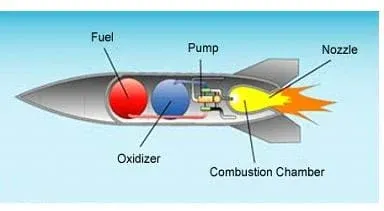 Figure 1. Diagram of a liquid fuel rocket.Copyright NASA with edits by 2005 Geoffrey Hill, University of Colorado Boulder http://spaceplace.jpl.nasa.gov/en/kids/
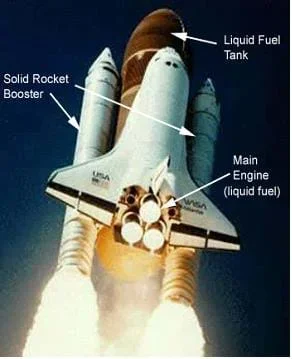 Figure 2. Liquid and solid rockets on the space shuttle.Copyright NASA with labels by 2005 Geoffrey Hill, University of Colorado Boulder http://nvo.gsfc.nasa.gov/astrodata/epohst-satellite.html
In a liquid fuel rocket, the fuel and oxidizer are pumped into a combustion chamber where the fuel and oxidizer burn to create super hot gas that is forced to escape through the nozzle. The rocket works on the same principle as Maya throwing the bowling ball while sitting in her canoe (do you remember: that for every action, there is an opposite reaction), but instead of throwing bowling balls the rocket is throwing hot gas. The rocket throws the hot gas down towards the Earth, which causes the rocket to move upward, away from the Earth. This does not seem like it would push the rocket very far, but the rocket is throwing so much hot gas at such a high speed that it can move very quickly. Other types of rockests use solid fuels. They are simpler rockets since no pump or oxidizer is required, but they cannot be turned on and off. Typically, solid fuel rockets are not as efficient as liquid fuel rockets. Examples of liquid fuel rockets include the space shuttle's main engine as well as the Atlas, Titan and Delta rockets that are used to put satellites into space. Examples of solid fuel rockets include the solid rocket boosters on the space shuttle, rocket powered cars and bottle rockets. Figure 2 shows the liquid and solid fuel rockets on the space shuttle.
For what purpose do engineers design rockets? We have already talked about designing rockets to go fast, but we have other reasons to design rockets, too. You may have heard or read that we often use rockets on spacecraft and satellites. That is because right now rockets are the only efficient way we have to move in space. Jets or propellers cannot be used to travel in space because they require the presence of air to work, and no air is exists in space. And, we cannot use a canoe to get around space because no water exists in which to paddle. We could get around in space if we had a bunch of bowling balls to throw! By throwing the bowling balls in one direction, we would be able to move in the opposite direction; however, throwing bowling balls is not the best way to move around in space, so we will continue to using rockets for now. Today, we are going to learn more about motion, engineering and about how a man named Isaac Newton formed three laws that describe for us why objects—including rockets and canoes—move. Following the lesson students can conduct the associated activiy Newton Rocket Car to learn about Newton's laws of motion as they build small vehicles that move by launching a mass backward.
Let's look around the room and find examples of balanced and unbalanced forces. (Possible classroom examples: an air duct, water faucet, clock, and the students themselves.) Any change in motion indicates unbalanced forces. Anytime something encounters friction, that is a force acting upon that object. Every time there is a force, there is an equal and opposite force. A fan blade hitting an air molecule pushes it away (one force), but the air molecule also applies a reactive force to the fan and slows it down slightly (equal and opposite force). Can you think of examples actions and reactions from everyday life? Do you think rockets would work without the natural behavior described in Newton's third law? (Answer: No way!) It is important to understand that a force is required for an object to start or stop moving. How fast an object speeds up (accelerates) is dependent on the mass of the object and the size of the force acting on it. Lastly, for every action there is always an equal and opposite reaction.
As we end this lesson, consider the fact that Spacewoman Tess and Spaceman Rohan need a rocket to put a communication satellite or two up in orbit in order to keep in contact with Maya as she goes on her journey. Since you all now understand the laws explaining motion, you are capable of becoming engineers who will be in charge of helping to build such a rocket.
- acceleration
- How quickly the speed of an object is changing.
- force
- A push or pull that causes motion or change.
- rocket
- A vehicle that moves by ejecting mass.
- isaac newton
- An English mathematician and physicist who defined three important laws of motion. Born 1642; died 1727.
- mass
- A measure of the amount of matter in an object.
- newton's first law
- No forces = no change in motion. An object at rest tends to stay at rest, and an object in motion tends to stay in motion unless a force acts on the object.
- newton's second law
- force = mass X acceleration
- newton's third law
- For every action, there is an equal and opposite reaction.
- rocket
- A vehicle that moves by ejecting mass.
Pre-Lesson Assessment
Concept Quiz: Administer the What Is a Rocket Quiz (PDF). Have students work together in groups of four. Encourage them to share ideas. Do not give them any answers yet!
Post Introduction Assessment
Vehicle Detectives: Organize the students up into teams of three to four. Give the groups each a specific vehicle, such as a skateboard, toy car, toy train, bicycle, pogo stick, etc., but preferably vehicles from the list generated earlier in the lesson, and ask students to describe the vehicle's motion using Newton's laws. Have students record their observations of the object's motion to provide evidence that a pattern can be used to predict future motion. Questions to ask:
- What sort of action is used to move the vehicle?
- What is the reaction to that action?
- What pattern(s) are there?
- Does the vehicle experience more or less friction depending on where it is used? Why?
- Is a vehicle that is already in motion more inclined to continue to be in motion? Why? Can you think of an example of one that is?
- What types of fuel are used to move the vehicle?
- Does the vehicle move fast or move slow? Why?
Lesson Summary Assessment
Concept Quiz: Have students redo their What Is a Rocket? Quiz (PDF). Discuss the answers and have students correct each other's papers.
Informal Discussion: Solicit, integrate and summarize student responses.
- Ask students to explain how rocket motion is different from car, airplane or canoe motion and reference Newton's third law (for every action there is an equal and opposite reaction).
- Ask the students to explain Newton's second law (force = mass x acceleration). Expect students to understand that many different combinations of mass and acceleration can give you the same final force using F=m x a:
12 = 1 x 12
12 = 2 x 6
12 = 3 x 4
Using the Equation: Have students use the force equations presented in the Lesson Background to calculate the force on the cannon and on the ball, given the following information:
- mass of cannon = 1000 kg
- mass of ball = 20 kg
- acceleration of cannon = 2 m/s2
- acceleration of ball = 100 m/s2
(Answers: Force on cannon = 1000 kg x 2 m/s2 = 2000 kg*m/s2. Force on the ball = 20 kg x 100 m/s2 = 2000 kg*m/s2)
Human Matching: On 10 pieces of paper, write either the term or the definition of the vocabulary words. Ask for volunteers from the class to come up to the front of the room, and give each person one of the pieces of paper. One at a time, have each volunteer read what is written on his/her paper. Have the remainder of the class match term to definition by voting. Have student "terms" stand by their "definitions." At the end, give a brief explanation of the concepts.
Take the class to the gym and have some students sit on scooters or skateboards with their feet off the ground while throwing heavier balls. Note the resulting movement. Is this an efficient way to travel? Why or why not? Have students discuss among themselves. (Answer: Probably not.)
Behne, Jacinta M. Genesis: Search for Origins. 2004. NASA. http://genesismission.jpl.nasa.gov/people/mckeegan/interview.html
Fernandez-Nieves, A. and de las Nieves, A.J. "About the Propulsion System of a Kayak and of Basiliscus Basiliscus." Eur. J. Phys.:19, 425–429, 1998. http://www.iop.org/EJ/abstract/-search=22851615.1/0143-0807/19/5/003
Henderson, Tom, Glenbrook South High School, Glenview, Illinois. The Physics Classroom, Newton's Laws. http://gbhsweb.glenbrook225.org/gbs/science/phys/Class/about.html
Utah State University, 2004. TeacherLink, "Rockets," July 2002. http://teacherlink.ed.usu.edu/tlnasa/units/Rockets2/
Contributors
Jeff White; Brian Argrow; Geoffrey Hill; Jay Shah; Malinda Schaefer Zarske; Janet Yowell
Supporting Program
Integrated Teaching and Learning Program, College of Engineering, University of Colorado Boulder
Acknowledgements
The contents of this digital library curriculum were developed under grants from the Fund for the Improvement of Postsecondary Education (FIPSE), U.S. Department of Education and National Science Foundation (GK-12 grant no. 0338326). However, these contents do not necessarily represent the policies of the DOE or NSF, and you should not assume endorsement by the federal government.
Copyright
2005 by Regents of the University of Colorado