
I'm Not in Range: Acting Out Cellular Phone Service
 Students explore how cellular phone service works.Copyright 2011 Tony Tolley, US Air Force, Wikimedia Commons https://commons.wikimedia.org/wiki/File:US_Navy_110502-F-HS649-178_Hospital_Corpsman_1st_Class_Cassandra_Townsend_shows_students_a_music_video_on_her_cell_phone_at_Matevulu_College_during.jpg
In this role-playing activity, students learn how cellular phone service works, its advantages and its limitations. Students also learn about the advantages and limitations of satellite phone service. Phone communication involves many aspects of science, math and engineering, and this activity conveys to students how these technologies help people to stay better connected. In the continuing story of this unit, students use what they learn to understand what communication options might be available for Maya and her parents, Spacewoman Tess and Spaceman Rohan.
Just because people are far away from each other or in constant movement does not mean that they must stop communicating. As people move further away, travel more often and to more remote locations, and, in fact, choose to live in more remote areas, engineers are developing ways for them to keep in touch. The invention of the telephone dramatically changed the way people communicate, and engineers—many different types working together—are continually creating newer and better ways for people to stay in touch with each other. To do this, engineers must understand how communication can occur over great distances, which means they must know about satellites and transmissions, receiving and measurements. The advancements made by engineers in communication and satellite technology help people by enabling them to communicate acoss continents with the touch of a button.
After this activity, students should be able to:
- Explain the basic concepts of how cellular phone service works.
- Describe how spatial arrangements affect different types of communication.
- Gather, analyze, and interpret data about components of the solar system
Grade 4
Do you agree with this alignment?
- STEL-4G Judge technologies to determine the best one to use to complete a given task or meet a need.
Grades 3-5
Do you agree with this alignment?
Each student needs:
- a poster board, cardboard or large piece of paper, either pre-cut into a hexagon, pre-stenciled or in original (rectangular) form
- a pair of scissors to cut the poster board or paper; may be shared among a few students
Let's brainstorm different ways that people who are not physically close together can communicate with each other. Let's start a list on the board. (The list might include: phones, cell phones, yelling or sending birds with messages). How many of you have ever used a cell (short for cellular) phone? Do your older siblings have them, or do you have one? Do your parents have them?
Have you ever wondered... Since they are not hooked up to anything, how do cell phones work? Why are you able to call from certain places and not others? This is what we are going to learn about today!
What is really happening when a cell phone disconnects while you are talking with someone? Do you know why? Why doesn't this happen with a regular phone (a landline)? Landline phones use telephone lines (wires) that connect from place to place. When using a landline telephone, you are physically connected to the vast network of telephone wires that exist, so it is rare that a phone stops working, unless... Can you think of ways that a landline telephone might stop working? (Possible answers: Wires to the phone are cut, a telephone line falls down in a storm and gets breaks the connection, the telephone or one of its parts breaks, the connection from the phone to the telephone line gets cut/disconnected.)
But what about cellular phones? Cell phones have no wires that can get disconnected or broken. So why might cellular phones stop working? Well, cellular phones work like a radio. Like radios, they rely on wireless technology and use antennas to receive the sound signals. The antennae might not be visible, since it can be on the inside or outside of the cell phone. This means that when a call is placed from your cell phone, it connects to a cellular phone tower by radio waves that get transferred to a central station that sends a signal (the phone call) to the person you are calling. Thus, no wires are needed. Instead, what is needed is a nearby cellular tower that close enough to pick up the signal and a station to receive the signal and send it to the person who is being contacted.
Have any of you heard of a satellite phone? A satellite phone works much like a cellular phone, except it uses a satellite that orbits the Earth to pick up phone signals (rather than using a cellular phone tower to receive/transmit signals). A satellite phone sends the signal of your voice back to Earth in just the right spot using advanced technologies. Engineers must learn everything they can about how sound travels in order to develop cell phones, cell phone technologies, communication towers and satellites. Engineers also need to understand where to place the cell phone towers so calls can be connected to central stations.
Today we will learn how cellular telephones make/receive calls and why you cannot call everybody everywhere all of the time—but what type of phone technology might be useful instead in these cases. You will also learn about the role engineering plays in improving people's lives through many advancements in communication technology.
Cellular Phones
A cellular phone can be described as a very sophisticated radio. They are a type of wireless communication device that uses many small cells with a base station and a cell phone tower at the center of each cell. These cells have extensive frequencies that permit many thousands of people to use cell phones at the same time. In this process, cellular calls are transferred from base station to base station as a user travels from cell to cell—in the case of this activity, from hexagon to hexagon.
A cellular network is composed of cellular towers. In essence, when a call is placed from a cell phone, it travels by radio waves to a cellular tower (in this activity, a student) that picks up the specific signal from the phone. These cellular towers are thought of as cells, with each cell able to typically pick up a signal within 10 square miles. Then the signal is sent to a Mobile Telephone Switching Office (MTSO) that handles calls from several towers—called a cluster. The MTSO transfers the signal to a local phone line that sends the signal to the final destination via landline, microwave signals or satellite. The MTSO senses when the signal is becoming weak and hands off your call to the next tower—or the MTSO in the next cluster. It controls the quality of your link by keeping you connected to the best possible signal as you move from cell to cell. When you have traveled beyond the range of the towers, the signal is lost and you cannot make or receive calls.
Satellite Phones
Satellite phones do not use cells or cell towers for sending/receiving calls. Most satellite phones use Low Earth Orbiting (LEO) communication satellites. When a satellite phone is turned on, the signal goes up to any number of satellites in a compatible constellation (group of satellites) where it is then registered with the constellation. When a call is made through the satellite phone, the signal goes to the satellites and then is directed down to a ground station and then further directed to the call destination. The call can be directed to a landline as well as a cellular network and the reverse is also true. This process allows the satellite phone to be used in the middle of nowhere—great distances from any cellular phone tower—and thus providing an essential form of communication for those who travel to very remote areas.
Activity Overview
Most of the class role plays as cellular phone towers. A student's (tower's) range of activity is the size of his/her hexagons that is provided or that they make themselves. This means that if any student is either touching or entirely in one of the hexagons, that person is "in range" of a cellular phone tower because they are in one of the "cells." Each tower represents one cell in cellular phone network and is typically sized at 10 square miles. Towers can be arranged in pretty much any fashion as long as the composition provides for at least one cluster of towers and some space in between other towers. See Figure 1 for an example layout for a 30-student class, with the setup of 24 tower students, 3 moving students, one house, and two recorders.
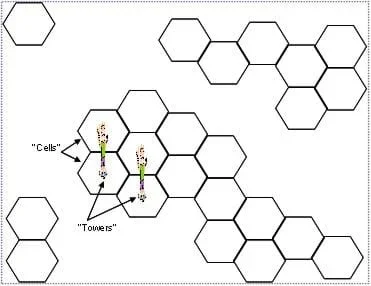 Figure 1. A possible layout of communication towers in a rectangular classroom space. Each hexagon is one tower; a student stands in each hexagon. Spaces with no hexagons have no towers.Copyright 2005 Jay Shah, University of Colorado Boulder
Before the Activity
- Arrange for a big open space, such as a classroom, gymnasium or outside basketball court. In a classroom, move all desks to the outer walls to create an open space in the middle of the room.
- Gather materials and make copies of the Communications Recording Sheet, one per recorder (probably two recorders for a class of 30 students).
- Prepare the poster board/cardboard/paper for students. If time permits, give students the plan poster board to make their own hexagons. To speed up the activity and/or provide more assistance for younger students, pre-cut or pre-stecil the poster board into hexagon shapes.
With the Students
- Explain the activity. Go through the general procedure with the students so they know what to expect.
- Have students draw and cut out their hexagons (or give them the pre-cut hexagons).
- Have students place their hexagons (towers) around the room, with some in clusters and some father apart.
- Ask for six volunteers. (All remaining students stand on hexagons in the tower configuration and are known as "towers" and do not move during the activity.)
- Assign four of the six student volunteers as "people" with cell phones who role play as follows:
- A person on a bike (bicyclist)
- A driver of a car (driver)
- A person in a house (house)
- A paddler in a canoe (canoeist)
- Ask the four "people" volunteers to stand anywhere on the tower arrangement—either on a hexagon or not. The driver, bicyclist and canoeist can move anywhere, but the person in the house cannot move at all. The movements can be made as follows: the bicyclist can only move one step (one hexagon) at a time, the canoeist can move two steps (two hexagons) at a time, and the car driver can move three steps (three hexagons) at a time. Make sure that the students in these roles know the limits of how far they can move at any given turn.
- The two remaining student volunteers are recorders. They record who can communicate with whom at any given time. Recorders use the data sheet .
- Next, start the role playing. To start, say Step 0, and everyone stays where they are. Then ask any of the students: Who is able to call whom? All the students should look around and see who is in range of a cellular tower. (Remember: students can only make or receive a call if they are touching a hexagon. This means that if any student is either touching or entirely in one of the hexagons, that person is "in range" of a cellular phone tower as they are in one of the "cells." Students can tell who can call whom as only those people within range of a cellular phone tower—with a cell phone—can place a call.) The recording students write down who can call whom.
- Then, say Step 1, and the students with phones move their designated steps in any direction in the room (that is, the driver moves 3 steps, the canoeist moves 2 steps, the bicyclist moves 1 step and the person in the house moves no steps). Emphasize that the students who are role playing as towers cannot move at all, as they are stationary objects. Again, the teacher asks all students: who is able to call whom? Direct all of the students to look around and see who is in range of a cellular tower. The recording students write down who can call whom.
- Repeat these steps: Step 2, Step 3, Step 4, for about 8 more steps for a total of 10 rounds. In the middle of these steps, ask the first part of the Activity Embedded Assessment questions.
- Now, replace the canoeist's phone with a satellite phone. (Say, "The canoeist now has a satellite phone.") For variety, switch out some of the student roles at this time, especially those doing the recording or any fidgiting towers. (What benefit does a satellite phone have? Answer: A satellite phone can call anywhere. How does a satellite phone work? Answer: When a call is made through the satellite phone, the signal goes to a satellite and then is directed down to a ground station and then further directed to the call destination. The call can be directed to a landline as well as a cellular network; the reverse is also true. This process means the satellite phone to be used in the middle of nowhere, far away from any cellular phone tower.)
- Start over with Step 0. Ask the students: who is able to call whom? All the students should look around and see who is in range of a cellular tower. The recording students write down who can call whom.
- Then, say Step 1, and students who can move, move their designated steps (that is, the driver moves 3 steps, the canoeist moves 2 steps and the bicyclist moves 1 step). Again, ask any of the students: who is able to call whom? All of the students should look around and see who is in range of a cellular tower. The recording students write down who can call whom.
- Repeat these steps: Step 2, Step 3, Step 4, for about 8 more steps for a total of 10 rounds. In the middle of these steps, ask the second part of the Activity Embedded Assessment questions.
Pre-Activity Assessment
Discussion Question: Solicit, integrate and summarize student responses.
- Ask students what sort of telephones they or their families use to communicate? Whom do they call? Do they have cell phones? How is the reception with their cell phones? Is the reception good sometimes and bad other times? What does going "out of range" on a cell phone mean?
Activity Embedded Assessment
Discussion Questions: Solicit, integrate and summarize student responses.
Questions for Part 1: During the cellular phone role play, ask students the following questions:
- Whose phone communications changed the most? Why? (Answer: Since the car driver can move more steps than the rest, it would be expected that his/her communications change the most. Expect the driver to be moving in and out of range the most, followed by the canoeist, bicyclist and person in the house).
- Where is a location where people cannot receive very many phone calls and why not? (Answer: Places where no cellular phone towers exist are difficult places for people to receive any cellular phone calls. Presumably on the board are spaces without any "cells" or hexagons. These are places where not very many cellular phone calls could be transmitted or received.)
- Where is a location where people can receive phone calls and why is it better? (Answer: Places where numerous clusters of hexagons or "cells" exaist are able to receive more phone calls. If you leave one cell, then another one right next to it).
- What would you change so that everybody could call everyone else all the time? (Possible answers: Put in more "cells" [hexagons] to eliminate any empty spaces without cellular towers. Then, everyone with a cell phone could call everyone else with a cell phone. Or, develop telephones that do not rely on the existence of cellular phone towers.)
Questions for Part 2: During the satellite phone role play, ask students the following questions:
- Whose phone communications have changed the most since we started over? Why? (Answer: The person with the satellite phone should now be able to call anyone from anywhere as s/he is bouncing signals off a satellite.)
- Who can the canoeist not call? Why? (Answer: The canoeist still cannot call somebody who is not in range of a cellular phone tower. While the canoeist can send a call even when not in range of a cellular phone tower, the receiving end must be in range of a tower to receive it.)
- Is there a location where the canoeist cannot call anybody at all? Why? (Answer: It depends, as long as someone else is within range of a tower. The canoeist can call from anywhere, but if nobody is in range of a tower, no matter where the canoeist is, it might not be received.)
- Is there a location from which the canoeist cannot be called? Why? (Answer: Yes, if someone is calling from a regular landline phone. Even though the canoeist has a satellite phone, the canoeist needs to be in range of a cellular phone tower or landline to receive the caller's call, which is not going through a satellite.)
- What would you change so that everybody could call everyone else all the time? (Possible answer: If everyone had satellite phones, their chances of calling each other would increase.)
Post-Activity Assessment
Question/Answer: Ask students questions and have them raise their hands to respond. Write answers on the classroom board and discuss as a class.
- What do both the caller and receiver need in order to make a cellular phone call? (Answer: To be in range of a cellular phone tower.)
- What would have happened if all of the towers were separate from all of the other ones, that is no sides of the hexagons were touching other hexagons? (Answer: When movement happened, the phones would go completely out of service.)
- What could the person in the house do about his/her phone service? (Answer: If the person was not in range of a tower, they should move in range of one, or have one built, or get/borrow a satellite phone.)
- What major difference did you see between the cellular phones and the satellite phone scenarios? (Answer: The person with the satellite phone could call anybody with a phone from anywhere in the world.)
- What change could you make to the cellular phone scenario so that everyone could call each other all the time? (Answer: More cellular towers in more places, mobile cellular towers.)
- What about the satellite phone scenario? (Answer: Even though the person with the satellite phone could call everyone wherever that person was, no one else could; so you could have everyone have satellite phones.)
To keep the activity running smoothly, remind students not to run from hexagon to hexagon; direct them to move slowly and quietly so as not to run into each other.
- The bigger the poster board, the better; but remember that larger poster boards require more space.
- Watch the moving student's steps: no jumps or hops allowed!
- If the class is quite large, have a second group of students recording.
- Depending on the size of the space, students might be tightly packed.
- Since this is an entire-class exercise, students who are towers might get antsy, so be sure to ask questions directly to them to keep them on their toes.
- If not enough space exists for all students to participate as towers, have students who are not assigned roles watch from their seats.
Have students think about the engineering and costs associated with putting in cellular phone towers and implementing satellite phone systems and create an advantage/disadvantage list. For places with no current telephone service at all, what are the advantages of landline phones over cell phones, or vice versa?
Create a coordinate system on the space where the towers and movement is, and record and analyze everyone's coordinates and how they change.
- For upper grades, put one or two students in charge of the steps, calling out step 1, step 2, etc., and asking the questions. Also, have students measure, draw and cut the hexagons.
- For lower grades, cut or stencil the hexagons in advance.
Abby, Mary Kay and Reda, Ellena. "I've Got Your Number: Mathematics for Telecommunications," Lab 10, The Math Works Project, Montgomery Community College, MD and Dutchess Community College, NY. http://www.ccc.commnet.edu/mwp/book1/section1/abstract10.shtml
Gobalcom Satellite Communication, Decatur, IL, http://www.globalcomsatphone.com/about.html
- Rockets
- Keep in Touch: Communications and Satellites
- I'm Not in Range: Acting Out Cellular Phone Service
- Newton Gets Me Moving
- Using Thrust, Weight & Control: Rocket Me into Space
- Blast Off: Generating Rocket Thrust with Propellants
- Learn to Build a Rocket in Five Days or Your Money Back
- Where Am I: Navigation and Satellites
- Keep in Touch: Communications and Satellites
Contributors
Jay Shah; Malinda Schaefer Zarske; Janet Yowell
Supporting Program
Integrated Teaching and Learning Program, College of Engineering, University of Colorado Boulder
Acknowledgements
The contents of this digital library curriculum were developed under grants from the Fund for the Improvement of Postsecondary Education (FIPSE), U.S. Department of Education and the National Science Foundation (GK-12 grant no. 0338326). However, these contents do not necessarily represent the policies of the Department of Education or National Science Foundation, and you should not assume endorsement by the federal government.
Copyright
2006 by Regents of the University of Colorado