
Rockets
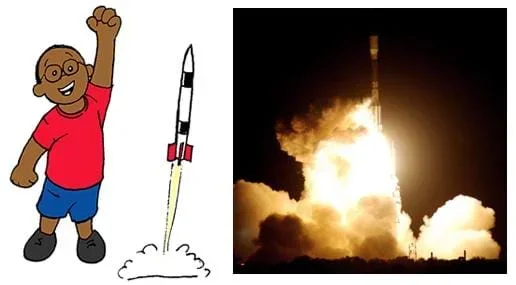 Students explore motion, rockets and rocket motionCopyright (left) Office of Diversity and Equal Opportunity, NASA; (right) Jack Pfaller, NASA http://eo.msfc.nasa.gov/c2w/ http://science1.nasa.gov/science-news/science-at-nasa/2009/06mar_keplerlaunch/
Students learn how and why engineers design satellites to benefit life on Earth, as well as explore motion, rockets and rocket motion. Through six lessons and 10 associated hands-on activities, students discover that the motion of all objects—everything from the flight of a rocket to the movement of a canoe—is governed by Newton's three laws of motion. This unit introduces students to the challenges of getting into space for the purpose of exploration.
How are rockets and satellites connected? How are rockets and engineers connected? How about rockets and Newton's laws? The answers are many! Engineers have played a key role in designing satellites, getting them into orbit (via rockets!), and using the data they relay back to Earth for useful purposes. Anytime engineers work on something that moves, including rockets, they use Newton's laws of motion to help describe, understand and design how it is going to move. Designing and building rockets requires many different types of engineers working together to create equipment that functions as intended. When designing rockets, engineers must not only consider how far and fast they need to go, but also their cost, safety, weight and impact on the environment. Doing this requires many, many design iterations along the way. This means engineering teams design and test a rocket, discover what is not working or could be better, and then redesign and test until a successful final design is achieved.
- CCSS.Math.Content.3.MD.B.3 Draw a scaled picture graph and a scaled bar graph to represent a data set with several categories. Solve one- and two-step "how many more" and "how many less" problems using information presented in scaled bar graphs.
Grade 3
Do you agree with this alignment? - CCSS.Math.Content.4.OA.A.3 Solve multistep word problems posed with whole numbers and having whole-number answers using the four operations, including problems in which remainders must be interpreted. Represent these problems using equations with a letter standing for the unknown quantity. Assess the reasonableness of answers using mental computation and estimation strategies including rounding.
Grade 4
Do you agree with this alignment?
- 3-5-ETS1-1 Define a simple design problem reflecting a need or a want that includes specified criteria for success and constraints on materials, time, or cost.
Grades 3-5
This resource focuses on the following Three Dimensional Learning aspects of NGSS:
Science & Engineering Practices- Define a simple design problem that can be solved through the development of an object, tool, process, or system and includes several criteria for success and constraints on materials, time, or cost.Do you agree with this alignment?
Disciplinary Core Ideas- Possible solutions to a problem are limited by available materials and resources (constraints). The success of a designed solution is determined by considering the desired features of a solution (criteria). Different proposals for solutions can be compared on the basis of how well each one meets the specified criteria for success or how well each takes the constraints into account.Do you agree with this alignment?
Crosscutting Concepts- People's needs and wants change over time, as do their demands for new and improved technologies.Do you agree with this alignment?
Do you agree with this alignment? - Define a simple design problem that can be solved through the development of an object, tool, process, or system and includes several criteria for success and constraints on materials, time, or cost.
- 3-5-ETS1-2 Generate and compare multiple possible solutions to a problem based on how well each is likely to meet the criteria and constraints of the problem.
Grades 3-5
This resource focuses on the following Three Dimensional Learning aspects of NGSS:
Science & Engineering Practices- Generate and compare multiple solutions to a problem based on how well they meet the criteria and constraints of the design problem.Do you agree with this alignment?
Disciplinary Core Ideas- Research on a problem should be carried out before beginning to design a solution. Testing a solution involves investigating how well it performs under a range of likely conditions.Do you agree with this alignment?
- At whatever stage, communicating with peers about proposed solutions is an important part of the design process, and shared ideas can lead to improved designs.Do you agree with this alignment?
Crosscutting Concepts- Engineers improve existing technologies or develop new ones to increase their benefits, to decrease known risks, and to meet societal demands.Do you agree with this alignment?
Do you agree with this alignment? - Generate and compare multiple solutions to a problem based on how well they meet the criteria and constraints of the design problem.
- 3-PS2-1 Plan and conduct an investigation to provide evidence of the effects of balanced and unbalanced forces on the motion of an object.
Grade 3
This resource focuses on the following Three Dimensional Learning aspects of NGSS:
Science & Engineering Practices- Plan and conduct an investigation collaboratively to produce data to serve as the basis for evidence, using fair tests in which variables are controlled and the number of trials considered.Do you agree with this alignment?
- Science investigations use a variety of methods, tools, and techniques.Do you agree with this alignment?
Disciplinary Core Ideas- Each force acts on one particular object and has both strength and a direction. An object at rest typically has multiple forces acting on it, but they add to give zero net force on the object. Forces that do not sum to zero can cause changes in the object's speed or direction of motion. (Boundary: Qualitative and conceptual, but not quantitative addition of forces are used at this level.)Do you agree with this alignment?
- Objects in contact exert forces on each other.Do you agree with this alignment?
Crosscutting Concepts- Cause and effect relationships are routinely identified.Do you agree with this alignment?
Do you agree with this alignment? - Plan and conduct an investigation collaboratively to produce data to serve as the basis for evidence, using fair tests in which variables are controlled and the number of trials considered.
- Day 1: Keep in Touch: Communications and Satellites lesson
- Day 2: I'm Not in Range: Acting Out Cellular Phone Service activity
- Day 3: Newton Gets Me Moving lesson
- Day 4: Newton Rocket Car activity
- Day 5: Using Thrust, Weight & Control: Rocket Me into Space lesson
- Day 6: Strawkets and Thrust activity
- Day 7: Strawkets and Weight activity
- Day 8: Strawkets and Control activity
- Day 9: Blast Off: Generating Rocket Thrust with Propellants lesson
- Day 10: Fuel Mystery Dis-Solved! activity
- Day 11: Aqua-Thrusters! activity
- Day 12: Pop Rockets activity
- Day 13: Learn to Build a Rocket in 5 Days or Your Money Back lesson
- Day 14: Rockets on a Shoestring Budget activity
- Day 15: Where Am I: Navigation and Satellites lesson
- Day 16: Find It! activity
Supporting Program
Integrated Teaching and Learning Program, College of Enginering and Applied Science, University of Colorado Boulder
Acknowledgements
The contents of this digital library curriculum were developed under grants from the Fund for the Improvement of Postsecondary Education (FIPSE), U.S. Department of Education, and the National Science Foundation (GK-12 grant no. 0338326). However, these contents do not necessarily represent the policies of the Department of Education or National Science Foundation, and you should not assume endorsement by the federal government.
Copyright
2009 by by Regents of the University of Colorado