
Strawkets and Control
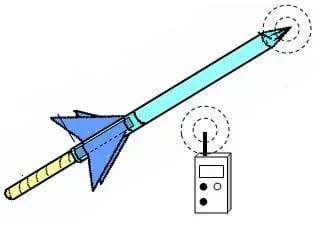 Figure 1. A controlled strawket.
Students investigate the effect that fins have on rocket flight. They construct two paper rockets that they launch themselves by blowing through a straw (see Figure 1). One "strawket" has wings and the other has fins. Students observe how these two control surfaces affect the flight of their strawkets. Students discover how difficult control of rocket flight can be and what factors can affect it. In the continuing hypothetical story for this unit, what students learn about rocket weight adds to their background understanding in their effort to help Tess launch a communication satellite.
Understanding how a rocket will behave in the Earth's atmosphere, as well as in space, is critical to rocket design. Engineers use control surfaces, such as fins, to help stabilize a rocket's launch into space. When designing other moving vehicles, engineers also need to consider the tradeoff of drag produced by adding control surfaces.
After this activity, students should be able to:
- Explain why the control of a rocket is important.
- Relate control of a rocket to fins and describe how fins affect rocket flight.
- Determine how the number of fins affects rocket flight.
- Identify some factors that engineers must consider when designing real rockets.
- 3.3.1.a Represent and interpret data.
Grade 3
Do you agree with this alignment? - 3.3.1.a.i Draw a scaled picture graph and a scaled bar graph to represent a data set with several categories.
Grade 3
Do you agree with this alignment?
- CCSS.Math.Content.3.MD.B Represent and interpret data.
Grade 3
Do you agree with this alignment? - CCSS.Math.Content.3.MD.B.3 Draw a scaled picture graph and a scaled bar graph to represent a data set with several categories. Solve one- and two-step "how many more" and "how many less" problems using information presented in scaled bar graphs.
Grade 3
Do you agree with this alignment?
- Models are used to communicate and test design ideas and processes.
Grades 3-5
Do you agree with this alignment? - Test and evaluate the solutions for the design problem.
Grades 3-5
Do you agree with this alignment?
- 3-5-ETS1-2 Generate and compare multiple possible solutions to a problem based on how well each is likely to meet the criteria and constraints of the problem.
Grades 3-5
This resource focuses on the following Three Dimensional Learning aspects of NGSS:
Science & Engineering Practices- Generate and compare multiple solutions to a problem based on how well they meet the criteria and constraints of the design problem.Do you agree with this alignment?
Disciplinary Core Ideas- Research on a problem should be carried out before beginning to design a solution. Testing a solution involves investigating how well it performs under a range of likely conditions.Do you agree with this alignment?
- At whatever stage, communicating with peers about proposed solutions is an important part of the design process, and shared ideas can lead to improved designs.Do you agree with this alignment?
Crosscutting Concepts- Engineers improve existing technologies or develop new ones to increase their benefits, to decrease known risks, and to meet societal demands.Do you agree with this alignment?
Do you agree with this alignment? - Generate and compare multiple solutions to a problem based on how well they meet the criteria and constraints of the design problem.
- 3-5-ETS1-3 Plan and carry out fair tests in which variables are controlled and failure points are considered to identify aspects of a model or prototype that can be improved.
Grades 3-5
This resource focuses on the following Three Dimensional Learning aspects of NGSS:
Science & Engineering Practices- Plan and conduct an investigation collaboratively to produce data to serve as the basis for evidence, using fair tests in which variables are controlled and the number of trials considered.Do you agree with this alignment?
Disciplinary Core Ideas- Tests are often designed to identify failure points or difficulties, which suggest the elements of the design that need to be improved.Do you agree with this alignment?
- Different solutions need to be tested in order to determine which of them best solves the problem, given the criteria and the constraints.Do you agree with this alignment?
Do you agree with this alignment? - Plan and conduct an investigation collaboratively to produce data to serve as the basis for evidence, using fair tests in which variables are controlled and the number of trials considered.
Each student needs:
- 1 half-sized piece of a letter-sized piece of paper, measuring 8.5 x 5.5 inches
- 1 letter-sized piece of paper, 8.5 x 11 inches
- 1 pencil
- 1 drinking straw
- 1 cotton ball
- 1 pair of scissors
- Control Quiz (PDF)
- Control Analysis Worksheet (PDF)
For the entire class to share:
- Planet Target pictures of each of the planets, Inner (PDF)and Outer (PDF)
- 1 balloon (any size works, but round balloons are best)
- several cellophane tape dispensers
- 1 stiff piece of cardboard, approximately 8.5 × 11 inches
- Planet Targets – Inner (pdf)
- Planet Targets – Outer (pdf)
- Control Analysis Worksheet (pdf)
- Launch from the Earth Handout (pdf)
- Launch from the Sun Handout (pdf)
- Results from the Earth Math Sheet (pdf)
- Results from the Sun Math Sheet (pdf)
- Planet Comparison Datasheet (xls)
- Control Quiz (pdf)
- Control Quiz Answers (pdf)
Imagine you are in a rocket, heading to space. All of a sudden, you catch a big gust of wind. What will happen to the rocket? Engineers must answer questions like this when they design rockets. You might be thinking that airplanes are also affected by gusts of wind. Airplanes look very different from rockets. Why do you think this is so? What do airplanes have that rockets do not? That's right, wings! You probably know that airplanes have wings and rockets have fins. But why? What if it was the other way around?
As Rohan and Tess' engineering team, we not only must be concerned with the thrust and weight of a rocket, but we also must consider how it will be controlled and how stable it will be. Engineers put fins on the back of rockets in order to stabilize them. These fins are similar to the fins on the tail of an airplane. The fins keep the rocket moving in the right direction even if is knocked off course by a gust of wind. Unlike airplanes, however, engineers do not put wings on rockets because wings would slow down the rocket too much. This is called drag.
Have you ever made a paper airplane and thrown it into the air? If so, you have seen how difficult it can be to make things fly in the direction you want. After today's lesson, you will learn why your paper airplane did not fly very straight. You will learn how to think like an engineer and how better to design Tess' rocket.
Before the Activity
- Gather materials and make copies of the Control Quiz (PDF) and Control Analysis Worksheet (PDF).
- Print out the Planet Targets, Inner (PDF)and Outer (PDF). If possible, print them in color and laminate them for reuse.
- Cut in half enough pieces of letter-sized paper so that each student receives one half. Almost any size paper can be used as long as it is not longer than the straw.
- If necessary, remove the straws from their paper packaging.
- Use tape or string to mark a starting line on the floor.
- Lay out the Planet Targets on the floor beyond the starting line. For a somewhat realistic layout, use one of the patterns: Launch from the Earth Handout (PDF) or Launch from the Sun Handout (PDF). For reference, see the Planet Comparision Data (XLS) (Excel® file) for actual planet distances and diameters.
With the Students
- Have students wrap one half-sheet of paper around a pencil, starting from the eraser end and working up to the graphite tip. When wrapping, spiral the paper to make a cone shape (this can be done by holding it tighter at the eraser end and wrapping upward; see Figure 2).
 Figure 2. A cone-shaped paper tube.Copyright 2003 Jeff White, College of Engineering and Applied Science, University of Colorado Boulder
- Have students tape the paper tube near each end so it keeps its shape. Then remove the pencil. Note: Make sure the final length of paper tubing is a few centimeters shorter than the straws so students have something to hold onto for the launch (cut the paper tubing with scissors if necessary).
- Have students pinch and fold the smaller tube end over and tape it so it is airtight. This end becomes the strawket "nose."
- Because engineers always include safety measures in their designs, direct students to tape a cotton ball to the nose of each strawket. To prevent the cotton from falling off the strawket, place the tape over the top of the cotton ball (that is, not wrapped inside/out and placed underneath the cotton ball as it sits on the nose of the paper tubing). Note: Some cotton balls are big enough to pull apart; only use as much cotton as necessary to provide some protective padding.
- Have students add large wings to their strawket in any design, however they want (see an example in Figure 3). Cut the wings from the full sheet of letter-sized paper. Remind students that for stable flight, it is best if the center of pressure is behind the center of gravity (nearer to the tail).
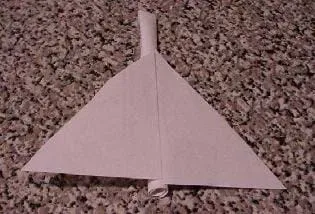 Figure 3. A cone-shaped strawket with wings.Copyright 2003 Jeff White, College of Engineering and Applied Science, University of Colorado Boulder
- Have students personalize their strawkets. Suggest that they write their names on them or draw a design so they are easy to identify as theirs.
- Have students sketch their strawkets on the worksheets.
- Blast Off: Have each student launch from the Earth or Sun (depending on the pattern you selected before the activity). Direct the students to insert the straw into the rocket—holding onto the straw, not the paper part of their strawket—aim at a planet and blow.
- After retrieving their strawkets, have students answer the three worksheet questions for the strawket just launched.
- Lay two strawkets (with or without fins as long as they are the same) on a table perpendicular to each other (in a "T" configuration). Ask students which orientation would fly better through the wind. Wave a stiff piece of paper or cardboard by hand from 5-10 feet away to blow air at the two rockets. Expect the one with its nose pointing at the wind to not move much while the one lying perpendicular to the wind spins or moves backwards. Explain that any surface area of a flying object that is exposed to the wind will create drag. Even though wings cannot create lift and gliding motion, they have a large surface area that causes a lot of drag. Remind students that real-world rockets do not use wings for lift. Wings on a rocket would help control it but would add too much drag. This is why rockets use fins instead of larger wings.
- Have students cut down their wings to a small fin size (see Figure 1). Alternatively, they can simply remove the wings and add small fins however they like.
- Repeat steps 7-9.
Pre-Activity Assessment
Demonstration: Blow up a balloon and pinch the end shut. Tell students that it is a rocket ship and you want it to land on a certain desk. Aim the balloon at the desk and let it go. Of course, it will not land on the desk—possibly not even near it! Ask students what went wrong. (Answer: The balloon had no control. Any energy used moving sideways is energy that could have been used to go farther forward.)
Concept Inventory: Have students attempt to complete the Control Quiz (PDF). Then put it aside to review again after the activity.
Activity Embedded Assessment
Worksheet: Have students record measurements and follow along with the activity on the Control Analysis Worksheet (PDF). After students have finished their worksheets, have them compare answers with their peers.
Post-Activity Assessment
Control Quiz: Have students correct any answers they missed on the Control Quiz (PDF).
Question/Answer: Ask the students the following questions. Have students raise their hands to answer.
- What would happen if you placed the fins near the strawket's nose? (Answer: The center of pressure is moved forward, and the strawket becomes unstable.)
- Are rocket fins necessary in outer space? (Answer: No, there is no air in space.)
- Ask the students if adding wings to an untied balloon will help stabilize it. (Answer: Yes)
- What about adding fins instead? (Answer: Yes)
- What would be the difference? (Answer: The wings would create more drag, and the balloon would not fly as far.)
Graphing Practice: Have students measure the distances their individual strawkets travel and record each attempt. Have them graph the data to show that fin-strawkets fly farther than wing-strawkets. Have students create bar graphs of the class results using the Results from the Earth Math Sheet (PDF) or Results from the Sun Math Sheet (PDF) (depending on where the students started their rockets from in step 8).
Permit no strawkets to be launched while the previous student is retrieving his/her strawket.
Watch that strawkets are not launched towards people.
Make a strawket or two in advance to make sure your materials are suitable. It is also a good idea to have some extra strawkets made in case a student's is lost or crushed during the activity.
If you do not have access to enough pencils, use extra drinking straws to help wrap the paper cone.
Distributing tape to each student can be difficult while demonstrating how to build the strawket. If possible, have several helpers pass out the tape or stick pieces on the edges of a few desks/tables in advance.
Make the tape used to secure the cotton balls fairly long so that the cotton balls are adhered properly.
Make sure students are not holding onto the strawket when they blow through the straw; advise them to hold onto the straw only.
Have students determine how small the fins can be and still stabilize their strawkets. Students can find this by trimming a little off of their fins before each launch. Have students measure the distance for each launch and graph their results.
Have students deterimine how many fins a strawket needs to become stabilized. Have them design a strawket with 1 fin, 2 fins, 3 fins, etc. Or add a fin before each launch. Have students measure the distance for each launch and graph their results.
Can students come up with any other design improvements (for example, less weight, high pressure air blower, fixed launch position, etc.)?
For grades K-2, have students complete the activity without using the worksheet. Students can build the strawkets and launch them, using fins and no fins. Have students count down to launch and the number of strawkets that make it to each planet. Make a bar graph to help them visualize the numbers (see the Results from the Earth Math Sheet (PDF) or Results from the Sun Math Sheet (PDF)). Discuss with the students how flight changes when fins are added.
For grades 4 and 5, have students complete the entire activity and make comparison bar graphs of the distances achieved for wing-strawkets and fin-strawkets using the Results from the Earth Math Sheet (PDF) or Results from the Sun Math Sheet (PDF). Also, have them find the class average for each case and comment on the difference between the two results.
James, Donald. Teacher Information: Paper Rockets. NASA Quest, National Aeronautics and Space Administration. http://quest.arc.nasa.gov/space/teachers/rockets/act5.html
Vogt, Gregory. "Paper Rockets," edited by Roger Storm, Aerospace Education Services Project, Oklahoma State University, NASA Glenn Learning Technologies Project. http://www.grc.nasa.gov/WWW/K-12/TRC/Rockets/paper_rocket.html
- Rockets
- Keep in Touch: Communications and Satellites
- Newton Gets Me Moving
- Using Thrust, Weight & Control: Rocket Me into Space
- Strawkets and Thrust
- Strawkets and Weight
- Strawkets and Control
- Blast Off: Generating Rocket Thrust with Propellants
- Learn to Build a Rocket in Five Days or Your Money Back
- Where Am I: Navigation and Satellites
Contributors
Jeff White; Brian Argrow; Luke Simmons; Jay Shah; Malinda Schaefer Zarske; Janet Yowell
Supporting Program
Integrated Teaching and Learning Program, College of Engineering, University of Colorado Boulder
Acknowledgements
The contents of this digital library curriculum were developed under grants from the Fund for the Improvement of Postsecondary Education (FIPSE), U.S. Department of Education, and National Science Foundation (GK-12 grant no. 0338326). However, these contents do not necessarily represent the policies of the Department of Education or National Science Foundation, and you should not assume endorsement by the federal government.
Copyright
2006 by Regents of the University of Colorado