
Constraints: Pop Rockets on a Shoestring Budget
Students revisit the Pop Rockets activity from Lesson 3, in which mini paper rockets are powered by the chemical reaction of antacid-tablets and water in plastic film canisters. This time, however, the design of their pop rockets is limited by budgets and supplies. They get a feel for the constraints of real engineering projects as well as the opportunity to redesign and retest their rockets to make improvements. Rocket build instructions as well as activity-guiding budget/sketch and data worksheets are provided.
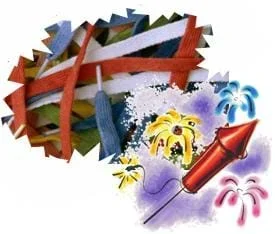 Rockets on a shoestring budget!
Engineers must consider all aspects of a project during the engineering design process. In rocket design, considerations include: how far and fast it needs to go, as well as its cost, safety, weight and environmental impact. Together, these are the requirements and limitations—called the "constraints"—of the engineering challenge. To reach a goal with limited resources, engineers must be creative in making choices to balance the competing factors of cost, resources, value, and performance; we call thse trade-offs.
After this activity, students should be able to:
- Give an example of a real-world constraint on engineering projects, such as budgets, deadlines, supplies and safety.
- Explain that engineering design has several steps, that a project is not usually perfect after the first design, and that it may take several redesigns to achieve a working/acceptable project.
- Use and fill out a budget and sketch sheet to create a specific design using imitation money.
- 5.1.2.c Add, subtract, multiply, and divide decimals to hundredths.
Grade 5
Do you agree with this alignment? - 3.3.1.a Represent and interpret data.
Grade 3
Do you agree with this alignment?
- CCSS.Math.Content.3.MD.B Represent and interpret data.
Grade 3
Do you agree with this alignment? - CCSS.Math.Content.5.NBT.B.7 Add, subtract, multiply, and divide decimals to hundredths, using concrete models or drawings and strategies based on place value, properties of operations, and/or the relationship between addition and subtraction; relate the strategy to a written method and explain the reasoning used.
Grade 5
Do you agree with this alignment?
- Students will develop an understanding of the attributes of design.
Grades K-12
Do you agree with this alignment? - Students will develop an understanding of engineering design.
Grades K-12
Do you agree with this alignment? - Models are used to communicate and test design ideas and processes.
Grades 3-5
Do you agree with this alignment? - Test and evaluate the solutions for the design problem.
Grades 3-5
Do you agree with this alignment? - STEL-7J Evaluate designs based on criteria, constraints, and standards.
Grades 3-5
Do you agree with this alignment? - STEL-7M Evaluate the strengths and weaknesses of existing design solutions, including their own solutions.
Grades 3-5
Do you agree with this alignment?
- 3-5-ETS1-1 Define a simple design problem reflecting a need or a want that includes specified criteria for success and constraints on materials, time, or cost.
Grades 3-5
This resource focuses on the following Three Dimensional Learning aspects of NGSS:
Science & Engineering Practices- Define a simple design problem that can be solved through the development of an object, tool, process, or system and includes several criteria for success and constraints on materials, time, or cost.Do you agree with this alignment?
Disciplinary Core Ideas- Possible solutions to a problem are limited by available materials and resources (constraints). The success of a designed solution is determined by considering the desired features of a solution (criteria). Different proposals for solutions can be compared on the basis of how well each one meets the specified criteria for success or how well each takes the constraints into account.Do you agree with this alignment?
Crosscutting Concepts- People's needs and wants change over time, as do their demands for new and improved technologies.Do you agree with this alignment?
Do you agree with this alignment? - Define a simple design problem that can be solved through the development of an object, tool, process, or system and includes several criteria for success and constraints on materials, time, or cost.
- 3-5-ETS1-2 Generate and compare multiple possible solutions to a problem based on how well each is likely to meet the criteria and constraints of the problem.
Grades 3-5
This resource focuses on the following Three Dimensional Learning aspects of NGSS:
Science & Engineering Practices- Generate and compare multiple solutions to a problem based on how well they meet the criteria and constraints of the design problem.Do you agree with this alignment?
Disciplinary Core Ideas- Research on a problem should be carried out before beginning to design a solution. Testing a solution involves investigating how well it performs under a range of likely conditions.Do you agree with this alignment?
- At whatever stage, communicating with peers about proposed solutions is an important part of the design process, and shared ideas can lead to improved designs.Do you agree with this alignment?
Crosscutting Concepts- Engineers improve existing technologies or develop new ones to increase their benefits, to decrease known risks, and to meet societal demands.Do you agree with this alignment?
Do you agree with this alignment? - Generate and compare multiple solutions to a problem based on how well they meet the criteria and constraints of the design problem.
- 3-5-ETS1-3 Plan and carry out fair tests in which variables are controlled and failure points are considered to identify aspects of a model or prototype that can be improved.
Grades 3-5
This resource focuses on the following Three Dimensional Learning aspects of NGSS:
Science & Engineering Practices- Plan and conduct an investigation collaboratively to produce data to serve as the basis for evidence, using fair tests in which variables are controlled and the number of trials considered.Do you agree with this alignment?
Disciplinary Core Ideas- Tests are often designed to identify failure points or difficulties, which suggest the elements of the design that need to be improved.Do you agree with this alignment?
- Different solutions need to be tested in order to determine which of them best solves the problem, given the criteria and the constraints.Do you agree with this alignment?
Do you agree with this alignment? - Plan and conduct an investigation collaboratively to produce data to serve as the basis for evidence, using fair tests in which variables are controlled and the number of trials considered.
Each group needs:
- 1 35-mm film canister with an internal snapping lid; see Figure 1 and note below
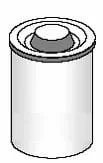 Figure 1. The type of film canister needed for this activity.Copyright 2003 Jeff White, College of Engineering and Applied Science, University of Colorado Boulder
Note: For this activity, use a film canister with an internal-sealing lid instead of one that snaps over the outside of the rim. These are usually clear, white canisters—not the solid black or gray ones. Film canisters are often available free of charge from camera shops and stores where film is processed, such as grocery stores, Target, Wal-mart, Costco, etc. These businesses recycle the canisters and are often willing to donate them for educational use. The most commonly available film canister is the solid black/gray style with the overlapping lid, which will not work for this activity, so you may have to make a few trips to these stores to get enough of the white translucent canisters with the internal-sealing lids! Alternatively, purchase the film canisters ($8.95 for 15 canisters) at https://www.amazon.com/Microlab-Scientific-FCFR-224-Film-Canisters/dp/B00IMUBZFY.
- 1 penny
- scissors
- antacid half-tablet, such as Alka-Seltzer© brand
- Blast-Off Bucks (PDF)
- Trial Data Worksheet (PDF)
- Budget and Sketch Worksheet (PDF)
- Rocket Build Instruction Sheet (PDF)
For the entire class to share:
- clear cellophane and masking tape
- unlined white paper
- heavy construction paper
- safety glasses/goggles, at least enough for the instructor and the launching group
- paper towels
- access to cold and hot water faucet
- (if launching rockets inside) an empty pitcher
Dreaming about how to build something is completely free. Engineers, however, are paid to think about how to build something. Doesn't that sound like fun? Being imaginative, therefore, is an important skill for an engineer. Building something also takes materials, building skills, and space in which to build. Materials cost money, gaining skills costs money (either education or trial and error with materials), and enough available space in which to build a project usually costs money. This is why engineers strive to build things that are useful and can be sold at a profit or used to save people time and/or money in the long run.
Building a rocket and using whatever it takes for a successful launch is fun, but the real challenge comes when resources are limited. (Note: NASA essentially had unlimited freedom during the "race to the moon" era since the U.S. federal government gave them whatever resources they needed!) Working within constraints is when an engineer's creative thinking skills are very important! To reach a goal with limited resources, choices must be made balancing cost, value and performance. We call these decisions that affect our actions trade-offs. Trade-offs are when we give up one thing in return for another. Buying the best engine for a rocket may mean not enough money is left for adequate structural materials, and subsequently, the rocket may fail. Using the strongest materials may mean the rocket is too heavy and cannot lift off. Using fuel A may improve thrust over fuel B, but fuel A costs twice as much as fuel B—so that's not a good value. It is only worth using the more expensive fuel if the extra money means the difference between success and failure. Part of being an engineer is about deciding how best to balance and compromise on these issues before actually building the final product.
When designing a real rocket, engineers are given budgets, deadlines, and requirements that limit what they can build and how they can build it. Engineers must work within these limits. Spacewoman Tess and Spaceman Rohan have needs such as getting their satellites and spacecraft into space. They have a required timeline; they need to get to space quickly in order for the satellites to be orbiting before Maya starts her journey. Also, they do not have much money with which to work. A good rocket design is a careful compromise between speed, strength, weight, cost, and safety. While we may have the technology to build better rockets, we may not have enough money or time to build one. We also may change the way we build a rocket because of safety or environmental concerns. It may take many designs and tests before engineers have a design that satisfies all the requirements and limitations. Today, we are going to work within a budget. We are going to be given a certain amount of money to buy materials to build our best pop rocket. Do you think you can do it? Let's try!
Background Information: Pop Action (Review from Lesson 3)
Rockets move by expelling fuel in one direction to move in the opposite direction (Newton's third law of motion). For our pop rockets, we will get the thrust force from a pressure build-up caused by a chemical reaction. When the antacid tablet is placed in water, many little bubbles of gas are created. What exactly is going on?
Antacid tablets contain aspirin, sodium bicarbonate (NaHCO3) and citric acid (H+). Bicarbonate compounds react with acids to form carbon dioxide and water.
HCO3- + H+ -> H2O (liquid) + CO2 (gas)
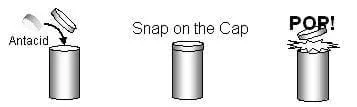 Figure 2. The basics of a pop rocket.Copyright 2003 Jeff White, College of Engineering and Applied Science, University of Colorado Boulder
In an antacid tablet, the bicarbonate and citric acid are solids and so the H+ and CO3-2 ions are not free to move, collide and react. When plopped into water, the citric acid and sodium bicarbonate dissolve, freeing the ions to react. This results in the formation of carbon dioxide gas.
The bubbles go up, instead of down, because they weigh less than water. When the bubbles get to the surface of the water, they break open. All that gas that has escaped from the bubbles pushes on the sides of the canister. Eventually, something has to give—the canister literally pops its top (which is really its bottom, since it is upside down in this activity). All the water and gas rush down and out, pushing the canister up and away, along with the rocket attached to it.
The rocket travels upward with a force that is equal and opposite to the downward force propelling the water, gas, and lid (Newton's third law of motion). The amount of force is directly proportional to the mass of water and gas expelled from the canister and how fast it is expelled (Newton's second law of motion).
Before the Activity
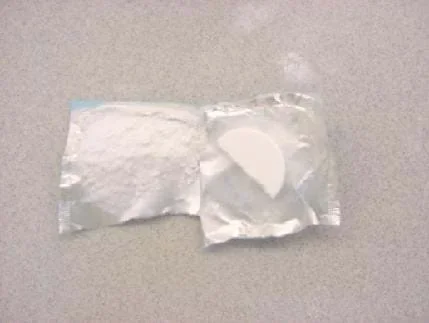 Figure 1. An antacid tablet, half crushed into powder and half intact.Copyright 2003 Jeff White, College of Engineering and Applied Science, University of Colorado Boulder
- Gather materials and make copies of the Trial Data Worksheet (PDF), Blast-Off Bucks (PDF), Budget and Sketch Worksheet (PDF) and Rocket Build Instruction Sheet (PDF).
- Choose a wall inside or outside that you can launch next to, and mark off 10 feet at 1-foot intervals with tape or chalk.
- Prepare crushed tablets (refer to the Troubleshooting Tips for recommendations for this step). Note: Half-tablets of antacid are more than enough to pop off the canister lids; more than a half-tablet is unnecessary and makes the lid pop off sooner, which is not desirable for this activity.
- Clean up any white powder that has been spilled as it may be mistaken for many dangerous or illegal substances. Note: Throughout the activity, only give out antacid tablets as needed so that you know that all tablets are accounted for and used only for the experiment.
With the Students
- Organize the class into student pairs.
- Tell the teams that their engineering challenge is to build a pop rocket that is at least 6 inches tall and can lift a penny at least 4-feet high. Since engineers often build small-scale models of their designs and test them, these pop rockets represent a possible development step in the engineering design process to design a bigger rocket The penny must be protected inside a paper tube. Unlike the last time they built rockets (in Lesson 4, Blast Off > Pop Rockets activity), the materials for building these rockets will be limited.
- Give each group a budget/sketch worksheet, and have them put their names on it.
- Give each group 8 "blast-off bucks."
- Introduce the students to the first few steps of the engineering design process (Ask: Identify Needs and Constraints, Research, Imagine: Develop Possible Solutions, Plan: Select a Promising Prototype). Give each group five minutes to fill out their budget, draw a concept sketch and present the budget and sketch to the teacher for an approval signature.
- The instructor checks the budget/sketch to make sure students are on the right track: Verify that the budget math is correct and is not less than zero. In the sketches, make sure everyone puts the canister lid at the bottom of the rocket, and make sure they indicate the rocket at at least 6 inches tall.
- Have students use the bucks to pay the amount required for their materials (if they have extra bucks, save them), and give them the materials they listed on the budget sheet.
- Give teams 10 minutes to work on step five of the engineering design process and build their rocket prototypes using scissors and their supplies. (Each group may follow the instruction sheet to build its rocket, but are free to try any design they think will work—as long as it is at least 6 inches tall.)
- Have groups each place a penny inside the paper tube of the rockets; make sure they do NOT place the penny inside the film canister itself.
- Have students decorate their rockets with graphic designs and their names.
- Step six of the engineering design process - Testing: Have one group at a time come up to the launch area and put on safety glasses. Make sure all other students are a safe distance away.
- Ask one group representative to hold the rocket upside down as the teacher fills the film canister 1/3 full of either hot or cold water—according to what is specified on the team's budget sheet.
The next steps must be done quickly:
- Have the group representative very quickly drop in the solid or crushed half-tablet (again, according to what is specified on the budget sheet).
- Snap the lid on very tightly, as quickly as possible.
- Turn the rocket upright (film canister lid down), and place it into the empty pitcher or onto the flat launch site—and stand back!
Expect the rocket to pop within 1-5 seconds
- Direct students to note the maximum height reached by the rocket and record it on their data worksheet. Then leave the launch area and answer questions 1 and 2.
- Once a team has launched its rocket, they brainstorm improvements, have them go into the seventh step of the engineering design process and improve and redesign and make revisions to the design, then rebuild the rocket.
- Once redesigns are completed, give students the opportunity to re-launch their rockets.
- Have teams record the height of their final launches and answer the rest of the data worksheet questions.
- trade-off
- Giving up one thing in return for another.
- constraint
- A limitation or restriction. For engineers, design constraints are the requirements and limitations that the final design solutions must meet.
- iteration
- Doing something again, like re-designing to make something better.
Pre-Activity Assessment
Brainstorming: As a class, have students engage in open discussion. Remind them that in brainstorming, no idea or suggestion is "silly." All ideas should be respectfully heard. Take an uncritical position, encourage wild ideas and discourage criticism of ideas. Have students raise their hands to respond. Write their ideas on the classroom board. Ask the students:
- How do companies get the money necessary to build rockets? (Answer: Many possible ways. They might take out a bank loan and then sell the rocket for a profit (assuming it works), get a grant or contract from the government (funding that comes from citizen's taxes), the owner of the company has money from some other source, a company that wants to launch something gives them the money to build a rocket, etc.)
Activity Embedded Assessment
Worksheet: Have students record measurements and follow along with the activity using the Trial Data Worksheet (PDF). After students have finished the worksheet, have them compare answers with their peers.
Group Question: During the activity, ask the groups:
- What made your rocket fail or succeed? What are the most important factors in building a successful rocket? Is it weight? Aerodynamics? Stability? Fuel? A good film canister?
Post-Activity Assessment
Re-Engineering: Ask students how they might improve their pop rockets, and have them sketch or test new ideas. Have students use the data from their own design results as well as the results they observed from other groups to come up with design improvements.
Journal Reflection: Ask students to each write a paragraph in their journals or on a sheets of paper to explain the design process they went through in order to build a better rocket. Have them answer the following question:
- Describe how you designed your rocket in three steps.
Making Sense: Have students reflect about the science phenomena they explored and/or the science and engineering skills they used by completing the Making Sense Assessment (PDF).
Remind students not to put the antacid tablets (crushed or solid) in their mouths; if a student eats a solid tablet s/he could become very sick.
Hand out antacid tablets only as necessary; do not give each group a "supply" in advance.
Make sure students wear safety glasses while they are launching their rockets; make sure sudents who are not launching rockets stay a safe distance away.
In order to effectively use half-tablets of antacid in powder form, the following method of preparation is recommended:
- Use scissors to cut a two-tablet packet down the middle (between the two whole tablets).
- Carefully, tear open each of the foil antacid packets and remove both tablets. Break them in half as evenly as possible.
- Place half of each tablet back into its foil packet.
- Fold over the open end of one of the packets, hold it shut and use a blunt object to crush the half-tablet in the packet (this takes some practice but works well). Repeat for the other tablet.
- Now you have two crushed half-tablets nicely contained in their packets and two solid half-tablets set aside.
Common student problems when building rockets:
- Forgetting to tape the rocket body to the film canister.
- Failing to mount the canister with the lid down.
- Not extending the canister far enough from the paper tube to ensure the lid can be snapped on easily.
It may be easier for students to build the rockets and the teacher to launch them since the chemical reaction of the Alka-Seltzer® tablet and water sometimes happens too fast for small hands.
Remember to have students stand back when the rockets are launching so that they do not get hit with flying rocket parts.
To extend the activity, give students more time the first day to complete and launch their first rockets. Talk to them about redesign and why it is important for engineers to learn from their mistakes (failures). On the second day, reissue Blast-Off Bucks, and have students design and build new rockets, incorporating the lessons learned from the first prototype.
Have students create a bar graph (x-axis: group names and trial numbers, y-axis: height that the rocket reached) representing all of the groups' rocket data.
For kindergarten and first-grade students, build rockets without a budget. Ask students if they think it is more expensive to build a rocket with more supplies. Ask them if they could build a rocket without paper. What if they could have all the paper they wanted? What would it look like then? Have students count out loud to see how long it takes each rocket to "pop." Then, ask for a choral response to these basic questions:
- Why does the rocket come back down when shot up? (Answer: Gravity)
- Where is the energy coming from to power the rocket? (Answer: The reaction between the antacid table and water.)
- If you could re-do your rocket, what would you change? Explain that engineers do not always get a project right the first time and often have to re-design a project or invention many times before getting it to work right. Sometimes, it take all of their money (budget). It is okay when this happens since it is part of the learning process; subsequently, after several tries, engineers are able to develop the best rocket for the money.
For second- and third-grade students, make all rockets the same size (height) so the comparison between materials is more obvious. Expect students to be able to build the rockets, but may need help with the launching procedure.
For fourth- and fifth-grade students, introduce the idea of launch insurance; that is, if a group pays one Blast-Off Buck, they can re-launch their rocket if the first launch fails. Have students graph the class results of rocket versus height.
Fisher, Diane. "Build a Bubble-Powered Rocket." Space Place, National Aeronautics and Space Administration. Accessed September 8, 2005. http://spaceplace.nasa.gov/pop-rocket/
Speake, Vicki, Science Is Here: E-SET, "What Puts the Fizz in Alka-Seltzer®?" September 2002. University Extension, Iowa State University. http://www.extension.iastate.edu/e-set/science_is_here/alkaseltzer.html
"Film Canister Rockets." The Society for International Space Cooperation. Space Xpress, International Space Station Curriculum and Activities. http://www.spacesociety.org/spaceexpress/Curriculum/film_canisters.html
- Rockets
- Keep in Touch: Communications and Satellites
- Newton Gets Me Moving
- Using Thrust, Weight & Control: Rocket Me into Space
- Blast Off: Generating Rocket Thrust with Propellants
- Learn to Build a Rocket in Five Days or Your Money Back
- Constraints: Pop Rockets on a Shoestring Budget
- Where Am I: Navigation and Satellites
Contributors
Jeff White; Brian Argrow; Geoffrey Hill; Jay Shah; Malinda Schaefer Zarske; Janet Yowell
Supporting Program
Integrated Teaching and Learning Program, College of Engineering, University of Colorado Boulder
Acknowledgements
The contents of this digital library curriculum were developed under grants from the Fund for the Improvement of Postsecondary Education (FIPSE), U.S. Department of Education, and National Science Foundation (GK-12 grant no 0338326). However, these contents do not necessarily represent the policies of the Department of Education or National Science Foundation, and you should not assume endorsement by the federal government.
Copyright
2006 by Regents of the University of Colorado