
Cooking with the Sun: Comparing Yummy Solar Cooker Designs
Students learn about using renewable energy from the sun for heating and cooking as they build and compare the performance of four solar cooker designs. They explore the concepts of insulation, reflection, absorption, conduction and convection. Then, as time permits, they make and eat quick-cooking food like marshmallow and chocolate s'mores!
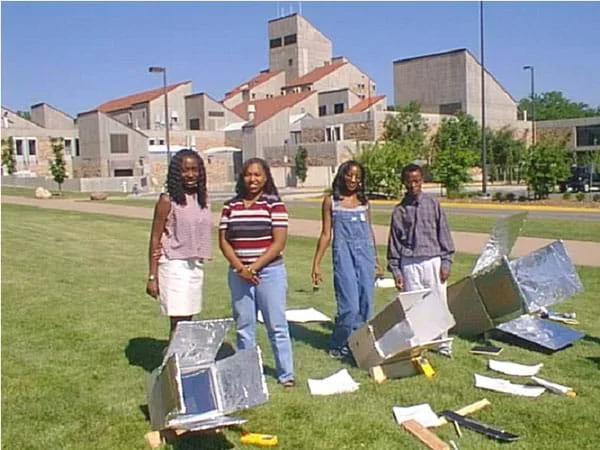 Students show their homemade solar ovens.
Engineers help people in remote areas and developing countries by designing alternative methods (to fossil fuels and electricity) for heating, cooking, obtaining fresh water and sanitation. Solar energy is often a suitable, available, inexpensive, renewable energy resource to power these technologies. Engineers study the position of the sun and the area's climate to optimize the amount of solar energy that can be collected at a given location. They also conduct research to determine the best available local materials that can be used to store solar energy, and size the solar technologies to adequately meet the community's expected needs.
After this activity, students should be able to:
- Explain how engineers help develop solar cooking technology to benefit people in developing countries.
- Describe the important properties of a solar cooker and their purposes.
- Describe the transformation of energy that takes place in a solar cooker.
- 5.4.2.b Represent real world and mathematical problems by graphing points in the first quadrant of the coordinate plane, and interpret coordinate values of points in the context of the situation.
Grade 5
Do you agree with this alignment? - 3.3.1.a Represent and interpret data.
Grade 3
Do you agree with this alignment? - 4.4.1 Appropriate measurement tools, units, and systems are used to measure different attributes of objects and time.
Grade 4
Do you agree with this alignment?
- Identify and describe the variety of energy sources
Grade 4
Do you agree with this alignment? - Gather, analyze, and interpret data such as temperature, air pressure, wind, and humidity in relation to daily weather conditions
Grade 5
Do you agree with this alignment?
- CCSS.Math.Content.4.MD.B Represent and interpret data.
Grade 4
Do you agree with this alignment? - CCSS.Math.Content.5.G.A.2 Represent real world and mathematical problems by graphing points in the first quadrant of the coordinate plane, and interpret coordinate values of points in the context of the situation.
Grade 5
Do you agree with this alignment?
- Models are used to communicate and test design ideas and processes.
Grades 3-5
Do you agree with this alignment? - Energy comes in different forms.
Grades 3-5
Do you agree with this alignment?
- 3-5-ETS1-2 Generate and compare multiple possible solutions to a problem based on how well each is likely to meet the criteria and constraints of the problem.
Grades 3-5
This resource focuses on the following Three Dimensional Learning aspects of NGSS:
Science & Engineering Practices- Generate and compare multiple solutions to a problem based on how well they meet the criteria and constraints of the design problem.Do you agree with this alignment?
Disciplinary Core Ideas- Research on a problem should be carried out before beginning to design a solution. Testing a solution involves investigating how well it performs under a range of likely conditions.Do you agree with this alignment?
- At whatever stage, communicating with peers about proposed solutions is an important part of the design process, and shared ideas can lead to improved designs.Do you agree with this alignment?
Crosscutting Concepts- Engineers improve existing technologies or develop new ones to increase their benefits, to decrease known risks, and to meet societal demands.Do you agree with this alignment?
Do you agree with this alignment? - Generate and compare multiple solutions to a problem based on how well they meet the criteria and constraints of the design problem.
- 4-PS3-4 Apply scientific ideas to design, test, and refine a device that converts energy from one form to another.
Grade 4
This resource focuses on the following Three Dimensional Learning aspects of NGSS:
Science & Engineering Practices- Apply scientific ideas to solve design problems.Do you agree with this alignment?
Disciplinary Core Ideas- Possible solutions to a problem are limited by available materials and resources (constraints). The success of a designed solution is determined by considering the desired features of a solution (criteria). Different proposals for solutions can be compared on the basis of how well each one meets the specified criteria for success or how well each takes the constraints into account.Do you agree with this alignment?
- The expression "produce energy" typically refers to the conversion of stored energy into a desired form for practical use.Do you agree with this alignment?
Crosscutting Concepts- Science affects everyday life.Do you agree with this alignment?
- Energy can be transferred in various ways and between objects.Do you agree with this alignment?
- Engineers improve existing technologies or develop new ones.Do you agree with this alignment?
- Most scientists and engineers work in teams.Do you agree with this alignment?
Do you agree with this alignment? - Apply scientific ideas to solve design problems.
Each team needs the following plus the materials for one type of solar cooker:
- scissors
- 250-ml beaker (or large glass jar) to hold 200 ml water
- a non-mercury thermometer
- water, 200 ml per cooker
- timer
- (optional) sunglasses
- Solar Cooker Worksheet (PDF), one per student
- (optional) mini-size marshmallows
- (optional) thin Hershey-brand chocolate bar
- (optional) graham cracker
For a shade area control station:
- 250-ml beaker (or large glass jar) to hold 200 ml water
- a non-mercury thermometer
- water, 200 ml
Each team needs the materials to build one of the four types of solar cookers.
Cooker #1 (Box Panel Cooker)
- 1 cardboard box, ~12 in (30 cm) on the longest side (ask students to bring boxes from home)
- rubber cement (or tape)
- aluminum foil, roll or sheets, to line the inside of the box
Cooker #2 (Modified Box Panel Cooker)
- 1 cardboard box, ~12 in (30 cm) on the longest side (ask students to bring from home)
- black paint and brushes (or black construction paper, scissors and glue)
Cooker #3 (Simple Cone Cooker)
- 1 cardboard box in which to prop the cone formed from the poster board (ask students to bring from home)
- 1 poster board, 35 x 35 in (90 x 90 cm)
- aluminum foil, to cover the poster board
- rubber cement (or tape)
- 3 brass brads (or heavy-duty stapler)
- pencil (to poke holes in the poster board if securing with brass brads)
Cooker #4 (Parabolic Solar Cooker)
- 1 rectangular cardboard box to make the frame, the longest side must be ~12 in (30 cm) (ask students to bring from home)
- 1 cardboard box to make the ends of the trough, the shortest side must be at least 9 in (23 cm) (ask students to bring boxes from home)
- 1 poster board, 11 x 14 in (28 x 35 cm)
- aluminum foil, to cover the poster board and trough ends
- pencil (to poke holes in the cardboard)
- rubber cement (or tape)
- clear or masking tape
- 2 nuts
- 2 bolts
- Parabolic Solar Cooker Pattern (PDF)
- (optional) 1 unpainted wire coat hanger
Who likes to cook? Who likes to eat? How do you think you could heat water or cook food without a stove, oven or microwave? How did people cook before such appliances? People have been able to cook food over open fires, but have you ever heard of cooking with the sun? Although people have used the sun to dry foods for centuries, solar cooking (cooking with the sun) is a more recent technology. There are several reasons to use the sun to cook as much as possible. Regular cooking techniques require burning wood, other fibrous plant remains or fossil fuels (indirectly, if electricity made from burning fossil fuel is used in cooking). Energy from the sun is free — you only need to build a device to capture it. Most solar cookers are easy to build, and solar cooking reduces fossil fuel and electricity consumption.
In areas without electricity or gas for energy, people often do not have ovens or stoves for cooking, so engineers design inexpensive solar cookers to help them. Usually, the people in these areas use wood to cook, so the use of solar cookers also saves trees, which reduces deforestation. Deforestation is a big contributor to global warming, habitat destruction and erosion of soil (which leads to flooding and landslides). Solar cookers can also be used to purify water without using wood or fossil fuel resources. Using solar cookers reduces pollution and the emission of greenhouse gases. Using a solar cooker, rather than an oven or stove, does not heat up the house in summer and is inexpensive to build. These are all good reasons to use a solar cooker! See http://solarcooking.org/plans/ for photographs of solar cookers being used in places all over the world.
Cooking food with the sun is basically the same as regular oven or stove cooking (not microwave cooking). However, there are three principles of solar cooking that engineers must consider: directing the maximum possible amount of sunlight to the food by reflection, converting sunlight into thermal energy, and holding on to solar heat by using insulation. Also, all solar cookers must be able to absorb as much sunlight as possible. Black pots, pans and dishes are all used in solar cookers to maximize the absorption of light. Some solar cookers have black interior surfaces to maximize conversion of sunlight into thermal energy.
Insulation minimizes how fast heat is lost from the solar cooker. Some models also use a glass or plastic lid to trap the heat inside. Cooking times are decreased if insulation is included, such as cardboard, wood, plastic, glass, a layer of air or commercially-produced, high-temperature resistant foam. Box cookers are the most efficient because they retain more heat than other models through the use of insulation on the sides of the box.
Review the ways heat moves:
- conduction = by direct contact of two materials
- convection = by the interaction of fluid molecules (such as air or water)
- radiation = by the movement of heat waves.
Which method of heat transfer delivers heat from the Sun to the Earth? (Answer: Radiation) Radiation is how the heat is going to get into our solar oven. So, how are we going to keep the heat in the oven? How does your house keep heat in during the winter, or keep heat out in the summer? (Answer: Insulation) Insulation is any material that slows down heat transfer. For our solar ovens, we are going to use cardboard as insulation. While cardboard is not the best insulator, it will work well-enough for our solar oven. (What might be a better insulator?)
Can you think of any ways to get more heat into our oven? Can we reflect heat? We can reflect heat just like we can reflect light. This means that if we use something reflective, such as aluminum foil, we can bounce more heat into our oven.
Placing a brick or other high heat capacity object in a solar cooker increases its ability to use solar energy. Although the solar cooker takes longer to heat up, the thermal mass (an object that stores the heat from the sun) stores energy that can be used to cook food after the sun sets. Using thicker pots increases solar cooker efficiency for the same reason.
Today, we are going to become engineers and compare different designs of solar cookers. Our goal is to build a solar cooker to successfully cook food using specific materials. Do you think you will be able to heat water (and make some food)? Once we learn about the design of solar cookers, we can help people who do not have ovens or stoves. Let's get cooking!
Background
In this two-day activity, student teams build and compare several different solar cooker designs as they heat water. This activity requires one class period on Day 1 to build the solar cookers, and another class period on Day 2 to measure and graph the temperature increases of water positioned in the cookers that are placed outside in the sun. Students also really enjoy using the solar cookers to heat or cook quick-cooking foods. See the Activity Extensions section for food ideas.
Solar cooker design considerations: Since the sun's position in the sky varies throughout the day, reflectors and reflecting surfaces are used on most solar cookers to allow them to capture enough light. Reflectors direct light onto the pot. Parabolic reflectors can have either a point or a line focus. The parabolic cooker in this activity directs light to the axis. The cone cooker in this activity works similarly. Parabolic reflectors with a point focus maximally heat one spot so the pan is placed at that spot. Panel cookers are more efficient than parabolic cookers because the panels reflect light toward the middle of the cooker and can be adjusted as needed. Box cookers usually have adjustable reflectors and reflective lining, so they are the least affected by variation in the direction of sunlight. However, if cookers are too deep, the resulting shadows in the cooker reduce its efficiency.
Before the Activity
- Divide the class into teams of three students each. Have student teams choose (or assign) the cooker type they want to make. The Box Panel Cooker and the Modified Box Panel Cooker are the easiest to construct. Ask students to note how the cookers use scientific ideas of solar radiation and its transfer of energy to the Earth's surface via sunlight.
- Collect boxes for the solar cookers. Ask students to bring empty boxes from home.
- Paint the inside of boxes for Cooker #2 the day before, so the paint has time to dry.
- Gather the rest of the materials and make copies of the Solar Cooker Worksheet (PDF).
- If making the parabolic solar cooker, make copies of the Parabolic Solar Cooker Pattern (PDF) (one pattern per team, also see Figure 5) for the ends of the cooker.
- Organize the materials for each type of solar cooker at team workstations.
Day 1 — Building the Solar Cookers
Construction of Cooker #1: Box Panel Cooker
- Cut off the top flaps of the box. (Or, remove the cover, if a shoe box.)
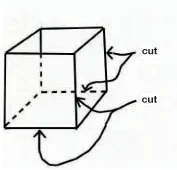 Figure 1. The cardboard edges to cut to create the box panel solar cooker.Copyright Infinite Power, http://www.infinitepower.org/lessonplans.htm. The Infinite Power of Texas materials are provided courtesy of the State Energy Conservation Office of the Comptroller of Public Accounts and the U. S. Department of Energy's State Energy Program; Comptroller and SECO reserve all rights to further use, reproduction, or other distribution and is subject to express written permission from Comptroller and SECO.
- Cut the cardboard box edges as shown in Figure 1, so the box opens up to lay flat, as indicated in Figure 2.
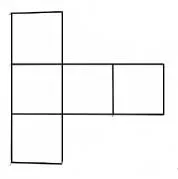 Figure 2. After cutting the box edges, the cardboard should lay flat in this shape.Copyright 2004 Jeff Lyng, graduate fellow, ITL Program, College of Engineering and Applied Science, University of Colorado Boulder
- To make the shiny inside surface of the box panel solar cooker, cut pieces of aluminum foil so they completely cover one side of the flattened cardboard box. Glue (or tape) the foil to the cardboard surface.
- Fold the flattened cardboard into a box shape again (see Figure 3) with the foil surface on the inside of the box, being careful not to rip the foil. The side and front walls are adjustable to help direct sunlight into the cooking area.
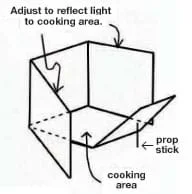 Figure 3. The box panel cooker prepared for cooking.Copyright Infinite Power, http://www.infinitepower.org/lessonplans.htm. The Infinite Power of Texas materials are provided courtesy of the State Energy Conservation Office of the Comptroller of Public Accounts and the U. S. Department of Energy's State Energy Program; Comptroller and SECO reserve all rights to further use, reproduction, or other distribution and is subject to express written permission from Comptroller and SECO.
Construction of Cooker #2: Modified Box Panel Cooker
- Follow the directions for Cooker #1, the box panel cooker, but instead of lining the box with aluminum foil, paint the inside of the box with black paint (or line it with black construction paper).
- Ask students what advantages there might be to having the inside of the oven black. Why not use red or white or yellow paint (or paper)? What happens when you wear a black t-shirt on a sunny day compared to a white t-shirt? (Answer: Darker colors absorb heat better than light colors. So when you wear a black t-shirt in the sun you get hotter than if you wear a white t-shirt. Since we want our oven to get hot, we want to collect as much heat as possible. If we were to make our oven insides white, the heat would be reflected rather than absorbed and our oven would not get as hot.)
Construction of Cooker #3: Simple Cone Cooker
- Cut aluminum foil to fit the poster board. Glue (or tape) the foil to the poster board.
- As shown in Figure 4, roll the poster board into a cone with the foil surface on the inside, being careful not to damage the foil.
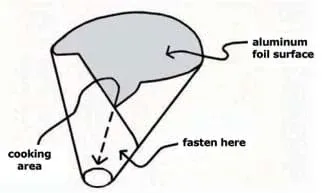 Figure 4. Simple cone cooker construction diagram.Copyright Infinite Power, http://www.infinitepower.org/lessonplans.htm. The Infinite Power of Texas materials are provided courtesy of the State Energy Conservation Office of the Comptroller of Public Accounts and the U. S. Department of Energy's State Energy Program; Comptroller and SECO reserve all rights to further use, reproduction, or other distribution and is subject to express written permission from Comptroller and SECO.
- Punch holes through the poster board where it overlaps at the bottom of the cone. Fasten the brass brads through these holes. Or, fasten securely using a strong stapler instead of the brads.
- Open up the box by cutting off or folding in the top flap(s), or removing the lid.
- Place stones or other weights in the box so it does not move in the wind. Place the solar cone cooker in the box, with its narrow side down.
Construction of Cooker #4: Parabolic Solar Cooker
- Referring to the Parabolic Solar Cooker Pattern (PDF) (see Figure 5), cut the ends of the parabolic trough from the smaller cardboard box. Mark on the pieces of cardboard the locations for the holes. Use a pencil to make the holes on each piece of cardboard.
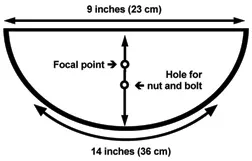 Figure 5. Construction diagram for cardboard side panels of the parabolic solar cooker.Copyright National Renewable Energy Lab
- Glue (or tape) aluminum foil to the poster board.
- Gently curve the poster board with the foil surface to the inside, and use tape to secure the trough-shaped poster board to the two, curved cardboard ends (see Figure 6).
- Cut the top flaps off the rectangular box. Cut a rectangle from one long side of the box (~4.5 in 12 in [11.4 cm 30.5 cm], as shown in Figure 6.
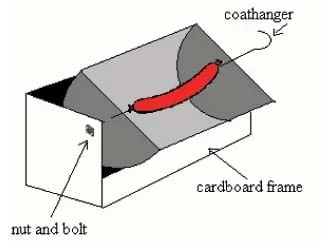 Figure 6. Parabolic cooker construction diagram, ready for cooking.Copyright 2005 Ashleigh Bailey, ITL Program, College of Engineering and Applied Science, University of Colorado Boulder
- Hold the trough in the frame so the hole to attach to the frame is at the corner of the box (see Figure 6). Mark the hole on both sides.
- Use a pencil to make the holes in the cardboard frame. Use the nuts and bolts to attach the parabolic trough to the box frame. Make sure the trough is stable, but can rotate easily.
- (Optional) To cook food, straighten the wire coat hanger and bend one end to make a handle. Push the wire through the hole on one side of the trough and out the hole on the other side.
Day 2 — Testing the Solar Cookers
- Take the cookers, thermometers, beakers, water and a timer outside. Remind students to put on their sunglasses. Position each cooker to receive maximum sunlight. Have the students pay careful attention to how they position their cooker so it receives the most sunlight and does not cast shadows inside the cooker. The side and front walls of the box cooker may be adjusted to better reflect sunlight onto the cooking area. Sometimes it helps to tilt or angle the cooker.
- Pour 200 ml of water into a beaker (or jar) for each cooker you are testing. As a control, place one container of 200 ml of water in the shade, with its own thermometer.
- Have teams place their beakers (or jars) in their cookers.
- Start the timer and have students measure the temperature of the water in their cookers every 2 minutes for 20 minutes, recording the temperature on their worksheets. Assign one student to measure and record the temperature of the control (shade) water jar at the same time intervals.
- Conclude with a class discussion, comparing results and graphs. How did each team's cooker temperature graph compare to the control (shade) temperature graph? Which solar cookers worked the best? How do you know? Did you adjust your cooker in any way to make it work better? What solar cooker characteristics made them work the best? Was there a certain location in each cooker that seemed to get the hottest? Ask students the post-activity discussion questions in the Assessment section.
- (Optional) Time to cook! Place a few mini marshmallows and a piece of thin chocolate on a graham cracker and place it in the oven to melt. (Note: See more snack suggestions in the Activity Extensions section.)
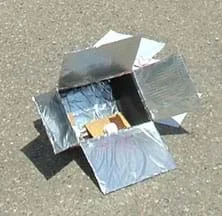 Copyright 2004 ITL Program, College of Engineering and Applied Science, University of Colorado Boulder
- absorb
- To be taken into a material without transmission or reflection.
- conduction
- The transfer of heat from a region of higher temperature to a region of lower temperature by increased kinetic energy moving from molecule to molecule.
- convection
- Transfer of heat in a fluid (liquid or gas) when higher-temperature fluid expands and moves, creating heat transfer.
- deforestation
- To cut down and clear away the trees or forests.
- electromagnetic spectrum
- The entire range of wavelengths or frequencies of electromagnetic radiation extending from gamma rays to the longest radio waves and including visible light. In order of decreasing frequency: cosmic-ray photons, gamma rays, x-rays, ultraviolet radiation, visible light, infrared radiation, microwaves and radio waves.
- erosion
- The process of destruction of a surface by abrasive action (for example, the soil eroded away after the trees were removed).
- fossil fuel
- A hydrocarbon deposit derived from living matter of a previous geologic time and used for fuel, such as coal, petroleum oil or natural gas.
- global warming
- An increase in the average temperature of the Earth's atmosphere, especially causing climatic change.
- greenhouse gases
- The atmospheric gases that contribute to the greenhouse effect by absorbing infrared radiation.
- habitat
- The area or environment where a person or ecological community lives.
- insulation
- A non-conductive material or substance used to prevent the transfer of heat, electricity or sound.
- parabolic
- A specific type of curved shape used in solar trough collectors. The shape focuses the sun at 30 to 100 times its normal intensity, achieving temperatures of more than 400 °C. Having the form of a parabola — a plane curve formed by the intersection of a right circular cone and a plane parallel to an element of the curve.
- purify
- To rid of impurities; cleanse.
- radiation
- The emission and propagation of energy in the form of electromagnetic waves or particles (photons).
- reflect
- To cause to bend back or return upon striking a surface.
- thermal energy
- The energy an object has due to the motion of its particles.
- thermal mass
- Material used to store thermal energy (heat). Stone, concrete, adobe, brick and water work best. Thermal mass is used in a building to absorb or emit heat, and reduce interior temperature swings.
- transmit
- To allow to pass through a material.
Pre-Activity Assessment
Discussion Questions/Review: Solicit, integrate and summarize student responses.
- Where does the Earth get its energy? (Discussion points: Nearly all the energy comes from the Sun. Everything you eat originally got its energy from the Sun. Plants convert the Sun's energy into energy and animals get their energy from eating plants.)
- Can you name devices that get their energy from the Sun? (Possible answers: Cars, trucks, trains, boats and airplanes, computers, ovens, lights, televisions, alarm clocks; anything that uses electricity directly or indirectly got its energy from the Sun.)
- What colors absorbs more heat? (Hint: What colors of clothing feel hotter outside on a sunny day?) (Answer: Dark-colored objects absorb more light and heat energy than light-colored objects.)
- What happens when we place a shiny object in sunlight? (Answer: Shiny surfaces reflect sunlight.)
- What happens to an object's temperature when it is in the sun for awhile? (Answer: An object's temperature increases when it absorbs sunlight. This is a transformation of solar energy to thermal energy.)
Brainstorming: In small groups, have the students engage in open discussion. Remind them that no idea or suggestion is "silly." All ideas should be respectfully heard. Ask:
- If we wanted to make sunlight shine on a particular spot on the ground and heat it up, what could we do?
Activity Embedded Assessment
Worksheet: Have students record the activity measurements and graph the data on their worksheets. After students have finished their worksheets, have them compare results with their peers. Review the worksheets to gauge their mastery of the subject.
Post-Activity Assessment
Re-Engineering: Ask the students how they could improve their solar cooker and have them sketch or test their ideas. Have students think about different ways of testing and using materials (i.e., testing the effects of covering or uncovering the oven, using transparent or opaque materials, using materials of different colors, or testing conductors and insulators of heat.
Discussion Questions: Ask the students and discuss as a class:
- What are some reasons to use a solar cooker? (Possible answers. To save fuel, money and energy; to reduce pollution and emission of greenhouse gases; to reduce deforestation.)
- What is the transformation of energy that happens in a solar cooker? (Answer: Sunlight, in the form of solar radiation, is reflected, absorbed and converted into thermal energy.
- What are the important properties in a good solar cooker? What are their purposes? (Answer: Good reflection of light onto the cooking area, insulation to retain heat, dark cookware or a dark surface to absorb sunlight. Solar cookers have reflecting surfaces that direct the sunlight to one spot in the cooker. It helps if the shiny surfaces are adjustable. The best solar cookers also have clear covers and insulation to minimize the loss of the collected thermal energy. Some cookers have thermal mass to absorb and retain the collected thermal energy.)
- Engineers always want to improve the design of their inventions. If you were an engineer, how might you improve your solar cooker to work better? (Answers: Add a clear glass or plastic cover to trap heat; add insulation to keep from losing heat, add bricks or stones for thermal mass, put it on a revolving tray to easily be turned to track with the sun, etc.)
- Why might engineers be concerned about providing methods for people to use solar energy to cook? (Answer: Because some people do not have technologies such as ovens or stoves.)
- How could you take advantage of solar energy without special technologies or a cooker? (Possible answers: Dry foods in the sun, dry clothes in the sun, etc.)
Pros & Cons: Ask students to list on the board all the advantages and disadvantages they can think of for using solar cookers. Possible advantages: Uses a free and renewable energy resource that does not emit greenhouse gases (that contribute to pollution and global warming); reduces need for fossil fuels and electricity; reduces need for wood to burn fires (saves trees and reduces deforestation, habitat destruction, soil erosion, etc.); helpful in areas without electricity, gas or appliances [ovens, stoves] that use them; does not heat up the house in the summer; inexpensive to build; can be used to purify water, too.) Possible disadvantages: Depends on having a sunny day, must cook outside, etc.
Making Sense: Have students reflect about the science phenomena they explored and/or the science and engineering skills they used by completing the Making Sense Assessment (PDF).
- Remind students to be cautious when poking holes and cutting cardboard or poster board.
- Wear sunglasses while outside since the reflection from aluminum foil is very bright.
Do this activity on a warm, sunny day. Or, use heat lamps if the sun is not shining.
It is best to paint the boxes a day before you construct the ovens so the paint has time to dry.
Advise the students who are testing the simplified cone cooker to be careful in setting the beaker of water in the collector. Shorter jars work better in this collector, but that affects the rate of heat transfer to the water somewhat. They may need to remove the jar briefly while they measure the temperature, replacing it as quickly and carefully as possible.
It helps heat up the water if the teacher places the ovens/water in a sunny spot in advance of when the students start to measure the water temperature.
Plan for other activities or classroom projects for students to work on between measurement times when they are waiting for their oven temperatures to rise. This might include conducting the Post-Activity Assessment activities or Activity Extensions.
Cook a snack: Have students use their solar cookers to make a fast-cooking food, such as hot dogs (pre-cooked, so only re-warming required), sliced frozen cookie dough, s'mores, brownies or nachos. Compared to cooking with a conventional oven or stove, the cooking times need to be adjusted. For example, these cookers only reach about 250 ºF (121 ºC) in direct sunlight, therefore expect cooking times to be longer than in commercial solar cookers or conventional ovens, which reach 450 ºF (232 ºC). If cooking food, alter the activity by having teams measure the air temperature inside their cookers every 2 minutes for 20 minutes and record these temperatures on their worksheets. Also see the Florida Solar Energy Center's What's Cooking Recipes (for s'mores, s'mores with peanut butter, banana boats and baked beans) at: http://www.fsec.ucf.edu/en/publications/pdf/FSEC-FS-33.pdf.
Have students brainstorm different materials and different designs of solar cookers. If possible, have them construct their own solar cooker, evaluate their design and defend their ideas. Students can research information at the Solar Cooking Archive and Solar Cooking Plans by the Solar Cookers International, http://www.solarcooking.org and http://www.solarcooking.org/plans/ (for photographs of many solar cooker designs).
Sunny Side Up Lunch: On a really hot day, put an oiled, cast iron frying pan on the hot sidewalk in direct sunlight. Break an egg into it and cover the pan with a sheet of glass or plastic. Cook and enjoy!
Have students take temperature measurements in different parts of their oven? Is the temperature the same everywhere? Why might it be warmer or cooler in certain areas?
Thinking like engineers, have students reflect upon how their solar ovens worked, and draw a labeled sketch and instructions for how they would re-design it to make a better solar oven.
How is capturing energy through solar cells like what plants do in photosynthesis? In what other ways do engineers mimic designs seen in nature? Explore this idea with the students. For reference, see the grade 5 (3-6) Biomimicry: Natural Designs activity at TeachEngineering.org.
See many other hands-on activities about the Sun's energy in the grade 4 (3-5) Energy lesson, Let the Sun Shine! activity at TeachEngineering.org.
- For younger students, precut the boxes for them.
- For lower grades, have the students design either the Box Panel Cooker or the Modified Box Panel Cooker, and take temperature measurements every five minutes instead of two.
- For upper grades, have students graph the temperature of the water in their solar cooker and the temperature of the control. Have students compare their graphs with teams using other cooker styles and determine which cooker design was the most efficient.
Catching Sunshine. Developed by Online Science-athon. Energy Science Projects and Activities. Energy Education and Training, Energy Efficiency and Renewable Energy, U.S. Department of Energy. Accessed November 28, 2005. (For grades 4-8, an activity to construct a solar collector, determining how to maximize the amount of sunshine it collects.) http://scithon.terc.edu/CatchingSunshine/
Constructing and Testing Solar Cookers. Renewable Energy Lesson Plans, Texas State Energy Conservation Office. Accessed November 28, 2005. (Activity adapted from this middle school lesson plan, click on #12 Cooking with the Sun) http://www.infinitepower.org/lessonplans.htm
Cooking with the Sun. Last updated September 6, 2005. NASA. Accessed November 28, 2005. (Great instructions and photos for making a pizza box solar oven to cook a snack.) http://www.nasa.gov/audience/forkids/activities/A_Cooking_with_the_Sun.html
Dictionary.com. Lexico Publishing Group, LLC. Accessed December 20, 2005. (Source of vocabulary definitions, with some adaptation.) http://www.dictionary.com
Lindo, Natasha and Lerios, Toli. Physics of Solar Cooking. Engineering Group, Stanford Youth Environmental Science, Stanford University, CA. Found at Outdoors Physics, Umeå University, Sweden. Accessed November 30, 2005. (Source of background information) http://www.ccathsu.com/files/handouts/Parabolic%20Solar%20Cookers.pdf
Schleith, Susan and Sheinkopf, Blanche. Solar Matters III. Florida Solar Energy Center, University of Central Florida. Accessed September 18, 2006. (A solar energy science unit for grades 6-8). http://www.fsec.ucf.edu/en/education/k-12/curricula/sm3/
Solar Energy, Dr. E's Energy Lab, EERE Kids. Updated November 7, 2005. Energy Efficiency and Renewable Energy, U.S. Department of Energy. Accessed November 28, 2005. http://www.eere.energy.gov/kids/solar.html
Solar Energy Basics. Learning About Renewable Energy & Energy Efficiency, National Renewable Energy Laboratory. Accessed November 28, 2005. (Source of background information) http://www.nrel.gov/learning/re_solar.html
The Solar Cooking Archive. Solar Cookers International. Accessed March 26 2007. http://solarcooking.org
Student Resources on Solar Energy. Learning about Renewable Energy & Energy Efficiency, National Renewable Energy Laboratory. Accessed November 28, 2005. http://www.nrel.gov/learning/sr_solar.html
What's Cooking Teacher Information, Solar Matters III. Florida Solar Energy Center, University of Central Florida. Accessed September 18, 2006. http://www.fsec.ucf.edu/en/education/k-12/curricula/sm3/documents/SM3_WhatsCooking2.pdf
- Solar System!
- Destination Outer Space
- Blazing Gas
- Our Sun and Heat Transfer Basics: Heat It Up!
- Cooking with the Sun: Comparing Yummy Solar Cooker Designs
- Mercury and Venus
- Our Big Blue Marble
- Moon Walk
- Mars and Jupiter
- The Outer Planets
- Life in Space: The International Space Station
- Beyond the Milky Way
- Renewable Energy: Solar
- Renewable Energy
- The Energy of Light
- Let the Sun Shine!
- Capturing the Sun's Warmth
- Cooking with the Sun: Comparing Yummy Solar Cooker Designs
- Design and Test Model Solar Water Heaters
- Design a Solar City
- Power to the People
Contributors
Xochitl Zamora-Thompson; Sabre Duren; Jeff Lyng; Jessica Todd; Geoffrey Hill; Jessica Butterfield; Malinda Schaefer Zarske; Denise W. Carlson
Supporting Program
Integrated Teaching and Learning Program, College of Engineering, University of Colorado Boulder
Acknowledgements
The contents of this digital library curriculum were developed under grants from the Fund for the Improvement of Postsecondary Education (FIPSE), U.S. Department of Education and National Science Foundation (GK-12 grant no. 0338326). However, these contents do not necessarily represent the policies of the Department of Education or National Science Foundation, and you should not assume endorsement by the federal government.
Copyright
2005 by Regents of the University of Colorado