
The Energy of Light
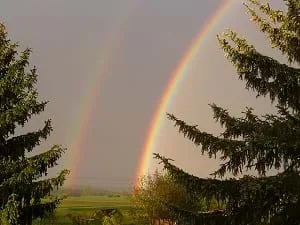 Rainbows are natural phenomena that illustrate refraction—a property of light.Copyright 2012 smartworker, Pixabay CC0 public domain https://pixabay.com/en/rainbow-refraction-171113/
In this introduction to light energy, students learn about reflection and refraction as they learn that light travels in wave form. Through hands-on activities, they see how prisms, magnifying glasses and polarized lenses work. They also gain an understanding of the colors of the rainbow as the visible spectrum, each color corresponding to a different wavelength.
Engineers use the properties of light to create many things that benefit society. To reduce our energy use, lighting engineers take advantage of natural light, sometimes reflecting sunlight off room surfaces to bring light to locations at a distance from windows. Engineers create lasers that are so bright that they can burn through metal. Lasers are used in industry, medicine and surgery, to make holograms, read bar codes and compact disks, and send messages along fiber-optic cables. The properties of light are also exploited in the design of medical equipment, cameras and microscopes.
After this lesson, students should be able to:
- Explain that light is a form of energy and that it can be characterized as a wave.
- Explain that different colors of the spectrum represent light waves vibrating at different frequencies.
- Describe reflection and refraction of light waves.
- Explain how engineers use light waves.
- Energy comes in many forms such as light, heat, sound, magnetic, chemical, and electrical
Grade 4
Do you agree with this alignment? - Identify and describe the variety of energy sources
Grade 4
Do you agree with this alignment?
- Energy comes in different forms.
Grades 3-5
Do you agree with this alignment?
- 4-PS3-2 Make observations to provide evidence that energy can be transferred from place to place by sound, light, heat, and electric currents.
Grade 4
This resource focuses on the following Three Dimensional Learning aspects of NGSS:
Science & Engineering Practices- Use evidence (e.g., measurements, observations, patterns) to construct an explanation.Do you agree with this alignment?
Disciplinary Core Ideas- Energy can be moved from place to place by moving objects or through sound, light, or electric currents.Do you agree with this alignment?
- Energy is present whenever there are moving objects, sound, light, or heat. When objects collide, energy can be transferred from one object to another, thereby changing their motion. In such collisions, some energy is typically also transferred to the surrounding air; as a result, the air gets heated and sound is produced.Do you agree with this alignment?
- Light also transfers energy from place to place.Do you agree with this alignment?
Crosscutting Concepts- Energy can be transferred in various ways and between objects.Do you agree with this alignment?
Do you agree with this alignment? - Use evidence (e.g., measurements, observations, patterns) to construct an explanation.
Light is a type of energy formed by a combination of electrical and magnetic rays, known as electromagnetic (EM) waves. (For a good, basic description and graphics on the electromagnetic spectrum, see NASA's Imagine the Universe website at http://imagine.gsfc.nasa.gov/docs/science/know_l1/emspectrum.html.) Use the attached Electromagnetic Spectrum (PDF) for a classroom visual aid; it is suitable for making overhead projector transparencies or student handouts.
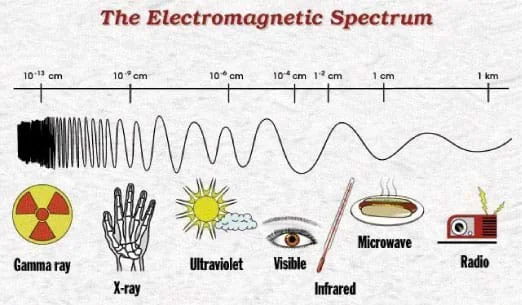 Copyright NASA http://saturn.jpl.nasa.gov/mission/nav-uplink.cfm
Visible light is only one type of EM wave. We use different kinds of electromagnetic waves for many different purposes. Radio transmitters, for example, generate artificial radio waves that carry radio and television programs in coded form by varying the height of the waves.
We see light. We use light every day, in endless ways. Light is a type of energy created by a combination of electrical and magnetic fields. In some ways, light travels as waves giving it typical wave features. For example, the color of light depends on the length of the wavelength of the beam of light. However, in other ways, light seems to be a stream of tiny particles or packets of energy called photons. Scientists have come to accept both of these ways of understanding light. They call the combination of these two properties the "wave-particle duality" of light. Nothing travels faster than light, which travels at a speed of 186,000 miles (299,792 kilometers) per second.
What is light? Can you give an example of light? (Possible answers: Light bulb, flashlight, the sun.) From where does light come? Light is a form of energy. Items such as light bulbs and television screens give off this light energy. Our eyes change visible light energy waves into something we can see. Visible light energy is just one form of light energy. There are invisible forms of light energy, or light energy we cannot see, such as infrared, ultraviolet, radio and x-ray light energy. All light energy is generated by light waves.
Demonstration idea: If a slinky is available, use it to show how waves vibrate in different wavelengths. Explain how the different "wavelengths" correspond to different colors. Use the slinky to show the class that waves can vibrate in any plane (vertical, horizontal or any angle in between). White light contains all of the wavelengths of the visible spectrum and all of the possible angles shown by the slinky.
Color is a product of visible light energy. Different colors represent light waves vibrating at different speeds (frequencies). Do you know that most colors of light can be made by mixing together just three colors—red, blue and green?
Light has other properties that make it fun to learn about. Light waves can bounce off an object; this is called reflection. You can see this when you look at your reflection in a mirror or you see the sky and clouds reflected in a pool of water. The light bounces off the shiny surface (mirror glass or water) back at us. Light waves can also refract; this happens when the light waves are bent as they pass through a clear object. The lens in a pair of eye glasses helps people see more clearly by bending the light rays to help the person's eye adjust images for a distance close up or far away. Refer to the Stations of Light activity to have students examine light energy behavior: refraction, magnification, prisms and polarization.
Different length light waves are all reflected in the same way, but not refracted the same. In refraction, red light waves bend the least and violet light waves bend the most, which gives us a rainbow effect when light bounces off prisms, glass and raindrops.
The brightness of any light source is determined by the amount of light energy it contains. Do you know that a laser light is even brighter than sunlight? It has so much concentrated energy that it can burn through metal. Engineers use lasers in hundreds of ways—in industry, medicine and surgery, to make holograms, read bar codes and compact disks, and send messages along fiber-optic cables.
The sun and other stars emit radio waves, sending them through space. To detect them on Earth, aerospace engineers use radio telescopes. These huge disks face the sky to collect and focus wave energy. The largest single-dish radio telescope is at Arecibo, Puerto Rico. The dish is built into karst topography—a natural hollow in the ground—and is 1,000 feet across. As the Earth moves, the disk turns to point at different parts of the sky.
Light energy is used by engineers in many other ways as well. Engineers have learned to control light using things like prisms and magnifying lenses. Engineers use light for developing medical equipment, x-ray machines, telescopes, cameras, computers and microscopes. Engineers need to know how light energy works to be able to create these cool products and equipment that help people every day. Today we are going to learn more about light energy and where it is found all around us.
Today we learned about light energy. Light energy travels in waves. What are the types of light energy? (Answer: Visible, infrared, ultraviolet, x-ray and radio.) What type of light energy do colors fall into? (Answer: Visible light energy.) What are some properties of light energy? (Answer: Reflection, refraction, waves, photons, wavelengths.) What is reflection? (Answer: When light bounces off the surface of an object.) What is refraction? (Answer: When light bends as it passes through a material.) Engineers use light to create many things that benefit our society. What are some objects that engineers use to control light energy? (Possible answers: Eye glasses, microscopes, medical equipment, magnifying glasses, prisms, polarized sunglasses.) When you go home tonight, tell a friend or family member what you learned about light energy and point out something around you that an engineer has designed that uses light energy, such as a lamp, camera lens, reading glasses, television or computer.
- electromagnetic spectrum
- The entire range of wavelengths or frequencies of electromagnetic radiation extending from gamma rays to the longest radio waves and including visible light. In order of decreasing frequency: cosmic-ray photons, gamma rays, x-rays, ultraviolet radiation, visible light, infrared radiation, microwaves and radio waves.
- lens
- A curved piece of glass that refracts light waves.
- light energy
- Visible light energy, such as from a light bulb, fireflies, computer screens or stars, is one form of electromagnetic energy. Others forms include infrared, ultraviolet, radio and x-ray. Your eyes are detectors of visible light energy.
- light speed
- The speed at which light travels in a vacuum. Defined as exactly 299,792,458 meters per second. (A measure of speed.)
- light year
- The distance that light travels in a vacuum in one year. Defined as 9.46 trillion kilometers or 5.88 trillion miles. (A measure of distance, not time.)
- photon
- A tiny particle or packet of energy. The quantum of electromagnetic energy, generally regarded as a discrete particle having zero mass, no electric charge and an indefinitely long lifetime.
- polarization
- The phenomenon in which waves of light or other radiation are restricted in direction of vibration.
- prism
- A solid figure whose bases or ends have the same size and shape and are parallel to one another, and each of whose sides is a parallelogram. A transparent body of this form, often of glass and usually with triangular ends, used for separating white light passed through it into a spectrum or for reflecting beams of light.
- reflect
- To give back or show an image of an object, for example, in a mirror. Light reflects or "bounces" off the surface of an object.
- refract
- The bending of light as it crosses the between the surface of two transparent materials.
- refraction
- The ability of light to bend when it crosses a transparent medium.
- wave
- (Physics) A disturbance traveling through a medium by which energy is transferred from one particle of the medium to another without causing any permanent displacement of the medium itself.
- wavelength
- The length between peaks or troughs of a wave. This distance determines the color of a beam of light.
Pre-Lesson Assessment
Know / Want to Know / Learn (KWL) Chart: Before the lesson, ask students to write down in the top left corner of a piece of paper (or as a group on the board) under the title, Know, all the things they know about light energy. Next, in the top right corner under the title, Want to Know, ask students to write down anything they want to know about light energy. After the lesson, ask students to list in the bottom half of the page under the title, Learned, all of the things that they have learned about light energy.
Post-Introduction Assessment
Discussion: As a class, review and discuss students' understanding of light energy. Ask the students:
- What are some types of light energy we have discussed? (Answers: Visible, x-ray, radio, ultraviolet, infrared.)
- Which is brighter, a laser or the sun? (Answer: A laser, because it has more concentrated light energy than the sun.)
- What other type of energy does the sun give off? (Answer: Besides light, the sun also gives off heat.)
- Can you hear someone yell in the room next door? (Remind students that sound must travel through matter [air, walls, etc.].) Does light function in the same way? (Point out that we receive light from the sun through the vacuum of space. Light can move through air, water, glass and other transparent material.)
- Can you see a black cat in the dark? Why or why not? (Explain that when we see an object, our eyes are detecting the light reflecting off of the object. So, our eyes cannot detect anything in the absence of light. Black objects reflect no light; white objects reflect all light.)
Lesson Summary Assessment
Roundtable: Have the class form into teams of 3-5 students each. Ask the class a question with several possible answers: How does an engineer use light energy? Have the students on each team make a list of answers by taking turns writing down ideas on a piece of paper. Students pass the list around the group until all ideas are exhausted. Have teams read aloud the answers and/or write them on the board.
KWL Chart (Conclusion): After the lesson, ask students to list in the bottom half of the page under the title, Learned (or on the board), all of the things that they have learned about light energy.
Class Definitions: To reinforce knowledge, have students develop their own definitions for refraction, reflection, visible light and wavelength. Do this in a class discussion or in teams in which the students develop a definition (written and/or illustrated) and read it aloud to the rest of the class. Post the class definitions in the classroom or on the board.
For an excellent demonstration showing the refraction and reflection of light, shine a multimedia laser pointer into a fishbowl. Fill the fishbowl with water, place a mirror in the bottom, turn off the lights and shine a laser pointer into the water.
Dictionary.com. Lexico Publishing Group, LLC. Accessed September 22, 2005. (Source of some vocabulary definitions, with some adaptation.) http://www.dictionary.com/
Electromagnetic Spectrum. Updated 1997-2005. NASA's Imagine the Universe, Goddard Space Flight Center. Accessed September 22, 2005. (Good basic description and graphics) http://imagine.gsfc.nasa.gov/docs/science/know_l1/emspectrum.html
Graham, I., Taylor, B, Farndon, J. and Oxlade, C. Science Encyclopedia. 1999, p. 78-90.
Irving, Bruce. Optics for Kids: Science and Engineering. Optical Research Associates, Pasadena, CA. Accessed September 28, 2005. (Excellent resource with graphics) http://www.opticalres.com/kidoptx.html
Contributors
Sharon D. Perez-Suarez; Jeff Lyng; Malinda Schaefer Zarske; Denise W. Carlson
Supporting Program
Integrated Teaching and Learning Program, College of Engineering, University of Colorado Boulder
Acknowledgements
The contents of this digital library curriculum were developed under grants from the Fund for the Improvement of Postsecondary Education (FIPSE), U.S. Department of Education and National Science Foundation (GK-12 grant no. DGE 0338326). However, these contents do not necessarily represent the policies of the Department of Education or National Science Foundation, and you should not assume endorsement by the federal government.
Copyright
2005 by Regents of the University of Colorado