
Renewable Energy
In this lesson, students are introduced to the five types of renewable energy resources by engaging in various activities to help them understand the transformation of energy (solar, water and wind) into electricity. Students explore the different roles engineers who work in renewable energy fields have in creating a sustainable environment – an environment that contributes to greater health, happiness and safety.
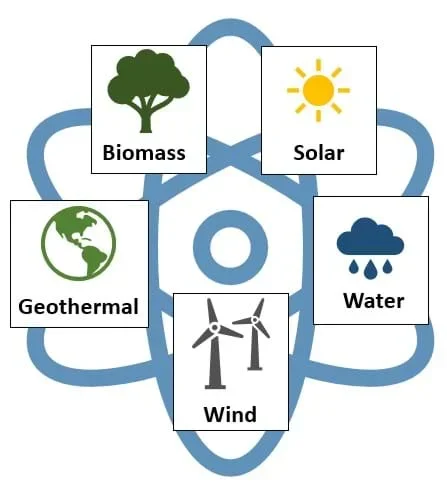 Figure 1. The five sources of renewable energy.Copyright 2020 Sabina Schill
Engineers have a good understanding about energy, so they can harness renewable resources to create electricity for use in our everyday lives. Mechanical, electrical and civil engineers collaborate to develop new and more efficient ways to generate electricity from renewable resources. They design cleaner-burning engines and new car designs (such as hybrid cars) that require less fuel and result in improved gas mileage which in turns improves our planet.
After this lesson, students should be able to:
- Describe sources and uses of energy.
- Define renewable and non-renewable energy.
- Provide examples of common types of renewable and non-renewable resources.
- Understand and explain general ways to save energy at a personal, community and global level.
- Understand and explain, in general terms, how passive solar heating, hydropower and wind power work.
- Describe some general characteristics of solar power, hydropower and wind power.
- Understand the benefits and disadvantages to using renewable resources.
- Explain how engineers design more efficient ways to use generate electricity.
- Describe the role of engineers in energy conservation.
- Energy comes in many forms such as light, heat, sound, magnetic, chemical, and electrical
Grade 4
Do you agree with this alignment? - Identify and describe the variety of energy sources
Grade 4
Do you agree with this alignment? - Use multiple resources – including print, electronic, and human – to locate information about different sources of renewable and nonrenewable energy
Grade 4
Do you agree with this alignment?
- The use of technology affects the environment in good and bad ways.
Grades 3-5
Do you agree with this alignment? - Energy comes in different forms.
Grades 3-5
Do you agree with this alignment? - Tools, machines, products, and systems use energy in order to do work.
Grades 3-5
Do you agree with this alignment?
- 4-ESS3-1 Obtain and combine information to describe that energy and fuels are derived from natural resources and their uses affect the environment.
Grade 4
This resource focuses on the following Three Dimensional Learning aspects of NGSS:
Science & Engineering Practices- Science explanations describe the mechanisms for natural events.Do you agree with this alignment?
Disciplinary Core Ideas- Energy and fuels that humans use are derived from natural sources, and their use affects the environment in multiple ways. Some resources are renewable over time, and others are not.Do you agree with this alignment?
Crosscutting Concepts- Cause and effect relationships are routinely identified and used to explain change.Do you agree with this alignment?
- Knowledge of relevant scientific concepts and research findings is important in engineering.Do you agree with this alignment?
- Over time, people's needs and wants change, as do their demands for new and improved technologies.Do you agree with this alignment?
Do you agree with this alignment? - Science explanations describe the mechanisms for natural events.
- 4-PS3-2 Make observations to provide evidence that energy can be transferred from place to place by sound, light, heat, and electric currents.
Grade 4
This resource focuses on the following Three Dimensional Learning aspects of NGSS:
Science & Engineering Practices- Identify the evidence that supports particular points in an explanation.Do you agree with this alignment?
Disciplinary Core Ideas- Energy can be moved from place to place by moving objects or through sound, light, or electric currents.Do you agree with this alignment?
- Energy is present whenever there are moving objects, sound, light, or heat. When objects collide, energy can be transferred from one object to another, thereby changing their motion. In such collisions, some energy is typically also transferred to the surrounding air; as a result, the air gets heated and sound is produced.Do you agree with this alignment?
- Light also transfers energy from place to place.Do you agree with this alignment?
- Energy can also be transferred from place to place by electric currents, which can then be used locally to produce motion, sound, heat, or light. The currents may have been produced to begin with by transforming the energy of motion into electrical energy.Do you agree with this alignment?
Crosscutting Concepts- Energy can be transferred in various ways and between objects.Do you agree with this alignment?
Do you agree with this alignment? - Identify the evidence that supports particular points in an explanation.
- 5-ESS3-1 Obtain and combine information about ways individual communities use science ideas to protect the Earth's resources and environment.
Grade 5
This resource focuses on the following Three Dimensional Learning aspects of NGSS:
Science & Engineering Practices- Obtain and combine information from books and/or other reliable media to explain phenomena or solutions to a design problem.Do you agree with this alignment?
Disciplinary Core Ideas- Human activities in agriculture, industry, and everyday life have had major effects on the land, vegetation, streams, ocean, air, and even outer space. But individuals and communities are doing things to help protect Earth's resources and environments.Do you agree with this alignment?
Crosscutting Concepts- Engineers improve existing technologies or develop new ones to increase their benefits (e.g., better artificial limbs), decrease known risks (e.g., seatbelts in cars), and meet societal demands (e.g., cell phones).Do you agree with this alignment?
Do you agree with this alignment? - Obtain and combine information from books and/or other reliable media to explain phenomena or solutions to a design problem.
What Is Power?
Energy is the ability to do work (applying a force over a distance), to make things happen, to cause change, or to start motion (a change in position of an object with time). It is the capacity for vigorous activity.
Energy can move (be transferred) and change (be transformed), but it cannot be destroyed. Interactions produce changes in a system, although the total quantities of energy remain unchanged. For example, a power station produces electricity by changing the energy from fuel into electrical energy. A gas-fired power station burns gas, converting the gas' chemical energy into heat. Almost every form of energy can be converted into other forms. But whatever form it is in, energy is essentially the capacity for making something happen or, as scientists put it, "doing work."
Energy comes from many sources, directly or indirectly: power plants, people, food, light, windmills, turbines, fires, electrical circuits, the sun, machines, etc. All energy originally comes from natural resources, most of which originate from the sun.
We use energy to heat houses and buildings, provide light, heating water, break down food, play sports, do activities, operate vehicles, etc.
What are the Different Types of Energy?
- Biomass is the combustion of materials that originate from living things.
- Chemical is used to fuel automobiles and other vehicles.
- Electrical drives many small machines and keeps lights glowing.
- Geothermal taps steam from water heated underground (like geysers) and uses it to spin turbines.
- Hydrogen power uses electricity to break down water into hydrogen gas. The amount of energy released is less than the energy used to break it apart, so not currently feasible.
- Hydroelectricity generates electricity by harnessing the power of flowing water (a renewable resource as long as there is rain). Refer to the associated activity Water Power for students to observe and learn about water related methods of harvesting energy.
- Kinetic is the energy of motion. A spinning top, a falling object, and a rolling ball all have kinetic energy. The motion, if resisted by a force, does work. Wind and water both have kinetic energy. Refer to the associated activity Wind Power to give students an understanding of how wind energy is harvested and used.
- Light energy is generated from light bulbs and computer screens, the sun.
- Nuclear fusion imitates the method the sun uses to produce energy. It involves the joining together of the nuclei of hydrogen atoms.
- Nuclear fission is when energy is given off from splitting nuclei of uranium atoms.
- Potential energy is the energy stored by an object as a result of its position. For example, roller coaster at the top of a hill.
- Sound energy is created, for example, when a door slams, it releases sound energy.
- Solar energy occurs from the sun (light). Refer to the associated activity Solar Power for students to explore this energy form.
- Thermal energy (or heat) boils water, keeps us warm and drives engines.
- Tidal energy is when the energy from ocean tides is harnessed.
Other energy sources, for example, include energy created from old car tires: this source fuels five power stations in the U.S. Also, engineers are trying to design new gas power stations (gas drives the electricity generators and then is reused to heat the plant). Lastly, methane that is produced in sanitary landfills may be used to make power.
How are Energy Sources Categorized?
Non-Renewable Energy Sources | Renewable Energy Sources |
Natural gas | Wind |
Coal | Water |
Oil | Solar |
Other Fossil Fuels |
|
What are Engineers Doing to Improve Our Energy Sources?
Current uses of fossil fuels have catastrophic effects on our environment. Obtaining and using them destroys natural habitats and pollutes the air, water, and land. We can reduce this consumption of fossil fuels by finding alternative, renewable methods of energy production. Engineers are involved in many new technologies that will save our precious resources from devastating long-term effects.
And, engineers are improving the design of factories and products to make even more efficient use of our resources. They are designing cleaner engines that use less fuel and new car designs that run by electric motors. They are studying corals because they very efficiently use low levels of phosphate in the water for energy. Corals have fractal surfaces, and scientists believe that fractal surfaces could make many chemical reactions more efficient. They are working to make machines smaller and more efficient (industrial engineers/designers). For example, they developed fiber optics (thin glass cables to replace heavy metal ones for phones). These efforts contribute to a better, cleaner planet for all inhabitants. Wouldn't it be great to be an engineer making such an important difference in our lives?
Brainstorm a list of ideas about where and when we use energy. (Answer: We use energy all the time. Humans use energy to be active – to walk, talk, play basketball, etc. We use energy to power our appliances, vehicles, lights, etc. Cells use energy to perform the most basic life functions. Life as we know it would not be possible without energy production and consumption.)
Energy is everywhere! Although sometimes you can hear energy (sound), feel energy (wind), taste energy (food), and see energy (light), most often it is hard to figure out exactly where energy is.
Energy can move and change, but it cannot be destroyed. Almost every form of energy can be converted into other forms. It is similar to the heat you feel coming off a light bulb while it is on. The warmth is light energy changed to heat energy. Whatever form it is in, energy is essentially the ability for making something happen or, as scientists put it, "doing work."
Where do we get our energy? Well, a lot of energy originally comes from the sun. We get some energy directly from the sun when we use solar panels; however, most energy comes from fossil fuels (coal and oil), which got their energy from fossilized plants and other organisms that obtained their energy directly from the sun by a process called photosynthesis that occurred many years ago. There are many different types of energy, as we brainstormed earlier. Some of these types of energy are called renewable, or can be re-used, such as energy from the sun, wind or water. Other energy is called non-renewable because once it is used up, it is gone, like coal and oil.
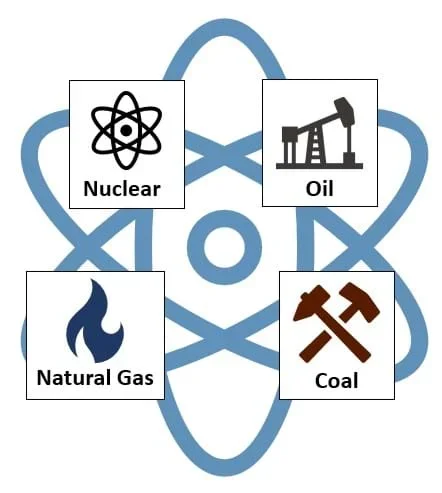 Figure 2. The four sources of non-renewable energy.Copyright 2020 Sabina Schill
Now, imagine yourself having surgery in a hospital and the power goes out. This scenario would be terrible. Fortunately, hospitals have backup generators (designed by engineers!) to prevent this from ever happening. Generators are like storage houses for energy and are usually powered by electricity from coal or fossil fuels. Generators are not normally attached to things like stoplights, railcars or computer networks, which is why we sometimes see stoplights that have gone out. Now, imagine that all of the above mentioned things are backed up with solar energy power or another type of stored renewable energy. This stored power, especially in the form of solar power, never becomes overloaded (which is what happens when the lights in your house or neighborhood go out). The renewable source is always supplying more energy; i.e., the sun is almost always shining on some part of the Earth, wind is always blowing, and rivers are always running. Storing renewable energy for power failures is a better idea because those energy supplies will never run out.
Engineers know all about energy and are currently designing new and more efficient ways to generate electricity using renewable resources. They are designing cleaner engines that use less fuel and new car designs that use electric motors. Today, we are going to look at how engineers can use sun, wind and water power to create electricity to run our homes, cars and everything else. Wow! What incredible engineering creativity!
Ask the students to describe some sources of renewable energy? (Answer: sun, wind, water) Can they list three specific ways that engineers are involved with renewable resources? (Possible answers: engineers study renewable resources to develop better ways to use these resources for energy generation; engineers design cars that run off renewable resources; engineers design generators that store the energy gathered from renewable resources; engineers develop wind farms to generate electricity for us to use; engineers develop hydropower plants to generate electricity for us to use; engineers are developing machines that are more efficient to reduce the amount of energy, renewable or non-renewable, that gets used; and engineers work to inform communities about what they can do to help conserve energy and use renewable resources.) Engineers work at developing new technologies that use renewable sources to contribute to greater health, happiness and safety of our Earth's inhabitants.
- absorb
- To be taken into a material without transmission or reflection.
- active solar system
- Solar power systems that use electrical or mechanical components, such as fans, pumps, and electrical controls in circulating fluids. These systems can be used for heating water or heating/cooling buildings.
- anemometer
- An instrument for measuring the velocity of wind.
- convection
- The transfer of thermal energy in a fluid (gas or liquid) by the circulation of currents in the heated fluid causing warmer packets to rise while cooler packets sink.
- electromagnetic radiation
- Electromagnetic energy transmitted in the form of waves or particles (photons); the electromagnetic spectrum, in order of increasing energy: radio waves, microwaves, infrared radiation, visible light, ultraviolet radiation, x-rays, gamma rays, cosmic-ray photons.
- generator
- A device that transforms mechanical energy into electrical energy.
- heat exchanger
- A device, such as an automobile radiator, that transfers heat from one liquid to another without allowing them to mix.
- heat-transfer fluid
- A fluid circulated in a heat exchanger; this fluid gains energy from one region and transfers it to another region.
- hydraulic head
- The difference in depth of a liquid at two given points; the pressure of the liquid at the lower point expressed in terms of this difference.
- insulation
- A material used to prevent the passage of heat, electricity, or sound (i.e., a non-conducting material).
- passive solar system
- Solar power systems that do not require electrical or mechanical components; these systems can be used for heating water or heating/cooling buildings.
- penstock
- A pipe or conduit used to carry water to a water wheel or turbine.
- photovoltaic system
- This is a system which converts solar energy into electricity.
- reflect
- This is when something such as sound waves or light waves bend back or return upon striking a surface.
- regenerate
- To re-grow or replace.
- renewable energy
- Energy that is made from sources that can be regenerated or reused is renewable.
- rotor
- The rotating part of an electrical or mechanical device is the rotor.
- thermal mass
- Materials that store thermal energy, such as water, concrete, brick, stone, adobe, tile, etc.
- transmit
- To allow the passage through a material.
- turbine
- A machine in which the kinetic energy of a moving fluid is converted into mechanical energy by causing a series of buckets, paddles, or blades on a rotor to rotate.
Pre-lesson assessment
Brainstorming: Ask students to brainstorm ideas about where and when we use energy. (Possible answers: We use energy all the time. Humans use energy to be active – to walk, talk, play basketball, etc. We use energy to power our appliances, vehicles, lights, etc. Cells use energy to perform the most basic life functions. Life as we know it would not be possible without energy production and consumption.)
Post-introduction assessment
Guess the Amount!: Ask students the following questions and ask them to guess at the different percentages of energy use. Discuss and explain the answers.
- What percent of the energy the world uses today is derived from fossil fuels (e.g., coal, oil, natural gas)? (Answer: 80-85%. This means that only 15-20% of the energy we use is from renewable energy sources such as sun, wind and water.)
- The U.S. has less than 5% of the world's population. What percent of the world's energy do we use? (Answer: Around 17%. This means that the U.S. uses a lot more energy than other countries. Why do the students think that is? Discuss the amount of toys, appliances and other electric powered items in a single person's home.)
- What percent of the electricity consumed in the U.S. is used for light bulbs? (Answer: 5%. This means that we leave a lot of light bulbs on when unused. Can the students think of a time where they could save some electricity by turning off a light bulb?)
Discussion: Ask students the following questions. Discuss the answers.
- How do we know the energy is there? (Answer: We can see it, feel it, hear it, etc.)
- Ask students to describe where this energy comes from. (Answer: ultimately all of it comes from natural resources (renewable and non-renewable), but it is often moved (transferred) and changed (transformed) in the process. You may want to give an example here like coal being mined from the earth, sent to power plants where it is burned to produce steam. The steam turns a turbine and produces electricity that is sent to our houses via power lines, and used in our electrical items like a refrigerator. Or how solar energy is used by plants to create food so they can grow and then we, in turn, use the plants as food to provide energy for our bodies.)
- Ask students to describe where they get their energy. (Answer: from food) Ask them to describe what might happen if suddenly there was no more food. (Note: this is a stretch for some because generally food is considered a renewable resource and because the food supply often seems unlimited to people in the U.S.). What would they do? (Answer: Become hungry, eventually starve, engineer some new source of nutrients, etc.) How would they feel? (Answer: Hungry, sad, scared, motivated to find a way to survive, etc.)
- What if there was only a tiny bit of food? How would it get distributed? Who would decide? What are some other consequences? (Answer: equal world-wide distribution, war, the rich get it, others die, new source of nutrients discovered/engineered, etc.)
Lesson summary assessment
Future Timeline: Ask students to work in a group to imagine what today would be like if there were no electricity (permanently, not just a blackout situation). Ask them to develop a timeline describing what this typical day might be like. Ask them to really consider how they would feel and what they would do. Ask each group to present their timeline to the class.
Venn Diagram: Ask students to create a Venn Diagram to compare/contrast a form of renewable energy and a form of non-renewable energy. They should provide as many facts and details as they can.
Homework
Save a Watt: Ask students to engage in two energy saving activities before the next class period. Ask them to describe in detail the impact these actions had during the next class. You can have the students list the activities or write a paragraph and turn the assignment in.
- Write and illustrate a children's story for 8-10 year olds about life in the year 2100. It should describe life without fossil fuels and should identify the energy sources used in everyday life as well as some type of conservation measures.
- Discuss what is happening with our world energy supply from fossil fuels and other non-renewable resources. (Examples: fossil fuels are being dangerously depleted, the rich countries receive a larger share of the energy and are more wasteful with it, wars are developing; e.g., the Gulf War, scientists and engineers are researching and developing renewable energy sources, etc.)
- Check out the awesome information and activities/games at Environmental Education for Kids (EEK) website from Wisconsin Department of Natural Resources at dnr.wi.gov
- Check out some of the activities at Watt Watchers: https://www.watt-watchers.com/student-activities/
- Check out some of the activities and games about energy online
- Play energy-themed games at NASA's Climate Kids website: https://climatekids.nasa.gov/menu/energy/
- Learn more about renewable energy at Alliant Energy's website: https://www.alliantenergykids.com/RenewableEnergy/RenewableEnergyHome
- Read, color, and solve puzzles in the "Saving Energy in My Home Coloring and Activity Book" at https://extension.colostate.edu/docs/pubs/consumer/saving-energy-home.pdf
- Try a Nuclear Chain Reaction activity at http://nuclearconnect.org/in-the-classroom/for-teachers/nuclear-chain-reaction-using-dominoes
American Wind Association, www.awea.org
Boulder Community Network, Environmental Center, bcn.boulder.co.us/environment/
California Energy Commission, www.energyquest.ca.gov/
Energy Information Administration, Energy Kid's Page, www.eia.gov/kids/
Hewitt, Paul G. Conceptual Physics, Boston, MA: Addison Wesley Publishing Company, 2004.
Goswami, D. Yogi, Kreith, Frank, and Kreider, Jan F. Principles of Solar Engineering, Taylor & Francis Group, 2nd edition, 2000.
Graham, Ian, Taylor, Barbara, Fardon, John, Oxlad, Chris and Parker, Steve. Science Encyclopedia, Miles Kelly, 2000.
Milton Hydro, https://www.miltonhydro.com/Residential/Community/Power-Kids
National Renewable Energy Laboratory, www.nrel.gov
Snow, Theodore. The Dynamic Universe: An Introduction to Astronomy, Minnesota: West Publishing Company, 1988.
Steen, Anthena S., Steen, Bill, Bainbridge, David and Eisenberg. The Straw Bale House, Vermont: Chelsea Green Publishing Company, 1994.
Texas State Energy Conservation Office, www.infinitepower.org/lessonplans.htm
U.S. Department of Energy, energy.gov
U.S. Department of Energy, Energy Efficiency and Renewable Energy, www.eere.energy.gov
- Renewable Energy: Wind
- Renewable Energy
- Harnessing Wind
- Thar She Blows! Wind as a Renewable Energy Source
Contributors
Amy Kolenbrander; Jessica Todd; Malinda Schaefer Zarske; Janet Yowell
Supporting Program
Integrated Teaching and Learning Program, College of Engineering, University of Colorado Boulder
Acknowledgements
The contents of this digital library curriculum were developed under a grant from the Fund for the Improvement of Postsecondary Education (FIPSE), U.S. Department of Education and National Science Foundation GK-12 grant no. 0338326. However, these contents do not necessarily represent the policies of the Department of Education or National Science Foundation, and you should not assume endorsement by the federal government.
Copyright
2005 by Regents of the University of Colorado.