
Build an Anemometer to Measure Wind Speed
Students create their own anemometers—instruments for measuring wind speed. They see how an anemometer measures wind speed by taking measurements at various school locations. They also learn about different types of anemometers, real-world applications, and how wind speed information helps engineers decide where to place wind turbines.
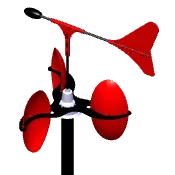 An anemometer in motionCopyright 2012 Jan Barani, Wikimedia Commons CC BY-SA 3.0
https://commons.wikimedia.org/wiki/File:Elliptic-Anemometer-2-Direction-Vane-Animation-175x175px.gif
An anemometer in motionCopyright 2012 Jan Barani, Wikimedia Commons CC BY-SA 3.0
https://commons.wikimedia.org/wiki/File:Elliptic-Anemometer-2-Direction-Vane-Animation-175x175px.gif
Engineers design sensors that collect wind speed and direction for many purposes. At airports, this real-time data helps pilots. For weather prediction, data is collected on sea buoys, marine vessels, ports and land. For safety and efficiency, railroads install wind alarms that report route conditions because high wind gusts cause loss of train power and derailments, and even blow over empty freight cars. Wind alarms also monitor conditions near industrial cranes, exposed roofs or other situations in which high winds can be hazardous. Sensors at chemical plants, oil refineries, incinerators and waste sites monitor wind conditions in case a harmful substance is discharged, or indicate if the wind is too high for the loading of dusty materials or powders. This sensor data is also used to control heating and ventilation in office building atriums and underground mines.
After this activity, students should be able to:
- Define an anemometer as an instrument used to measure wind speed.
- Use an anemometer to predict whether a location is a good place to place a wind turbine.
- Describe why engineers want to know wind speed in determining where to place wind turbines.
- 3.1.3.a Represent and solve problems involving multiplication and division.
Grade 3
Do you agree with this alignment? - 4.1.3.b Use the four operations with whole numbers to solve problems.
Grade 4
Do you agree with this alignment?
- Gather, analyze, and interpret data such as temperature, air pressure, wind, and humidity in relation to daily weather conditions
Grade 5
Do you agree with this alignment?
- CCSS.Math.Content.3.OA.A Represent and solve problems involving multiplication and division.
Grade 3
Do you agree with this alignment? - CCSS.Math.Content.5.NBT.B Perform operations with multi-digit whole numbers and with decimals to hundredths.
Grade 5
Do you agree with this alignment?
- Models are used to communicate and test design ideas and processes.
Grades 3-5
Do you agree with this alignment? - Energy comes in different forms.
Grades 3-5
Do you agree with this alignment?
- SEP.2.3-5.2 Define a simple problem that can be solved through the development of a new or improved object or tool.
Grade 3
Do you agree with this alignment? - CCC.1.3-5.8 Patterns can be used as evidence to support an explanation.
Grade 4
Do you agree with this alignment? - SEP.4.3-5.4 Develop a model to describe phenomena.
Grades 4-5
Do you agree with this alignment?
Each group needs:
- 4 small paper cups
- push pin
- sharpened pencil with eraser on the end
- timer on a phone, clock or watch
- stiff, corrugated cardboard (enough to cut two, same-size strips, each 13 to 23 cm [5 to 9 in] long for each team; used boxes are ideal)
- modeling clay (about 85 grams or 3 oz or ¼ cup)
- scissors
- marking pens
- rulers (for measuring)
- stapler
- Anemometer Worksheet (PDF)
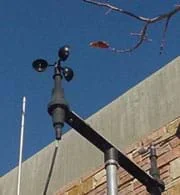 A cup anemometer; part of a weather station.Copyright 2005 Denise W. Carlson, ITL Program, University of Colorado Boulder
How can we tell the difference between a windy day and a really windy day? We measure the speed of the wind. Wind over land is sometimes measured in kilometers (or miles) per hour. Wind over water is sometimes measured in units called knots. How do we measure wind speed? We use a special instrument called an anemometer. Wind speeds are usually measured using a cup anemometer. A cup anemometer has a vertical pole with three cups that capture the wind. The number of times the cups spin around per minute is counted electronically. This type of anemometer is commonly seen on weather stations and is often used in our weather reports on the news.
Do you know what a wind vane is? Sometimes it is shaped like a rooster and is located on a barn's roof? It is also called a weather vane. It spins in the wind, and shows us the direction from which the wind is coming. Well, typically an anemometer is also fitted with a wind vane to indicate the wind direction.
Engineers design anemometers to measure wind speed for many situations other than for weather measurements. For example, anemometers are used to determine the how much airflow is entering or exiting mines, to make certain that miners have adequate ventilation and have enough air to breathe in the underground caves. Engineers also design other anemometers that use lasers to detect changes in light waves reflected from the air molecules in wind. Engineers have created hot wire anemometers that detect the wind speed through very tiny temperature differences between wires placed in the wind and in the wind shadow. All of these non-mechanical anemometers can be much more accurate, but also more expensive than a simple cup anemometer. The advantage of non-mechanical anemometers may be that they are less sensitive to icing, so they are able to make measurements in all weather, even winter. Cup anemometers are sometimes heated so they can work in cold weather.
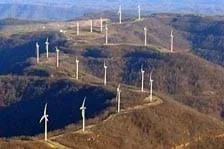 Copyright Tennessee Valley Authority http://www.tva.gov/
Where would you locate a wind farm? Anemometers are also important instruments for determining the best locations for wind power generators, or wind turbines, especially since the direction and strength of the wind is very dependent on local terrain. Wind turbines are machines that convert the moving energy of wind into mechanical/electrical energy for us to use, like a windmill. Also, wind speed changes with height, so engineers use anemometers to determine the best height to place the turbine. Wind turbines need a constant wind speed of 15 kilometers (9 miles) per hour, for small wind turbines, and 21 kilometers (14 miles) per hour, for utility-scale turbines. It is very important that these wind speed measurements be very accurate because any error in wind speed will be greatly magnified. For example, if your anemometer overestimates the wind speed by 10%, you overestimate the power by roughly 133%, or one third too much.
Today, we are going to become engineers and build our own simple anemometers. With these instruments, we can figure out the best place around our school to place a wind turbine.
Before the Activity
- A few days in advance, collect used corrugated cardboard boxes.
- Gather all the materials and make copies of the Anemometer Worksheet (PDF).
With the Students
- Divide the class into teams of two students each. Provide each team with materials and a work space.
- Have students color the outside of one paper cup with the marking pen.
- Next, have them cut from the corrugated cardboard boxes two, same-size strips, each 13 to 23 cm (5 to 9 in) long. Use the rulers, as necessary. These will be the anemometer blades.
- Cross the cardboard strips so they make a plus (+) sign. Staple them together in the middle, where they cross (see Figure 1), making sure the anemometer blades are of equal length. Use the rulers to measure the blades and locate the exact center.
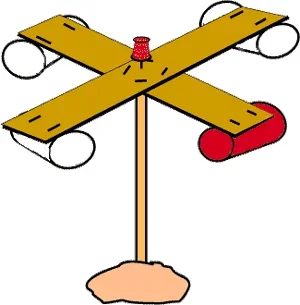 Figure 1. The cup anemometer activity set up.Copyright California Energy Commission http://www.energyquest.ca.gov/projects/anemometer.html
- Staple one cup, turned sideways, to the end of each cardboard blade, making sure the cups all face the same direction.
- Push the pin through the center of the cardboard cross and attach it to the eraser point of the pencil. Blow on the cups to make sure the cardboard blades spin freely on the pin.
- Take students outside (perhaps to the playground area) with their anemometers and modeling clay. Have teams each choose a location at which they would like to measure the wind speed.
- Have students place the modeling clay on a stable surface, such as a fence rail, a wall or a rock. Stick the sharpened end of the pencil into the clay mound, so it stands up straight and holds the anemometer securely.
- Measure the wind speed by counting the number of times the anemometer spins around in a minute (rotational rate). Point out how it helps to keep track of the number of spins by watching the movement of the cup with the markings. Students should take three measurements at their location and calculate the average rotational rate. Record measurements and observations on the worksheet.
- Have student team members work together to complete the worksheet.
- Conclude with a class-wide comparison of each team's results (see the Engineering Your Playground post-activity assessment in the Assessment section). What are the wind patterns in the playground area? Which is the windiest location? The calmest location? Steady winds? Gusty winds? Why (or why not) are these good locations for placing a wind turbine?
- anemometer
- An instrument for measuring wind force and velocity.
- cup anemometer
- A vertical pole with three cups that capture the wind. An instrument used to measure wind speed.
- generator
- A device that transforms mechanical energy into electrical energy.
- kinetic energy
- The energy of motion. For example, a spinning top, a falling object and a rolling ball all have kinetic energy. The motion, if resisted by a force, does work. Wind and water both have kinetic energy.
- knot
- (Nautical definition) A unit for measuring wind speed over water. 1 knot = = 1.852 kilometers per hour (or, 1.15 miles per hour). In nautical usage knot is a unit of speed, not of distance, and has a built-in meaning of "per hour." So, a ship might travel at ten knots (not ten knots per hour). Origin: Used on sailing ships since the 1600s. The term comes from the knots tied at equal intervals in a line attached to a log. The log line was thrown overboard and a sailor counted the knots that passed through his hands during a set time period, as a way to calculate the ship's speed.
- rotational rate
- The number of anemometer spins per minute.
- turbine
- A machine in which the kinetic energy of a moving fluid is converted into mechanical energy by causing a series of buckets, paddles or blades on a rotor to rotate.
- weather station
- A facility or location at which meteorological data are gathered, recorded and released.
- wind energy
- Energy obtained from the natural movement of wind.
- wind farm
- A power plant that uses many wind turbines to generate electricity.
- wind turbine
- A machine that converts the moving energy of wind into mechanical and/or electrical energy.
- wind vane
- A tool for measuring wind direction. Positioned high in the air on an unobstructed roof or pole. It spins (rotates) freely on a rod. The arrow-shaped end points in the direction from which the wind comes and the other end catches the breeze. Also called a weather vane.
Pre-Activity Assessment
Brainstorming: In small groups, have students engage in open discussion to think of locations where it can be really windy and locations where it is not usually windy. Remind them that no idea or suggestion is "silly." All ideas should be respectfully heard. Have one student from each team write their ideas on the board to share with the class.
Prediction: Have students suggest areas around the outside of the school where it might be windy and list them on the board. Have students predict which locations might be the windiest and record predictions on the board.
Activity Embedded Assessment
Worksheet: Have students record their measurements and complete the Anemometer Worksheet (PDF) in teams. Review their answers to gauge their mastery of the concepts.
Post-Activity Assessment
Engineering Your Playground: Use the class data to determine the wind patterns of the playground (or area that you used in this activity). Have students draw a map of this area and write the wind speeds for the different locations on it. Have a student draw a wind turbine in the best location on this map and explain why they chose that spot.
Toss-a-Question: Provide students with a list of questions (see below). Students work in groups and toss a ball or wad of paper back and forth. The student with the ball asks a question and then tosses the ball to someone to answer. If a student does not know the answer, they toss the ball onward until someone gets it. The person who gets the answer correct gets to start the next question. Review the answers at the end. Possible questions/answers:
- How does an anemometer measure wind speed? (Answer: Wind hitting the cups of the anemometer causes the anemometer to rotate. The rate of the rotation of the anemometer is related to wind speed.)
- Why would you want to know the wind speed? (Possible answers: To know how to dress for the weather. To determine if it is a good day to play tennis outside. To decide if it is a good day to have a picnic, read outside or fly a kite.)
- Why would you want to know the wind direction? (Possible answers: To get a kite started. To set up a badminton or volleyball court to be fair for each side. To find a sheltered spot in your yard for a pet. To maneuver the sail on a sailboat, or safely land a plane.)
- Why would an engineer want to know the wind speed? (Answer: Engineers use wind speed to determine the location to place wind turbines, detect weather patterns and determine air flow, such as air flow for mine ventilation.)
- Why do engineers need to use anemometers in deciding where to put wind turbines? (Answer: Wind generators produce much more electricity at locations of steady, high wind speed.)
- Where might an engineer locate a small wind turbine used for generating electricity for a single home? (Possible answers: On the roof of the house, on a hill by the house, or on a pole up high near the house.)
- Warn students to be careful when pushing a push pin into a pencil eraser so their hands do not slip, accidentally puncturing themselves.
Make sure students position the cardboard into a cross with legs exactly the same length.
Make sure the axis of the anemometer is placed precisely at the center of the cardboard cross. Some students may require assistance in determining the exact center of the cardboard cross.
Have students use their anemometers to determine the speed of the air current produced by a fan at low and high speeds.
Have students keep a record of the wind speed during a weekend. Have them measure the speed in the morning, the afternoon and the evening. Compare the students' measurements. Does wind speed vary much over the course of a day? Does wind speed vary much from place to place? What effects do structures have on the wind speed?
Have students build different wind gauges and wind vanes. See more information at the Franklin Institute Online, Make Your Own Weather Vane, http://www.ps-survival.com/PS/Weather/Make_Your_Own_Weather_Station_2004.pdf and Wind Vane, http://sw031.k12.sd.us/weather.htm
- For lower grades, it may be easier to cut out enough cardboard blades in advance. Have students practice counting the number of times the anemometer spins in a minute.
- For upper grades, have students convert the rate of rotation of the anemometer into a wind speed in centimeters (or inches) per second. The wind speed is measured in terms of the rotational rate of the anemometer in revolutions per minute (rpm). To convert to wind speed in centimeters (or inches) per second, use the equation below with the diameter of the anemometer in centimeters (or inches).

- For upper grades, collect all the wind speed data from the class, and have students determine the minimum, maximum and average wind speeds.
Dictionary.com. Lexico Publishing Group, LLC. Accessed December 19, 2005. (Source of some vocabulary definitions, with some adaptation)
Make an Anemometer. Science Projects, California Energy Commission. http://www.energyquest.ca.gov/projects/anemometer.html Accessed October 19, 2005. (Source of activity)
Contributors
Xochitl Zamora-Thompson; Sabre Duren; Natalie Mach; Malinda Schaefer Zarske; Denise W. Carlson
Supporting Program
Integrated Teaching and Learning Program, College of Engineering, University of Colorado Boulder
Acknowledgements
The contents of this digital library curriculum were developed under grants from the Fund for the Improvement of Postsecondary Education (FIPSE), U.S. Department of Education and the National Science Foundation (GK-12 grant no. 0338326). However, these contents do not necessarily represent the policies of the DOE or NSF, and you should not assume endorsement by the federal government.
Copyright
2005 by Regents of the University of Colorado