
Windmill of Your Mind — Distributed Energy Goes to School
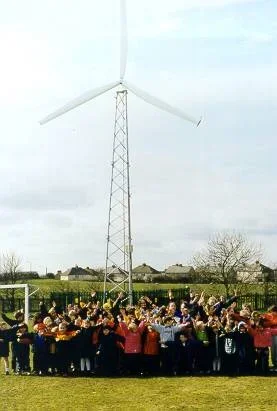 Figure 1. School First for Wind Power.Copyright Department of Trade and Industry, New and Renewable Energy Programme, UK http://www.dti.gov.uk/NewReview/nr41/html/school_wind.html
Students research the feasibility of installing a wind-turbine distributed energy (DE) system for their school. They write a proposal (actually, an executive summary of a proposal) to the school principal based on their findings and recommendations. While this activity is geared towards fifth-grade and older students, and Internet research capabilities are required, some portions of this activity may be appropriate for younger students.
Engineers often conduct or contribute research to prepare feasibility reports for large projects. Feasibility studies are a forthright presentations of all issues—benefits, costs, effectiveness, alternatives, environmental impact, marketplace, competition, available technology, resources, public opinion, risk, and any other pertinent factors—of a complex design or project. Such research informs the person/organization funding the project or a company manger approving the project about the key issues and advantages of doing a project or doing it a certain way. Usually engineers are responsible for communicating reasons and advantages of their designs in light of budget or time constraints.
Photo caption: Figure 1. School First for Wind Power. "The first wind turbine installed at a school site in mainland Britain was at Cassop Primary School in County Durham. The Atlantic Orient Corporation 15/50-type wind turbine produces an average of 270kWh/day, which is about twice the school's electricity requirement. The surplus energy is exported to the grid via an import/export meter. The children at the school designed an interactive display panel with information from the turbine."
After this activity, students should be able to:
- Use a full range of strategies to comprehend technical writing.
- Write stories, letters and reports with greater detail and supporting material.
- Choose vocabulary and figures of speech that communicate clearly.
- 4.1.3.a.i Fluently add and subtract multi-digit whole numbers using standard algorithms.
Grade 4
Do you agree with this alignment?
- Identify and describe the variety of energy sources
Grade 4
Do you agree with this alignment? - Use multiple resources – including print, electronic, and human – to locate information about different sources of renewable and nonrenewable energy
Grade 4
Do you agree with this alignment?
- CCSS.Math.Content.5.NBT.B Perform operations with multi-digit whole numbers and with decimals to hundredths.
Grade 5
Do you agree with this alignment? - CCSS.Math.Practice.MP1 Make sense of problems and persevere in solving them.
Grades K-12
Do you agree with this alignment?
- The use of technology affects the environment in good and bad ways.
Grades 3-5
Do you agree with this alignment? - Energy comes in different forms.
Grades 3-5
Do you agree with this alignment?
- 4-ESS3-1 Obtain and combine information to describe that energy and fuels are derived from natural resources and their uses affect the environment.
Grade 4
This resource focuses on the following Three Dimensional Learning aspects of NGSS:
Science & Engineering Practices- Obtain and combine information from books and other reliable media to explain phenomena.Do you agree with this alignment?
Disciplinary Core Ideas- Energy and fuels that humans use are derived from natural sources, and their use affects the environment in multiple ways. Some resources are renewable over time, and others are not.Do you agree with this alignment?
Crosscutting Concepts- Cause and effect relationships are routinely identified and used to explain change.Do you agree with this alignment?
- Knowledge of relevant scientific concepts and research findings is important in engineering.Do you agree with this alignment?
- Over time, people's needs and wants change, as do their demands for new and improved technologies.Do you agree with this alignment?
Do you agree with this alignment? - Obtain and combine information from books and other reliable media to explain phenomena.
- paper and pencils, for reserch and report writing
- Internet access, for online research
A basic understanding of wind as a renewable energy source, including the advantages and disadvantages wind turbines and wind farms.
As an alternative energy resource, wind power is coming into its own. In this activity, you will evaluate wind power as a form of distributed energy resource (DER) that not only can power a local facility—in this case a school—but that has the potential to generate extra power that can be sold back to the power grid for distribution to other energy users. In other words, a school can not only save money, but make money by generating its own power (see example described in Figure 1). After an initial pay-back period, additional funds may be available to directly benefit students for programs that typically get eliminated during budget cuts.
Sounds like a great idea, but is it feasible? The answer appears to be a strong "yes." Take a look at examples of wind turbines installed at Kansas schools, https://www.thomasnet.com/insights/imt/2011/11/02/the-answer-is-blowing-in-the-wind-kansas-schools-building-their-own-wind-turbines/, and at Iowa schools, https://www.cityofbryant.com/grab/documents/document_center/Library/SESEM%20Academy%20Resources%202014/Renewable%20Energy%20&%20Alternative%20Fuels/Wind%20Energy%20for%20Schools_201406171552194350.pdf. A local DER, such as a wind turbine, can also be connected to the power grid, as illustrated in Figure 2.
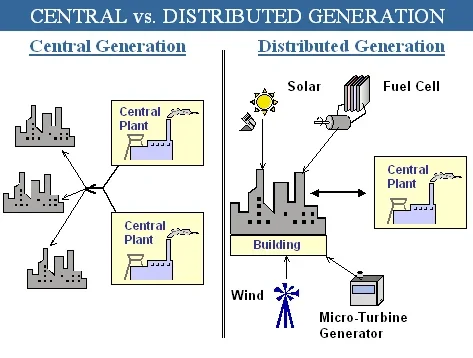 Figure 2. Central vs. distributed generation. "Distributed generation is often contrasted to central generation. In the case of central generation, power is generated in a large plant (gigawatts in size) and electricity is transmitted over transmission and distribution lines (collectively referred to as the power grid) to buildings where the power is consumed. In the case of distributed generation, the potential exists to provide generation at the building where the power is consumed AND feed excess power back into the power grid as well as take power from it."Copyright National Fuel Cell Research Center, University of California, Irvine, CA. Used with permission. http://www.nfcrc.uci.edu/fcresources/FCexplained/stationary.htm
Why is distributed energy so important? Because it represents a dynamic way of solving problems associated with the aging infrastructure of the national power grid (as discussed in the Energy unit literacy activities in Lesson 4, Blackout! and The Grid). It also makes the system less vulnerable as a whole to disruption of power over large areas (blackouts).
As described in a U.S. Department of Energy fact sheet, The Choice for Onsite Power, "The mission of the Distributed Energy (DE) Program is to strengthen America's aging energy infrastructure and provide utilities and consumers with a greater array of energy efficient technology choices for the onsite generation of electricity and use of thermal energy." Source: http://www.eere.energy.gov/de/pdfs/distenergy_fs.pdf.
Onsite generation makes the local DER both independent and connected at the same time. The DER is not as susceptible to blackouts and brownouts and can in many cases sell excess power back to the grid to offset demand in other areas. Energy can even be generated and stored during periods of low demand, when the cost of energy is low, and then released during periods of peak demand when the cost of energy is high, an efficient process known as peak shaving.
In this activity, you will discover how your school could become a DER and take part in the exciting initiative that is helping to improve the way the U.S. distributes power.
![A graphic shows how various types of distributed energy resources (DER] such as fuel cells, photovoltaic (solar) cells, wind turbines, micro-turbines, thermal, low-head hydro, etc., can power local sites such as hospitals, schools, manufacturing facilities and homes, and sell any surplus energy generated back to the power grid, connecting via a substation to the central station.](https://teachengwebstorageprod.blob.core.windows.net/te-content-prod/cub_energy2_lesson07_activity3_fig3-485x348.webp) Figure 3. Types of distributed energy resources and technologies.Copyright California Energy Commission http://energy.ca.gov/distgen/background/background.html
Figure 3. Types of distributed energy resources and technologies.Copyright California Energy Commission http://energy.ca.gov/distgen/background/background.html
With the Students
Tell the students: This class activity has two parts.
- You will assess the feasibility of installing a windmill at your school. To do that you will analyze the cost of the project and compare it with the benefits. Look at the financial costs and benefits and weigh them against social costs and benefits.
- You will prepare a report of your findings to present to the school principal. If you find that the concept is feasible, your report will be a proposal recommending that the school district fund the project. You must demonstrate that the district will realize an acceptable return on its investment (ROI).
Observing
Conduct background research to learn about the general benefits of distributed energy and the U.S. Department of Energy's Distributed Energy Program (see https://www.energy.gov/lpo/distributed-energy-projects). As stated at their website:
Distributed energy offers solutions to many of the nation's most pressing energy and electric power problems, including blackouts and brownouts, energy security concerns, power quality issues, tighter emissions standards, transmission bottlenecks, and the desire for greater control over energy costs.
Make a list of the benefits, both for the local site and for the power distribution system (the grid) as a whole. Also check out Distributed Energy Resources at https://elibrary.ferc.gov/idmws/search/fercgensearch.asp.
The Whole Building Design Guide, Distributed Energy Resources (DER), one of the two main resources for this activity, also provides a good list of DER benefits (see http://www.wbdg.org/resources/distributed-energy-resources-der). As stated by Barney Capehart on the WBDG website:
"DER is a faster, less expensive option to the construction of large, central power plants and high-voltage transmission lines. They offer consumers the potential for lower cost, higher service reliability, high-power quality, increased energy efficiency, and energy independence. The use of renewable distributed energy generation technologies and 'green power' such as wind, photovoltaic, geothermal, biomass or hydroelectric power can also provide a significant environmental benefit."
Next, conduct some research to learn why a wind turbine is considered to be an excellent DER for a school. Look at the advantages and challenges of wind power itself at https://www.energy.gov/eere/wind/advantages-and-challenges-wind-energy. Explore the Wind for Schools Project at https://www.nrel.gov/docs/fy08osti/41966.pdf.
See the References section of the Energy unit Lesson 2 literacy activity, Greenewables, for additional links to sources that provide in-depth wind power information.
Thinking
For your feasibility analysis, answer the following questions for your state and location:
- Is your state's public policy friendly to the development of DER in general and wind turbine technology in particular?
- Is your location windy enough?
- Is the local cost of electricity average or above average?
- Does your school use electricity at a high enough rate (kWh per year) to justify installing a wind turbine?
- Are there financial resources available in your state, such as a state-sponsored low-interest loan program or grant program, to help with funding such a project?
- What would the typical energy savings be?
- Which size turbine would you need, based on the kWh per year your school uses?
- Is there a site available on the school property for a wind turbine that allows for adequate "setback" and distance from surrounding residences?
- Calculate your annual savings on electricity. On that basis, how long will it take your system to pay for itself? How long before it can produce a return on investment (ROI)?
The goal of this activity is to introduce students to the basic concept of how engineers analyze feasibility. If the students get excited about the project and can "do the math" [basic arithmetic and percentages] consider taking the project to the level of a realistic analysis of cost-benefit and return on investment. You may wish to bring in a local environmental engineer to assist with the project.)
Writing
If you are able to justify a wind turbine installation at your school, go the next step and make a proposal to your principal. This is exciting. If your principal likes the concept, s/he might take it higher up, to the school administrator(s) or board. You could make history in your local school district!
You do not need to write a full-blown formal proposal; an executive summary will serve to get the main points across. In this case, your executive summary should have three parts:
- Problem: A brief statement of the need for the wind turbine (one or two paragraphs).
- Solution: A short description of the project, including what will take place and how the school, the school district and the students themselves benefit (two paragraphs, one for description, one for benefits).
- Funding requirement: An explanation of the amount of loan or grant money required for the wind turbine installation and how long it will take to start paying for itself and provide a return on investment (ROI) (one paragraph).
- cost-benefit analysis
- The analysis of the potential costs and benefits of a project to determine return on investment. (Source: Jane Evenson)
- distributed energy resources
- Any technology that is included in DG and DP as well as demand-side measures. Under this configuration, power can be sold back to the grid where permitted by regulation. Source: Abbreviated as DER. http://www.wbdg.org/design/der.php.
- distributed generation
- Any technology that produces power outside of the utility grid (for example, fuel cells, microturbines and photovoltaics). Abbreviated as DG. Source: http://www.wbdg.org/design/der.php.
- distributed power
- Any technology that produces power or stores power (for example, batteries and flywheels). Abbreviated as DP. Source: http://www.wbdg.org/design/der.php.
- executive summary
- A summary of a report or proposal intended to provide the main conclusions and recommendations of the longer document in short form for a busy person to read. (Source: Jane Evenson)
- feasible
- Capable of being accomplished or brought about; possible: a feasible plan.
- feasibility study
- An analysis of a proposed project that addresses issues including the project's benefits, costs, effectiveness, alternatives considered, environmental effects, public opinions and other factors.
- peak shaving
- Generating and storing electricity during periods of low demand, when the cost of energy is low, and then releasing it during periods of high demand when the cost is greater.
- power grid
- A network of electric power lines and associated equipment used to transmit and distribute electricity over a geographic area. The network of transmission lines that link all generating plants in a region with local distribution networks to help maximize service reliability. Also called a utility grid or electrical grid.
- proposal
- A plan put forward for consideration, discussion or adoption.
- return on investment
- The amount of income or cash flow realized from an investment, usually expressed as a percentage of that investment; the additional sum of money expected from an investment over and above the original investment. Abbreviated as ROI. (Source: Jane Evenson)
Pre-Activity Assessment
Call-Out Questions/Quiz: Reinforce the basic concepts and vocabulary introduced during the Observing activity with call-out questions and a vocabulary quiz.
Activity Embedded Assessment
Call-Out Questions: During the Thinking discussion, use call-out questions to test students' understanding of the concepts.
Post-Activity Assessment
Reports: The students' feasibility analysis and written proposal demonstrate their understanding of the concepts.
Windmill of Your Mind: Build a model of your wind turbine to accompany your proposal.
Energy Fair: Conduct your own school Renewable Energy Science Fair and make your feasibility study and windmill turbine proposal the centerpiece of the event.
E-Pals: Learn about elementary schools in other countries that are installing wind turbines. Write students in these schools to learn about their experience, for example, the photograph in Figure 1 shows students from a school that is the first in the United Kingdom to install a wind turbine on its grounds. You might try contacting them.
DIY... Design-It-Yourself: Use HOMER to design a DE system for your school. NREL's HOMER is a design optimization tool. You don't need to restrict yourself to designing a wind turbine; that would be re-inventing the wheel. Let your imagination fly. Maybe you'll come up with a new idea for a way your school can generate its own power. (This is an advanced activity, but worth exploring because the software provides a real-world glimpse of the kinds of tools engineers really use to design systems. While HOMER is user-friendly, you may want to find the assistance of an engineer who is familiar with software of this kind and the concepts involved.)
This activity is intended to be an introduction to the concept of the feasibility study and proposal. At the fifth-grade level, obviously not all technical factors need be considered that would normally apply. The idea is to give students the essential concept along with an opportunity to use math skills to conduct a basic cost-benefit analysis. For more advanced classes, scale up the activity to include more technical considerations.
California Distributed Energy Resource Guide. Updated October 18, 2004. California Energy Commission. Accessed January 26, 2006. http://energy.ca.gov/distgen/background/background.html
Capehart, Barney L. Distributed Energy Resources. Whole Building Design Guide, National Institute of Building Sciences. Accessed October 24, 2005. (Main resource for this activity. Highly recommended. Excellent, concise introduction to DER with case studies showing benefits of small DE installations. Includes feasibility analysis tools.) http://www.wbdg.org
The Choice for Onsite Power, Distributed Energy Program Fact Sheet. Energy Efficiency and Renewable Energy. Accessed October 24, 2004. http://www1.eere.energy.gov/femp/technologies/m/derchp_resources.html
Colorado Wind & Distributed Energy: Renewables for Rural Prosperity. April 13-14, 2004. Governor's Office of Energy Management & Conservation, Colorado. Accessed October 24, 2004. (Highly recommended. PDF versions of presentations given at the 2004 CWADE Conference. Interesting, easy to follow presentations focusing mainly on wind.) http://goliath.ecnext.com/coms2/summary_0199-632012_ITM
Dictionary.com. Lexico Publishing Group, LLC. Accessed October 24, 2004. (Source of vocabulary definitions, with some adaptation.) http://www.dictionary.com
Distributed Energy Program. Updated October 19, 2005. Energy Efficiency and Renewable, U.S. Department of Energy. Accessed October 24, 2004. http://www.eere.energy.gov/de/
Proposal Writing Short Course. Learning Lab, The Foundation Center. Accessed October 24, 2004. (Excellent for teacher background; may be adapted for use with students.) http://fdncenter.org/learn/shortcourse/prop1.html
Renewable Energy Science Fair. St. Luke's School, New York, NY. Accessed October 24, 2004. http://www.stlukeschool.org/curriculum/faculty-student/renewable_fair.htm
Wind, Thomas A. Interconnection of Wind Generation to the Grid. April 13, 2004. Wind Utility Consulting, Jefferson, IA, c/o Colorado Wind & Distributed Energy: Renewables for Rural Prosperity, Governor's Office of Energy Management & Conservation, Colorado. Accessed October 24, 2004. (A more technical presentation, but shows how a wind turbine really does connect to the power grid.) http://www.state.co.us/oemc/events/cwade/2004/presentations/Wind_Interconnection.pdf
Wind, Thomas A. Wind Projects for Iowa Schools. April 13, 2004. Wind Utility Consulting, Jefferson, IA, c/o Colorado Wind & Distributed Energy: Renewables for Rural Prosperity, Governor's Office of Energy Management & Conservation, Colorado. Accessed October 24, 2004. (Excellent presentation. Provides a step-by-step analysis that serves as the model [in somewhat simplified form] for the feasibility analysis in this activity.) http://www.state.co.us/oemc/events/cwade/2004/presentations/Wind_School.pdf
- Renewable Energy: Wind
- Renewable Energy
- Harnessing Wind
- Thar She Blows! Wind as a Renewable Energy Source
- Build an Anemometer to Measure Wind Speed
- Wind Power! Designing a Wind Turbine
- Windmill of Your Mind — Distributed Energy Goes to School
Contributors
Jane Evenson; Malinda Schaefer Zarske; Denise W. Carlson
Supporting Program
Integrated Teaching and Learning Program, College of Engineering, University of Colorado Boulder
Acknowledgements
The contents of this digital library curriculum were developed under grants from the Fund for the Improvement of Postsecondary Education (FIPSE), U.S. Department of Education and National Science Foundation (GK-12 grant no. DGE 0338326). However, these contents do not necessarily represent the policies of the Department of Education or National Science Foundation, and you should not assume endorsement by the federal government.
Copyright
2005 by Regents of the University of Colorado