
Thar She Blows! Wind as a Renewable Energy Source
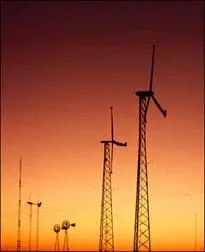 From old Holland to U.S. farms, windmills have long been used for pumping water and grinding grain. Today, the windmill's modern equivalent—a wind turbine—uses wind energy to generate electricity.Copyright Scott Bauer, Agricultural Research Service, USDA
Students learn about wind as a source of renewable energy and explore the advantages and disadvantages wind turbines and wind farms. They also learn about the effectiveness of wind turbines in varying weather conditions and how engineers work to create wind power that is cheaper, more reliable and safer for wildlife.
Moving air behaves like a fluid, so engineers study wind and its behavior for many purposes. They are interested in how fluids (air, water, gases) flow around various shapes. Visualizing flow patterns is important in designing cars, ships, airplanes, bicycles, helmets, clothing and fabrics, sports gear, wind breaks, or anything that air or water moves over. It is also important in mixing chemicals efficiently and understanding the weather patterns on Earth and planets. An understanding of fluid flow has resulted in more aerodynamic car shapes — modern vehicles designed with curved or more slanted front ends to reduce the amount that the wind pushes on the car as it moves forward. Engineers' use of wind tunnels and computer modeling has impacted the evolution of body positions for ice skaters, swimmers, divers, bicyclists, skiers and many other athletic pursuits.
After this lesson, students should be able to:
- Define wind energy as a renewable energy source.
- Define wind energy, wind turbine and wind farm.
- List some advantages and disadvantages of wind turbines.
- Recognize that engineers develop technologies that harness energy from the wind.
- Energy comes in many forms such as light, heat, sound, magnetic, chemical, and electrical
Grade 4
Do you agree with this alignment? - Identify and describe the variety of energy sources
Grade 4
Do you agree with this alignment?
- Energy comes in different forms.
Grades 3-5
Do you agree with this alignment? - Tools, machines, products, and systems use energy in order to do work.
Grades 3-5
Do you agree with this alignment?
- 4-ESS3-1 Obtain and combine information to describe that energy and fuels are derived from natural resources and their uses affect the environment.
Grade 4
This resource focuses on the following Three Dimensional Learning aspects of NGSS:
Science & Engineering Practices- Identify the evidence that supports particular points in an explanation.Do you agree with this alignment?
Disciplinary Core Ideas- Energy and fuels that humans use are derived from natural sources, and their use affects the environment in multiple ways. Some resources are renewable over time, and others are not.Do you agree with this alignment?
Crosscutting Concepts- Knowledge of relevant scientific concepts and research findings is important in engineering.Do you agree with this alignment?
- Over time, people's needs and wants change, as do their demands for new and improved technologies.Do you agree with this alignment?
Do you agree with this alignment? - Identify the evidence that supports particular points in an explanation.
- 4-PS3-1 Use evidence to construct an explanation relating the speed of an object to the energy of that object.
Grade 4
This resource focuses on the following Three Dimensional Learning aspects of NGSS:
Science & Engineering Practices- Use evidence (e.g., measurements, observations, patterns) to construct an explanation.Do you agree with this alignment?
Disciplinary Core Ideas- The faster a given object is moving, the more energy it possesses.Do you agree with this alignment?
Crosscutting Concepts- Energy can be transferred in various ways and between objects.Do you agree with this alignment?
Do you agree with this alignment? - Use evidence (e.g., measurements, observations, patterns) to construct an explanation.
See the Wind Power Reading (PDF) for a more in-depth look at how wind energy is harnessed. (This article is not appropriate reading material level for fourth-grade students.)
From where does wind come?
Wind is the movement of air relative to the surface of the Earth. Uneven heating of the atmosphere by the sun produces horizontal and vertical differences in atmospheric pressure, which in turn cause air to flow as winds. In this way, wind can be thought of as a form of solar energy. While only 2% of the solar energy reaching the Earth is converted into wind power, the total amount of energy is very large. The direction and strength of the wind are modified by the Earth's terrain, bodies of water and vegetative cover. So, some locations consistently have strong winds from a particular direction, while other locations have erratic or little wind.
How can wind be used to do work?
For thousands of years people have converted wind flow into energy to do work. Windmills have been used to convert the kinetic energy in the wind into mechanical energy for tasks such as pumping water or grinding grain. Modern wind turbines have generators that convert mechanical energy into electricity. All electric-generating wind turbines, no matter what size, are comprised of a few basic components: a tower, a rotor (the part that actually rotates in the wind), a speed control system and an electrical generator. Refer to the associated activity Wind Power! Designing a Wind Turbine for students to design and construct small wind turbines and measure the current they produce. Then students can investigate implementing a turbine at their own school with the associated activity Windmill of Your Mind — Distributed Energy Goes to School .
To capture the most energy, wind turbines are mounted on a tower. At 30 meters or more above ground, they can take advantage of faster and less turbulent wind. Usually, two or three blades are mounted on a shaft-like a propeller to form a rotor. A blade in a wind turbine acts much like an airplane wing; when the wind blows, a pocket of low-pressure air forms on the downwind side of the blade. The low-pressure air pocket pulls the blade toward it, causing the rotor to turn. This is called lift. The force of the lift is actually much stronger than the wind's force against the front side of the blade, which is called drag. The combination of lift and drag causes the rotor to spin like a propeller, and the turning shaft spins a generator to make electricity.
An electric generator is a rotating machine that supplies an electrical output with voltage and current. In most generators, a voltage is induced in coils of wire by a change in magnetic field as the machine rotates. The needed magnetic field is produced either by direct current in field coils or by permanent magnets. In the simplest case, the induced voltage is alternating in sign (plus/minus), since the direction of the magnetic field reverses direction as the machine rotates.
The amount of energy contained in the wind can be calculated using the following equation:

where m is the mass of the moving air and v is the speed of the wind. If the wind speed doubles, the energy of the wind quadruples. Or, if the wind speed increases by three times, then the kinetic energy in the wind increases by nine times. Kinetic energy is measured in Joules (J). Engineers have developed tools to accurately measure wind speed called anemometers. Students can use the associated activity Build an Anemometer to Measure Wind Speed to design and build their own devices to be used in action!
We usually want to know the amount of power that a wind turbine can produce rather than the kinetic energy of the wind. The power produced by a wind turbine is the amount of energy gained from the wind in a certain time: P = E/t. Power is measured in watts, W. One watt is equal to one Joule per second (J/s). The power derived from the wind over the area swept by the rotor blades can be expressed as:

where ρ is the density of air, A is the exposed rotor area, and v is the wind speed. Wind turbines do not perfectly convert wind energy into electric power, so the formula includes an efficiency factor, e. Since modern turbines have only about 25% efficiency, the electric power generated is no more than one-quarter of the energy in the wind.
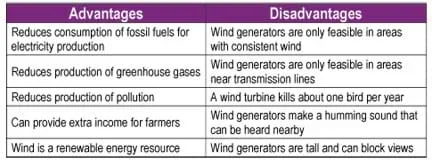 Table 1. Advantages and disadvantages of large-scale wind power.
Have you ever felt a strong wind? What could you do with a steady, strong wind? (Possible answers: Fly a kite, sail a boat, dry laundry on a line, turn a windmill, open the window to cool or air out your house, etc.) When we get wind to do something for us, we are making it work. Who remembers the definition of energy? (Answer: Energy is when something does work.) Using this definition, is wind an energy source? Yes it is!
People have been harnessing the wind's energy for thousands of years. Have you ever seen a wooden windmill with large blades? Or, have you ever seen those tall, modern, white windmills located in large groups on open hillsides? We call those tall, white windmills wind turbines, and when there are several of them together, it is called a wind farm. These wind farms are how engineers convert wind energy into usable energy for people, in the form of electricity. A wind farm is a power plant that uses wind turbines to create electricity. Did you know that some people get the electricity for their home from the wind?
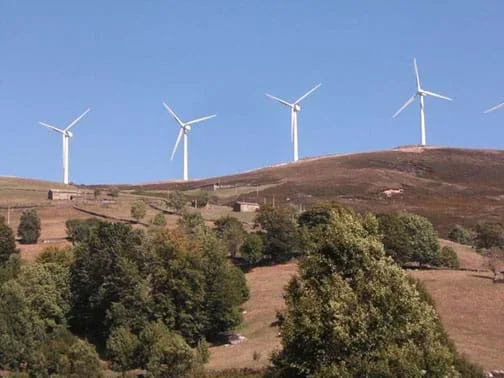 Huge wind turbines in Spain. Each blade is about 4 meters (12 feet) wide.Copyright 2005 Charles M. Carlson. Used with permission.
Today, engineers continue to make improvements in wind power technology. Wind energy has several advantages. Can you think of any? Well, it is a renewable energy source and it does not pollute the environment. Of course there are some disadvantages, too. What happens when there is no wind? (Answer: No work can be done. So, it is important to be able to store the wind energy for continual use.) Also, it is expensive to change wind into usable energy. Engineers are working make wind power cheaper, more reliable and safer for birds who might fly into the turbines.
As power companies install wind farms in more and more locations, engineers design turbines and generators that work under all weather conditions. Engineers must design turbines to work in severe weather conditions as well as typical windy days. Sometimes the force of the wind can be steady and sometimes it can cause a powerful repetitive force on the wind turbine, similar to a flag flapping in the wind. If the wind turbine is improperly designed, it might fall apart in a severe windstorm. As another example, engineers designed a wind farm in Maine that works in the bitter cold of winter. The turbines include rotor blades with a slippery, black surface to minimize the buildup of ice and absorb the sun's energy to melt the ice. In addition, several heaters and synthetic lubricants enable the rotors to operate in temperatures as low as -40°C.
Since the wind does not blow all of the time, electrical engineers devise ways to ensure that extra energy generated during windy periods can be stored for use during calmer times.
Engineers also design wind farms to protect wildlife. Laws, such as the Migratory Bird Treaty Act and the Endangered Species Act, prohibit the killing of a single bird if it is a protected species. An early 1990s wind farm in California's Altamont Pass caused the loss of so many golden eagles that concerns were raised about building more wind farms. Engineers are involved with research projects to address the bird-wind power problem in a variety of settings, so they can reduce bird deaths from wind plants.
You might not expect engineers to be concerned that wind turbines kill thousands of insects. But, dead bugs on the blades can significantly reduce how well the turbines work. Occasionally, utilities must stop the turbines and pressure-wash hundreds of blades. To reduce the problems caused by insects, engineers incorporate nonstick surfaces and different blade angles into their designs.
Today, we are going to be engineers and learn more about how wind energy can be captured and used to work for us. Are you ready?
Today we learned about wind energy. What type of machine changes wind energy into usable energy? (Answer: A wind turbine or windmill.) What do we call it when we have many of these machines together in one place to generate electrical power? (Answer: A wind farm.). How can the energy of the wind be used to do work? (Answer: By building structures [such as windmills, wind turbines, boat sails, etc.] that are moved by the wind and cause something else to move.) What is a disadvantage to using wind energy? (Answer: We need constant wind to work. It can kill birds and insects.) Engineers are working on ways to eliminate the disadvantages of using wind energy by making the wind turbines cheaper to run, safer to birds and insects and able to store energy for less windy times. Would you want to use electricity generated by the wind?
- anemometer
- An instrument for measuring the force and velocity of wind.
- energy
- The ability to do work.
- generator
- A device that transforms mechanical energy into electrical energy.
- kinetic energy
- The energy of motion. For example, a spinning top, a falling object and a rolling ball all have kinetic energy. The motion, if resisted by a force, does work. Wind and water both have kinetic energy.
- renewable energy
- Energy that is made from sources that can be regenerated. Sources include solar, wind, geothermal, biomass, ocean and hydro (water).
- rotor
- The rotating part of an electrical or mechanical device.
- turbine
- A machine in which the kinetic energy of a moving fluid is converted into mechanical energy by causing a series of buckets, paddles or blades on a rotor to rotate.
- wind energy
- Energy obtained from the natural movement of wind.
- wind farm
- A power plant that uses many wind turbines to generate electricity.
- wind turbine
- A machine that converts the moving energy of wind into mechanical and/or electrical energy.
Pre-Lesson Assessment
Brainstorming: As a class, have the students engage in open discussion about what energy is and how we use it to do work, such as transportation, and heating and cooling of our homes and schools. Remind them that in brainstorming, no idea or suggestion is "silly." All ideas should be respectfully heard. Take an uncritical position, encourage wild ideas and discourage criticism of ideas. Have students raise their hands to respond. Write their ideas on the board.
Post-Introduction Assessment
Journaling: Have each student write a journal entry on how they might use energy from the wind instead of from fossil fuels. Possible scenarios include transportation by sailboats or providing electricity for their homes. Have them describe two positive and two negative aspects for each replacement case. For example a sailboat is quieter than a gas engine-powered boat and does not produce as much pollution, but you cannot move as quickly and you could get stuck in the middle of a lake if the wind stops blowing.
Definitions: Have students write their own definitions for the following terms: wind energy, wind turbine and wind farm.
Lesson Summary Assessment
Engineering Design Challenge: A local community, Windy Town, has windy days every day. The Windy Town mayor wants to help the townspeople save money and reduce the pollution in the town. So, your company, Windy Town Transportation Engineering Company, was asked to develop an alternative transportation method to cars that uses wind. Start with another method of transportation, such as a skateboard, bicycle or roller skates, and design (draw) a Windy Town version of this method to get around. How would you modify the object to use the wind to make it go? Present your ideas to the Windy Town mayor and city council members (rest of the class).
Inside-Outside Circle: Have the class form into two concentric circles (an inner-outer circle), so that each student has a partner facing him/her from the other circle. The outside circle faces in and the inside circle faces out. Three people may work together if necessary. Ask the students a question (see below).Have partners consult each other to discuss the answer. Call on either the inner or outer circle group to answer the question all together. Repeat until all the questions have been answered correctly. Ask the students:
- What is a wind turbine? (Answer: A machine that converts the moving energy of wind into mechanical energy.)
- What is a wind farm? (Answer: A power plant composed of many wind turbines that create electricity.)
- How do engineers help us capture wind? (Answer: Engineers design wind turbines that change wind energy into usable energy, usually in the form of electricity.)
- Do engineers care about the birds and insects that fly into a wind turbine? (Answer: Yes. Engineers design wind turbines that reduce the number of bird and insect deaths.)
The U.S. Department of Energy provides wind maps for almost every state. Print the map for your state from their website: https://windexchange.energy.gov/. Ask students to point out the best areas for a wind farm. Engineers use this information to determine the best places to locate wind farms. Have students explain why some areas are better than others in your state (for example, mountains may block wind, location of bodies of water, mountain gaps funnel wind, type of vegetation, open areas with no wind breaks, etc.).
Wind energy has many different applications. See the National Renewable Energy Laboratory (NREL) website for some great resources for learning about wind: https://www.nrel.gov/wind.
Bugs Can Gum Up Wind-Power Turbines. Published July 5, 2001. USA TODAY.com. http://www.usatoday.com/news/science/enviro/2001-07-05-wind-power-bugs.htm Accessed October 19, 2005.
Hewitt, Paul G. Conceptual Physics. Boston, MA: Little, Brown and Company, 1977.
Kagan, S. Cooperative Learning. San Juan Capistrano, CA: Kagan Cooperative Learning, 1994. (Source of Inside-Outside Circle assessment tool.)
Learning About Renewable Energy & Energy Efficiency. National Renewable Energy Lab (NREL), a national laboratory of the U.S. Department of Energy, Office of Energy Efficiency and Renewable Energy. www.nrel.gov/learning/ Accessed October 19, 2005.
Wind Energy Fact Sheets. 2004. American Wind Energy Association (AWEA). Accessed October 19, 2005.
Wind Powering America: State Wind Resource Map. Updated August 16, 2005. Wind & Hydropower Technologies Program, Energy Efficiency and Renewable Energy, U.S. Department of Energy. http://www.windpoweringamerica.gov/wind_maps.asp Accessed October 19, 2005.
- Renewable Energy: Wind
- Renewable Energy
- Harnessing Wind
- Thar She Blows! Wind as a Renewable Energy Source
Contributors
Xochitl Zamora-Thompson; Sabre Duren; Natalie Mach; Malinda Schaefer Zarske; Denise W. Carlson
Supporting Program
Integrated Teaching and Learning Program, College of Engineering, University of Colorado Boulder
Acknowledgements
The contents of this digital library curriculum were developed under a grant from the Fund for the Improvement of Postsecondary Education (FIPSE), U.S. Department of Education and National Science Foundation GK-12 grant no. 0338326. However, these contents do not necessarily represent the policies of the Department of Education or National Science Foundation, and you should not assume endorsement by the federal government.
Copyright
2005 by Regents of the University of Colorado.