
A Case of Innovation: Technical Writing about River Current Power
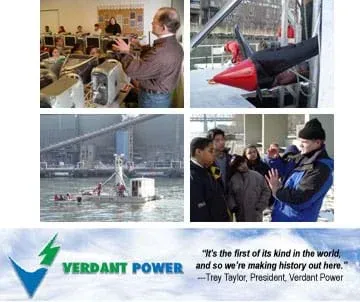 Students explore power generationCopyright Verdant Power, LLC, http://nyc10044.com/wire/2310/verdant.html. Used with permission.
Students learn about power generation using river currents. A white paper is a focused analysis often used to describe how a technology solves a problem. In this literacy activity, students write a simplified version of a white paper on an alternative electrical power generation technology. In the process, they develop their critical thinking skills and become aware of the challenge and promise of technological innovation that engineers help to make possible. This activity is geared towards fifth grade and older students and computer capabilities are required. Some portions of the activity may be appropriate with younger students.
Every day we use a great amount of electricity to run our lives—to light our schools, power televisions and gadgets, keep our food cold and heat our homes. Engineers are concerned about the way this energy is produced and its impact on our natural environment. Many engineers are devoted to developing innovative alternative energy sources and ways to conserve energy. Solar, wind and nuclear power are some alternatives to the existing high-CO2 emitting (polluting) coal plants. However no energy source is perfect and engineers constantly weigh the pros and cons of each energy source.
After this activity, students should be able to:
- Use a full range of strategies to comprehend technical writing.
- Apply skills in analysis, synthesis, evaluation and explanation to their writing and speaking.
- Incorporate source materials into their speaking and writing (for example, interviews, news articles, encyclopedia information).
- Write and speak in the content areas using the technical vocabulary of the subject accurately.
- Identify and describe the variety of energy sources
Grade 4
Do you agree with this alignment? - Use multiple resources – including print, electronic, and human – to locate information about different sources of renewable and nonrenewable energy
Grade 4
Do you agree with this alignment?
- Energy comes in different forms.
Grades 3-5
Do you agree with this alignment? - STEL-3D Explain how various relationships can exist between technology and engineering and other content areas.
Grades 3-5
Do you agree with this alignment?
- 4-ESS3-1 Obtain and combine information to describe that energy and fuels are derived from natural resources and their uses affect the environment.
Grade 4
This resource focuses on the following Three Dimensional Learning aspects of NGSS:
Science & Engineering Practices- Obtain and combine information from books and other reliable media to explain phenomena.Do you agree with this alignment?
Disciplinary Core Ideas- Energy and fuels that humans use are derived from natural sources, and their use affects the environment in multiple ways. Some resources are renewable over time, and others are not.Do you agree with this alignment?
Crosscutting Concepts- Cause and effect relationships are routinely identified and used to explain change.Do you agree with this alignment?
- Knowledge of relevant scientific concepts and research findings is important in engineering.Do you agree with this alignment?
- Over time, people's needs and wants change, as do their demands for new and improved technologies.Do you agree with this alignment?
Do you agree with this alignment? - Obtain and combine information from books and other reliable media to explain phenomena.
- 5-ESS3-1 Obtain and combine information about ways individual communities use science ideas to protect the Earth's resources and environment.
Grade 5
This resource focuses on the following Three Dimensional Learning aspects of NGSS:
Science & Engineering Practices- Obtain and combine information from books and/or other reliable media to explain phenomena or solutions to a design problem.Do you agree with this alignment?
Disciplinary Core Ideas- Human activities in agriculture, industry, and everyday life have had major effects on the land, vegetation, streams, ocean, air, and even outer space. But individuals and communities are doing things to help protect Earth's resources and environments.Do you agree with this alignment?
Crosscutting Concepts- A system can be described in terms of its components and their interactions.Do you agree with this alignment?
- Science findings are limited to questions that can be answered with empirical evidence.Do you agree with this alignment?
Do you agree with this alignment? - Obtain and combine information from books and/or other reliable media to explain phenomena or solutions to a design problem.
- paper and pencils
- graphical images (to incorporate into the white paper; either electronic or paper for cut and paste)
- computer hardware and software, if available
- desktop-publishing software for white paper layout, if available
- Adobe Acrobat software (to make white papers into PDF documents for website posting), if available
- Internet access, if available
A basic understanding of electrical energy (charge, voltage, current, resistance), and its pervasiveness in our way of life (lights, heat, safety, appliances, computers, medical equipment, transportation, entertainment). An understanding of renewable and nonrenewable energy sources. An understanding of how water turns hydroelectric power plant turbines to generate electricity.
Innovative technology can change the world and the way we live, and engineers play a key role. Think of the telephone, electric light, the computer, the Internet—all world-changing technologies. What do they have in common? They are powered by electricity.
(If you have access to the Internet, show the students the National Academy of Engineering website that lists the Top 20 Greatest Engineering Achievements of the 20th Century, https://pressbooks.bccampus.ca/engineeringinsociety/chapter/greatest-engineering-achievements-of-the-20th-century-by-the-national-academy-of-engineering/. Electrification is number one on the list.)
Did you know that approximately two billion people in the world have no access to electricity? Of the world's current population of 6.4 billion, close to one-third live entirely without the conveniences you enjoy and take for granted. Stop for a moment to imagine what your world would be like without electricity... That's right — no computer games, no TV, no cell phones, no lights. Have you ever been in a storm when the lights in your home went out? Imagine if that was how you lived every day.
As the world's population continues to grow and people increasingly demand and can afford to purchase electrically-powered appliances, how will the demand for power be satisfied? (Visit the WorldPop clock, http://www.ibiblio.org/lunarbin/worldpop, to see how fast the world population is growing.)
As described in the literacy activity The Grid: Technical Writing via Task Force Research & Reporting, supplying the power demand is an issue both of generation and transmission. In this activity, we focus on the way an innovative technology can help to solve these problems by giving people a local source of affordable, renewable electric power.
Free-flow hydropower is a way to make electricity by using the energy of flowing water to move large turbines that power electric generators—converting kinetic energy to electrical energy (see Figure 1). Free-flow hydro works a lot like a wind farm, except underwater. The design of this instream axial-flow rotor turbine consists of a concentric hub with radial blades, similar to that of a windmill. Mechanical power is applied directly through a speed increaser to internal electric generator, or through a hydraulic pump that in turn drives an onshore electric generator. This technology is also called Instream Energy Generation Technology or IEGT.
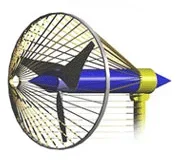 Figure 1. The design of this instream axial-flow rotor turbine consists of a concentric hub with radial blades, like a windmill. Kinetic Energy Conversion System (KHECS).Copyright Verdant Power, LLC, http://www.verdantpower.com. Used with permission.
What is great about this technology is that it is clean and renewable. Unlike traditional power generation systems that burn coal and other nonrenewable fossil fuels to make steam that powers its turbine systems, instream technology depends on endlessly cycling systems of nature, like the water cycle, which feeds flowing streams and rivers, and the revolution of the moon around the Earth, which causes the rising and falling of the tides. Instream technology has no negative effect on the environment: it is non-polluting, does not harm birds or fish, and does not promote global warming. And, because the turbines are placed directly in streams, rivers or tidal basins, instream hydro does not require the costly and environmentally damaging construction of high dams.
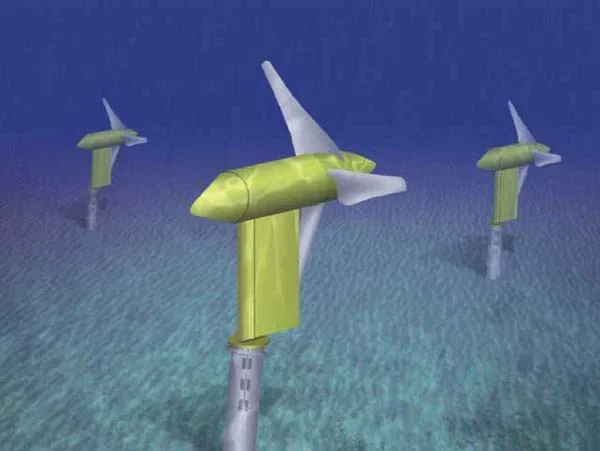 Figure 2. These Verdant Power turbines operate under water. Free-flow hydro works a lot like a wind farm, but underwater.Copyright Verdant Power, LLC, http://www.verdantpower.com. Used with permission.
The company developing and commercializing this technology is Verdant Power, LLC. Look up the meaning of "verdant" in your dictionary and see if you can guess why "Verdant Power" is an appropriate name for a company that produces renewable energy systems. Hint: the connection is in the word "green." Then, have a look at Verdant Power's website, http://www.verdantpower.com. Today we will learn all about this company's exciting and innovative technology.
Before the Activity
In this activity, students write white papers on the topic of Verdant Power's innovative free-flow hydropower technology. In form, white papers are similar to the five-paragraph essays students have written elsewhere. A white paper begins with an introductory paragraph that identifies the problem, preferably with a story that captures the reader's imagination, then develops solution points in three paragraphs, and concludes with a paragraph that summarizes the solution. (See the References section for essay-writing guidelines.)
The white paper also has elements in common with a case study of the kind outlined in presentation format in the literacy activity Is That Legal? A Case of Acid Rain. Like a case study of that type, a white paper focuses on the solution for a problem, but unlike that particular case study, it does not include an explicit "call to action," although the conclusion may be motivational.
When writing any paper, it is best to have an audience in mind. White papers written for business purposes are usually directed to a customer or potential investor with the purpose of educating rather than selling. The marketing message is more subtly implied than it would be in advertising or brochure copy. For guidelines, see How to Write a White Paper, http://www.writing-world.com/tech/tech4.shtml, a brief, but often-cited resource that may be adapted for grades 3-5.
For their white papers, direct students to think in terms of an audience of children their age whom they are educating—and indirectly persuading or "selling"—on the concept of an innovative renewable energy solution. To engage the reader, suggest the white paper begin with a story that vividly illustrates the problem that Verdant Power's technology solves and conclude with a concise, clear summary.
Despite its uncolorful name, the white paper is often presented in a graphical format that includes photographs, designs and other images. Encourage students to search the Internet for examples of layouts. Students are not expected to produce sophisticated business documents, of course. Their white papers are simplified versions of these types of documents, but should combine text and graphics to convey a clear message.
If possible, have students use basic desktop-publishing software to lay out their white papers, incorporating images, graphic elements and appropriate fonts. If your school has Adobe Acrobat software, have students publish their documents in PDF format for a professional look and post them to the school website, perhaps through hypertext links from a story about their project. The design process and use of imagery helps students conceptualize the topic and sharpen their writing skills to present their text within the requirements of the format. If these resources not available, consider creating a template on paper for the white paper, with a selection of images from which students can choose to cut and paste.
Because students work on the assignment in teams of four or five students, responsibility for research, writing, designing, editing and publishing to the website may be divided among team members.
To get students thinking about the topic, use the White Paper Study Guide (PDF) as an assignment and discussion tool.
Observing
In this activity, you will write a white paper about an innovative technology being developed and commercialized by Verdant Power, LLC. To complete your assignment, learn as much about the company and its technology as you can. You also need background knowledge about the issues the technology addresses: power generation and transmission, alternative energy sources, and environmental problems such as pollution and global warming. Refer to the literacy activity Visual Literacy: Tears in (Acid) Rain for some helpful information. You may also use other research tools, including the Internet.
Your teacher will provide a White Paper Study Guide (PDF) with questions to discuss in class. Discussion of these questions prepares you to develop your topic.
Thinking
[Note to teachers: Some terms italicized in the section below are defined in context. Use these terms in vocabulary quizzes, even if they are not included on the vocabulary list.]
What exactly is a white paper? With any writing assignment you think about a subject by writing about it. With a white paper you think about a solution for a problem.
The technology Verdant Power is developing is significant because it solves several problems at once. It provides a local source of clean, renewable, affordable power. The main question you will answer in your white paper is, "How?"
As you think about these problems and solutions, think also about the challenge presented by innovation. Why might people have difficulty accepting a new technology? What steps must a company go through to have its technology welcomed in the marketplace? What are some of the political challenges, social challenges, financial challenges? Study the case of Verdant Power to discover some answers to these questions.
Think also about how exciting it would be to develop an innovative product that would help solve a problem that directly affects people's lives, and how satisfying it would be to make the world a better place as the innovative engineers at Verdant Power are striving to do.
To succeed in the marketplace, a company needs to prove especially able or even uniquely able to meet the needs of its potential customers. This ability is called the company's defining advantage in the marketplace. When a company is compared with a competitor, defining advantage is also referred to as competitive advantage.
A company can have an advantage for many different reasons or a combination of reasons. The company may hold patents on a technology or possess trade secrets. Technology companies like Verdant Power frequently have engineers on staff as well as other employees who possess strong know-how, often referred to as intellectual capital or knowledge assets. The staff may also work well together, share a common vision and make sound business decisions as a team, giving them an advantage over companies that do not possess these traits.
As a business strategy, technology companies often focus on a select portion of the market or market segment, called a niche (similar to an ecological niche), which the company serves. The company uses its success in this niche to expand the sale of its product or service into the larger marketplace. In other cases the company remains focused on its niche.
In the following statement, Verdant Power's president, Trey Taylor, describes his company's defining advantage. Applying what you learned about alternative power generation and distributed energy describe Verdant Power's advantage in your own words.
Of the approximately 40 different technologies from around the world, which we examined for the Electric Power Research Institute (EPRI) (http://www.epri.com/), for converting hydro-kinetic energy to mechanical and then to electrical power, only four have projects with either working prototypes or pre-commercial systems underway: Norway's Hammerfest Strom; UK's Marine Current Turbines and Engineering Business (Stingray); South Korean Government using the Gorlov Helical Turbine (same one we are using with our Amesbury Project); and in the U.S.—Verdant Power's RITE Project.
We say that the RITE Project is the first of its kind in the world for a couple of reasons: it's the first distributed generation project (the others are off-shore and require transmission lines for power delivery) and it's a field of turbines (the six-pack) operating in unison and delivering power to a customer on shore.
The others have tested and will continue to test single units in anticipation of building big central tidal power facilities. Our niche is focusing on distributed generation to which can be added other systems such as potable water, irrigation and hydrogen extraction for stationary fuel cells.
Ask students the following questions, and discuss as a class:
- What do you think would be the advantage in focusing on distributed generation? (Answer: DG or DE [distributed energy] is widely regarded as the wave of the future in power generation. It helps to bridge the gap in supply for existing and future power demand.)
- What advantage would the added systems provide, especially in developing countries? (Answer: By providing an economical way to deliver clean water and irrigate farm land, and extract hydrogen for fuel cells.)
- In looking at the information on the Verdant Power website, what indication do you get that the employees of the company work as a team? (Answer: See "Mission Statement," "Executive Summary," "Verdant Power Team" and various articles in the Newsroom on their website, http://www.verdantpower.com/.)
- What are some examples of specific know-how or intellectual capital? (Answer: See "Technology" on the Verdant Power website, http://www.verdantpower.com/.)
- What are some specific ways that Verdant Power engineers are developing and improving existing technology? (Answer: See "Technology" and "Projects" on their website, http://www.verdantpower.com/.)
Writing
Use the basic essay format to write your paper as follows:
- Introductory story (paragraph) that illustrates the problem.
- Three paragraphs that describe the technology and how it solves the problem. Briefly explain how the technology works, but focus on the problem being solved.
- Concluding summary paragraph.
If possible, use desktop-publishing software to lay out your white paper, incorporating images, graphic elements and appropriate fonts. If your school has Adobe Acrobat software, publish your documents in PDF format for a professional look. You might also post your white papers to the school website, perhaps through links from a story about your project. Or, use a paper template your teacher provides, with a selection of images from which you can choose to cut and paste.
The audience for your paper is students your own age. Think in terms of educating them about the technology, while at the same time persuading them that it is effective. Do not come across as if you are writing an advertisement with a strong sales message or aggressive sales pitch. In business, that is called a "hard sell." You want to be subtle. Technology companies that use white papers to educate their customers often find the "soft sell" approach is more effective. That is generally true in life. People resist strong-arm tactics, and rightly so.
- acronym
- A word formed from the initial letters of a name, such as IEGT for instream energy generation technology, or by combining initial letters or parts of a series of words, such as radar for radio detecting and ranging.
- case study
- A detailed analysis of a person or occurrence, often used as an example or cautionary model.
- commercialize
- To develop a technology and sell it in the marketplace for profit.
- fossil fuel
- A hydrocarbon deposit, such as oil, coal or natural gas, derived from living matter of a previous geologic time, and used for fuel.
- free-flow hydropower
- A technology that uses the energy of flowing water to move turbines that power electric generators. Free-flow hydro works a lot like a wind farm, except underwater. Also called instream hydropower.
- impact
- An effect, as in free-flow hydropower is a low-impact technology.
- innovation
- The act of introducing something new.
- installed capacity
- The total capacity (ability to produce power) of electrical generation devices in a power station or system.
- instream energy generation technology
- (IEGT) "...also called free-flow hydropower technology or kinetic hydro energy systems — generate electricity from the kinetic energy present in flowing water. The systems may operate in rivers, manmade channels, tidal waters or ocean currents. IEGT systems utilize the water stream's natural pathway." Source: Verdant Power, http://www.verdantpower.com/Tech/lowimpact.shtml
- kinetic energy
- The energy of motion; the energy an object has because of its motion. For example, a spinning top, a falling object and a rolling ball all have kinetic energy. The motion, if resisted by a force, does work. Wind and water both have kinetic energy.
- llc
- An acronym that stands for limited liability company. An LLC combines the best features of partnerships and corporations. Verdant Power is an LLC.
- marketplace
- The world of business and commerce.
- pilot project
- An activity planned as a test or trial: "the pilot project helped the company determine how many more turbines, like those successfully used in the test, would be required in its river to produce the electric power that it needed."
- prototype
- A first attempt or early model of a new product or creation. May be revised many times in the process of testing and refining.
- renewable energy
- Energy made from sources that can be regenerated, either by being inexhaustible or replaceable by new growth. Sources include solar, wind, geothermal, biomass (like firewood), ocean and hydro (water).
- solution
- (jargon) Business-speak for a technology or method that solves a problem.
- sustainable
- Able to maintain or sustain over a long period, as in sustainable resources such as solar power, wind power and free-flow hydropower. The Worldwatch Institute defines "sustainable" as "meeting present needs without compromising the ability of future generations to meet their own needs." Source: Worldwatch, http://www.worldwatch.org/
- turbine
- A machine in which the kinetic energy of a moving fluid is converted into mechanical energy by causing a series of buckets, paddles or blades on the machine to rotate.
- white paper
- Originally a government document; called a "white paper" because it was not long enough to be bound into a book. A white paper is used by a technology company for an educational purpose, and indirectly a marketing purpose, typically by describing how the company's technology solves a problem.
Pre-Activity Assessment
Call-Out Questions / Vocabulary Quiz: Introduce basic concepts and vocabulary during the Observing session through the White Paper Study Guide (PDF) discussion questions and reinforce them with call-out questions and a vocabulary quiz.
Activity Embedded Assessment
Call-Out Questions: Use call-out questions during the Thinking discussion to test students' understanding of the concepts.
Post-Activity Assessment
White Papers: Students' white papers demonstrate their understanding of the concepts as well as writing ability.
Think like an engineer: (This could be a class activity, supervised by the teacher, perhaps including a field trip to a potential site.) Investigate whether a local river, stream or tidal basin near your community would be an appropriate site for an IEGT system. Consider such factors as the depth of the water, current flow, distance to electrical power transmission facilities, etc. Without current flow devices how will you find the speed of the current flow? (A good student math activity: Verdant Power's own engineers at times toss an orange in the water and clock the time that it takes for it to travel from the point of entry for some distance—40 feet [12 meters], for example, in 8 seconds—meaning that the current was moving approximately 5 feet [1.5 meters] per second [fps] or about 3 knots, the minimum velocity required for an IEGT system.) Write a report of your findings.
Take a field trip to a local power plant to see how electricity is generated in the traditional way. Report about your trip for the school newspaper or website.
Make a model of an IEGT system or develop a poster presentation that explains how an IEGT system works. Write brief descriptions as part of your display.
What are other creative ideas for generating electricity? Research and write a description to inform the class. For example, a student has designed a special floor that generates electricity from pedestrians walking on it. Concealed in the flooring, a plastic material moves very slightly when people walk on it, generating electricity. See Peter Treadway, Powerfloor, http://www.petertreadway.com.
Because this is a team activity, students can support each other's efforts. Tasks can be assigned according to interests and abilities.
Greatest Engineering Achievements of the 20th Century. National Academy of Engineering. Accessed November 2, 2005. (List of the top 20; electrification is #1) http://www.greatachievements.org/
Help with Essays, Taft Online Writing Lab. Liberal Arts Division, Taft College, West Kern Community College District, Taft, CA. (See sample three- and five-paragraph essays) Accessed November 2, 2005. http://www.taft.cc.ca.us/newTC/Academic/LiberalArts/OWL/ESSAYS.HTML
Knowles, Michael. How to Write a White Paper. 2001. Writing-World.com. Accessed November 2, 2005. (A brief, but often-cited resource. May be adapted for grades 3-5.) http://www.writing-world.com/tech/tech4.shtml
Verdant Power, LLC. Accessed November 2, 2005. (Highly recommended) http://www.verdantpower.com
World Population Clock. Continuously updated. Ibiblio, the public's library and digital archive, Chapel Hill, NC. Accessed November 2, 2005. (To see how fast the world population is growing.) http://www.ibiblio.org/lunarbin/worldpop
- Renewable Energy: Water
- Renewable Energy
- A River Ran Through It
- Falling Water
- Waterwheel Work: Energy Transformations and Rotational Rates
- A Case of Innovation: Technical Writing about River Current Power
Contributors
Jane Evenson; Trey Taylor; Cindy Coker; Malinda Schaefer Zarske; Denise W. Carlson
Supporting Program
Integrated Teaching and Learning Program, College of Engineering, University of Colorado Boulder
Acknowledgements
The contents of this digital library curriculum were developed under grants from the Fund for the Improvement of Postsecondary Education (FIPSE), U.S. Department of Education and National Science Foundation (GK-12 grant no. 0338326). However, these contents do not necessarily represent the policies of the Department of Education or National Science Foundation, and you should not assume endorsement by the federal government.
This activity was prepared with the assistance of the Verdant Power executive team. Special thanks to Trey Taylor, President, and Cindy Coker, Manager of Business Operations. http://www.verdantpower.com/
Copyright
2005 by Regents of the University of Colorado