
A River Ran Through It
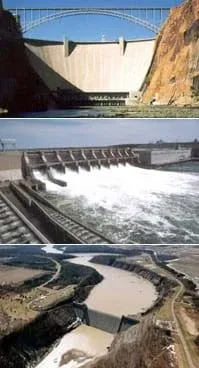 Hydropower plants capture the kinetic energy of falling water to generate electricity. A turbine and a generator convert the energy from the water to mechanical to electrical energy. Hydropower is a renewable domestic resource that does not release polluting emissions.Copyright (Top to bottom) U.S. Department of the Interior, Office of Scientific and Technical Information, and U.S. Army Corps of Engineers http://www.usbr.gov/power/data/sites/glencany/glencany.html http://www.osti.gov/hyp/ http://www.lrb.usace.army.mil/brochure/mmd.html)
Students learn how water is used to generate electricity. They investigate water's potential-to-kinetic energy transformation in hands-on activities about falling water and waterwheels. During the activities, they take measurements, calculate averages and graph results. Students also learn the history of the waterwheel and how engineers use water turbines in hydroelectric power plants today. They discover the advantages and disadvantages of hydroelectric power. In a literacy activity, students learn and write about an innovative new hydro-electrical power generation technology.
Hydroelectric power has been used by people for thousands of years, with engineering design of hydroelectric power plants for industrial use dating to the 1880s. Hydroelectric power accounted for nearly 7% of U.S. power generation and 38% of renewable power generation in 2019. Environmental engineers are concerned with dams that aid in the production of hydroelectricity because of the effects on humans and animals in the surrounding environment. It is the job of these engineers help to design maximum efficiency dams that do not harm the environment and its inhabitants.
After this lesson, students should be able to:
- Describe the energy transformations that occur in a hydroelectric power plant.
- Describe some of the environmental effects of hydropower.
- Identify how engineers are involved in designing and constructing hydropower systems.
- Energy comes in many forms such as light, heat, sound, magnetic, chemical, and electrical
Grade 4
Do you agree with this alignment? - Identify and describe the variety of energy sources
Grade 4
Do you agree with this alignment?
- The use of technology affects the environment in good and bad ways.
Grades 3-5
Do you agree with this alignment? - Energy comes in different forms.
Grades 3-5
Do you agree with this alignment? - Tools, machines, products, and systems use energy in order to do work.
Grades 3-5
Do you agree with this alignment?
- 4-ESS3-1 Obtain and combine information to describe that energy and fuels are derived from natural resources and their uses affect the environment.
Grade 4
This resource focuses on the following Three Dimensional Learning aspects of NGSS:
Science & Engineering Practices- Science explanations describe the mechanisms for natural events.Do you agree with this alignment?
Disciplinary Core Ideas- Energy and fuels that humans use are derived from natural sources, and their use affects the environment in multiple ways. Some resources are renewable over time, and others are not.Do you agree with this alignment?
Crosscutting Concepts- Knowledge of relevant scientific concepts and research findings is important in engineering.Do you agree with this alignment?
- Over time, people's needs and wants change, as do their demands for new and improved technologies.Do you agree with this alignment?
Do you agree with this alignment? - Science explanations describe the mechanisms for natural events.
- 4-PS3-2 Make observations to provide evidence that energy can be transferred from place to place by sound, light, heat, and electric currents.
Grade 4
This resource focuses on the following Three Dimensional Learning aspects of NGSS:
Science & Engineering Practices- Use evidence (e.g., measurements, observations, patterns) to construct an explanation.Do you agree with this alignment?
Disciplinary Core Ideas- Energy can be moved from place to place by moving objects or through sound, light, or electric currents.Do you agree with this alignment?
- Energy is present whenever there are moving objects, sound, light, or heat. When objects collide, energy can be transferred from one object to another, thereby changing their motion. In such collisions, some energy is typically also transferred to the surrounding air; as a result, the air gets heated and sound is produced.Do you agree with this alignment?
- Energy can also be transferred from place to place by electric currents, which can then be used locally to produce motion, sound, heat, or light. The currents may have been produced to begin with by transforming the energy of motion into electrical energy.Do you agree with this alignment?
Crosscutting Concepts- Energy can be transferred in various ways and between objects.Do you agree with this alignment?
Do you agree with this alignment? - Use evidence (e.g., measurements, observations, patterns) to construct an explanation.
See the attached reading, Hydropower — Energy from Moving Water (PDF), for an even more in-depth look at hydropower. (This article is not an appropriate reading material level for fourth-grade students.)
How is electricity generated in a hydropower plant?
Dam placement takes into consideration the natural water cycle. For most hydropower plants, dams are built on rivers at locations at which rain and snowmelt provide a plentiful and reliable supply of water flow. The geology of the area around a dam is also important for engineers to understand; if water seeps around the sides of the dam or underneath it, the dam could fail catastrophically.
The basic components of a hydropower plant are a dam, intake, turbine, generator, transformer, power lines and outflow. Most hydropower plants rely on a dam that holds back water, creating a large reservoir. Dams are some of the largest man-made structures on Earth. Large dams are vital for large-scale hydropower, but dams of all sizes are also used for flood control, water storage and irrigation throughout the world. When gates on the dam open, gravity pulls the intake water through the penstock, a pipeline that leads to the turbine. The water builds pressure as it flows through this pipe. Then the water strikes and turns the large blades of a turbine, which is attached to a generator above it by way of a shaft. As the turbine blades turn, so do a series of magnets inside a generator. Giant magnets rotate past copper coils, producing alternating current (AC). A transformer inside the powerhouse takes the AC and converts it to higher-voltage current that is carried on high-tension power lines. The used water is carried through pipelines, called tailraces, and this outflow re-enters the river downstream.
The water in the reservoir is considered stored energy. When the gates open, the water flowing through the penstock has kinetic energy because it is in motion. Several factors determine the amount of electricity generated; two of those factors are the volume of water flow and the amount of hydraulic head. The head refers to the distance between the water surface and the turbines. As the head and flow increase, so does the electricity generated. The head is usually dependent upon the amount of water in the reservoir.
A few hydropower plants are of a special design called pumped-storage plants; they are used to store energy until it is needed. In our homes, schools and workplaces, we tend to use much more electricity during the day than late at night. Some power plants, such as coal-burning generators, work more efficiently close to their peak capacity, so power from these plants is sent to a pumped-storage plant. Using a reversible turbine, the pumped-storage plant pumps water up from a lower reservoir into a high reservoir. During peak demand hours, water flows back down through the turbines and generates electricity, just like a conventional hydropower plant.
Most people are familiar with large-scale hydropower, but the energy of moving water can be captured on a much smaller scale, called micro-hydropower. In micro-hydropower small to mid-size generators are placed in rivers and streams to provide electricity for a few buildings or other smaller applications. See the literacy activity, A Case of Innovation, for information on a technology that generates electrical power from turbines placed in water currents.
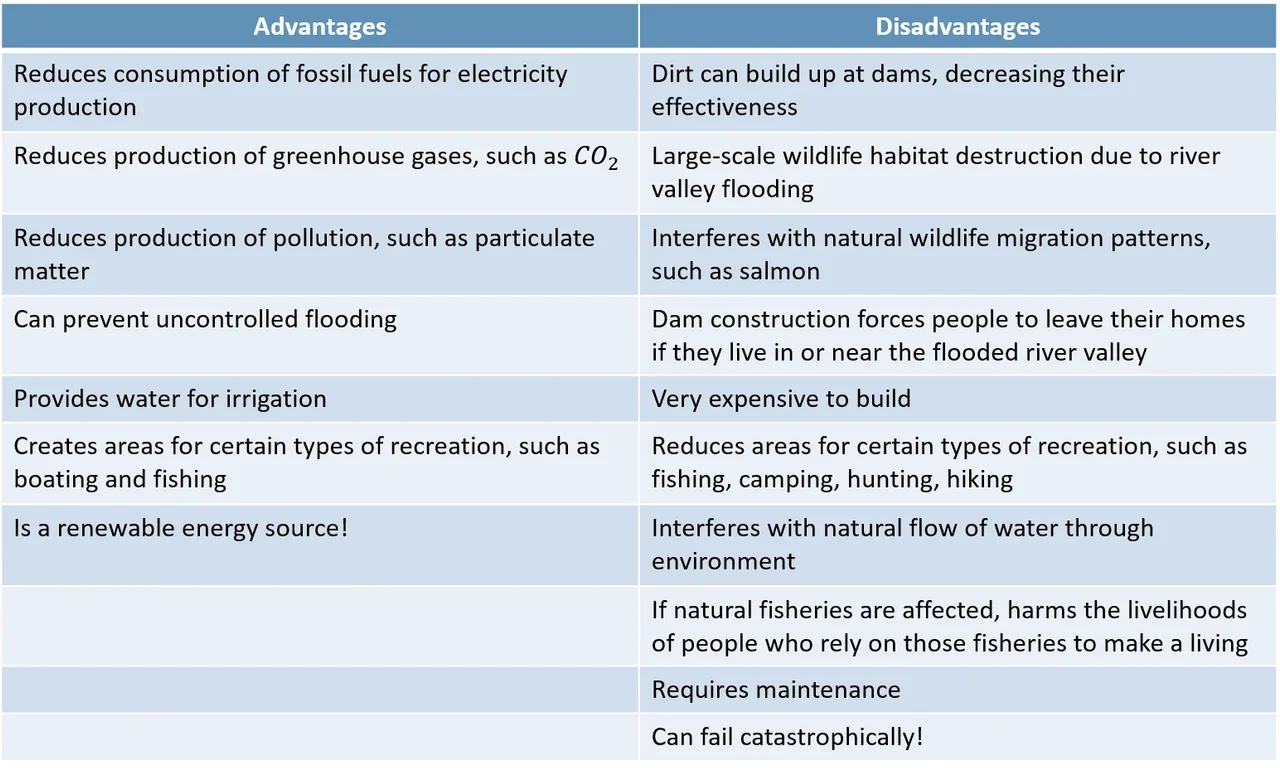 Table 1. Advantages and disadvantages of large-scale hydropower.Copyright U.S. Department of Energy http://www.eere.energy.gov/windandhydro/hydro_ad.html
How Do Dams Affect Ecosystems?
While dams are important for flood control and electric power generation, they have a significant effect on fisheries and river ecosystems. Dams can disrupt migratory fish patterns and spawning habits, especially for species like salmon. This can have devastating effects on both the fish population and people whose livelihoods depend on these fish.
Early engineering efforts to help salmon focused on designing systems that allowed the fish to bypass either the turbines or the dam itself. The most common method of bypassing the turbines is by releasing water over the dam to provide an alternate path for the passing fish. In most dams, the turbine intake is fitted with a screen that acts to guide the fish away from the turbine and towards the open spill gates. However, spilling water is less than ideal because the long fall is often traumatic for the fish. Also, the tumbling water increases dissolved gas concentrations that lead to a condition called gas bubble disease. At some dams, the government implemented transport programs in which young ocean-bound salmon are collected and barged or trucked downstream to avoid the dams. Scientists raised concerns over the trucking and barging of young salmon downstream because adult salmon that were not allowed to swim downstream as juveniles may have difficulty finding their way when they return to spawn.
The less-than-spectacular results of these earlier salmon conservation efforts led engineers to design a more fish-friendly dam. Because most salmon deaths occur as the fish pass through the turbines, engineers focused their efforts on designing new turbines. To get a better understanding of the forces felt by fish traveling through the blades, the Army Corps of Engineers used sensor fish — fish-sized plastic tubes containing instruments that measured the conditions fish would experience. They released the sensor fish into the turbine intake and collected them on the other side of the dam. They downloaded the sensor data into a computer and used it to gain insights into the cause of death for salmon passing through the turbine. With this research, engineers developed more efficient and safe turbine designs.
The most significant change in turbine design was the elimination of gaps between the turbine blades and the turbine hub, and between the outer edge of the blade and the wall of the turbine housing. Those gaps had provided places for salmon to be trapped or cut by the spinning blade. The elimination of the gaps also resulted in a smooth surface for water flow and greatly reduced turbulence. Smoother surfaces on all turbine parts protect against injuries resulting from fish colliding with abrasive turbine surfaces, while new lubricant formulations allow for smooth turbine operation without contaminating passing river water. The new designs allow for survival rates as high as 97%.
Do you think water is a source of energy? Let's think about it. Energy is when something can do work. Can you think of an example in which water does work? How about a waterwheel? People have been using water for power for a long time. More than 2,000 years ago, farmers used waterwheels to grind wheat into flour. Waterwheels spin around as a stream of water hits their blades. The gears of the wheel ground the wheat into flour. Water is definitely a source of energy, and not only that, it is a source of renewable energy!
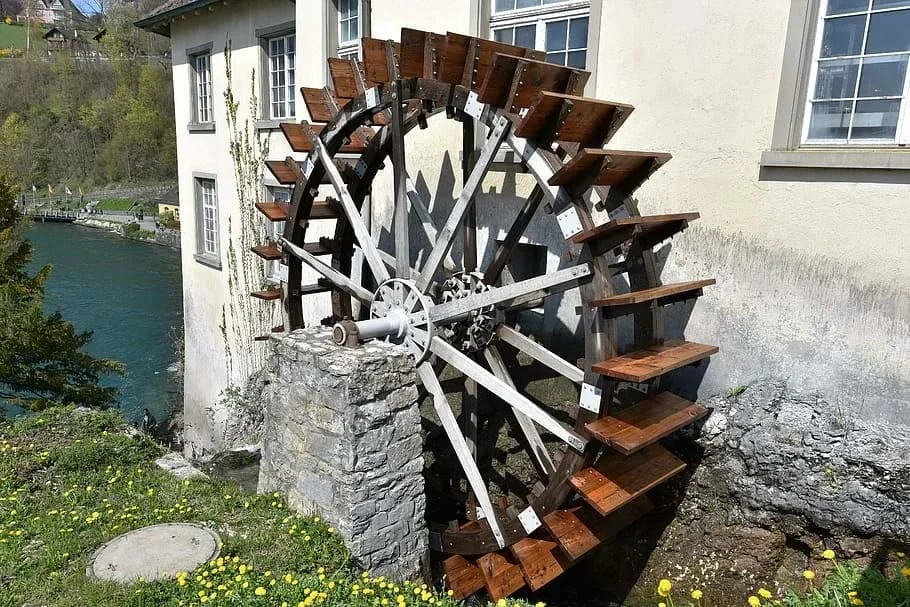 Copyright pxfuel.com 2020. Free for commercial use.
https://www.pxfuel.com/en/free-photo-jktau
Copyright pxfuel.com 2020. Free for commercial use.
https://www.pxfuel.com/en/free-photo-jktau
Modern waterwheels are found in hydroelectric power plants. What do you think hydroelectric means? Let's break it down. Hydro means water and electric is electricity; so, hydroelectric means using water to create electricity. Did you know water could help us produce electricity to run our televisions, refrigerators, and homes? Well, it can! Worldwide, hydroelectric power plants produce about 19% of the world's electricity and supply more than 1 billion people with power. Utilities in the U.S. operate about 2,400 hydroelectric power plants, making hydropower the largest renewable energy source in the country. Hydroelectric power plants take in water energy and use simple steps to change that energy into electricity. Hydroelectric power plants use some basic technology: water flowing through a dam turns a turbine, which turns an electric generator. The kinetic energy of the moving water turns the blades of a turbine, which rotates magnets inside coils of wire, producing electricity.
How do we get the water to flow through a waterwheel? Fast flowing rivers are one way, but some waterwheels run off the water stored up by a dam. In the U.S., engineers have been involved with the construction of about 80,000 dams. On average, one dam has been completed each day since the signing of the Declaration of Independence! If the water needed to run the waterwheel is stored up on one side of the wheel with a dam, then it can be made to flow through the waterwheel at a particular rate. Engineers help create dams so water can flow through a hydroelectric plant at a certain speed to produce the most electricity. Meanwhile, the reservoirs or lakes created by dams are used for boating and fishing, and often the rivers beyond the dams provide opportunities for whitewater rafting and kayaking. Students can create their own waterwheels in the associated activity Waterwheel Work: Energy Transformations and Rotational Rates to investigate the transformations of energy involved in turning the blades of a hydro-turbine into work, and experiment with how weight affects the rotational rate of the waterwheel.
The rate of construction of dams has slowed in recent years. In fact, these days, civil, structural and environmental engineers are more likely to be redesigning dams or taking them apart. Sometimes dams kill fish that are trying to migrate. For instance, in the Columbia River, salmon must swim upstream to their spawning grounds to reproduce, but the series of dams blocks their way. Different approaches to fixing this problem have been used, including the construction of "fish ladders" that help the salmon "step up" the dam to the spawning grounds upstream. Dams also change the local habitat by storing water where it may not have been stored before. Engineers often redesign existing dams to be more fish-friendly. In a dozen cases, dams have been removed entirely to restore wildlife habitats.
Sometimes engineers help to evaluate whether a dam is worth keeping. In other cases, engineers plan the best way to remove a dam. After a dam is removed, environmental engineers monitor sand and debris as it flows downstream, and help to restore the wildlife habitat. After dams are removed, much of the original wildlife returns to the area. Also, logs are salvaged from the bottom of the dam for use to build furniture, musical instruments and other products.
Water is a source of renewable energy and has many benefits. Hydroelectric power does not produce much pollution, and dams can be used for flood control as well as providing the stored (potential) energy for hydroelectric plants (Refer to the associated activity Falling Water for students to explore how potential energy is converted to kinetic to power these devices). Water can also be used to irrigate farms and for recreation. On the other hand, dams can destroy animal habitats and be expensive to build properly. If a dam breaks, flooding can destroy the entire surrounding area. Engineers consider all these advantages and disadvantages when designing and developing technologies that use water energy. Following the lesson, students can engage their creative thinking in the literacy based associated activity A Case of Innovation: Technical Writing about River Current Power where they write about emerging technology and its accompanying challenges to engineers!
Today, we have learned about the energy from water. Our word of the day is hydroelectric. What does that mean? (Answer: Using running water to create electricity.) How can the energy of moving water be used to do work? (Answer: By building structures that are moved by the water and cause something else to move, such as waterwheels and hydroelectric generators.) How does energy move through a hydroelectric power system? (Answer: The kinetic energy of the moving water turns the blades of a turbine, which rotates magnets inside coils of wire, producing electricity.) What are some advantages and disadvantages that engineers consider when working with hydroelectricity? (Answer: Advantages include: Does not produce a lot of pollution, can provide the stored [potential] energy for hydroelectric plants, can be used for irrigation and recreation. Disadvantages include: Destroying animal habitats, a potential for flooding, and expensive to build properly.)
- dam
- A barrier constructed across a waterway to control the flow or raise the level of water.
- energy
- The ability to do work.
- generator
- A device that transforms mechanical energy into electrical energy.
- hydraulic head
- The difference in depth of a liquid at two given points; the pressure of the liquid at the lower point expressed in terms of this difference.
- hydroelectric power plant
- A power plant that uses water turbines to generate electricity.
- hydroelectricity
- Electricity produced by the energy of running water.
- kinetic energy
- The energy of motion. For example, a spinning top, a falling object and a rolling ball all have kinetic energy. The motion, if resisted by a force, does work. Wind and water both have kinetic energy.
- penstock
- A pipe or conduit used to carry water to a waterwheel or turbine.
- potential energy
- Potential energy is the energy stored by an object as a result of its position. For example, a roller coaster at the top of a hill, or water being held behind a dam.
- renewable energy
- Energy made from sources that can be regenerated. Sources include solar, wind, geothermal, biomass, ocean and hydro (water).
- reservoir
- A natural or artificial pond or lake used for the storage and regulation of water.
- rotor
- The rotating part of an electrical or mechanical device.
- tailrace
- A pipeline below a waterwheel or dam through which the spent water flows.
- turbine
- A machine in which the kinetic energy of a moving fluid is converted into mechanical energy by causing a series of buckets, paddles or blades on a rotor to rotate.
- waterwheel
- A wheel propelled by falling or running water and used to power machinery.
Pre-Lesson Assessment
Discussion: Ask the students if they have ever seen a beaver dam at the zoo or on a hike. Ask them to suggest reasons why the beaver builds these dams (Possible answers: To hold back water, create a home, etc). Engage them in discussing how the dams must be strong to hold back all that water.
Post-Introduction Assessment
Brainstorming: As a class, have students engage in open discussion to come up with what they think are the positives and negatives of creating dams. Remind them that in brainstorming, no idea or suggestion is "silly." All ideas should be respectfully heard. Take an uncritical position, encourage wild ideas and discourage criticism of ideas. Have students raise their hands to respond. Write their ideas on the board. Compare their ideas with the advantages and disadvantages provided in the table in the Lesson Background & Concepts for Teachers section.
Lesson Summary Assessment
For or Against: In 2019, half (50%) of the total U.S. hydroelectric capacity for electricity generation was concentrated in three states (Washington, California and New York) with approximately 24% in Washington, the location of the nation's largest hydroelectric facility—the Grand Coulee Dam. Have the students discuss why this is. Have them determine if there is a place in your city or state that might be good for a hydroelectric plant. Would they want one built nearby to them? Why or why not? What factors would engineers consider if building a hydroelectric plant in your area (wildlife, river flow, etc.)? If time, hold a debate about this topic, with half the class debating for the building of the plant and half debating against the plant.
Explore the Renewable Energy Living Lab, which provides real-time U.S. Geological Survey stream flow data to educate students about what it takes to maintain our precious water supply. See: http://www.teachengineering.org/livinglabs/
Bonsor, Kevin. How Hydropower Plants Work. How Stuff Works. http://www.howstuffworks.com/hydropower-plant.htm
Building Big: All About Dams. WGBH Educational Foundation. http://www.pbs.org/wgbh/buildingbig/dam/index.html
Dam Removal Toolkit. American Rivers, Washington, DC. http://www.americanrivers.org/site/PageServer?pagename=AMR_content_8cf8
Dictionary.com. Lexico Publishing Group, LLC.(Source of some vocabulary definitions, with some adaptation.) http://www.dictionary.com
Hydroelectric Power. Updated August 24, 2020. Encyclopædia Britannica. www.britannica.com/science/hydroelectric-power.
Hydropower—Energy from Moving Water, Energy Kid's Page. Last revised March 2020. Energy Information Administration, U.S. Department of Energy. Accessed January 19, 2021, http://www.eia.doe.gov/kids/energyfacts/sources/renewable/water.html
Kagen, S. Cooperative Learning. San Juan Capistrano, CA: Kagan Cooperative Learning, 1994. (Source for Inside –Outside Circle assessment tool.)
Maxwell, Jessica. "Swimming with Salmon." Natural History, September 1995, pp. 26-39.
Turning to Hydropower. Foundation for Water and Energy Education (FWEE). http://www.fwee.org/
Types of Hydropower Plants. 2018, Office of Energy Efficiency and Renewable Energy. www.energy.gov/eere/water/types-hydropower-plants#:~:text=Many%20dams%20were%20built%20for,which%20only%202%2C400%20produce%20power.
Water Resources of the United States. Updated September 8, 2005. U.S. Geological Survey, U.S. Department of the Interior. http://water.usgs.gov/
Water Science for Schools. Updated October 14, 2005. U.S. Geological Survey, U.S. Department of the Interior. http://ga.water.usgs.gov/edu/
Contributors
Xochitl Zamora-Thompson; Sabre Duren; Natalie Mach; Malinda Schaefer Zarske; Denise W. Carlson
Supporting Program
Integrated Teaching and Learning Program, College of Engineering, University of Colorado Boulder
Acknowledgements
The contents of this digital library curriculum were developed under grants from the Fund for the Improvement of Postsecondary Education (FIPSE), U.S. Department of Education and National Science Foundation (GK-12 grant no. DGE 0338326). However, these contents do not necessarily represent the policies of the Department of Education or National Science Foundation, and you should not assume endorsement by the federal government.
Copyright
2005 by Regents of the University of Colorado