
Falling Water
Students drop water from different heights to demonstrate the conversion of water's potential energy to kinetic energy. They see how varying the height from which water is dropped affects the splash size. They follow good experiment protocol, take measurements, calculate averages and graph results. In seeing how falling water can be used to do work, they also learn how this energy transformation figures into the engineering design and construction of hydroelectric power plants, dams and reservoirs.
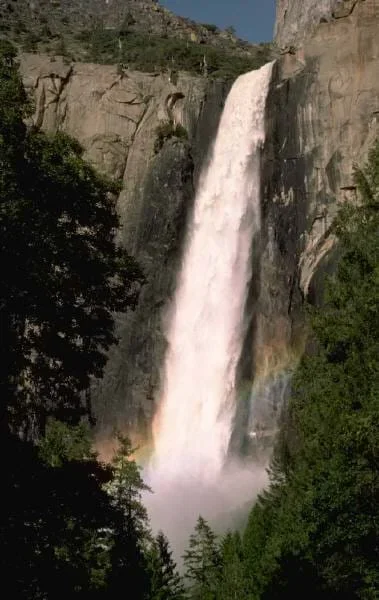 Bridal Veil Falls, Yosemite National Park, CA.Copyright 2004 Microsoft Corporation, One Microsoft Way, Redmond, WA 98052-6399 USA. All rights reserved.
Engineers design hydroelectric dams to take advantage of the conversion of water's potential energy to kinetic energy, and then mechanical energy to electrical energy. Since the force of kinetic energy is dependent on the height and mass of the falling water, civil engineers take this into consideration when designing dam turbines. High kinetic energy (caused by a great amount of water or falling from a high distance) results in incredible force on the turbine blades, so engineers design the blade and the assembly to withstand this force. Engineers use this same understanding of energy transfer when they design roller coasters.
After this activity, students should be able to:
- Describe an object's varying potential energy as being dependant on its height above the Earth's surface.
- Explain the path of potential energy converted into kinetic energy as objects fall.
- List ways that the energy of falling water is used to do work.
- Describe how engineers use the potential and kinetic energy measurements of water to design reservoirs and hydroelectric power plants.
- 4.1.3.a.i Fluently add and subtract multi-digit whole numbers using standard algorithms.
Grade 4
Do you agree with this alignment? - 4.3.1 Visual displays are used to represent data.
Grade 4
Do you agree with this alignment?
- Identify and describe the variety of energy sources
Grade 4
Do you agree with this alignment?
- CCSS.Math.Content.4.MD.B Represent and interpret data.
Grade 4
Do you agree with this alignment? - CCSS.Math.Content.5.NBT.B Perform operations with multi-digit whole numbers and with decimals to hundredths.
Grade 5
Do you agree with this alignment? - CCSS.Math.Practice.MP4 Model with mathematics.
Grades K-12
Do you agree with this alignment?
- Energy comes in different forms.
Grades 3-5
Do you agree with this alignment?
- 4-PS3-1 Use evidence to construct an explanation relating the speed of an object to the energy of that object.
Grade 4
This resource focuses on the following Three Dimensional Learning aspects of NGSS:
Science & Engineering Practices- Use evidence (e.g., measurements, observations, patterns) to construct an explanation.Do you agree with this alignment?
Disciplinary Core Ideas- The faster a given object is moving, the more energy it possesses.Do you agree with this alignment?
Crosscutting Concepts- Energy can be transferred in various ways and between objects.Do you agree with this alignment?
Do you agree with this alignment? - Use evidence (e.g., measurements, observations, patterns) to construct an explanation.
- MS-PS3-2 Develop a model to describe that when the arrangement of objects interacting at a distance changes, different amounts of potential energy are stored in the system.
Grades 6-8
This resource focuses on the following Three Dimensional Learning aspects of NGSS:
Science & Engineering Practices- Develop a model to describe unobservable mechanisms.Do you agree with this alignment?
Disciplinary Core Ideas- A system of objects may also contain stored (potential) energy, depending on their relative positions.Do you agree with this alignment?
- When two objects interact, each one exerts a force on the other that can cause energy to be transferred to or from the object.Do you agree with this alignment?
Crosscutting Concepts- Models can be used to represent systems and their interactions—such as inputs, processes and outputs—and energy and matter flows within systems.Do you agree with this alignment?
Do you agree with this alignment? - Develop a model to describe unobservable mechanisms.
Each group needs:
- plastic drinking straw; clear is best
- cup or glass, to hold colored water for dipping the straw
- meter stick
- pencil or pen
- marking pens
- newsprint, newspaper or blank paper; minimum of 12-16 sheets per team
For the entire class to share:
- 1 or 2 plastic, gallon-size (3.78 liter-size) milk containers to distribute water
- water, preferably colored with food coloring
- Falling Water Worksheet (PDF), one per team
What is energy? (Answer: Something that can do work). Have you ever heard of potential or kinetic energy? Well, potential energy is simply the "stored" energy of an object. An object's potential energy depends partly on its height and gravity. Kinetic energy is the energy of the object in motion. As an object falls, or moves down an incline, its potential energy is converted into kinetic energy. So, a falling object (or one rolling or sliding down a hill) loses its potential energy as it increases its kinetic energy.
 Installation of huge water turbines at Ft. Loudoun Dam, TN.Copyright Charles Krutch, Tennessee Valley Authority http://www.tva.gov/heritage/camera/.
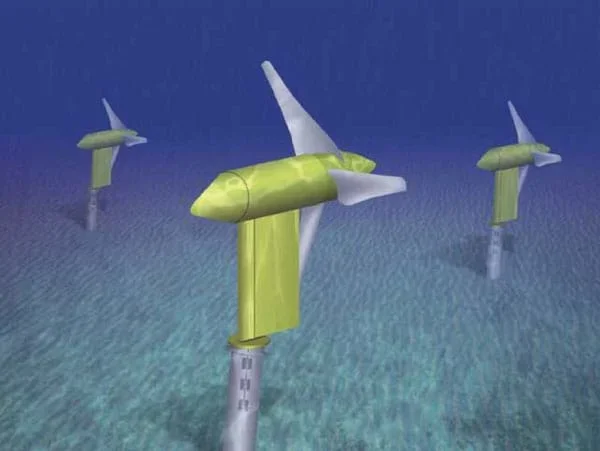 The new technology of free-flow hydro works a lot like a wind farm, except with underwater turbines.Copyright Verdant Power, LLC, http://www.verdantpower.com. Used with permission.
When we think of water, potential energy is the energy of the water as it sits calmly in a reservoir or lake. The kinetic energy of water is when it is rushing through a river, down a waterfall or through a hydroelectric power plant. The force of the kinetic energy is dependent on the height and mass of the falling water. Hydroelectric is when water is used to produce electricity. Civil engineers design and build dams and hydroelectric power plants that use the energy of falling water to turn the blades of turbines to generate electricity that we can use in our homes. So, it is actually the kinetic energy of water moving through a power plant that can produce electricity.
In this activity, we are going to drop water from different heights to demonstrate how the kinetic energy of water changes when it hits the floor. Engineers must understand how height affects the amount of kinetic energy so they create a reservoir that holds the correct amount of water and design a hydroelectric power plant that produces the necessary amount of electricity. Since water falls too fast for us to measure the velocity (or kinetic energy) of the water directly, we will measure the size of the splash produced to show us how much kinetic energy exists.
Before the Activity
- Gather materials and make copies of the Falling Water Worksheet (PDF).
- Fill the containers with water. Color the water with several drops of food coloring.
With the Students
- Divide the class into teams of three or four students each.
- Show the students how to use a straw like a water dropper (see Figure 1). Stick the straw in a glass of water. Place a finger on the top of the straw. Pull the straw out of the glass, while still holding your finger over the top. Hold the straw over a piece of paper and remove your finger.
- Ask the students how they can all be sure to use the same amount of water for each trial. (Answer: By marking a line on the straw and always refilling it to that point.)
 Figure 1. How to use a straw like a water dropper.Copyright 2005 Denise W. Carlson, ITL Program, College of Engineering and Applied Science, University of Colorado Boulder
- Discuss with students methods for measuring the diameter of a splash. Have the students agree on a standard class method for determining the diameter of a splash. Have students use a pencil or pen to outline the splash, and label it with their name, the drop height, and the splash diameter.
- Have student teams describe on the worksheet what they predict will happen to the splash as it is dropped from increasing heights. Do they expect the size of the splash to increase or decrease with higher drop heights?
- Have the class agree on four heights from which to drop the water, such as 30 cm, 60 cm, 90 cm and 1 m (note this on the worksheet). Teams measure the diameter of the water splash for all four heights. Each team member drops the water once from each height. Thus, teams with three members have 12 data points and teams with four members have 16 data points.
- Students take turns doing each part of the activity. One student holds the meter stick. One student drops the water using the straw. A third student measures the splash diameter.
- Hold the bottom of the straw at the height by first placing it next to the correct height on the meter stick and then moving it several centimeters away, being careful to keep the straw at the same height. On the paper, write the height, diameter and team member name, and record the data on the worksheet.
- After one person drops the water, the team members switch places and repeat the process. The student measuring the diameter of the splash moves the paper so the water falls on a dry piece.
- After teams have finished their drops, have them complete the worksheet by calculating averages and creating a graph of their average data.
- Conclude with a class-wide comparison of each team's results (table data and graphs) and a concluding discussion, as described in the Assessment section.
- diameter
- The straight-line distance across a circular area, through its center point.
- energy
- The ability to do work.
- hydroelectric power plant
- A power plant that uses water turbines to generate electricity.
- hydroelectricity
- Electricity produced by the energy of running water.
- kinetic energy
- The energy of motion. For example, a spinning top, a falling object and a rolling ball all have kinetic energy. The motion, if resisted by a force, does work. Wind and water both have kinetic energy.
- mechanical energy
- Energy that can be used to do work. It is the sum of an object's kinetic and potential energy.
- potential energy
- Potential energy is the energy stored by an object as a result of its position. For example, a roller coaster at the top of a hill, or water being held behind a dam.
- renewable energy
- Energy that is made from sources that can be regenerated. Sources include solar, wind, geothermal, biomass, ocean and hydro (water).
- turbine
- A machine in which the kinetic energy of a moving fluid is converted into mechanical energy by causing a series of buckets, paddles, or blades on a rotor to rotate.
Pre-Activity Assessment
Voting: Ask a true/false question and have students vote by holding thumbs up for true and thumbs down for false. Tally the votes and write the totals on the board. Give the right answer.
- True or False: An object's potential energy depends on its height above the Earth's surface. (Answer: True)
- True or False: Kinetic energy is the energy of something staying very still. (Answer: False. Kinetic energy is the energy of an object in motion.)
- True or False: An object's kinetic energy increases as its speed increases. (Answer: True)
Discussion Question: Ask a discussion question to get students to think about the upcoming activity. After soliciting answers, explain that these questions will be answered during the activity. Ask the students:
- What makes a good experiment? Only one variable can be changed at a time in a good experiment. Why?
Activity Embedded Assessment
Prediction: Ask students to predict the outcome of the activity before the activity is performed. What will happen to the splash as it is dropped from increasing heights? Do you expect the size of the splash to increase or decrease with higher drop heights?
Design Decisions: As a class, design the parameters for your experiment, including determining standard methods to ensure experimental consistency in the following:
- Amount of water being dropped
- Measurement of the splash diameter
- Height from which to drop water
Worksheet: Have teams record measurements, answer questions, make calculations and graph data on the worksheet. Review their answers to gauge their mastery of the subject.
Post-Activity Assessment
Concluding Discussion: Ask the students and discuss as a class:
- What patterns do we see in the results? How might we have altered the experiment or our methods to make a better experiment? What conclusions can we draw?
- What happens when we increase the height from which the water is dropped? What if a light bulb is dropped from 1 cm off the floor? From 2 meters off the floor? How does the potential energy and the resulting force (kinetic energy) change in these two cases? What if you dropped a glass into the sink? Does the height at which it is dropped make a difference in whether it breaks or not? How is a short waterfall different from a very high waterfall?
- How would engineers use this understanding to design hydroelectric power plants? How would engineers use this understanding to design roller coasters? How is the force you feel on a roller coaster different if you are coming down a steep section compared to a level section?
Diagramming: Ask students to illustrate the concept of energy transfer through drawing.
- Draw the transformations of energy that occur when an object is dropped. (Answer: Potential energy due to the object's height above the Earth is converted to kinetic energy as it falls. Note: Point out to students that when the object strikes the Earth, the kinetic energy is converted into other forms of mechanical and potential energy, such as sound or heat energy. It may be appropriate to explain that energy may change its form, but there is no net change to the amount of energy. This is called conservation of energy.)
- Draw the transformations of water energy as it goes from a reservoir through a hydroelectric plant.
Engineering Application: Have students reflect on the following engineering applications for kinetic and potential energy. This assignment is suitable for a class discussion or a journal entry.
- Use your understanding of kinetic energy to explain why engineers place some hydro generators in fast-moving waters. (Answer: Fast moving waters have more kinetic energy to transfer to the blades of a turbine, making them spin faster than they would in slow moving waters.)
- Use your understanding of potential and kinetic energy to explain why engineers build large dams for hydroelectric power plants. (Answer: The dams hold back large amounts of water. The water is higher than the turbines so it has potential energy. As the water moves downward to the turbines, its potential energy is transformed to kinetic energy, turning the blades of the turbine.)
Remind students that wet floors can be slippery and to be careful in areas in which water is being used.
Make sure students fill their straw to the mark before each trial, otherwise the amounts will be inconsistent.
This activity works best if the teams drop the water onto a hard, flat surface.
Shorter students may require chairs or stools on which to stand when they drop the water.
Test how changing the mass of the water drop affects the size of the splash produced. Try different sized drops for each height.
Math Problem Solving: Present the class with the following problems and ask the students to determine which case has the greater kinetic energy when it hits the ground. (Note: Greater height or mass = greater kinetic energy.)
- A 2-ml drop of water dropped from 2 meters, or a 2-ml drop of water dropped from 1 meter? (Answer: The 2 ml drop of water dropped from 2 meters.)
- A 4-ml drop of water dropped from 3 meters, or a 2-ml drop of water dropped from 3 meters? (Answer: The 4-ml drop of water dropped from 3 meters.)
- A 1-liter bottle of water dropped from 2 meters, or a 1-liter bottle of water dropped from 6 meters? (Answer: The 1-liter bottle of water dropped from 6 meters.)
Test how the angle at which water falls affects the size of the splash produced. See the Foundation for Water and Energy Education's Turning to Hydropower activity, "Will changing the slope of falling water affect how fast it flows?" at: http://www.fwee.org/TG/unit_2c.pdf.
For upper grades: Using their graph results on the worksheet, have students make and test predictions for what would happen at intermediate heights and heights greater than 1 meter. Are their predictions correct?
The Artist with a Camera. Tennessee Valley Authority. Accessed October 31, 2005. (Story of TVA photographer Charles Krutch) http://www.tva.gov/heritage/camera/
The Nature of Water Power, Curriculum Units. Foundation for Water and Energy Education. Accessed October 27, 2005. (Activity adapted from this source.) http://www.fwee.org/TG/curriculum.html
Verdant Power, LLC. Accessed October 27, 2005. (Engineers who design underwater turbine power generating systems) http://www.verdantpower.com
Contributors
Xochitl Zamora-Thompson; Sabre Duren; Natalie Mach; Malinda Schaefer Zarske; Denise W. Carlson
Supporting Program
Integrated Teaching and Learning Program, College of Engineering, University of Colorado Boulder
Acknowledgements
The contents of this digital library curriculum were developed under grants from the Fund for the Improvement of Postsecondary Education (FIPSE), U.S. Department of Education and National Science Foundation (GK-12 grant no. 0338326). However, these contents do not necessarily represent the policies of the Department of Education or National Science Foundation, and you should not assume endorsement by the federal government.
Copyright
2005 by Regents of the University of Colorado