
Waterwheel Work: Energy Transformations and Rotational Rates
Students learn the history of the waterwheel and common uses for water turbines today. They explore kinetic energy by creating their own experimental waterwheel from a two-liter plastic bottle. They investigate the transformations of energy involved in turning the blades of a hydro-turbine into work, and experiment with how weight affects the rotational rate of the waterwheel. Students also discuss and explore the characteristics of hydroelectric plants.
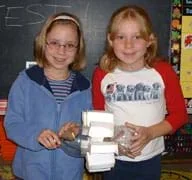 Students hold the plastic bottle waterwheel they made.
Throughout human history, waterwheels performed many types of mechanical work: saw timber, drive pumps, run farm equipment, trip hammers, grind grains into flour, make iron products and power textile mills. Today, the modern equivalents of waterwheels are the huge turbines of hydroelectric power plants, which generate electricity that we use everyday to perform all types of work: heating, cooling, refrigeration, and the powering of appliances, televisions and entertainment. Hydropower is a way to produce electricity using a renewable energy source that does not use fossil fuels, pollute or produce greenhouse gases. Yet, such big projects require engineers to consider all the implications of their impact on the surrounding environment.
After this activity, students should be able to:
- Describe hydropower as a source of renewable energy.
- Discuss the history and uses for a waterwheel.
- Explain how engineers design and redesign hydropower technologies.
- Use counting to measure the rate of revolution of a waterwheel.
- 3.1.3.c.i Fluently multiply and divide within 100, using strategies such as the relationship between multiplication and division or properties of operations.
Grade 3
Do you agree with this alignment? - 4.1.3.b Use the four operations with whole numbers to solve problems.
Grade 4
Do you agree with this alignment?
- Identify and describe the variety of energy sources
Grade 4
Do you agree with this alignment? - Use multiple resources – including print, electronic, and human – to locate information about different sources of renewable and nonrenewable energy
Grade 4
Do you agree with this alignment?
- CCSS.Math.Content.4.MD.A.3 Apply the area and perimeter formulas for rectangles in real world and mathematical problems.
Grade 4
Do you agree with this alignment? - CCSS.Math.Content.5.MD.C.5 Relate volume to the operations of multiplication and addition and solve real world and mathematical problems involving volume.
Grade 5
Do you agree with this alignment? - CCSS.Math.Content.5.NBT.B.6 Find whole-number quotients of whole numbers with up to four-digit dividends and two-digit divisors, using strategies based on place value, the properties of operations, and/or the relationship between multiplication and division. Illustrate and explain the calculation by using equations, rectangular arrays, and/or area models.
Grade 5
Do you agree with this alignment? - CCSS.Math.Content.5.NBT.B.7 Add, subtract, multiply, and divide decimals to hundredths, using concrete models or drawings and strategies based on place value, properties of operations, and/or the relationship between addition and subtraction; relate the strategy to a written method and explain the reasoning used.
Grade 5
Do you agree with this alignment?
- Energy comes in different forms.
Grades 3-5
Do you agree with this alignment? - STEL-8D Follow directions to complete a technological task.
Grades 3-5
Do you agree with this alignment?
- 3-5-ETS1-3 Plan and carry out fair tests in which variables are controlled and failure points are considered to identify aspects of a model or prototype that can be improved.
Grades 3-5
This resource focuses on the following Three Dimensional Learning aspects of NGSS:
Science & Engineering Practices- Plan and conduct an investigation collaboratively to produce data to serve as the basis for evidence, using fair tests in which variables are controlled and the number of trials considered.Do you agree with this alignment?
Disciplinary Core Ideas- Tests are often designed to identify failure points or difficulties, which suggest the elements of the design that need to be improved.Do you agree with this alignment?
- Different solutions need to be tested in order to determine which of them best solves the problem, given the criteria and the constraints.Do you agree with this alignment?
Do you agree with this alignment? - Plan and conduct an investigation collaboratively to produce data to serve as the basis for evidence, using fair tests in which variables are controlled and the number of trials considered.
- 4-PS3-4 Apply scientific ideas to design, test, and refine a device that converts energy from one form to another.
Grade 4
This resource focuses on the following Three Dimensional Learning aspects of NGSS:
Science & Engineering Practices- Apply scientific ideas to solve design problems.Do you agree with this alignment?
Disciplinary Core Ideas- Possible solutions to a problem are limited by available materials and resources (constraints). The success of a designed solution is determined by considering the desired features of a solution (criteria). Different proposals for solutions can be compared on the basis of how well each one meets the specified criteria for success or how well each takes the constraints into account.Do you agree with this alignment?
- Energy can also be transferred from place to place by electric currents, which can then be used locally to produce motion, sound, heat, or light. The currents may have been produced to begin with by transforming the energy of motion into electrical energy.Do you agree with this alignment?
- The expression "produce energy" typically refers to the conversion of stored energy into a desired form for practical use.Do you agree with this alignment?
Crosscutting Concepts- Science affects everyday life.Do you agree with this alignment?
- Energy can be transferred in various ways and between objects.Do you agree with this alignment?
- Engineers improve existing technologies or develop new ones.Do you agree with this alignment?
- Most scientists and engineers work in teams.Do you agree with this alignment?
Do you agree with this alignment? - Apply scientific ideas to solve design problems.
Each group needs:
- 1 empty, clean two-liter plastic soda bottle (ask students to bring from home or collect from recycling center)
- 1 pair of scissors
- tape
- 6-8 large index cards (4 x 6-inch size works)
- waterproofing materials to wrap over the index cards (aluminum foil, plastic wrap, etc.) so that the index cards do not disintegrate in the water
- pen or marker
- wooden dowel, ~¾-inch (2 cm) diameter (to fit into the bottle opening with a little room to turn) and longer than the length of the soda bottle; dowel can be re-used (Alternative: If large-enough dowels are not available, use smaller dowels and drill holes into the bottle cap big enough to accept the dowel and allow it to spin.)
- timer, clock or watch (to count seconds elapsed)
- string
For the entire class to share:
- water source
- pouring container to hold ~ 2 liters water
- sink or outside area that can get wet
Today we are going to talk about hydropower. Hydropower is a renewable energy resource. Hydro means water, so hydropower is something that gets power from water. Hydropower captures energy from the movement of water or water's kinetic energy. Have you ever seen a waterwheel? A waterwheel is an example of how people have created a machine that uses and produces hydropower. A waterwheel is also called a turbine.
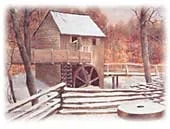 Water-powered grist mill in Tennessee.Copyright Tennessee Valley Authority http://www.tva.gov/
The waterwheel is one of the oldest known sources of power. A waterwheel spins as a stream of water (which is being pulled down by gravity) hits its paddles or blades. The first reference to its use is about 4000 BC. More than 2,000 years ago, farmers used waterwheels to grind wheat into flour. The gears of the wheel ground the wheat into flour. Waterwheels use the kinetic energy of moving water to perform many types of mechanical work. Waterwheels were used to power farm equipment, drive pumps, trip hammers, saw timber, grind grains into flour, forge iron, and power textile mills. Before the development of steam power during the colonial and industrial revolution eras, waterwheels were the only sources of power (besides human or animal power). Often, towns were built close to a river so waterwheels could be built nearby
Three types of waterwheels are tha horizontal waterwheel, overshot vertical waterwheel, and undershot vertical waterwheel. In the horizontal waterwheel, water flows from an aqueduct or pipe from the side of the wheel and onto the wheel. The forward motion of the water turns the wheel. In the overshot vertical waterwheel, water drops down from a water source above onto the wheel, turning it. Undershot vertical waterwheels are large vertical waterwheels placed in a stream such that the wheel is turned by the moving water.
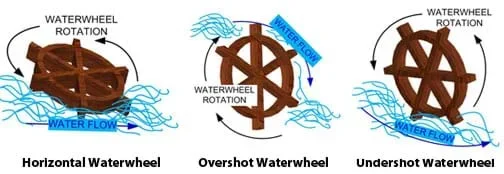 Three types of waterwheels: horizontal, overshot and undershot.Copyright 2010 Jean Parks, ITL Program, College of Engineering, University of Colorado at Boulder
The world's first hydroelectric power plant began operating in 1882, on the Fox River in Appleton, WI. Hydroelectric is when water is changed into electrical energy. Hydroelectricity can be used to power lights, heaters, appliances and televisions. The plant was started by a man who was a paper manufacturer and engineer, and was inspired by Thomas Edison's plans for an electric power plant.
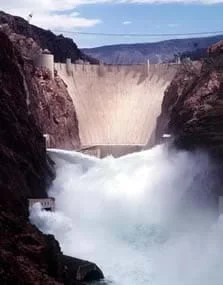 Hoover Dam in Nevada, USA.Copyright U.S. Department of the Interior, Bureau of Reclamation http://www.usbr.gov/lc/hooverdam/.
Today, engineers around the world develop hydroelectric plants to meet growing energy demand. The waterwheel concept is used in dams to generate electricity. Dams are some of the largest human-made structures on Earth. In fact, the Hoover Dam on the Colorado River in Nevada is 221 meters high, 379 meters long and 14 meters wide at the top. That is pretty big! It has 17 electric generators and provides electricity for about 500,000 homes in Nevada, Arizona and California. One of the world's largest hydroelectric power plant—the Itaipú Power Plant on the Paraná River in Brazil—provides energy to two countries (25% of Brazil's electricity and 78% of Paraguay's electricity).
The same concepts that are employed in a waterwheel are used in these gigantic hydroelectric power plants. A waterwheel is a simple turbine—a device with buckets, paddles or blades that is rotated by moving water, converting the kinetic energy of water into mechanical movement. Hydroelectric power plants use huge and more complex turbines to generate electricity.
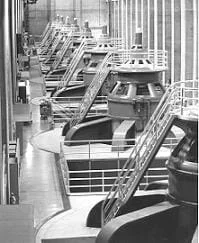 Huge turbines inside a hydroelectric power plant.Copyright Bureau of Reclamation, U.S. Department of the Interior https://www.doi.gov/
Using hydroelectric power plants can reduce the amount of fossil fuels needed to generate electricity. The biggest advantages of using hydropower for electricity are that it is a renewable resource and it does not give off air pollution during operation. Engineers design (and redesign existing) dams to be friendlier for fish and wildlife, and to work better at making electricity.
In this activity, we are going to design a model of an overshot vertical waterwheel. Engineers often build models or prototypes of a waterwheel or any product or large project before they build the real thing. This method of testing something on a small scale helps to prevent mistakes in making the real ones work.
Before the Activity
- Prepare and test a waterwheel before demonstrating it to the class.
- Ask the students to save two-liter soda bottles and bring from home, or collect these bottles from a recycling center.
- Gather materials and make copies of the Waterwheel Worksheet (PDF).
With the Students
- As a class, discuss what students already know about hydropower. To warm up the class, ask them the true/false questions provided in the Assessment section.
- Show students your model waterwheel.
- Divide the class into teams of three or four students each, providing work space for each.
- Have the students in each team make their own waterwheels using the following instructions (refer to Figure 1):
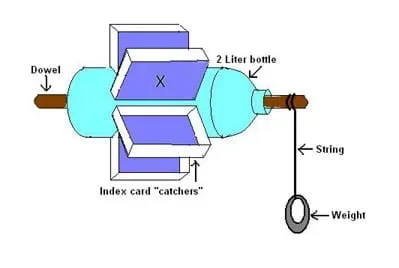 Figure 1. Assembly diagram for the plastic bottle waterwheel.Copyright 2005 Malinda Schaefer Zarske, ITL Program, College of Engineering, University of Colorado Boulder
- With a pen or marker, draw 6 to 8 lengthwise equidistant lines along the length of the large plastic bottle. These mark the locations where index card "water catchers" will be taped.
- Fold the index cards to make small boxes or envelopes ("catchers") with open sides. These will serve as waterwheel paddles (or buckets or blades) to catch the water. Exactly how the index cards are folded and attached provides an engineering design opportunity for each team.
- Mark one index card with an "X" so counting the number of turns is easier. (The students will count each time the marked catcher reaches the top of the waterwheel while turning.)
 Figure 2. Example plastic bottle waterwheel.Copyright 2005 Joe Friedrichsen, ITL Program, College of Engineering, University of Colorado Boulder
- Tape the index card "catchers" to the soda bottle at each line. Your waterwheel will spin in one specific direction (choose either clockwise or counterclockwise), so make sure each catcher faces the same direction to help the bottle to spin in that direction. See Figure 2.
- Make a hole in the bottom of the bottle so that the dowel can be inserted through the center of the bottle like an axle (from the opening at the top through the hole in the bottom), as shown in Figure 1. The hole in the bottom of the bottle should be slightly larger than the dowel, so that the whole bottle can freely spin on the dowel. If the hole is too tight, then the bottle will have trouble spinning on the dowel.
- Discuss how to measure the rate of rotation of the waterwheel (refer to the Waterwheel Worksheet (PDF)). Agree on what it means for the waterwheel to slow down. Does it have to completely stop? Have the students create a procedure to count the turns of the waterwheel during a given period of time. For example, during the pouring, as the waterwheel spins, students could count the number of turns by noting how many times the marked catcher passes the top of the wheel.
- (Conduct this step over a sink or outside.) Have one team member keep track of the elapsed time using the second hand on a clock or watch. As soon as the wheel is spinning, start taking the time while other team members count the number of turns the waterwheel makes. Stop counting turns and keeping track of the time when the waterwheel slows down.
- Change roles and repeat until every member has counted or there is a consistent measurement for the rate at which the waterwheel spins. Record your data on the worksheet. Have students complete the front side of the worksheet.
- Have teams fasten a string to the neck of their water turbines. Tie objects to the string so the spinning waterwheel pulls them up as the string rolls up around the neck of the bottle.
- (Conduct this step over a sink or outside. See Figure 3.) Have one team member keep track of the elapsed time using the second hand on a clock or watch. As soon as the waterwheel (with the weight) is spinning, start taking the time while other team members count the number of turns the waterwheel makes. Stop counting turns and keeping track of the time when the waterwheel slows down. Repeat this until every member has counted or there is a consistent measurement for the rate at which the waterwheel spins. Record your data on the worksheet. Have students complete the back side of the worksheet.
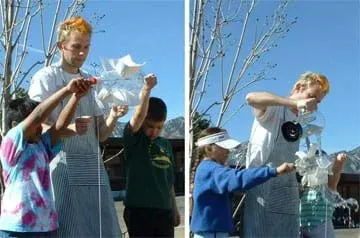 Figure 3. Pouring water on the waterwheels.Copyright 2005 Joe Friedrichsen, ITL Program, College of Engineering, University of Colorado Boulder
- Close with a class-wide comparison of each team's results and a concluding discussion. Use the post-activity questions and activities as described in the Assessment section.
- dam
- A barrier constructed across a waterway to control the flow or raise the level of water.
- design
- To plan out in systematic, often graphic form. To create for a particular purpose or effect. For example, to design a power plant.
- energy
- The ability to do work.
- engineering design
- The process of devising a system, component or process to meet desired needs. (Source: ABET)
- hydropower
- Generating power from the movement of water. Also called hydroelectric power.
- hydroelectric power plant
- A power plant that uses water turbines to generate electricity.
- hydroelectricity
- Electricity produced by the energy of moving water.
- kinetic energy
- The energy of motion. For example, a spinning top, a falling object and a rolling ball all have kinetic energy.
- mechanical energy
- Energy used to create motion. It is the sum of an object's kinetic and potential energy.
- model
- A small object, usually built to scale, that represents another, often larger object.
- power plant
- A complex of structures, machinery, and associated equipment for generating electric energy.
- potential energy
- Potential energy is the energy stored by an object as a result of its position. For example, a roller coaster at the top of a hill, or water being held behind a dam.
- prototype
- A first attempt or early model of a new product or creation. May be revised many times in the process of testing and refining.
- renewable energy
- Energy made from sources that can be regenerated. Sources include solar, wind, geothermal, biomass, ocean and hydro (water).
- reservoir
- A natural or artificial pond or lake used for the storage and regulation of water.
- rotational rate
- How fast something turns. A measure of speed indicated by the number of turns that take place during a period of time. For example, 100 revolutions per minute.
- turbine
- A machine in which the kinetic energy of a moving fluid is converted into mechanical energy by causing a series of buckets, paddles or blades on a rotor to rotate.
- waterwheel
- A wheel that rotates by direct action of water; used to generate power or do work. The wheel often includes buckets, paddles or blades to catch the water. A simple turbine.
Pre-Activity Assessment
Exploratory Discussion: As a class, discuss the following topics:
- Define hydropower as a class. (Answer: Power from the movement of water.)
- Describe how hydropower is used in everyday life.
- Discuss the advantages of using renewable energy sources.
Voting: To warm up the class, ask the following true/false questions and have students vote by holding thumbs up for true and thumbs down for false. Tally the votes and write the totals on the board. Give the right answer.
- True or False: Hydropower dams reduce the production of pollution. (Answer: True)
- True or False: Hydropower dams are inexpensive to build. (Answer: False. They can be very expensive to build.)
- True or False: Hydropower dams do not interfere with natural wildlife. (Answer: False. Dams can disrupt migratory fish patterns and spawning habits, especially for species like salmon. This can have devastating effects on both the fish population and people whose livelihoods depend on these fish. Change in water levels can also fatally affect other wildlife and plants.)
Activity-Embedded Assessment
Question/Answer: Ask the students how waterwheels (hydromills) and windmills are similar (Answer: Both have "vanes" and a turbine shaft, and both generate renewable energy.)
Design Decisions: As a class, design the parameters for your experiment, including determining standard methods to ensure experimental consistency in the following:
- How to count the rotations (turns) of the waterwheel
- How to keep the flow rate of the water onto the waterwheel constant
Worksheet: Have the student teams record measurements, calculate averages and answer questions on the worksheet. Review their answers to gauge their mastery of the subject.
Post-Activity Assessment
Concluding Discussion: Ask the students and discuss as a class:
- What happened to the waterwheel as you poured water on it?
- What patterns do we see in the results? Why do teams have different average rates of rotation? What conclusions can we draw?
- To improve your waterwheel, how might you re-design your water catchers to work better?
- What happened to the rate of rotation when we added weight?
- How would engineers use this understanding to design hydroelectric power plants? (Answer: Engineers would learn about the different paddle or blade designs to see how well they moved the weight. The better the blade design, the faster the waterwheel turned and moved the weight upwards. They would use this information to design a turbine that generated the most electricity from the turning wheel.)
- How might we have altered the experiment or our methods to make a better experiment?
Engineering Design Project: Divide the class into groups and inform them that they are engineering teams working for H2O Solutions, an engineering design company that specializes in waterwheels and water energy. The city has asked them to use what they have learned in this activity to design a waterwheel that is more efficient than the waterwheel they just designed during this activity. Tell the teams that they can include whatever resources (e.g., time, materials) that they want in their design. Ask them to sketch their new design. Have teams present their designs to the rest of the class.
- Ask students to describe, in general terms, how hydropower works. They can use information from the demonstration/activity to support their ideas.
- Ask the students to brainstorm how they think they could make their waterwheel more efficient if they had additional resources (materials, time).
- Among all teams, ask students to decide which new design is the best and why?
Engineering Application: Have students reflect on the following engineering applications for hydropower. This assignment is suitable for a class discussion or a journal entry.
- To use the natural water flows in a river or stream for hydropower, what type of natural river conditions do engineers require? (Answer: It must be fast-moving water.)
- What are some reasons why engineers construct hydroelectric power plants? (Possible answers: To produce electricity. To make use of a renewable energy source [water]. To produce electricity without polluting or producing greenhouse gases.)
- Why do engineers construct dams for large hydroelectric power systems? (Answer: The dam holds a great deal of water in one place to supply the kinetic energy required to turn the turbine blades.)
- How was the waterwheel you made similar to what happens in a hydroelectric power plant? (Answer: Water dropped from a container to spin the blades just like water runs from a dam to spin the blades of a turbine. The spinning waterwheel was used to do work just like the spinning blades of turbines make electricity, which we use to do work.)
Re-Design Practice: Have the students list on their worksheet any design or fabrication changes they would make to their waterwheel to make it work better.
It is helpful to prepare and test one model waterwheel before students conduct the activity.
Make sure the dowels spin freely within the bottle openings or bottle cap holes.
Have students investigate and make posters showing different varieties of the three types of waterwheels.
Have students make waterwheels out of different types of materials or bottles. How does the material of the waterwheel affect the amount of work that is done? Make available bottles with different shapes and volume/capacities. Ask each team to come to the sink where the tap water is running at a constant flow rate for each. Finally, ask the students to compare their waterwheels to their peers' based on the number of turns per minute at the same flow rate of water. Ask the students why their waterwheel performs differently than the others'. Which type works best? Why?
How does the size of the index card affect the efficiency of the waterwheel? Have the students measure the length and width of the index card, and find its area. After the sides of the index card have been bent to create the box-shaped "catchers," have the students calculate the volume of water that the catcher can hold. What folding method allows for the largest amount of water to be held in the catcher? Is it better to have a waterwheel catcher that can hold a lot of water or a little bit of water? Compare results as a class to find out what shapes and sizes work best!
Make some other water turbine models. See Make a Turbine Science Project at Energy Quest, at http://www.energyquest.ca.gov/projects/turbine.html and Hydro-Power Science Project at Energy Quest, at http://www.energyquest.ca.gov/projects/hydro-power.html .
Have students conduct research: How much water to do we use daily? For what purposes? Do people in other countries use as much water? What are some ways to conserve water and energy?
Have students research the history of several large dams and hydroelectric power plants, such as Aswan High Dam, Three Gorges Dam, Itaipú Dam, Guri Dam, Hoover Dam, Dalles Dam and Grand Coulee Dam. How old are they? How much electric power do they produce? How much water does each dam hold? What were the environmental concerns about building them?
- For lower grades, conduct this activity as a class demonstration, or build the waterwheel as a class project.
- For lower grades, it may be too much to ask students to calculate the rate of rotation. If so, just have them measure time and rotations, and discuss what happens when you add weight on the string.
- For upper grades, have students compile all the data from the teams and calculate class averages, and the range, median and mode for the various composite sets of data.
- For more advanced students, have them evaluate the waterwheel as an energy source. They could measure the amount of water required to turn the waterwheel a certain number of turns with a gram load. Place a large bucket under the waterwheel to capture the water. See how many turns it takes to lift an object a given distance by turning the string around the bottle of the neck. Finally, compare this idea to real energy costs. (The percent efficiency can be calculated by dividing the weight of the object by the weight of the water required to raise the object the same distance the water fell — about one foot — then multiply the result by 100.)
- For more advanced students, have them explore different waterwheel variables, such as the type, shape and material of the turbine, number and position of fins on the turbine, etc.
Bonsor, Kevin. How Hydropower Plants Work. How Stuff Works. Accessed December 8, 2005. www.howstuffworks.com/hydropower-plant.htm
Building Big: All About Dams. PBS Online by WGBH Educational Foundation. Accessed December 8, 2005. www.pbs.org/wgbh/buildingbig/dam/index.html
Dictionary.com. Lexico Publishing Group, LLC. Accessed December 20, 2005. (Source of some vocabulary definitions, with some adaptation)
Encyclopedia of Science Projects. New York, NY: The Shooting Star Press, 1994.
Energy Quest. California Energy Commission. Accessed December 8, 2005. www.energyquest.ca.gov/
Moving Water - Moving Blades: An Overshot Waterwheel. Hydro-Power Science Projects, Experiment with Water to Produce Energy, California Energy Commission. Accessed October 27, 2005 www.energyquest.ca.gov/projects/waterenergy.html
Turning to Hydropower. Foundation for Water and Energy Education. Accessed December 8, 2005. www.fwee.org/
Water Power. Lowell National Historical Park & Tsongas Industrial History Center, National Park Service. Accessed October 27, 2005. (Good graphics of waterwheel mechanics) www.nps.gov
Water Science for Schools. Updated October 14, 2005. U.S. Geological Survey. Accessed December 8, 2005. http://ga.water.usgs.gov/edu/
The World's First Hydroelectric Power Plant Began Operation. Jump Back in Time, Gilded Age (1878-1889), America's Story from America's Library, The Library of Congress. Accessed October 27, 2007. www.americaslibrary.gov/cgi-bin/page.cgi/jb/gilded/hydro_1
- Dams
- Water Resources: Why Do We Build Dams?
- Water and Dams in Today's World
- Locks and Dams
- Clean Energy: Hydropower
- Waterwheel Work: Energy Transformations and Rotational Rates
- Water Power
- Dam Impacts
- Swim to and from the Sea!
- Where Has All the Water Gone?
- Are Dams Forever?
- Renewable Energy: Water
- Renewable Energy
- A River Ran Through It
- Falling Water
- Waterwheel Work: Energy Transformations and Rotational Rates
- A Case of Innovation: Technical Writing about River Current Power
Contributors
Xochitl Zamora-Thompson; Sabre Duren; Natalie Mach; Malinda Schaefer Zarske; Denise W. Carlson
Supporting Program
Integrated Teaching and Learning Program, College of Engineering, University of Colorado Boulder
Acknowledgements
The contents of this digital library curriculum were developed under grants from the Fund for the Improvement of Postsecondary Education (FIPSE), U.S. Department of Education and National Science Foundation (GK-12 grant no. 0338326). However, these contents do not necessarily represent the policies of the Department of Education or National Science Foundation, and you should not assume endorsement by the federal government.
Copyright
2005 by Regents of the University of Colorado