
Dams
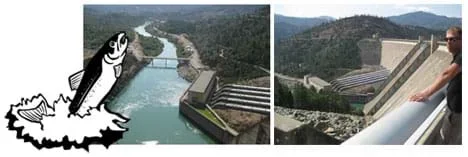 Shasta Dam in northern California. The five silver pipes are the penstocks, delivering water from the reservoir to the power plant to generate electricity.
Overview of lesson/activity topics: Lesson 1, the varied reasons why people build dams; lesson 2, the four main types of dam construction; lesson 3, Pascal's law and water pressure, and lock systems for river navigation; lesson 4, hydropower generation, falling water and waterwheels, turbines and generators, non/renewable energy sources; lesson 5, the effect of dams on the river and local ecosystem health including water temperature and seasonal flooding; lesson 6, salmon life cycle and dam accommodations to aid fish migration; lesson 7, the water cycle, especially evaporation; and lesson 8, dam maintenance, lifespan, failure and removal.
Dams are impressive engineering achievements, providing countless ways to apply an understanding of science and math concepts (including potential and kinetic energy, Pascal's Law, water pressure, gravity, forces) to creating unique structures that provide many benefits to people. Dams have many functions: to divert and control a water supply to prevent floods; to store water for irrigation and during droughts; to generate electricity, and to provide navigable waters. All types of engineers cooperate to design dams; they consider an array of variables that range from environmental impact to amount of energy generation to river navigation via locks, working with community planners to balance competing demands to create the most effective and useful designs. Engineers calculate the forces expected to act on a dam's structure, taking into consideration different geometries and materials, and the most suitable size and type for its planned purpose and surroundings. Increasingly, engineers are understanding the disturbances dams cause to surrounding ecosystems, and are finding new ways to mitigate ecological disruption. In addition to designing dams, engineers oversee their long-term reliability and maintenance, learning from any failures, and sometimes recommend their removal.
- 5-ESS3-1 Obtain and combine information about ways individual communities use science ideas to protect the Earth's resources and environment.
Grade 5
This resource focuses on the following Three Dimensional Learning aspects of NGSS:
Science & Engineering Practices- Obtain and combine information from books and/or other reliable media to explain phenomena or solutions to a design problem.Do you agree with this alignment?
Disciplinary Core Ideas- Human activities in agriculture, industry, and everyday life have had major effects on the land, vegetation, streams, ocean, air, and even outer space. But individuals and communities are doing things to help protect Earth's resources and environments.Do you agree with this alignment?
Crosscutting Concepts- A system can be described in terms of its components and their interactions.Do you agree with this alignment?
- Science findings are limited to questions that can be answered with empirical evidence.Do you agree with this alignment?
Do you agree with this alignment? - Obtain and combine information from books and/or other reliable media to explain phenomena or solutions to a design problem.
- MS-ESS2-4 Develop a model to describe the cycling of water through Earth's systems driven by energy from the sun and the force of gravity.
Grades 6-8
This resource focuses on the following Three Dimensional Learning aspects of NGSS:
Science & Engineering Practices- Develop a model to describe unobservable mechanisms.Do you agree with this alignment?
Disciplinary Core Ideas- Water continually cycles among land, ocean, and atmosphere via transpiration, evaporation, condensation and crystallization, and precipitation, as well as downhill flows on land.Do you agree with this alignment?
- Global movements of water and its changes in form are propelled by sunlight and gravity.Do you agree with this alignment?
Crosscutting Concepts- Within a natural or designed system, the transfer of energy drives the motion and/or cycling of matter.Do you agree with this alignment?
Do you agree with this alignment? - Develop a model to describe unobservable mechanisms.
- MS-ESS3-4 Construct an argument supported by evidence for how increases in human population and per-capita consumption of natural resources impact Earth's systems.
Grades 6-8
This resource focuses on the following Three Dimensional Learning aspects of NGSS:
Science & Engineering Practices- Construct an oral and written argument supported by empirical evidence and scientific reasoning to support or refute an explanation or a model for a phenomenon or a solution to a problem.Do you agree with this alignment?
Disciplinary Core Ideas- Typically as human populations and per-capita consumption of natural resources increase, so do the negative impacts on Earth unless the activities and technologies involved are engineered otherwise.Do you agree with this alignment?
Crosscutting Concepts- Cause and effect relationships may be used to predict phenomena in natural or designed systems.Do you agree with this alignment?
- Scientific knowledge can describe the consequences of actions but does not necessarily prescribe the decisions that society takes.Do you agree with this alignment?
- All human activity draws on natural resources and has both short and long-term consequences, positive as well as negative, for the health of people and the natural environment.Do you agree with this alignment?
Do you agree with this alignment? - Construct an oral and written argument supported by empirical evidence and scientific reasoning to support or refute an explanation or a model for a phenomenon or a solution to a problem.
- Day 1: Water Resources: Why Do We Build Dams? lesson
- Day 2: How Much Water Do You Use? activity
- Day 3: Water and Dams in Today's World lesson
- Day 4: Dam Forces activity
- Day 5: Locks and Dams lesson
- Day 6: Under Pressure activity
- Day 7: Clean Energy: Hydropower lesson, Dam Impacts lesson
- Day 8: Your River's Health activity
- Day 9: Swim to and from the Sea! lesson
- Day 10: Fish-Friendly Engineering activity
- Day 11: Where Has All the Water Gone? lesson
- Day 12 and Day 18: Witnessing Evaporation activity (Note: Divide time as follows: 20 minutes on first day, then 5-15 minutes each day for a week, then 45 minutes to conclude)
- Day 13: Are Dams Forever? lesson, Dam Pass or Fail activity
As a general introduction to dams, show students a 24-slide overview "virtual tour" of the Shasta Dam in northern California, available at the US Bureau of Reclamation's Mid-Pacific Region page at https://www.usbr.gov/mp/ncao/docs/virtual-tour.pdf.
Supporting Program
Integrated Teaching and Learning Program, College of Engineering, University of Colorado Boulder
Acknowledgements
The contents of these digital library curricula were developed by the Integrated Teaching and Learning Program under grants from the Fund for the Improvement of Postsecondary Education (FIPSE), U.S. Department of Education; the National Science Foundation (GK-12 grant no. 0338326); and the Discovery-Learning Apprentice Program at CU-Boulder's College of Engineering and Applied Science. However, these contents do not necessarily represent the policies of the Department of Education or National Science Foundation, and you should not assume endorsement by the federal government.
Copyright
2008 by Regents of the University of Colorado