
Witnessing Evaporation
The engineers at Splash Engineering (the students) have been commissioned by Thirsty County to conduct a study of evaporation and transpiration in their region. During one week, students observe and measure (by weight) the ongoing evaporation of water in pans set up with different variables, and then assess what factors may affect evaporation. Variables include adding to the water an amount of soil and an amount of soil with growing plants.
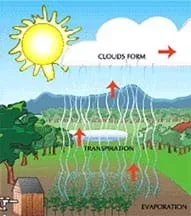 Evaporation and transpiration create clouds, as part of the Earth's water cycle.Copyright Agency for Toxic Substances & Disease Registry, Centers for Disease Control and Prevention, US Department of Health and Human Services http://www.atsdr.cdc.gov/sites/vieques/groundwater.html
Engineers consider evaporation in the design and operation of dams, and it is an important factor in the site selection and operation of dams because of its potential to cause substantial water loss, especially in hot and arid environments. Typically, engineers and hydrologists use computer models and spreadsheets to estimate a reservoir's water "budget," taking into account the effects of evaporation on its storage. The information from an evaporation study provides the water budget with more accurate regional estimates of expected water loss due to evaporation and transpiration.
After this activity, students should be able to:
- Define evaporation and transpiration.
- Describe how soil helps retain water to be available for plants.
- Recongize that evaporation is an important consideration in the design and operation of dams
- 6.3.1.d.i Display numerical data in plots on a number line, including dot plots, histograms, and box plots.
Grade 6
Do you agree with this alignment? - 5.3.1.a Represent and interpret data.
Grade 5
Do you agree with this alignment?
- Research and evaluate data and information to learn about the types and availability of various natural resources, and use this knowledge to make evidence-based decisions
Grade 6
Do you agree with this alignment? - Gather and analyze data from a variety of print resources and investigations to account for local and world-wide water circulation and distribution patterns
Grade 6
Do you agree with this alignment?
- CCSS.Math.Content.5.MD.B Represent and interpret data.
Grade 5
Do you agree with this alignment? - CCSS.Math.Content.6.SP.B.4 Display numerical data in plots on a number line, including dot plots, histograms, and box plots.
Grade 6
Do you agree with this alignment?
- STEL-8M Use instruments to gather data on the performance of everyday products.
Grades 6-8
Do you agree with this alignment?
- MS-ESS2-4 Develop a model to describe the cycling of water through Earth's systems driven by energy from the sun and the force of gravity.
Grades 6-8
This resource focuses on the following Three Dimensional Learning aspects of NGSS:
Science & Engineering Practices- Develop a model to describe unobservable mechanisms.Do you agree with this alignment?
Disciplinary Core Ideas- Water continually cycles among land, ocean, and atmosphere via transpiration, evaporation, condensation and crystallization, and precipitation, as well as downhill flows on land.Do you agree with this alignment?
- Global movements of water and its changes in form are propelled by sunlight and gravity.Do you agree with this alignment?
Crosscutting Concepts- Within a natural or designed system, the transfer of energy drives the motion and/or cycling of matter.Do you agree with this alignment?
Do you agree with this alignment? - Develop a model to describe unobservable mechanisms.
Each student needs:
- graph paper
- pencil
- Witnessing Evaporation Worksheet (PDF)
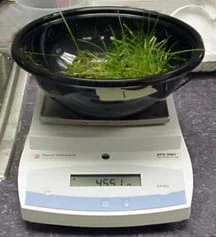 Copyright ITL Program, College of Engineering, University of Colorado at Boulder.
For the entire class to share:
- 3 identical cake pans or plastic containers
- 3 platform scales
- soil or dirt to fill pan one-third full
- soil or dirt with shallow-rooted plants (such as a chunk of sod or weeds dug from a field), enough to fill pan one-third full
- masking tape and marker (to label pans)
Everyone in this room has seen precipitation. (Write "precipitation" on the board.) What do rain and snow have in common? Rain and snow are both examples of precipitation, of water forming into liquid or solid form and falling from the sky to the ground.
The water cycle includes another process, called "evaporation," that is just as important as precipitation. (Write "evaporation" on the board.) Who can tell me what evaporation is? (Take suggestions from students.) Evaporation is the process when liquid water converts into water vapor and rises into the air.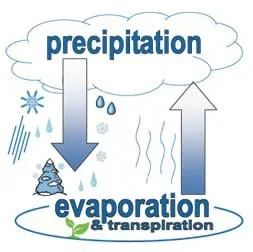 Copyright Denise W. Carlson, ITL Program, College of Engineering, University of Colorado at Boulder.
Has any one heard of transpiration? (Write "transpiration" on the board.) Transpiration occurs when plants "breathe" and is similar to evaporation because a change from liquid water to water vapor occurs. Plants draw water from the ground through their roots and keep it inside their plant bodies. When the plants open their stomata (tiny holes in the leaves) to take in carbon dioxide for photosynthesis, some of the water stored within the plant escapes as water vapor and travels up into the atmosphere. This water vapor that escapes from the plant is similar to the water vapor you see when you exhale on a cold day. That little puff of "smoke" you see is really a tiny water vapor cloud.
For plants, precipitation is the water supply, and evaporation and transpiration are the water demand. When the demand exceeds the supply, plants dry up, die or go dormant. Has anyone seen a plant in your house or yard die because it did not get enough water? That was a case when the plant's demand for water exceeded its supply.
On farms, including the farms in Thirsty County, crops shrivel and die when evaporation and transpiration together are greater than precipitation. We call this condition a "drought." How do droughts affect the farmers in Thirsty County? How do they affect the other people in the county?
As the engineering firm of Splash Engineering, this class has been hired by Thirsty County to conduct a study of the region's evaporation and transpiration. To do this, we are going to conduct an experiment all week that will tell us how much water evaporates from a given area each day. We will test areas with and without soil and plants. After we finish the test and look at the results, Splash Engineering will be able to make a report to Thirsty County. The firm will also be able to explain why it's important for the engineering designers of the county's dams to know how much water evaporates in the area.
Before the Activity
- Gather materials and make copies of the Witnessing Evaporation Worksheet (PDF).
- Use a marker and masking tape to label the pans "A," "B" and "C."
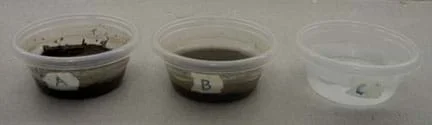 The activity setup.Copyright Megan Podlogar, ITL Program, University of Colorado at Boulder.
With the Students
- Begin the experiment by preparing the three pans. All three pans should be the same size and shape. In pan A, place enough soil that contains living grass or weed plants to fill about one-half of the volume of the pan. In pan B, place enough soil to fill about one-half of the volume of the pan. In pan C, fill one-half of the volume of the pan with water only.
- Place each pan on its own scale.
- Add water to pan A until water reaches the top of the soil, without drowning the living plants. Add the same amount of water to pan B. Record the mass of each of the pans A, B and C, so that the change in mass can be calculated throughout the week.
- Place all three pans on a windowsill or on a table near a window, keeping the scales under each pan.
- Once a day for a week (including the setup day), have students observe and record on their worksheets the weight of each pan.
- At the end of the week, after recording the last weight, have students graph their results, as directed on the worksheet, and answer the six questions on the worksheet.
- Conclude with a class discussion that reviews the six worksheet questions.
- Assign students to write short paragraphs on the backs of their worksheets summarizing their findings, as if they were engineers reporting to the mayor of Thirsty County, making sure to inform him/her why these findings are important to the design of the county's dam.
- engineer
- A person who applies her/his understanding of science and math to creating things for the benefit of humanity and our world.
- evaporation
- The process whereby liquid water is converted to water vapor.
- hydrologic cycle
- A continuous process by which water is evaporated and transported from the Earth's surface (including the oceans) to the atmosphere and back to the land and oceans. Also called the water cycle.
- transpiration
- The passage of watery vapor from a plant to the atmosphere through the plant's pores.
Pre-Activity Assessment
Definition Matching: On the board, write the vocabulary words in one column and the definitions in another column, but mix them up. Call on random students to draw arrows from the terms to their correct definitions.
Activity Embedded Assessment
Worksheet: Throughout the week, have students record their measurements (and any observations) on their activity worksheets. Monitor their progress by reviewing their worksheets. Review their answers to the discussion questions to gauge their mastery of the subject.
Post-Activity Assessment
Report to Thirsty County: Have each student write two or three sentences describing the evaporation study findings to the mayor of Thirsty County and telling him/her why these findings are important to the design of the dams that Splash Engineering will design for them.
- Immediately clean up any spilled water on the floor to avoid slipping.
Make sure the scales are zeroed before use.
To test the relative welfare of the plants in the soil, add a fourth pan, D, that is setup just like pan A, with the same amount of soil and growing plants. Then, replenish the water daily (like you are watering a garden, but making sure to keep track of how much water you put in) in pan D and compare the condition of the plants in pans A and D at the end of the week. What might be the role of soil in keeping water available to plants between rains? (Answer: Soil serves as a sort of reservoir from which plant roots can draw water.) How might the rate of evaporation on large pieces of land be different if they were covered with vegetation compared to being bare of plants? How does this explain what happens in areas where forests and jungles are entirely removed?
What else might affect evaporation? Extend the experiment with more variables. Does hotter ambient air make water evaporate faster? What about more humid air? Does it matter whether the water is in the sun or shade? Fill several identical containers with the same amount of water (use a scale) and put them in different places to test these factors.
Does surface area make a difference? What if the same volume of water is left for a week in a flat pan vs. a tall container? Fill up several differently-shaped containers with the same amount of water (use a scale) and place them in identical conditions for a week to test for the difference in surface area exposure of water to the air.
- For lower grades, have students complete the worksheet working in groups and assist them with the table, graph and discussion questions.
Introduce or review the water cycle with an excellent one-minute animated video at the US Environmental Protection Agency's Drinking Water & Ground Water Kids' Stuff website: http://www.epa.gov/ogwdw/kids/flash/flash_watercycle.html
Nova, Kenneth. Making Evaporation Real, Fifth Grade Water Unit. Last updated December 27, 2005. Boulder Area Sustainability Information Network. Accessed September 29, 2009. (Source of activity) http://bcn.boulder.co.us/basin/learning/evaporation.html
Groundwater. Last updated August 7, 2009. Agency for Toxic Substances & Disease Registry. Centers for Disease Control and Prevention, US Department of Health and Human Services. Accessed September 29, 2009. http://www.atsdr.cdc.gov/sites/vieques/groundwater.html
Contributors
Jeff Lyng; Kristin Field; Megan Podlogar; Denise W. Carlson
Supporting Program
Integrated Teaching and Learning Program, College of Engineering, University of Colorado Boulder
Acknowledgements
The contents of this digital library curriculum were developed under a grant from the Fund for the Improvement of Postsecondary Education (FIPSE), U.S. Department of Education and National Science Foundation GK-12 grant no. 0338326. However, these contents do not necessarily represent the policies of the Department of Education or National Science Foundation, and you should not assume endorsement by the federal government.
Copyright
2008 by Regents of the University of Colorado.