
Water and Dams in Today's World
 Different types of dams (left to right): arch dam, embankment dam, gravity dam, and a buttress dam.Copyright PBS, WGBH, http://www.pbs.org/wgbh/buildingbig/dam/challenge/index.html
Students learn about the importance of dams by watching a video that presents historical and current information on dams, as well as descriptions of global water resources and the hydrologic cycle. Students also learn about different types of dams, all designed to resist the forces on dams. (If the free, 15-minute "Water and Dams in Today's World" video cannot be obtained in time, the lesson can still be taught. See the Additional Multimedia Support section for how to obtain the DVD or VHS videotape, or a PowerPoint presentation with similar content [also attached].)
When engineers design dams and other large structures, they calculate the forces expected to act on the structure as well as its potential for reacting to these forces. Different geometries and materials respond differently to the forces created by a dam. As part of the design process, engineers take into consideration information about the intended use of a dam to help them determine the most suitable size and type.
After this lesson, students should be able to:
- Identify various types of dams.
- Understand the different forces acting on a dam.
- Understand the considerations engineers must make when desinging a dam.
- Analyze and interpret data identifying ways Earth's surface is constantly changing through a variety of processes and forces such as plate tectonics, erosion, deposition, solar influences, climate, and human activity
Grade 5
Do you agree with this alignment?
- The use of technology affects the environment in good and bad ways.
Grades 3-5
Do you agree with this alignment? - STEL-5D Determine factors that influence changes in a society's technological systems or infrastructure.
Grades 3-5
Do you agree with this alignment?
Besides Egyptian pyramids or the Great Wall of China, dams are the largest structures built by humans. Throughout history, large dams have prevented flooding, enabled farmland irrigation, and generated great amounts of electricity. Our modern life would not be the same without dams. Since the first large-scale dam was built in Egypt more than 5,000 years ago, engineers have devised various types of dams to withstand river forces.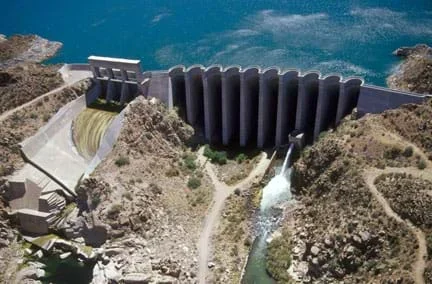 Built in the 1930s, the Bartlett Dam in Arizona is an example of a reinforced concrete, multiple arch and buttress dam; it consists of 10 arches, nine buttresses and two gravity wing dams.Copyright Andy Pernick, US Bureau of Reclamation, US Department of the Interior http://www.usbr.gov/lc/region/g5000/photolab/gallery_detail.cfm?PICIDTYPE=2030
The four main types of dams are: arch, embankment, gravity and buttress (as well as combinations of these types). A description of each is provided in the Vocabulary/Definitions section. Dam types differ in their design, size and material. A dam's design may be influenced by local topography. For instance, a deep narrow canyon provides an ideal place to construct a tall arch dam (like the Hoover Dam).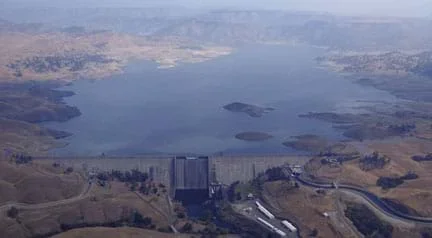 Completed in 1942, the Friant Dam on the San Joaquin River in California is an example of a concrete gravity structure.Copyright Bart Good, US Bureau of Reclamation, US Department of the Interior http://www.usbr.gov/lc/region/g5000/photolab/gallery_detail.cfm?PICIDTYPE=8213
Much force is exerted on a dam by the water held in its reservoir. If this force is large enough, it can cause the dam to fail at any weak points. Engineers take these critical forces into account and design dams that can withstand large forces plus a safety factor. "Building in a safety factor" means designing something to withstand more force that is usually needed, so it will not fail in case unforeseen events of unusual magnitude happen, such as floods and earthquakes.
The Teton Dam failure in 1976 is the largest, recent dam failure in the US. The Teton Dam was authorized in 1964, and finished in November 1975. Filling began on October 3, 1975, and continued until the dam failed on June 5, 1976. At that time, the reservoir was 302-feet (92-meters) deep, ~3-feet (1-meter) below the spillway. Leaks below the dam were first noticed on June 3, 1976, but were not considered cause for alarm. However, starting at 7am on June 5, dam personnel noted leaks both in the abutment rock at the north bank of the river at the base of the dam and about 100 feet from the top of the dam. These leaks worsened and by mid-morning warnings were sent out that the dam might fail. Failure occurred at 11:50am. Property damage was estimated at up to $1 billion, and 14 people died in the flood. No one can agree on why it collapsed, and the dam was never re-built.
(Note: In advance of this lesson, obtain a free copy of the 15-minute "Water and Dams in Today's World" video as described in the Additional Multimedia Support section. As an alternative, use the PowerPoint slide show (PPT) available at the same website [also attached]. Also make copies of the Get the Facts Worksheets (PDF) (PDF) for students fill out during or after the video/slide presentation.)
Dams are one way that communities make sure they have enough water for everyone in their area. Dams help with irrigation, business needs, farming, and in producing hydroelectricity. How can water be stored so that you have enough in the middle of summer? How do hydroelectric plants have controls over the amount of water entering a turbine? Can you think of any negative impacts of dams? What happens when you block a river? Where do the fish go? What happens to the river and terrain on the side below the dam? What happens to the natural environment above the dam? What about salmon that migrate upstream to lay eggs? These are important questions relating to the creation of dams.
The video, "Water and Dams in Today's World," that you are about to watch provides great footage of many dams and their uses. While you watch this film, keep these questions in mind (write them on the board): Are all dams the same? How do they differ? What are the four main types of dams? How do dams differ in size, construction material, design and capacity?
What do engineers consider when they design a new dam? What do engineers worry about? Engineers mainly concern themselves with the forces expected to be exerted on the dam. A dam must withstand the forces acting on it or else it will fail. If failure does occur, it can be catastrophic including the loss of lives and property.
What is a force? What exerts a large force on a dam? A force is an outside influence that can cause a motion or pressure. When you lean on a wall, you exert a force on it. A large amount of force is exerted on a dam by the water in the reservoir. Imagine that you had to hold up a dam wall by leaning on it. Can you imagine how much all the water behind the dam would push on you? Could you do it? Would it help if you leaned over to support it instead of standing straight up?
(If you're planning to do the associated activity Dam Forces, say the following.) Let's return to our ongoing story about Thirsty County. Now that you (the engineers at Splash Engineering) understand why Thirsty County needs a dam for water supply and hydropower (as described in lesson 1's activity), you may begin designing that dam!
Let's find out about the different types of dams and learn about the forces acting on each type of dam. This is what civil engineers do as part of creating a good design for their clients (such as Thirsty County).
(If you're planning to do the associated activity, say the following.) Once we've done that — at the end of the activity — Splash Engineering will choose which type of dams to use in its design for Thirsty County.
(Hand out the worksheets and run the video or slide show.)
How important are dams to our society? Are all dams the same? Let's discuss the different types of dams and how forces affect them. What are some common dam types that engineers consider when designing a dam for a particular river location? (Answers: Arch, embankment, gravity, buttress.) What makes each one of these different from the others? Do you know of any dams in our community? Have you ever visited a dam in another town, state or country? Thinking of those dams, what types (or combination of types) were they?
Let's also review forces. Does anyone have any examples of forces? Remember that a force is anything that can cause motion. In what direction does the force of a student sitting in a chair act? Kicking a soccer ball? Why do we talk about forces when we talk about designing dams or any other big structure? (Possible answers: Because forces affect the design and materials chosen for a dam, and if we do not design a structure to handle the expected forces then it might fail and become dangerous.) What are the different forces acting on a dam? (Answer: The main force is the water in the reservoir pushing on the dam; other forces include the weight of the dam itself, any traffic across the dam, and in some cases wave pressure, snow load or earthquake forces.)
- arch dam
- A curved dam whose shape directs the force of the water into the canyon walls adjacent to the dam. This type of dam requires less material than any other type of dam and is ideally suited to narrow, rocky locations.
- buttress dam
- A dam braced by a series of supports, or buttresses, on the downstream side. Most buttress dams are made of reinforced concrete.
- dam
- A barrier to obstruct the flow of water, especially one made of earth, rock, masonry and/or concrete, built across a stream or river.
- embankment dam
- A dam made of earth and/or rock, relying upon its heavy weight to resist the force of water. Embankment dams include a waterproof core that prevents water from seeping through it. Embankment dams are the most commonly-built type of dam in the US.
- engineer
- A person who applies her/his understanding of science and mathematics to creating things for the benefit of humanity and our world.
- force
- An outside influence that can cause a motion or pressure. For example, to open a door, you exert a force on the door in the direction that you want to open it.
- gravity dam
- Massive dams that resist the thrust of water entirely by their own weight. Most gravity dams are expensive to build because they require so much concrete.
- hydrologic cycle
- The natural, continuous cycle of water in various forms, including ocean water, clouds and precipitation, around the Earth. Also called the water cycle.
- spillway
- The route, channel or passageway through which surplus water escapes from a reservoir, so as to not damage the dam. A common spillway type is an overflow — a rounded crest that is somewhat lower than the top of the dam. The overflow allows water to be spilled from the dam before the dam is overflowed.
Pre-Lesson Assessment
Discussion Questions: Ask discussion questions to get students to think about the upcoming lesson. After soliciting answers, explain that these questions will be answered during the lesson.
- How strong must a dam be to hold back the water of a river?
- How would an engineer at Splash Engineering know how strong to make a dam?
- How strong must the Thirsty County dam be to counteract the force of the water acting on it?
Post-Introduction Assessment
Concept Juggle: Have students stand in a circle and toss a ball to each other. Each time they toss the ball, have them give an example of a force and estimate how strong it is (such as, very strong, weak, etc.), and then pass the ball along to someone else. Go around the circle until everyone has had a chance to catch the ball. (Example forces: Pushing a wheelbarrow, pulling a rope, kicking a soccer ball, throwing a ball.)
Lesson Summary Assessment
Splash Engineering Conference/Discussion: As a class, discuss the answers to the Get the Facts Worksheet (PDF). Arrange student desks in a circle to mimic engineers holding a discussion around an office conference table.
Independent Research: To help reinforce their understanding of the four types of dams, ask students (alone or in small teams) to choose one type of dam and find a real-world example. Ask them to describe their chosen dam to the class. For instance, the Roosevelt Dam is a famous arch dam located in Phoenix, AZ. It is 357 feet high and has a hydroelectric generating capacity of 36,000 kW.
Obtain a free copy of the 15-minute video, "Water and Dams in Today's World," contact the United States Society on Dams at 1616 17th Street, Suite 483, Denver, CO 80202 (303-628-5430) or email Larry Stephens at stephens@ussdams.org. Request DVD or VHS video format. Also see: http://ussdams.com/ussdeducation/resources.html#top
As an alternative to the video (with similar content), use the 65-slide PowerPoint presentation, "Water and Dams in Today's World (PPT)," available at the United States Society on Dams website (also attached): http://ussdams.com/ussdeducation/resources.html#top
Show students an animation of the hydrologic cycle at the United States Society on Dams website: http://www.pbs.org/wgbh/buildingbig/dam/basics.html
See a slide show of dams in the Pacific Northwest region at the US Bureau of Reclamation's website: http://www.usbr.gov/pn/gallery/slideshow.html
See information, slides and video of the Teton Dam Failure (1 minute, 12 seconds) at University of California's Department of Geological Sciences website: http://www.geol.ucsb.edu/faculty/sylvester/Teton_Dam/welcome_dam.html or on YouTube: http://www.youtube.com/watch?v=KEdM6Ys6spA
Building Big: Dam Basics. WGBH Educational Foundation. Accessed July 8, 2009. (Good description and photos of four dam types) http://www.pbs.org/wgbh/buildingbig/dam/basics.html
Kagen, S. Cooperative Learning. San Juan Capistrano, CA: Kagan Cooperative Learning, 1994. (Source for Concept Juggle assessment activity.)
Link, Paul Karl and Phoenix, Chilton E. The Teton Dam Disaster. June 5, 1976. 1996. Rocks, Rails & Trails, Second Edition, pg. 73. The Digital Atlas of Idaho Project. Accessed July 8, 2009. http://imnh.isu.edu/digitalatlas/geog/rrt/RRTfr.htm
Link, Paul Karl and Phoenix, Chilton E. The Teton Dam Disaster. June 5, 1976. 1996. Rocks, Rails & Trails, Second Edition, pg. 73. The Digital Atlas of Idaho Project. Accessed July 8, 2009. http://imnh.isu.edu/digitalatlas/geog/rrt/part3/chp8/73.htm
Theodore Roosevelt Dam. Wikipedia, The Free Encyclopedia. Updated June 12, 2009. Accessed July 8, 2009. http://en.wikipedia.org/wiki/Roosevelt_Dam
United States Society on Dams, Denver, CO. Accessed July 25, 2009. http://ussdams.com/ussdeducation/index.html
Contributors
Sara Born; Kristin Field; Denali Lander; Lauren Cooper; Denise W. Carlson
Supporting Program
Integrated Teaching and Learning Program, College of Engineering, University of Colorado Boulder
Acknowledgements
The contents of this digital library curriculum were developed under a grant from the Fund for the Improvement of Postsecondary Education (FIPSE), U.S. Department of Education and National Science Foundation GK-12 grant no. 0338326. However, these contents do not necessarily represent the policies of the Department of Education or National Science Foundation, and you should not assume endorsement by the federal government.
Copyright
2008 by Regents of the University of Colorado.