
Swim to and from the Sea!
Students are introduced to the basic biology behind Pacific salmon migration and the many engineered Columbia River dam structures that aid in their passage through the river's hydroelectric dams. Students apply what they learn about the salmon life cycle as they think of devices and modifications that might be implemented at dams to permit the natural cycle of fish migration, and as they make (hypothetical) Splash Engineering presentations about their proposed fish mitigation solutions for Birdseye River's dam in Thirsty County.
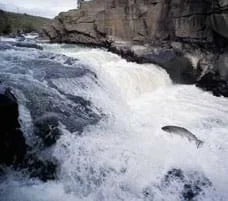 Students explore fish migrationCopyright 2004 Microsoft Corporation, One Microsoft Way, Redmond, WA 98052-6399 USA. All rights reserved.
Massive engineered structures such as dams have an effect on the natural environment. Because the application of scientific knowledge to satisfy human needs requires natural resources, engineering solutions inevitably impact the natural environment. The priorities of engineering projects are ultimately chosen by the priorities of the public, and thus, engineering projects change along with people. Because society is now more aware of the importance of environmental conservation, the design and modification of these structures take into consideration care for the ecosystems in which they operate and on which they depend.
After this lesson, students should be able to:
- Name the stages of the salmon life cycle.
- Explain why it is important for adult salmon to migrate upstream past dams.
- Name three examples of engineered structures designed to protect fish.
- Identify the components that make a habitat type unique
Grade 4
Do you agree with this alignment? - Make a plan to positively impact a local ecosystem
Grade 4
Do you agree with this alignment?
- The use of technology affects the environment in good and bad ways.
Grades 3-5
Do you agree with this alignment? - STEL-5D Determine factors that influence changes in a society's technological systems or infrastructure.
Grades 3-5
Do you agree with this alignment?
- 3-LS1-1 Develop models to describe that organisms have unique and diverse life cycles but all have in common birth, growth, reproduction, and death.
Grade 3
This resource focuses on the following Three Dimensional Learning aspects of NGSS:
Science & Engineering Practices- Develop models to describe phenomena.Do you agree with this alignment?
- Science findings are based on recognizing patterns.Do you agree with this alignment?
Disciplinary Core Ideas- Reproduction is essential to the continued existence of every kind of organism. Plants and animals have unique and diverse life cycles.Do you agree with this alignment?
Crosscutting Concepts- Patterns of change can be used to make predictions.Do you agree with this alignment?
Do you agree with this alignment? - Develop models to describe phenomena.
An understanding of the basic purpose of dams and the different types, as provided in lesson 4 of the Dams unit.
Six species of anadromous salmon find habitat in the Columbia River Basin (chinook, coho, chum, sockeye, pink and steelhead), plus anadromous shad, smelt and lamprey. Anadromous fish migrate from salt water to breed in fresh water, which is different than catadromous fish that live in fresh water and migrate to marine waters to breed.
As described on the Salmon Life Cycle Handout (PDF), the six stages of the salmon life cycle are egg, alevin, fry or parr, smolt, juvenile and adult. The salmon life cycle begins when they hatch in fresh water rivers and tributaries where they remain to grow for a year or two (see Figure 3). Then they migrate from fresh-water rivers to the salty ocean where they live for two to five years. As mature adults, they return to their birthplaces to spawn. Exhausted after the upstream swim, the adults die shortly after spawning, their bodies adding nutrients to the stream where the eggs hatch.
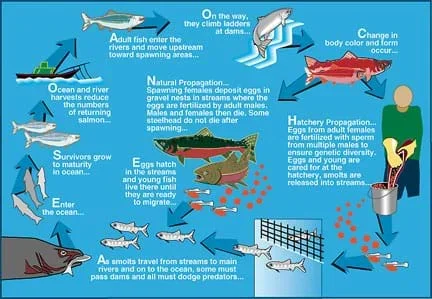 Figure 3. The salmon life cycle.Copyright U.S. Army Corps of Engineers http://www.nwd.usace.army.mil/ps/myimages/lgcycle.jpg
Many factors can impact the health of salmon populations, including overharvesting; the harming of water habitat from farming, cattle grazing, mining, logging, road construction and industrial pollution; and the existence of a network of tributary and mainstream dams. The presence of dams affects the habitat and migration of anadromous salmon species because they impede fish migrations to and from the ocean by their physical presence and by creating reservoirs. Compared to rivers, the reservoirs behind dams are places of slower water velocities and altered river temperatures. Slowed water movement increases the time it takes fish to migrate and increases the likelihood of being caught by predators. Warmer water temperatures alter the fish habitat and can change fish behavior. Dams also lower salmon survival because they are treacherous for juvenile salmon to navigate en route to the ocean, and reduce (or eliminate) access to fresh water habitat (preventing adult fish from returning to spawn).
To address these issues, many dams now have facilities to help fish migrate past the dams. In addition, many dams are now operated to improve passage and reservoir conditions for fish. For example, during the juvenile fish migration season, late March until fall, river flows are increased to mimic seasonal high flows, and additional water is spilled to aid migration.
Juvenile fish can migrate past dams by several routes: through the turbines (not safe!), over a dam spillway, through a screened juvenile fish bypass system, or via transport by barge or truck. Juvenile fish bypass systems use submerged screens (or cage-like racks) positioned in front of dam turbines to keep fish away from the dangerous powerhouse turbines. Sometimes underwater sound, light and bubbles are used as "behavioral barriers" to divert fish away from turbine intakes. Once at the screens, the young fish are directed into channel openings that route them back to the river below the dam (which is called "bypassing"), over a spillway, through ice or trash sluiceways, or to holding areas for loading on specially equipped barges or trucks for transport downriver. During barge transport, river water circulates through the boats so the fish can imprint the chemicals and smells of the water during the trip downriver through dams and locks. Juvenile bypass systems safely guide millions of spring/summer salmon away from the turbines and help them navigate rivers containing many dams and reservoirs.
Most juvenile salmon tend to stay in the upper 10 to 20 feet of the water column as they migrate downstream to the ocean, so it is harder for them to find a way past a dam if they must dive to 50 to 60 feet to find a spillway opening or a bypass channel. Engineers design new technologies that provide more surface-oriented, less stressful passage routes for the young fish. Some new designs are similar to waterslides.
Sending juvenile fish over dam spillways is one safe way to help fish past the dams, but so much spilling water causes more bubbles of gas (nitrogen) to be trapped in the water, which can be harmful to fish at high levels. Engineers design spillway flow deflectors to produce a more horizontal spill flow that minimizes this problem, causing less change to fish habitat.
To help adult fish gain access to fresh water habitat above dams, adult fishways include fish ladders and fish elevators. Since 1938, fish ladders have been effectively integrated into the design of many Columbia River Basin dams. These ladders look like a series of steps and pools and provide a gradual upward climb up the vertical height of the dams for returning adult fish (see Figure 2). Essentially, fish ladders mimic a series of low, natural waterfalls, which is something that salmon are able to navigate. To guide the adult fish to the downstream ladder entrances, engineers simulate "attraction" flow conditions like those that would be found at the base of natural waterfalls. Fish elevators or fish lifts are mechanical ways to raise fish up from the bottom of a dam to the top part of the reservoir so they can continue to swim upstream.
Engineers and biologists continue to evaluate and monitor the success of fish passage and survival at hydropower dams. Some of their studies involve inserting very small tags containing radio antennas and/or computer chips into fish body cavities to enable them to track the fish during their lifetimes. Sometimes engineers place sensors in the stream flow to collect data on how many fish go through the various passage routes.
When we build dams on rivers, we get the benefits of hydroelectric power generation. We also have discovered that blocking the river and lowering the water flow impacts the surrounding ecosystems. Realizing this has led to environmental stewardship practices such as enabling fish to bypass dams, improving water quality and implementing additional river flows to benefit downstream aquatic habitat.
Let's review some basic salmon biology. Once they are hatched, what stages do salmon go through to become adults? How many stages do you go through as a human? Let's look at the handout to understand the stages of a salmon's life. (As a class, review the Salmon Life Cycle Handout (PDF) in detail.)
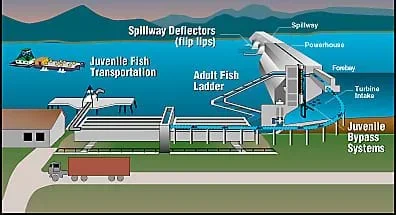 Figure 1. To aid fish migration at hydroelectric dams, engineers design into dams juvenile bypass systems, fish transport facilities, and adult fish ladders.Copyright U.S. Army Corps of Engineers http://www.nwd.usace.army.mil/ps/juvetran.asp
When a dam blocks a river, the river habitat is replaced by lake habitat. While this may not sound so bad—fish and birds like lakes, too—it can cause some environmental problems. Historically, in the Pacific Northwest, large dams blocked the migration of coho, chinook and sockeye salmon from the ocean to their upstream spawning grounds. To address this, many efforts have been made to help the fish around the dams (see Figure 1), such as creating safer routes over a dam or putting them in barges (large boats that ship them upriver) or building fish ladders (see Figure 2). In addition, dam turbine blades can kill young fish heading downriver to the ocean. (Optional: Show students a map of the dams in the Columbia River Basin in the Northwest so they can see how many dams might block fish from swimming to the ocean and back. See http://www.nwd-wc.usace.army.mil/dd/common/sysmap/www/index.html?lat=47&long=-118&zoom=6.)
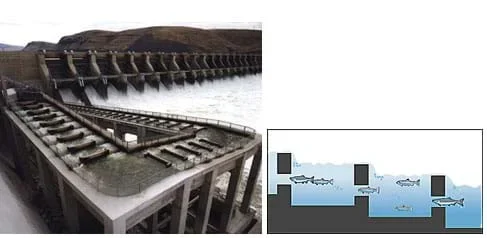 Figure 2. Fish ladders are a series of steps and pools that provide a gradual upward climb over dams, providing passageways for returning adult fish that are swimming upstream.Copyright U.S. Army Corps of Engineers http://www.nwd.usace.army.mil/ps/fishway.asp
In our ongoing hypothetical situation, citizens in and around Thirsty County are concerned about the salmon population in the Birdseye River. They have asked Splash Engineering to present a variety of dam designs that will be safe to the fish population and not hinder seasonal salmon migration up and down Birdseye River.
Upstream fish passage can be aided using fish ladders or elevators (see Figure 2), or by trapping and hauling the fish upstream by barge or truck. Downstream fish passage is aided by diverting fish from turbine intakes using screens or racks or even underwater lights, sounds and bubbles, and by maintaining a minimum spill flow past the turbine. Let's discuss these designs and how they help the fish survive passing by the dam.
As the engineers for Splash Engineering, you can incorporate into your Thirsty County dam designs these sorts of devices and structures that protect and help the migrating salmon in Birdseye River. Let's brainstorm to think about how we could protect fish swimming both upstream and downstream.
(To conclude, either lead an informal discussion or assign student teams to come up with their own proposed plan of fish mitigation solutions for the Birdseye River dam in Thirsty County that include a labeled drawing and short presentation; see details in the Assessment section. If conducting the associated activity Fish-Friendly Engineering, do this after the activity is completed.)
Let's review the six stages of the salmon life cycle. What are they? (Answer: Egg, alevin, fry or parr, smolt, juvenile and adult.) At which stage are salmon when they swim downstream past dams? And at which stage are they when swimming upstream? (Answers: Smolts and adults, respectively.) Why do the adult salmon swim upstream? (Answer: To return to their birthplaces to spawn.) What happens if the adult salmon cannot migrate upstream to where they hatched? (Answer: They will not lay eggs so that new salmon can be born, reducing the salmon population.)
How do dams lower salmon survival rates? (Possible answers: Dams are physical barriers to the seasonal fish navigation up and down rivers, some fish die in the turbines, reservoirs above dams are not the ideal habitat for salmon, some fish are lost or eaten while in the warmer and slower-moving reservoirs, salmon cannot get past the dams to return to their native rivers to reproduce, etc.)
What types of structures and solutions do engineers incorporate into the dams they design so they are less disruptive of the natural migration cycle of fish such as salmon? (Possible answers: Engineers incorporate fish ladders, fish elevators/lifts, juvenile fish bypass systems with submerged turbine intake screens and racks, underwater sound/light/bubble diversion devices to guide fish to safer routes over a dam, barge and truck transportation, ice or trash sluiceways, spilling additional water to flow past the turbines and the dam, increasing river flows to mimic seasonal river water levels, etc.)
- adult salmon
- A salmon that is fully developed. Adult salmon swim upstream to their spawning grounds.
- anadromous
- Fish that migrate from salt water to breed in fresh water.
- engineer
- A person who applies her/his understanding of science and mathematics to creating things for the benefit of humanity and our world.
- fish ladder
- A device used to aid in the upstream migration of adult salmon over a dam.
- juvenile salmon
- A salmon that is not yet fully developed. Juvenile salmon swim downstream to the ocean where they become adults.
- salmon migration
- A round-trip voyage that salmon embark on from their birthplace in their home streams out to the ocean and back again to spawn.
- smolt
- A fish that has not yet reached juvenile stage.
- spawn
- The reproductive process of salmon. Spawning females deposit eggs in gravel nests in streams where the eggs are fertilized by adult males.
- spillway
- The part of a dam where water from the upstream reservoir "spills" into the tailrace.
- tailrace
- A channel on the downstream side of a dam (or portion of the river immediately downstream of a dam) that directs water back into the main river.
Pre-Lesson Assessment
Diagramming: Ask students to create a diagram of the human life cycle (baby, toddler, child, pre-teen, teen, young adult, adult, older adult). Does the salmon life cycle have more or fewer steps than a human life cycle? (A salmon has six main stages to its life cycle.) Tell students they will learn more about the salmon life cycle in this lesson.
Post-Introduction Assessment
Toss-a-Ball: Ask the class the following questions and have students catch and toss a ball while attempting to give the correct answers.
- What is salmon migration? (Answer: A round-trip voyage that salmon embark on from their birthplace in their home streams out to the ocean and back again to spawn.)
- Why do adult salmon swim upstream? (Answer: To return to their birthplaces to spawn.)
- How do some dams hinder fish migration? (Possible answers: Dams are physical barriers to fish passage up and down rivers [could you swim up a very high waterfall?], many fish are killed when they go through the turbines along with the water that turns the turbines to make electricity, fish must navigate a complex of route-blocking dams and reservoirs, dam reservoir water temperature and flow conditions are not the ideal habitat for fish. If fish cannot return to their native river and birthplaces to spawn, no eggs are laid for the next generation of fish.)
- How are dams modified to help fish migration? (Possible answers: Limit the physical barrier to fish passage, make the passage less dangerous by blocking turbine entrances for fish, create special passageways just for fish, add underwater sound/light/bubbles to divert fish away from dangers and towards safer routes over the dam, move fish via barges that go through locks in the dam, catch and move fish around dams via truck, release more water from the dam to mimic seasonal river water levels, etc.)
Lesson Summary Assessment
Informal Discussion: Lead the class in a discussion that reveals the depth of their understanding of the ecological impact of human-built dams. Ask the students:
- Of the many ways that we have learned how to make dams more fish-friendly, which should we include for the dam at Birdseye River? Why?
- What are the costs and benefits?
- How would these measures protect Thirsty County's river ecosystem?
Splash Engineering Presentation: Working in teams of two or three students each, have students brainstorm and research what methods and devices they plan to incorporate into their engineering team's design of a dam for Thirsty County, so as to provide the safest and least disruptive migration passage for salmon in Birdseye River. Start with some of the links provided in the References section. Have teams draw sketches of their plans, noting the features and benefits, then each give a brief summary presentation to the class.
Have you ever heard of dams being entirely removed for environmental reasons? In Oregon, dam removal has been completed or proposed in order to restore salmon passage to natural conditions. What happened to the river and its ecosystems after dam removal? Assign students to research the pro and con arguments of actual cases, such as the Marmot Dam on the Sandy River, the Savage Rapids Dam on the Rogue River, and numerous dams on the Klamath River. This topic is also covered in lesson 8 of this unit, Are Dams Forever? Example resources:
https://www.seattletimes.com/seattle-news/dams-demise-lets-the-rogue-river-run/
https://www.seattletimes.com/outdoors/oregon-to-fund-klamath-river-dams-removal/
See descriptions, diagrams and photos about fish mitigation at the US Army Corps of Engineer's Fish Management Office website: http://www.nwd.usace.army.mil/Missions/Environmental/FishManagementOffice.aspx.
See diagrams of juvenile fish bypass systems at these US Army Corps of Engineer websites:http://www.nwd.usace.army.mil/Media/FactSheets/FactSheetArticleView/tabid/2128/Article/1154/columbia-river-fish-mitigation.aspx
See a good salmon life cycle graphic at the North to the Future website at: http://beena0721.wordpress.com/2009/07/31/spawn-til-you-die/
See good photos and descriptions of the life cycle of the salmon at the Seymour Salmonid Society's website: http://www.seymoursalmon.com/education/salmon-lifecycle/
Advanced Hydropower Technology. Revised October 5, 2005. Environmental Sciences Division, Oak Ridge National Laboratory. Accessed September 21, 2009. http://www.esd.ornl.gov/research/ecol_management/hydropower_technology.shtml
The Fascinating Life of an Alaskan Salmon. FishEx Alaskan Seafoods. Accessed September 21, 2009. (good life cycle graphic, photos and descriptions) http://www.fishex.com/seafood/salmon/salmon-life-cycles.html
Fish Management Office. Last updated May 15, 2009. Northwestern Division, U.S. Army Corps of Engineers. Accessed September 21, 2009. (source of much teacher background information; good photos and diagrams) http://www.nwd.usace.army.mil/Missions/Environmental/FishManagementOffice.aspx
How a Fish Lift Works. Safe Harbor Water Power Corporation. Accessed September 21, 2009. http://www.shwpc.com/fishlift.html
How Hydroelectric Energy Works. Union of Concerned Scientists, Cambridge, MA. Accessed September 21, 2009. http://www.ucsusa.org/clean_energy/our-energy-choices/renewable-energy/how-hydroelectric-energy.html#.VtiAtfkrKM8
How Hydropower Works, Hydropower Basics. Last updated September 30, 2005. Wind & Hydropower Technologies Program, Energy Efficiency and Renewable Energy, U.S. Department of Energy. Accessed September 21, 2009. http://www1.eere.energy.gov/windandhydro/hydro_how.html
Juvenile Bypass Improvements and Surface Bypass Systems, Columbia River Fish Mitigation. Last updated: May 15, 2009. Fish Management Office, U.S. Army Corps of Engineers, Northwestern Division. Accessed September 21, 2009. http://www.nwd.usace.army.mil/Media/FactSheets/FactSheetArticleView/tabid/2128/Article/1154/columbia-river-fish-mitigation.aspx
Juvenile Fish Passage at the Dams, Columbia River Basin–Dams and Salmon. Last updated: 5/15/2009. Fish Management Office, U.S. Army Corps of Engineers, Northwestern Division. Accessed September 21, 2009. http://www.nwd.usace.army.mil/Media/FactSheets/FactSheetArticleView/tabid/2128/Article/1154/columbia-river-fish-mitigation.aspx
Contributors
Jeff Lyng; Kristin Field; Lauren Cooper; Denise W. Carlson
Supporting Program
Integrated Teaching and Learning Program, College of Engineering, University of Colorado Boulder
Acknowledgements
The contents of this digital library curriculum were developed under grants from the Fund for the Improvement of Postsecondary Education (FIPSE), U.S. Department of Education and National Science Foundation (GK-12 grant no. 0338326). However, these contents do not necessarily represent the policies of the Department of Education or National Science Foundation, and you should not assume endorsement by the federal government.
Copyright
2008 by Regents of the University of Colorado